
Introduction
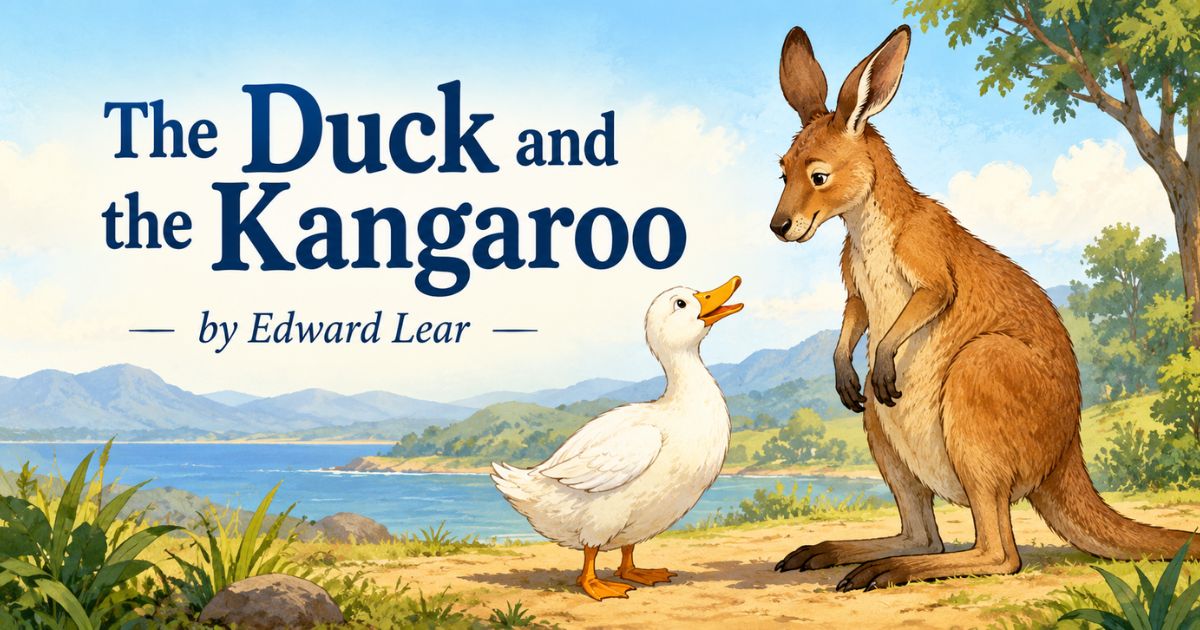
“The Duck and the Kangaroo” is a nonsense poem by Edward Lear, first published in 1871 in his collection Nonsense Songs, Stories, Botany, and Alphabets. It tells the story of a duck who feels trapped in a “nasty pond” and asks a kangaroo for a ride so she can see the world beyond it. Through gentle rhyme, humour, and an unlikely friendship, Lear turns a simple wish into a lesson about courage, compromise, and companionship.
The poem sits alongside “The Owl and the Pussy-Cat” as one of Lear’s best-known nonsense songs, and it is still taught in schools around the world, including as part of the Class 8 English syllabus in India and Pakistan. In my own reading of Lear’s nonsense verse over the years, what stands out is how much emotional truth hides inside the silliness: a duck who is bored of her surroundings, a kangaroo who worries about practical details, and a friendship that only works because both animals are honest about their limits.
Readers often tell us that the poem feels surprisingly modern for something written more than 150 years ago, because the core idea, that two very different characters can travel well together once they address each other’s concerns, still applies to real friendships today. This article walks through the poem’s summary, its structure, its central theme, and the reasons it has stayed popular for over a century.
Key Takeaways
Before the full stanza-by-stanza summary, here are the essential facts about the poem worth remembering:
- “The Duck and the Kangaroo” was written by Edward Lear and first published in 1871 in Nonsense Songs, Stories, Botany, and Alphabets.
- The poem is a five-stanza dialogue between a Duck, who is bored of pond life, and a Kangaroo, who can hop across land and water.
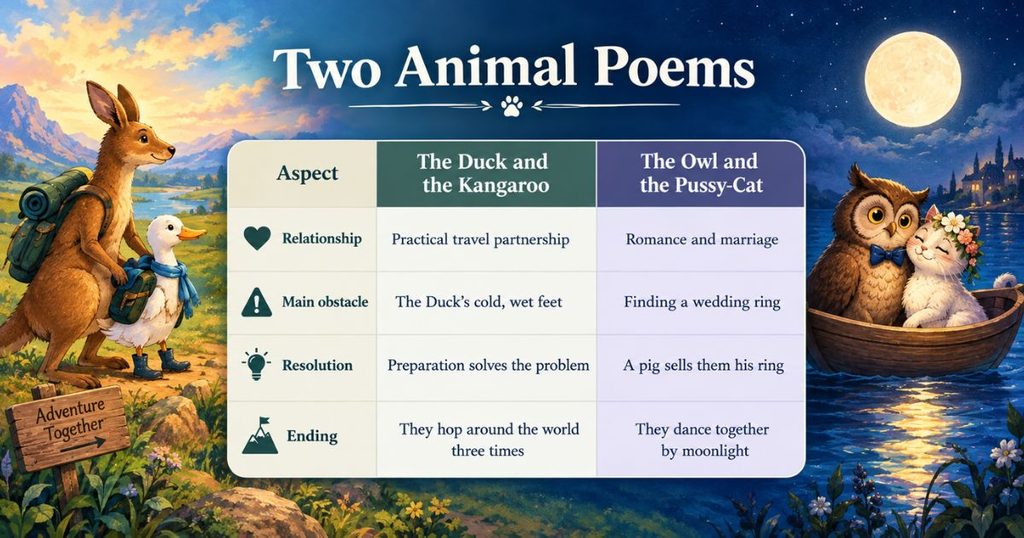
- The Kangaroo hesitates at first because the Duck’s feet are “unpleasantly wet and cold,” fearing it will give him rheumatism.
- The Duck solves the problem with worsted socks, a cloak, and a promise to smoke a cigar to stay warm, showing that the poem values preparation as much as politeness.
- The central theme of the poem is friendship built on compromise: both animals get what they want only once they listen to each other.
- The poem ends with the pair hopping “the whole world three times round,” a joyful image of adventure earned through cooperation.
These takeaways cover the plot, the central conflict, the resolution, and the poem’s core theme, but the sections below unpack each point in more depth, walking through the stanzas one at a time and starting with the poet who created this odd, endearing pair.
Edward Lear: The Poet Behind The Duck and the Kangaroo
Edward Lear (1812–1888) was an English artist, illustrator, and writer best remembered today for popularising literary nonsense in the Victorian era. He trained first as a natural history illustrator, drawing birds and animals for scientific publications, before turning his attention to limericks and nonsense songs that delighted children and adults alike. His 1846 collection, A Book of Nonsense, made him famous, and by the time “The Duck and the Kangaroo” appeared in 1871, Lear had already established the playful, rhythmic style readers now associate with his name.
Unlike Lear’s limericks, which follow a strict five-line structure, “The Duck and the Kangaroo” is written as a five-stanza narrative poem with a loose, musical rhyme scheme that mimics natural speech. Each stanza is framed as dialogue, a technique Lear used often, letting the animals speak for themselves rather than relying on a narrator to explain their feelings. This choice gives the poem its warmth: readers hear the Duck’s longing and the Kangaroo’s caution directly, in their own words, rather than being told what each character thinks.
Lear’s reputation rests on more than this one poem. He also wrote “The Owl and the Pussy-Cat,” “The Jumblies,” and the invented character “The Yonghy-Bonghy-Bò,” and he spent much of his adult life travelling and painting landscapes across Europe, the Middle East, and India, work that funded his writing and fed his taste for unusual place names like “the Dee, and the Jelly Bo Lee.” He died in San Remo, Italy, in 1888, but his nonsense verse, including “The Duck and the Kangaroo,” has stayed in print continuously since its first publication, a rare achievement for children’s poetry from the Victorian period.
Lear wrote most of his nonsense poems for real children he knew, often the sons and daughters of his patrons and friends, and he illustrated many of them himself. The original drawings that accompanied the poem show a plump, determined duck perched on a lanky, good-natured kangaroo, an image that has shaped how illustrators have pictured the pair ever since. Knowing this background matters because it explains why the poem reads less like a moral fable and more like an affectionate, slightly absurd story shared between a grown-up and a child, which is exactly the tone that has kept it in classrooms for over a century.
Full Summary of The Duck and the Kangaroo, Stanza by Stanza
The plot of the poem is short enough to read in a few minutes, but its five stanzas move through a complete arc: complaint, request, objection, solution, and departure. Breaking the poem down stanza by stanza makes it easier to see how carefully Lear builds the story before the final, joyful hop around the world. The poem follows a loose, musical rhyme pattern within each stanza and closes every section on a variation of its refrain, “Said the Duck to the Kangaroo,” a device that works like a chorus and keeps the reader anchored to the conversation even as the story moves forward.
Stanzas 1–2: The Duck’s Complaint and Bold Request
The poem opens with the Duck admiring the Kangaroo’s ability to hop “over the fields, and the water too.” She admits that her own life “is a bore in this nasty pond” and confesses that she longs “to go out in the world beyond.” In the second stanza, the Duck makes her request directly: she asks for a ride on the Kangaroo’s back, promising to “sit quite still, and say nothing but ‘Quack‘” for the entire journey. She even names real and invented places she hopes to visit, “the Dee, and the Jelly Bo Lee,” over land and over sea.
This opening does real work: it establishes the Duck’s restlessness, her politeness, and her willingness to make herself small and quiet in exchange for the adventure she wants. The stanza’s soft internal music and the childlike simplicity of “Quack” as a promised sound set the tone for a poem that never takes itself too seriously even while it takes the Duck’s longing seriously.
Stanzas 3–5: The Kangaroo’s Objection and the Journey Begins
The Kangaroo does not refuse outright. Instead, he pauses to think, telling the Duck, “this requires some little reflection.” His one objection is practical rather than unkind: the Duck’s feet are “unpleasantly wet and cold,” and carrying her might give him rheumatism. This is where the poem’s humour and its logic both sharpen, since the Kangaroo is not rejecting friendship, only raising a fair concern.
The Duck answers in the fourth stanza with proof that she has already solved the problem: she has bought four pairs of worsted socks that “fit my web-feet neatly,” a warm cloak, and she promises to smoke a cigar every day to stay warm. Satisfied, the Kangaroo agrees in the fifth stanza, asking only that the Duck sit steady “at the end of my tail” to keep them balanced.
The poem closes on its most memorable image: the pair hop away together, “and they hopped the whole world three times round,” ending on a question that answers itself, who was as happy as the Duck and the Kangaroo?
Theme and Meaning of The Duck and the Kangaroo
At its heart, the theme of The Duck and the Kangaroo is that friendship succeeds when both sides are honest about what they need. The Duck wants adventure and freedom from a life that feels small; the Kangaroo wants a travelling companion who will not slow him down or cause him harm.
Neither animal gets a free pass: the Duck has to prepare properly, and the Kangaroo has to be willing to change his mind once his concern is addressed. This mutual give-and-take, rather than one character simply granting the other’s wish, is what separates Lear’s poem from a simpler story about kindness.
Lear also builds the poem’s charm through specific literary devices. Anthropomorphism lets the Duck and the Kangaroo speak, worry, and negotiate exactly as people would, which is what makes their eventual agreement feel earned rather than magical.
The repeated refrain, “Said the Duck to the Kangaroo,” functions as a structural anchor, while playful invented rhymes, such as bending “rheumatism” into “roo-Matiz” to rhyme with Kangaroo, show Lear stretching language for comic effect without breaking the poem’s gentle rhythm.
These choices matter for readers studying the poem in school, since exam questions often ask how form supports theme, and here the answer is direct: the steady refrain and playful rhyme scheme mirror the steady, good-humoured way the two characters work out their disagreement.
A second, quieter theme is the value of preparation over pleading. The Duck does not argue with the Kangaroo or beg him to overlook the problem; she goes away, thinks it through, and returns with socks, a cloak, and a plan. This detail rewards careful readers and gives the poem a small, practical moral: good intentions travel further when they are backed up with real effort. It is a lesson that suits the poem’s young audience well, since it teaches problem-solving through a story rather than a lecture.
The comparison below shows how this poem’s central relationship differs from Lear’s other famous animal pairing, the Owl and the Pussy-Cat:
For readers who want to apply the poem’s lesson beyond the page, the Duck’s approach offers a simple, repeatable method:
1. Name the thing that is holding you back, as the Duck names her boredom in the pond.
2. Ask directly for what you want, the way the Duck asks the Kangaroo for a ride.
3. Listen to the other side’s real objection instead of dismissing it, as the Kangaroo’s cold-feet concern is taken seriously.
4. Solve the specific problem, not just the complaint, with the same care the Duck shows in buying socks and a cloak.
Read this way, The Duck and the Kangaroo is less a children’s fantasy about a duck riding a kangaroo and more a compact model of how to turn a wish into a plan, which may be exactly why it has stayed in classrooms and bedtime story collections for more than 150 years.
FAQs
Q: Who wrote The Duck and the Kangaroo?
A: The Duck and the Kangaroo was written by Edward Lear, the English artist and poet famous for popularising literary nonsense in the Victorian era. He first published the poem in 1871 in his collection Nonsense Songs, Stories, Botany, and Alphabets, alongside other favourites like “The Owl and the Pussy-Cat.” Lear illustrated the poem himself, and his original drawings of a plump duck riding a lanky kangaroo have shaped how the poem is pictured in storybooks and school textbooks ever since.
Q: What is the summary of The Duck and the Kangaroo?
A: In The Duck and the Kangaroo, a duck who is bored of pond life asks a kangaroo for a ride so she can see the world. The Kangaroo hesitates because the Duck’s feet are cold and wet, but she solves this by buying warm socks and a cloak. Satisfied with her preparation, the Kangaroo agrees, and the poem ends with the two hopping around the world three times together, closing on a shared image of happiness and friendship.
Q: What is the theme of The Duck and the Kangaroo?
A: The main theme of The Duck and the Kangaroo is friendship built through honesty and compromise. The Duck wants adventure beyond her pond, and the Kangaroo wants a companion who will not cause him harm. Rather than one animal simply giving in, both address the real obstacle between them, the Duck’s cold feet, with a practical solution. The poem also quietly celebrates preparation and problem-solving as a form of care, teaching young readers that good intentions work best when backed by real effort.
Q: Why was the Kangaroo reluctant to give the Duck a ride?
A: The Kangaroo was not unwilling out of unkindness; he raised one fair, practical objection. He worried that the Duck’s “unpleasantly wet and cold” feet would give him rheumatism during their long journey. This hesitation is central to the poem’s gentle logic; it shows that agreeing to help someone does not mean ignoring real concerns. The Duck respects this objection instead of dismissing it, and her thoughtful response, buying warm socks and a cloak, is what ultimately convinces the Kangaroo to say yes.
Q: What lesson does The Duck and the Kangaroo teach children?
A: The Duck and the Kangaroo teaches children that wishes become real plans through preparation and honest communication. The Duck does not simply hope for a ride; she anticipates the Kangaroo’s objection and solves it before being asked twice. For young readers, the poem models how to ask for help politely, how to listen when someone raises a concern, and how small, practical steps, like the Duck’s socks and cloak, can turn a “no, but” into a “yes.”
Final Thoughts
“The Duck and the Kangaroo” endures because it never talks down to its readers. Edward Lear takes a genuinely awkward problem, one friend asking a favour that could inconvenience the other, and lets both characters solve it with patience, honesty, and a little creativity. There is no villain in the poem, no punishment for asking, and no scolding for hesitating; there is only a duck who prepares well and a kangaroo who is fair enough to change his mind.
That balance is rare in children’s literature even today, and it is worth returning to the text itself now and then, reading the five stanzas aloud, and noticing how much warmth Lear packed into a poem about a duck hitching a ride on a kangaroo’s tail. Whether you are studying it for an exam or reading it at bedtime, The Duck and the Kangaroo rewards a second, slower look.
Recent Article : Meeting at Night: Full Analysis, Summary and Meaning

Jennifer Aston is a passionate poetry curator and writer with a deep love for the written word. She believes poetry has the power to heal, inspire, and connect people across all walks of life. Through PoemSteric, she brings together timeless and modern verses for every emotion and every moment.