
Introduction
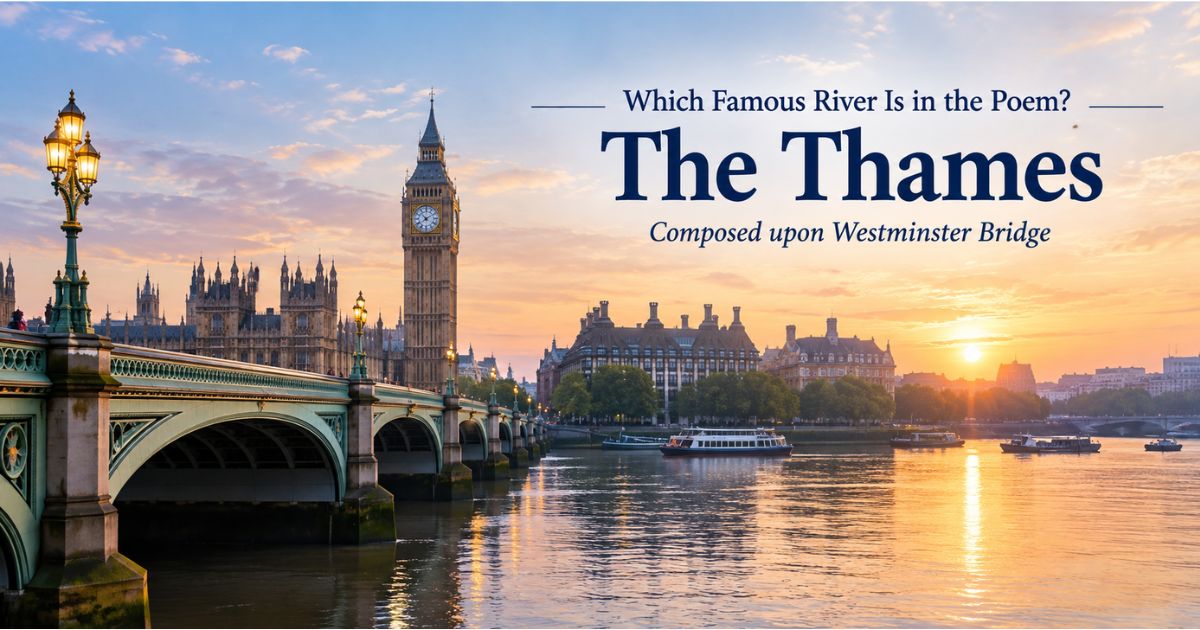
Which famous river is in the poem “Composed upon Westminster Bridge, September 3, 1802”? The answer is the River Thames, which William Wordsworth observes from Westminster Bridge during a remarkably quiet early morning in London. Although Wordsworth does not mention the word “Thames” directly in the fourteen-line sonnet, he refers to it simply as “the river,” describing its peaceful movement through the sleeping city.
The poem’s title provides the key geographical clue: Westminster Bridge crosses the River Thames in central London. Wordsworth’s sister, Dorothy Wordsworth, also recorded the beautiful morning view of London, the river, St. Paul’s, and boats while crossing the bridge, supporting the historical setting behind the poem.
The Thames is more than just part of the scenery. Its calm movement helps Wordsworth transform normally busy London into a peaceful, almost natural landscape. This unexpected harmony between the river, city, sunlight, and morning atmosphere is central to the poem’s Romantic vision.
Key Takeaways
The river in Wordsworth’s poem is the River Thames, although the poet calls it simply “the river” in the sonnet. Understanding this point also helps explain why the poem presents London as unusually peaceful. The main facts to remember are:
- Poem: “Composed upon Westminster Bridge, September 3, 1802”
- Poet: William Wordsworth
- River: River Thames
- Location: Westminster Bridge, London
- Poem form: Petrarchan sonnet
- First published: Poems, in Two Volumes in 1807
- Main setting: London at dawn
- Central effect: The normally busy city appears calm, silent, and almost natural.
One important point is that students should not confuse this poem with Wordsworth’s “Lines Composed a Few Miles above Tintern Abbey,” where the named river is the River Wye. In “Composed upon Westminster Bridge,” the geographical setting is London, so the river is the Thames. This distinction is useful in examinations. If the question asks which famous river appears in the Westminster Bridge poem, the correct answer is Thames, not Wye.
A quick comparison makes the difference clear:
Westminster Bridge poem → River Thames
Tintern Abbey poem → River Wye
Thus, the river is not just background scenery. It is part of the peaceful morning view that allows Wordsworth to see London differently.
Which Famous River Is in the Poem? The Thames Explained
The answer to which famous river is in the poem is the River Thames. The connection comes from the poem’s setting at Westminster Bridge, which spans the Thames in central London. Wordsworth describes the scene from this elevated position, looking across the city and toward the river during the quiet morning hours.
How the River Is Identified
Wordsworth writes that “the river glideth at his own sweet will.” Although this line does not give the river’s name, the surrounding details establish its identity. The poem describes London landmarks and the view from Westminster Bridge, making the geographical reference clear.
The historical background makes the identification even stronger. Dorothy Wordsworth described crossing Westminster Bridge early in the morning and seeing London, St. Paul’s, the river, and many small boats. Her account closely matches the visual experience that appears in Wordsworth’s sonnet.
In my own reading of the poem, the absence of the river’s name actually makes the scene more interesting. Wordsworth does not need to write “Thames” because the location already provides the geographical clue. Instead, he concentrates on how the river looks and moves at dawn.
Why the Thames Matters in the Poem
The Thames contributes to the poem’s atmosphere of stillness. Wordsworth describes the river as moving peacefully while the houses and the rest of the city seem asleep. This image is striking because London was normally associated with noise, traffic, commerce, smoke, and crowded streets.
The British Library notes that Wordsworth’s view presents London almost like a natural landscape. The unusual morning conditions remove much of the smoke and activity normally associated with the capital, allowing the poet to see its buildings, river, and open sky as a harmonious scene.
The river therefore connects two worlds in the poem: nature and the city. The Thames is a natural feature flowing through a heavily built urban environment. Yet, in the early morning, the city appears so peaceful that Wordsworth can compare its beauty with valleys, rocks, and hills.
This is one reason the river is important beyond simply answering a factual question. It helps create the poem’s central impression of unexpected beauty and tranquillity.
River Imagery, London, and Wordsworth’s Morning Vision
The Thames becomes especially meaningful because of the way Wordsworth describes the entire landscape. He sees ships, towers, domes, theatres, temples, the sky, sunlight, and the river as parts of one calm picture. The city is not presented as ugly or chaotic. Instead, it appears almost transformed by the morning light.
Wordsworth’s description of the river is particularly gentle. Rather than presenting the Thames as a powerful or dangerous body of water, he imagines it moving freely and quietly. The river seems to possess its own calm rhythm while the surrounding city remains completely still.
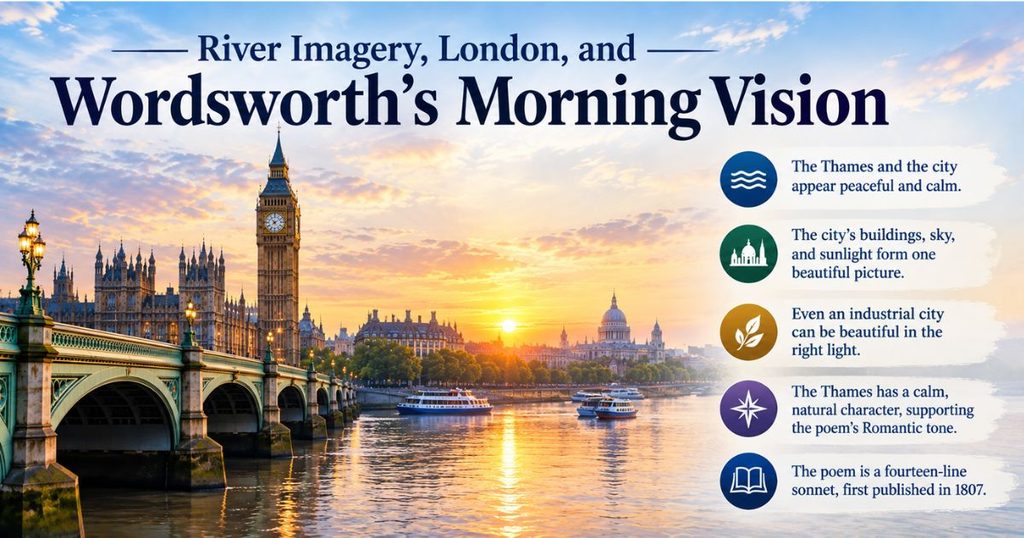
This image supports one of the poem’s most important ideas: even an industrial city can become beautiful when viewed under the right conditions. The poem was written during a period of rapid urban and industrial change, yet Wordsworth temporarily removes the usual signs of London’s activity.
The famous river also contributes to the poem’s Romantic character. Romantic poets frequently explored the emotional and spiritual effects of nature. Here, Wordsworth discovers something similar within the city itself. The Thames, sunlight, sky, and quiet morning allow London to appear almost like a natural landscape.
For students, the connection can be remembered step by step:
- Wordsworth is viewing London from Westminster Bridge.
- Westminster Bridge crosses the River Thames.
- The poem describes the river flowing peacefully.
- The quiet river contributes to the stillness of the city.
- The peaceful scene allows Wordsworth to see London as beautiful and almost natural.
The poem was first published in Poems, in Two Volumes in 1807. It is a fourteen-line sonnet, and its structure helps Wordsworth develop a single concentrated moment of wonder.
FAQs
Q: Which famous river is in the poem “Composed upon Westminster Bridge”?
A: The famous river is the River Thames. William Wordsworth views the Thames from Westminster Bridge while describing London at dawn. The river is not named directly in the fourteen-line sonnet; Wordsworth calls it “the river.” However, the poem’s title identifies Westminster Bridge as the setting, and Westminster Bridge crosses the Thames. Historical evidence from Dorothy Wordsworth’s journal also connects the poem’s inspiration with the river seen from the bridge.
Q: Does Wordsworth mention the Thames by name in the poem?
A: No, Wordsworth does not use the word “Thames” in the poem itself. He writes about “the river” and describes it flowing peacefully through London. The river is identified as the Thames because the poem is set on Westminster Bridge, which crosses the Thames. This is an important examination detail because students may incorrectly think the river must be named explicitly in the poem before it can be identified.
Q: Why is the River Thames important in the poem?
A: The River Thames helps create the poem’s atmosphere of peace and stillness. Wordsworth describes the river moving quietly while London appears almost asleep. Its presence also connects the natural world with the urban landscape. Through the Thames, sunlight, sky, and quiet morning air, Wordsworth presents London as unexpectedly beautiful and almost like a natural scene rather than a crowded city.
Q: Which river is mentioned in “Tintern Abbey”?
A: The river mentioned in Wordsworth’s “Lines Composed a Few Miles above Tintern Abbey” is the River Wye, not the Thames. This distinction is useful because both poems are strongly associated with nature and Wordsworth. “Composed upon Westminster Bridge” presents the Thames in London, while “Tintern Abbey” focuses on the Wye Valley. Therefore, the river depends on which Wordsworth poem the question refers to.
Q: Who wrote the poem about the River Thames from Westminster Bridge?
A: William Wordsworth wrote “Composed upon Westminster Bridge, September 3, 1802.” The sonnet describes an early morning view of London from Westminster Bridge, including the river, buildings, sky, and sunlight. It was first published in Poems, in Two Volumes in 1807. The poem is one of Wordsworth’s notable examples of finding beauty and tranquillity in an urban landscape.
Final Thoughts
The answer to which famous river is in the poem is the River Thames. Wordsworth does not name it directly, but the poem’s Westminster Bridge setting makes its identity clear. The Thames is important because its quiet movement helps turn London into a peaceful, almost natural landscape.
For students, the easiest way to remember the answer is simple: “Composed upon Westminster Bridge” → Westminster Bridge → River Thames. Do not confuse it with “Tintern Abbey,” where Wordsworth describes the River Wye.
Recent Article : The Duck and the Kangaroo: Summary, Theme & Meaning

Jennifer Aston is a passionate poetry curator and writer with a deep love for the written word. She believes poetry has the power to heal, inspire, and connect people across all walks of life. Through PoemSteric, she brings together timeless and modern verses for every emotion and every moment.