
Introduction
The rhyme scheme of a poem is the pattern formed by the rhyming sounds at the ends of its lines. Poets usually represent each different rhyme sound with a letter, such as A, B, C, or D. For example, a poem with an ABAB rhyme scheme has alternating end-rhyme sounds.
Understanding what is the rhyme scheme of the poem helps readers recognize how a poem is organized. It can also reveal how a poet creates rhythm, emphasis, musicality, and structure. The process is simple once you know what to look for. Read the poem aloud, compare the final sounds of each line, and assign matching letters to matching rhyme sounds.
Key Takeaways
A rhyme scheme shows the pattern of rhymes in a poem.

Letters such as A, B, and C identify different rhyme sounds.

Lines ending with the same rhyme receive the same letter.

ABAB means the first and third lines rhyme, while the second and fourth rhyme.

AABB means the first two lines rhyme and the next two lines rhyme.

You should compare sounds, not simply the spelling of words.

A poem can have a regular, irregular, or non-existent rhyme scheme.

Free verse may not follow a fixed rhyme pattern.

Rhyme scheme is different from meter, which describes rhythmic patterns of stressed and unstressed syllables.
Rhyme Scheme in Poetry: Meaning and Purpose
A rhyme scheme describes the organization of rhyming sounds in a poem. It focuses mainly on the sounds that occur at the ends of lines, although poets can also use internal rhyme within lines.
To identify the pattern, readers give the first rhyme sound the letter A. When a different sound appears, it receives B. A third sound receives C, and the process continues.
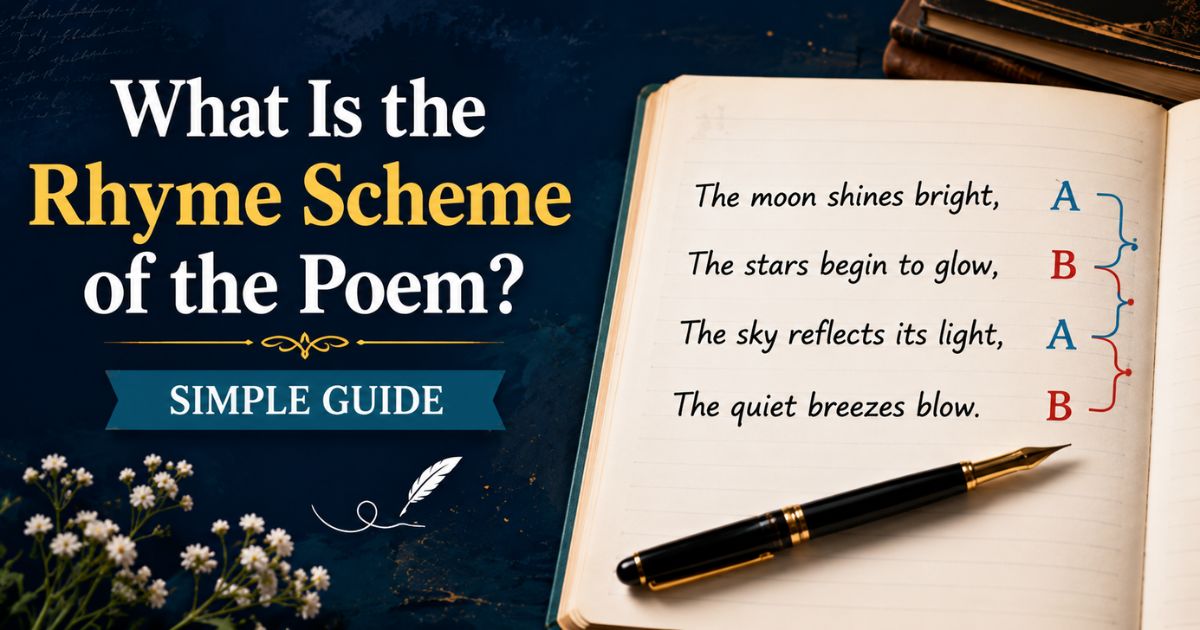
For example:
The moon shines bright – A
The stars begin to glow – B
The sky reflects its light – A
The quiet breezes blow – B
The pattern is therefore ABAB.
What the Letters A, B, C, and D Mean
The letters do not represent specific sounds. Instead, they act as labels.
Suppose four lines end with these words:
light
day
night
way
“Light” and “night” share a rhyme sound, so both receive A. “Day” and “way” share another sound, so both receive B.
The result is:
A B A B
The important point is that letters represent matching sounds, not identical words.
A poem with four completely different ending sounds might therefore have an ABCD pattern. If the first, second, and fourth lines rhyme while the third is different, the pattern could be A B A A.
Why Poets Use Rhyme Schemes
Rhyme gives poetry a sense of pattern and expectation. When readers recognize a recurring sound, they begin to anticipate its return.
This can make a poem easier to remember and can give certain lines greater emphasis. Rhyme can also contribute to a poem’s musical quality. However, rhyme is not merely decoration. A poet may deliberately break an established pattern to create surprise or emphasize a particular idea.
In my own reading of structured poetry, a changed rhyme often becomes noticeable because the earlier pattern has trained the reader to expect something else. That small disruption can therefore have a meaningful artistic effect.
How to Identify a Poem’s Rhyme Scheme
Finding a rhyme scheme is easier when you follow a consistent process. You do not need to understand every literary device before identifying the pattern.
Step 1: Read the Poem Aloud
Begin by reading the poem naturally.
Listen carefully to the final sound of each line. This matters because rhyme depends on sound rather than spelling.
For example:
night
light
These words clearly rhyme.
However:
move
love
look similar but do not form a perfect rhyme in standard English pronunciation.
Reading aloud can help you hear these differences more clearly.
Step 2: Compare the End Sounds
Write down the final word from each line or simply focus on those words while reading.
Now compare their sounds.
For example:
sky – A
tree – B
fly – A
sea – B
The first and third lines rhyme. The second and fourth lines also rhyme.
Therefore:
ABAB
Do not assign letters based on spelling alone. Two words can have similar spellings without having the same rhyme.
Step 3: Assign Letters to Each Rhyme
Start with A for the first rhyme sound.
If the next line has the same sound, it also receives A. If it has a new sound, assign B.
Continue until every line has a letter.
For example:
| Line | Ending | Label |
| 1 | light | A |
| 2 | day | B |
| 3 | night | A |
| 4 | way | B |
The final pattern is ABAB.
If a fifth line ends with a sound that matches “light,” it receives A. If it introduces a completely new sound, it receives C.
The key is consistency. Once you assign a letter to a particular rhyme sound, use the same letter whenever that sound returns.
Common Rhyme Scheme Patterns With Examples
Several rhyme patterns appear frequently in traditional poetry. Learning the most common ones makes rhyme analysis much faster.
AABB and ABAB Patterns
AABB is often called a couplet-based pattern because two neighboring lines rhyme.
Example:
The golden sun begins to rise – A
Its gentle light fills up the skies – A
A quiet breeze moves through the tree – B
And carries birdsong back to me – B
The pattern is:
AABB
The ABAB pattern alternates between two rhyme sounds.
The morning sun is shining bright – A
A bird is singing in the tree – B
The flowers open to the light – A
The world wakes quietly – B
The pattern is:
ABAB
These patterns are easy to hear because their organization is regular.
ABBA, ABCB, and Other Patterns
An ABBA pattern is sometimes called an enclosed or embracing rhyme because the outside lines rhyme and the middle lines form another pair.
Example:
The evening settles over town – A
A quiet bird begins to sing – B
The distant bells softly ring – B
While shadows slowly settle down – A
The pattern is:
ABBA
An ABCB pattern uses a different arrangement:
The river moves beneath the sun – A
The clouds drift slowly through the sky – B
The afternoon has just begun – A
A distant bird goes flying by – B
Again, the pattern is ABAB, because lines one and three rhyme, while lines two and four rhyme. This example also shows why you should label sounds rather than guess from the visual arrangement.
Other poems may use:
- AAAA – every line shares the same rhyme
- ABCB – lines two and four rhyme
- ABCD – four different rhyme sounds
- ABCABC – a repeating six-line pattern
- ABABCDCD – two alternating patterns across eight lines
Not every poem follows a predictable pattern. Some use occasional rhymes or deliberately change patterns between stanzas.
Rhyme Scheme vs. Rhyme and Meter
These three concepts are connected, but they describe different things.
Rhyme refers to matching or similar sounds.
The rhyme scheme describes the organized pattern of those rhymes across lines.
Meter describes the rhythmic arrangement of stressed and unstressed syllables.
For example, a poem can have an ABAB rhyme scheme while also using a particular meter.
| Term | What it describes |
| Rhyme | Similarity between sounds |
| Rhyme scheme | Pattern of rhymes across lines |
| Meter | Pattern of stressed and unstressed syllables |
| Stanza | Group of lines forming a unit |
| End rhyme | Rhyme occurring at line endings |
This distinction matters when analyzing poetry. Saying that a poem has an ABAB rhyme scheme does not tell you its meter.
Likewise, saying that two words rhyme does not describe the structure of the entire poem.
A complete analysis can discuss all these features separately and then explain how they work together.
For example, a regular rhyme scheme may create a calm or predictable effect, while a sudden break in the pattern may create tension. The meaning depends on the poem’s context, so readers should avoid assuming that one pattern always creates the same emotional response.
FAQs
Q: What is the rhyme scheme of the poem?
A: The rhyme scheme of a poem is the pattern created by rhyming sounds at the ends of its lines. Readers normally use letters to represent the pattern. For example, if lines one and three rhyme and lines two and four rhyme, the scheme is ABAB. To identify the pattern accurately, compare the sounds of the final words rather than relying only on their spelling.
Q: How do you find the rhyme scheme of a poem?
A: Read the poem aloud and focus on the final sound of each line. Give the first rhyme sound the letter A. When a different sound appears, give it B. Continue assigning letters as new sounds appear. Whenever an earlier sound returns, use its original letter. The resulting sequence, such as AABB, ABAB, or ABBA, identifies the rhyme scheme.
Q: What does ABAB rhyme scheme mean?
A: An ABAB rhyme scheme means that the first and third lines rhyme with each other, while the second and fourth lines share another rhyme sound. The letters simply label the sounds. Therefore, ABAB does not mean that the words themselves are identical. It describes the recurring pattern of their ending sounds across the stanza.
Q: Can a poem have no rhyme scheme?
A: Yes. Free verse and some forms of modern poetry may not use a regular end-rhyme pattern. However, such poems can still have strong sound structures through repetition, alliteration, assonance, consonance, rhythm, or internal rhyme. Therefore, a poem without a fixed rhyme scheme is not necessarily lacking structure or musical qualities.
Q: What is the difference between rhyme and rhyme scheme?
A: Rhyme refers to the similarity between particular sounds, usually at the ends of lines. A rhyme scheme describes how those rhymes are organized throughout a poem. For example, “light” and “night” rhyme. If they appear at the ends of lines one and three while another pair rhymes in lines two and four, the overall pattern could be ABAB.
Q: Does the rhyme scheme tell you the meter of a poem?
A: No. Rhyme scheme and meter describe different aspects of poetic form. Rhyme scheme identifies the pattern of rhyming sounds, while meter describes the pattern of stressed and unstressed syllables. A poem can have an ABAB rhyme scheme and also use iambic pentameter. Therefore, both features should be analyzed separately.
Final Thoughts
Understanding what is the rhyme scheme of the poem becomes simple once you focus on sound and pattern. Start with the final sound of each line, assign letters consistently, and then read the resulting sequence.
Remember that rhyme scheme is only one part of poetic form. A poem’s meaning also depends on its language, imagery, rhythm, structure, tone, and subject. The most reliable approach is to identify the pattern first and then ask why the poet may have chosen it. That second step turns a basic rhyme exercise into meaningful poetry analysis.
Recent Article : What Do You Like Most About the Poem? Best Answer

Jennifer Aston is a passionate poetry curator and writer with a deep love for the written word. She believes poetry has the power to heal, inspire, and connect people across all walks of life. Through PoemSteric, she brings together timeless and modern verses for every emotion and every moment.