

Introduction
Robert Browning’s “Meeting at Night” is a compact love poem built on urgency and secrecy. The poem has two six-line stanzas. The first describes the sea crossing, while the second covers the walk inland and the reunion. Browning keeps the language plain, yet every image is chosen carefully.
This free full analysis explains the poem’s summary and meaning stanza by stanza. It also covers imagery, rhyme scheme, rhythm, themes, and historical background. Because the language is simple, students and general readers can follow every step.
First, some background helps. Browning first printed the poem as part of a two-part work called “Night and Morning” in Dramatic Romances and Lyrics (1845). He later split it from its companion, “Parting at Morning.” As a result, the ending reads differently on its own than it did in 1845.
In short, this guide shows what happens, how Browning creates the mood, and why the poem still rewards close reading. Use it for essays, revision, or simple curiosity about this Victorian love lyric. Along the way, you will also find a five-question FAQ.
Key Takeaways
Here are the essential points at a glance:
- What it is: A 12-line lyric in two six-line stanzas by Robert Browning, first printed in 1845 as the opening part of “Night and Morning.”
- Plot: The speaker crosses the sea by boat, walks a mile along a beach, crosses three fields, and taps at a window.
- Rhyme scheme: Each stanza follows ABCCBA, so outer rhymes such as land/sand and beach/each enclose the inner ones.
- Rhythm: The meter is loosely iambic, with about four beats per line. Irregular stresses give the journey a hurried, urgent feel.
- Imagery: The first stanza relies on sight, mainly gray, black, and yellow. The second adds smell, touch, and sound.
- Themes: Love, urgency, secrecy, and the contrast between a huge dark landscape and one private moment.
- Context: Browning began writing to Elizabeth Barrett in 1845. Early critics objected to the lovers’ secret meeting, and the couple themselves married secretly in 1846.
- Companion poem: Read with “Parting at Morning,” the poem becomes one complete cycle of arrival and departure.
- Speaker: The speaker is unnamed. Browning is reported to have said the speaker is a man, though the text never says so.
- Best way to study it: Read it aloud twice, then trace how the senses change from stanza to stanza.
Poem Summary: The Journey in Meeting at Night, Step by Step
The speaker is never named. Browning is reported to have said the speaker is a man, so this guide uses “he.” Because the poem moves in a straight line, a step-by-step, line by line reading works well.
The sea at night (lines 1–4). The poem opens with “the gray sea and the long black land” under a “yellow half-moon large and low.” The waves seem startled, as if the boat has woken them.
The landing (lines 5–6). The speaker reaches the cove “with pushing prow.” The boat’s speed stops in “the slushy sand.”
The beach (line 7). He then covers “a mile of warm sea-scented beach.” The tone shifts from dim colors to warmth and smell.
The fields (line 8). Three fields remain “till a farm appears.” The short list of steps builds a sense of steady, hurried progress.
The signal (lines 9–10). A tap at the pane comes first. Then a “quick sharp scratch” and a “blue spurt of a lighted match” follow. Readers disagree about who makes the scratch, yet many see the flame as a sign that the beloved is awake.
The reunion (lines 11–12). The poem ends with “a voice less loud” than “the two hearts beating each to each!” The phrase “joys and fears” in between shows mixed feelings, not simple happiness. The meeting happens in sound and feeling, not in a described scene.
Notice how much of the poem describes the trip. Only the last two lines show the lovers together. As a result, the speaker’s eagerness, not the reunion itself, becomes the emotional center.
Literary Analysis: Imagery, Sound, and Structure
Browning packs a great deal of craft into the twelve lines of Meeting at Night. In particular, he controls what the reader sees, hears, and feels at each stage. In my own reading, the poem rewards a slow second pass, because the first read feels like a quick adventure while the second reveals the planning behind it.
Sensory Imagery From Sea to Farm
The first stanza is mostly visual. Browning uses a dim palette of gray, black, and yellow, much like a night painting. The waves are “startled” and “little,” and they leap “in fiery ringlets from their sleep.” This personification makes the sea feel alive and aware of the boat’s arrival.
The second stanza brings in other senses. A “warm sea-scented beach” adds touch and smell. The “tap,” the “scratch,” and the “voice” add sound. Finally, the “blue spurt of a lighted match” adds the poem’s sharpest visual contrast against the dark.
One useful way to read the imagery is as a camera zoom. The poem begins with a wide view of sea and land, then narrows to a cove, a beach, fields, a farm, a window, a match, and finally two heartbeats. As a result, the scale shrinks while the emotion grows.
For example, if you are writing about imagery, quote one image from each stanza and explain which sense it appeals to. That simple habit makes your analysis specific and easy to follow.
Rhyme Scheme, Meter, and Sound Devices
Each stanza follows the rhyme scheme ABCCBA. In the first stanza, land rhymes with sand, low with prow, and leap with sleep. In the second, beach rhymes with each, appears with fears, and scratches with match.
Readers interpret this pattern in two ways. First, the two C rhymes sit side by side at the center, like the lovers finally coming together. Second, the scheme runs forward and then reverses, which may hint that the meeting cannot last.
The meter is loosely iambic tetrameter, meaning about four beats per line. However, Browning does not keep it strict. Heavy stresses in “gray sea” and “long black land” slow the opening line, while lighter, quicker lines later hurry the reader forward.
Sound devices add to the effect. For example, five of the twelve lines begin with “And.” This repetition, called anaphora, creates a breathless, one-thing-after-another rhythm. Alliteration and sibilance appear in “sea-scented” and “slushy sand,” and the word “scratch” imitates the sound it describes.
Finally, punctuation guides the pace. In most editions, semicolons end lines one, two, seven, and eight, so the images arrive one at a time. The last line ends with an exclamation mark, which turns the reunion into a burst of feeling.
Themes and Context: Love, Secrecy, and Elizabeth Barrett
The most obvious theme is love, expressed as urgency. Although the scenery is vivid, the speaker notices it only briefly before hurrying on. As a result, the sea, beach, and fields become a measure of how much he wants the meeting.
Secrecy is the second major theme. The lovers meet at night, at a remote farm, and the signal is a quiet tap and a small flame. Even the voice at the end is “less loud” than the two heartbeats. Together, the themes of love and secrecy make the meeting feel both urgent and hushed.
A third theme is the contrast between a huge outer world and a tiny private one. Sea, land, and moon fill the first stanza, yet the poem ends inside a single moment between two people. That shrinking of scale suggests that intimacy outweighs any landscape.
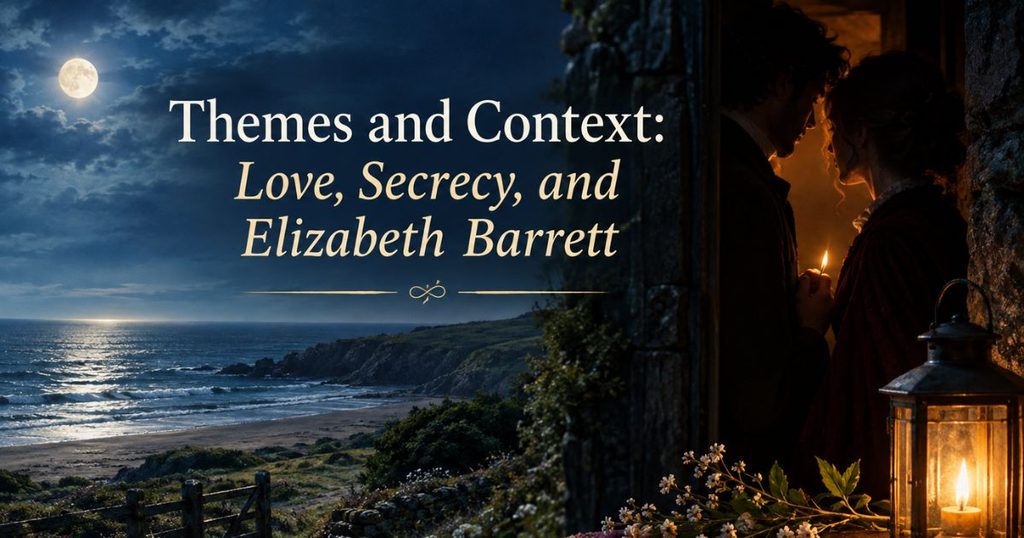
The poem is often read alongside Browning’s courtship of Elizabeth Barrett, which began the same year it was written; some Victorian critics found the secret meeting improper. It was also originally paired with a companion piece, “Parting at Morning,” as one poem before Browning split them later. (For the full publication story – the original title, the pamphlet it appeared in, and the 1849 split see our companion guide on the poem’s publication history.)
Two mis readings are worth avoiding. First, the poem does not describe a formal visit; the night, the tap, and the match all suggest a private rendezvous. Second, the ending is not simply happy, because the words “joys and fears” show mixed emotions. Checking the text closely prevents both errors.
To turn these ideas into an essay paragraph, follow these steps:
- State one clear claim, such as “Browning shrinks the poem’s scale to make intimacy feel earned.”
- Choose one short quotation from each stanza as evidence.
- Name the technique, such as imagery, rhyme, or anaphora.
- Explain the effect on the reader.
- Link your explanation back to your claim.
FAQs
Q: What is Meeting at Night about?
A: Meeting at Night is about a speaker who travels across a dark sea, a beach, and three fields to meet a lover in secret. Most of the poem describes the journey, which shows the speaker’s eagerness. The final two lines reveal the reunion through sound, with a hushed voice and two heartbeats. Overall, the poem explores love, urgency, and secrecy in a compact, sensory form.
Q: What is the rhyme scheme of the poem?
A: The rhyme scheme of Meeting at Night is ABCCBA in each stanza. In the first stanza, land rhymes with sand, low with prow, and leap with sleep. The second stanza uses a new set of rhymes: beach and each, appears and fears, scratch and match. This enclosed pattern wraps the outer lines around the inner ones, so each stanza ends by returning to its opening sound.
Q: What is the theme of Meeting at Night?
A: The main theme is love expressed as urgency. Secrecy is a close second, since the lovers meet at night in a remote place and keep everything quiet. A third theme is the contrast between a vast outer landscape and a small, private moment. Together, these themes show that the speaker cares more about the reunion than about the scenery he crosses.
Q: Who is the speaker in the poem?
A: The speaker is unnamed, and the text never states a gender. However, Browning is reported to have said the speaker is a man. Some readers also link the speaker to Browning himself because the poem dates from his courtship of Elizabeth Barrett. That link is only a possibility, though, because Browning rarely identified directly with his speakers. For essays, it is safest to say “the speaker” and mention both possibilities.
Q: Is Meeting at Night connected to Parting at Morning?
A: Yes, the two were originally one poem before Browning split them into separate pieces. Together they form a complete cycle: arrival in darkness, then departure at dawn. Reading them side by side shows the full story, since “Meeting at Night” alone ends right at the reunion. (See our guide to the poem’s full publication history for the original title and dates.)
Final Thoughts
Meeting at Night rewards close reading because so much happens in so few lines. A quiet journey becomes a study in desire, secrecy, and the pull between a vast world and a private moment.
Browning achieves this effect with simple tools. Imagery moves from sea to farm, rhyme encloses each stanza, and rhythm hurries the reader along. Furthermore, the final image of two heartbeats replaces description with pure feeling. For students, that means every line can support a specific, well-evidenced point.
If you are studying the poem, start with the step-by-step summary. Next, list one image, one sound, and one structural choice, and explain the effect of each. Finally, compare the poem with “Parting at Morning” to see the full cycle.
Above all, remember that good analysis rests on evidence. Quote briefly, name the technique, and explain what the reader feels. With that approach, this Victorian love poem by Robert Browning becomes a clear and rewarding text for essays, exams, and simple enjoyment.
Recent Article : Where Was Meeting at Night First Published? (Verified)

Jennifer Aston is a passionate poetry curator and writer with a deep love for the written word. She believes poetry has the power to heal, inspire, and connect people across all walks of life. Through PoemSteric, she brings together timeless and modern verses for every emotion and every moment.