
Introduction
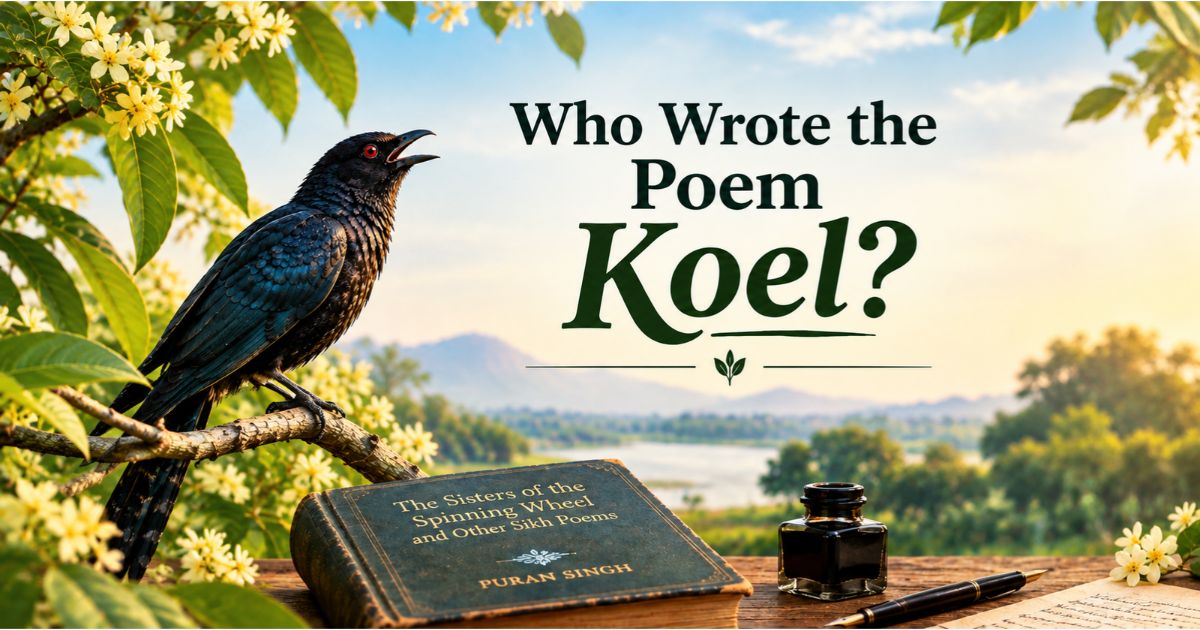
If you’re asking who wrote the poem Koel, the direct answer is Punjabi poet Puran Singh (1881–1931). His poem, formally titled “Koel (The Black Cuckoo),” appears in his English-language collection The Sisters of the Spinning Wheel and Other Sikh Poems, published in 1921. It addresses the koel bird directly, using its restless, haunting call as a symbol of longing and separation.
Readers often notice that this poem gets confused with other works that share the same one-word title, so this article clears that up too. Below, you’ll find who Puran Singh was, what the poem actually says, how it differs from other “Koel” poems circulating online, and the poetic devices that make it work.
Key Takeaways
- Poet: Puran Singh (1881–1931), a Punjabi writer, scientist, and mystic
- Full title: “Koel (The Black Cuckoo)”
- Collection: The Sisters of the Spinning Wheel and Other Sikh Poems (1921)
- Subject: The koel, a bird similar to a cuckoo, addressed directly by the poet
- Theme: Longing, restlessness, and the arrival of spring
- Common mix-up: Not to be confused with the 15th-century Sanskrit poem Kokila Sandeśa by Uddanda Sastri, or with any “Koel” poem attributed to other authors in some quiz banks
Who Wrote the Poem Koel? Meet Puran Singh
To answer who wrote the poem Koel with real confidence, it helps to know the poet’s background, since his life shaped both the subject and the tone of his poetry.
Puran Singh’s Life and Literary Journey
Puran Singh was born in 1881 in a village near Abbottabad, in what was then British India and is now Pakistan. As a young man, he travelled to Japan to study pharmaceutical chemistry at Tokyo Imperial University. While there, he came under the influence of Swami Rama Tirtha, a wandering spiritual teacher whose ideas shaped Puran Singh’s mystic, nature-centred worldview for the rest of his life.
After returning to Punjab, Puran Singh worked as a chemist and later as a forest officer, all while writing poetry in both Punjabi and English. He became a close associate of Bhai Vir Singh, one of the central figures of the Punjabi literary revival in the early twentieth century. Puran Singh is often credited as a pioneer of free verse in Punjabi poetry, moving away from the strict traditional meters that dominated the language’s poetry before him. He died in 1931, leaving behind a body of work that blends spiritual reflection with vivid natural imagery exactly the combination found in “Koel.”
Where “Koel” Was Published
“Koel (The Black Cuckoo)” appears in The Sisters of the Spinning Wheel and Other Sikh Poems, an English-language collection Puran Singh published in 1921. Unlike much of his Punjabi verse, this collection was written directly in English, which is part of why it circulated widely in colonial-era literary journals and later found its way into school anthologies across the subcontinent. If your textbook or study guide names a publication year or source for “Koel,” this 1921 collection is the one to cite.
Poem Summary and Meaning of Koel
At its core, “Koel” is a short lyric addressed directly to the bird itself, using the old-fashioned pronouns “thy,” “thou,” and “art” a technique called apostrophe, where a poet speaks to something that cannot answer back. The koel’s call becomes a trigger for memory and restlessness, echoing across the poem the way its real call echoes through spring evenings in North India.
In my own reading of the poem, what makes it distinctive is how physical the imagery stays throughout: mango blossoms, the arrival of spring, and the bird’s insistent, repeated cry all work together instead of drifting into abstract philosophy. Critics have compared Puran Singh’s technique here to William Wordsworth’s “To the Cuckoo” and John Keats’s “Ode to a Nightingale” since all three poems use a bird’s song as a doorway into a larger emotional or spiritual state.
The koel, unlike the European cuckoo or nightingale, carries a specific cultural weight in Indian poetry: it is closely tied to spring, to mango season, and to the ache of separated lovers in classical Indian literature, a tradition Puran Singh draws on directly.
Don’t Confuse Koel With Other Poems of the Same Name
Because “koel” is simply the common name for a bird found across South Asia, more than one poem shares this title, and mixing them up is a common mistake worth avoiding.
The most important one to separate from Puran Singh’s poem is Kokila Sandeśa, a 15th-century Sanskrit poem by Uddanda Sastri. “Kokila” is the Sanskrit word for the same bird, and the poem is structured as a message (“sandeśa”) carried by the bird between separated lovers a completely different text, language, and era from Puran Singh’s 1921 English poem.
There’s also a second, smaller source of confusion worth flagging honestly: some online quiz banks attribute a poem titled “Koel” to the Nepali poet Laxmi Prasad Devkota instead of Puran Singh. If you’ve come across that attribution, it likely traces back to a different regional syllabus or a separate Nepali-language poem using the same bird as its subject. For the specific poem titled “Koel (The Black Cuckoo)” that appears in Indian and Pakistani English textbooks, Puran Singh remains the verified, source-confirmed author.
Here’s a quick way to check which poem you’re dealing with:
| Poem | Poet | Language | Date |
| “Koel (The Black Cuckoo)” | Puran Singh | English | 1921 |
| Kokila Sandeśa | Uddanda Sastri | Sanskrit | 15th century |
| A separate “Koel” sometimes cited in quiz banks | Attributed to Laxmi Prasad Devkota | Nepali (unverified for this exact title) | Unconfirmed |
Poetic Devices and Style in Koel
Puran Singh builds “Koel” from a small, deliberate set of poetic tools rather than dense, ornate language, which is part of why the poem reads so directly even a century later.
The most obvious device is apostrophe: the poet speaks straight to the bird using “thy” and “thou,” a formal, almost prayer-like register that suits the poem’s mystic undertone. Personification follows naturally from that choice, since the koel is treated less like an animal and more like a companion who understands longing. Spring imagery, especially mango blossoms, grounds the poem’s emotion in a specific, recognisable season rather than a vague or timeless setting.
A few features to look for when you read the poem yourself:
- Repetition of address the bird is called back to again and again, mimicking its own repeated call
- Archaic pronouns (“thy,” “thou,” “art”) that signal a formal, devotional tone
- Seasonal imagery tied specifically to spring and mango blossoms
- An unanswered question structure, where the poet asks the bird why it calls, without ever receiving a literal reply
FAQs
Q: Who wrote the poem Koel?
A: The poem “Koel (The Black Cuckoo)” was written by Puran Singh (1881–1931), a Punjabi poet, chemist, and mystic. It was published in his 1921 English-language collection The Sisters of the Spinning Wheel and Other Sikh Poems. So when a textbook or exam question asks who wrote the poem Koel, Puran Singh is the correct, source-confirmed answer for this specific poem.
Q: What is the poem Koel about?
A: The poem addresses a koel bird directly, using its repeated, haunting call as a symbol of longing, restlessness, and the arrival of spring. Puran Singh draws on mango-blossom imagery and formal, almost devotional language to turn the bird’s cry into a meditation on memory and separation, in a style critics have compared to Wordsworth’s and Keats’s bird poems.
Q: Is Koel the same poem as Kokila Sandeśa?
A: No. Anyone asking who wrote the poem Koel should know there are two separate works involved. Kokila Sandeśa is a 15th-century Sanskrit poem by Uddanda Sastri, written centuries before Puran Singh’s “Koel (The Black Cuckoo)” and composed in a completely different language and literary tradition. They share a bird as their subject, nothing more.
Q: When was the poem Koel published?
A: “Koel (The Black Cuckoo)” was published in 1921, inside Puran Singh’s collection The Sisters of the Spinning Wheel and Other Sikh Poems. This English-language book is the primary published source for the poem and is the edition most textbook excerpts are drawn from.
Q: Why is there confusion about who wrote the poem Koel?
A: Confusion mostly comes from the word “koel” itself, since it’s simply the common name for a bird native to South Asia, and more than one poet has written about it. Some online quiz sources even attribute a differently titled “Koel” poem to Nepali poet Laxmi Prasad Devkota. For the specific poem “Koel (The Black Cuckoo)” studied in most English textbooks, however, Puran Singh is the verified author.
Final Thoughts
To sum up who wrote the poem Koel: it was Puran Singh, a Punjabi poet writing in English, and the poem first appeared in his 1921 collection The Sisters of the Spinning Wheel and Other Sikh Poems. The poem itself is a short, direct address to the bird, built from apostrophe, spring imagery, and formal, archaic pronouns that give it a devotional feel.
If you take one thing from this article, let it be the disambiguation: “Koel” is a common bird name, not a unique title, so always check the collection and publication date before citing an author. With that context in hand, you can confidently answer who wrote the poem Koel and explain why, in this case, the name Puran Singh is the one that belongs in your notes.
Recent Article : Who are Ink and Blink in the Poem? Explained

Jennifer Aston is a passionate poetry curator and writer with a deep love for the written word. She believes poetry has the power to heal, inspire, and connect people across all walks of life. Through PoemSteric, she brings together timeless and modern verses for every emotion and every moment.