
What Is an Ode in Poetry?
An ode in poetry is a formal poem written to praise or celebrate a person, place, object, or idea. It typically uses direct address, elevated language, and a serious, admiring tone. A clear example of an ode in poetry is John Keats’s “Ode to a Grecian Urn,” which speaks directly to an ancient vase to explore the relationship between art, beauty, and time.
In my own reading of classical and Romantic poetry, what stands out about odes is how they turn ordinary attention into something almost ceremonial. Pablo Neruda even wrote an ode to his socks, and it reads like a small hymn. That range, from ancient Greek victory songs to a poem about warm feet, is exactly what makes the ode such a flexible and rewarding form to study. This guide walks through real examples of an ode in poetry, the three traditional types, how odes are built, and how you can write one of your own.
Key Takeaways
•An ode is a poem of praise addressed directly to its subject, whether that subject is a person, a season, or a pair of socks.

•There are three main types of odes: Pindaric, Horatian, and Irregular, each with a different origin and structure.

•Famous examples of an ode in poetry include Keats's "Ode to a Grecian Urn," Shelley's "Ode to the West Wind," and Neruda's "Ode to My Socks."

•Modern odes don't need rhyme or a fixed stanza pattern. What they do need is direct address and real, specific appreciation.

•Odes differ from elegies, which mourn, and sonnets, which follow a strict 14-line rhyme scheme, mainly in tone and purpose.
The 3 Types of Odes: Pindaric, Horatian, and Irregular
Ancient Greek poets first developed the ode as a public, performed art form, sung aloud rather than read silently. Over the centuries, poets adapted the form to fit their own languages and purposes, which is why three distinct types emerged. Understanding these types makes it much easier to recognize an example of an ode in poetry when you encounter one, because each type signals a slightly different mood and structure.
Pindaric Odes: Grand and Ceremonial
Named after the Greek poet Pindar, who lived in the 5th century BCE, the Pindaric ode is the oldest and most formal type. It follows a three-part pattern: the strophe, the antistrophe, and the epode. Pindar originally composed these odes to honor athletes who had won at events like the ancient Olympic Games, and they were performed by a singing, dancing chorus rather than read alone.
Because of this performance history, Pindaric odes tend to feel grand and public. Thomas Gray’s “The Progress of Poesy” is a well-known English-language example that borrows this ceremonial structure.
Horatian Odes: Quiet and Reflective
The Horatian ode takes its name from the Roman poet Horace, who adapted the Greek form for a more private, contemplative purpose. Unlike the Pindaric ode’s public performance, Horatian odes were meant to be read quietly, often addressing everyday scenes, friendship, or simple pleasures.
Horatian odes typically use short, regular stanzas, usually two to four lines, with a consistent rhyme scheme throughout. Alexander Pope’s “Ode on Solitude,” written when he was just twelve years old, follows this calmer, more personal Horatian model.
Irregular Odes: Free From the Rules
The irregular ode, sometimes called the Cowleyan ode after 17th-century poet Abraham Cowley, abandons both the Pindaric and Horatian structures entirely. It has no fixed stanza length, rhyme scheme, or meter, giving poets complete freedom to shape the poem around its subject.
Most odes written in English since the Romantic period, including nearly all the examples in the next section, follow this irregular pattern. As a result, when people ask for an example of an ode in poetry today, they are usually thinking of this flexible, modern form rather than the strict Greek original.
8 Examples of an Ode in Poetry You Should Know
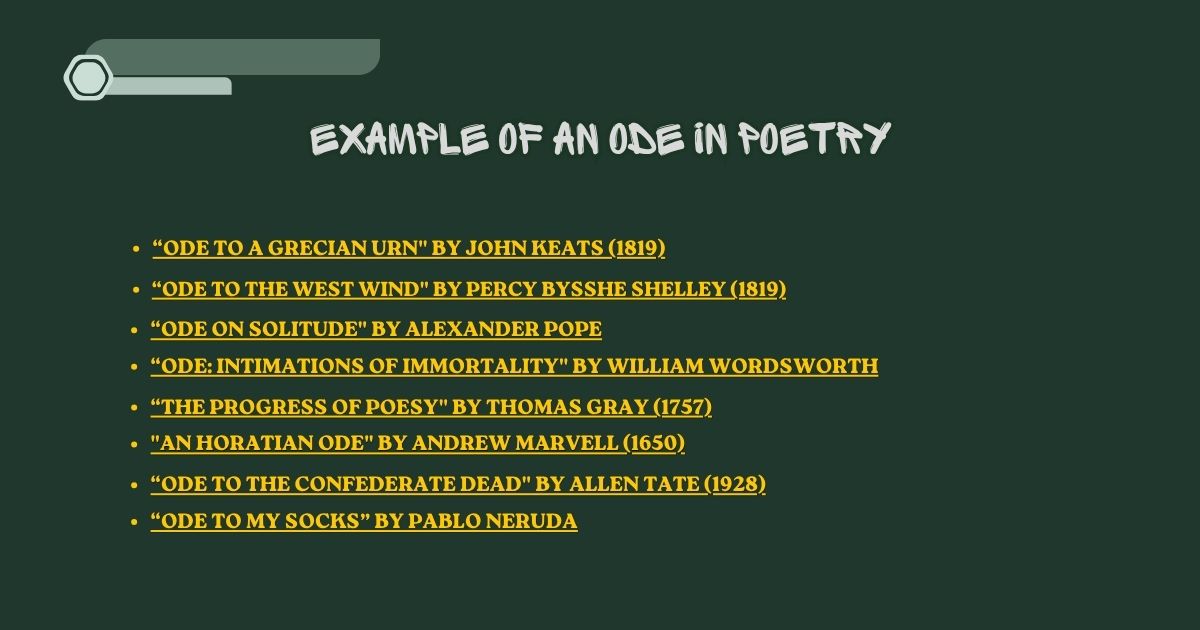
The clearest way to understand what an ode actually looks like on the page is to study real, well-known examples of odes in poetry. The eight poems below span more than two thousand years and several very different subjects, yet each one follows the same basic instinct: address something directly, and praise it with care.
1. “Ode to a Grecian Urn” by John Keats
Written in 1819, this is perhaps the single most quoted example of an ode in poetry in the English language. Keats addresses an ancient Greek urn decorated with frozen figures, using its stillness to meditate on how art can preserve a single moment forever, while human life keeps moving toward loss and death. The poem’s famous closing thought, that beauty and truth are ultimately the same thing, has been debated by scholars for two centuries.
2. “Ode to the West Wind” by Percy Bysshe Shelley
Shelley wrote this ode in 1819 after witnessing a dramatic autumn storm near Florence, Italy. He addresses the wind itself as a wild, destructive, and renewing force, asking it to scatter his own words across the world the way it scatters dead leaves. The poem ends on a note of hope, tying personal and political renewal to the natural cycle of the seasons.
3. “Ode on Solitude” by Alexander Pope
This short, quiet Horatian ode was reportedly written by Pope when he was only twelve years old, though it wasn’t published until later in his life. Rather than addressing a grand subject, the Pope praises the simple pleasure of a private, self-sufficient country life, away from public ambition. Its calm, regular stanzas make it one of the easiest examples of an ode in poetry for beginners to study.
4. “Ode: Intimations of Immortality” by William Wordsworth
Considered one of the great Pindaric odes in English, Wordsworth’s poem mourns the fading of childhood wonder as we grow older, then finds comfort in the idea that this wonder points to something the soul knew before birth. Its shifting, irregular stanza lengths mirror the emotional journey from loss toward acceptance.
5. “The Progress of Poesy” by Thomas Gray
Gray modeled this 1757 ode closely on Pindar’s original ceremonial structure, using it to trace the history of poetry itself, from ancient Greece through to English poets like Milton and Dryden. Its formal strophe-antistrophe-epode pattern makes it one of the clearest surviving examples of a true Pindaric ode written in English.
6. “An Horatian Ode” by Andrew Marvell
Marvell wrote this politically charged ode in 1650, shortly after the execution of King Charles I. He addresses the poem to the recent achievements of Oliver Cromwell, praising his military success while also acknowledging, with striking evenhandedness, the dignity of the king Cromwell helped remove from power.
7. “Ode to the Confederate Dead” by Allen Tate
This 1928 irregular ode by American poet Allen Tate reflects on a Confederate cemetery, using it to explore how modern readers struggle to genuinely connect with history and its dead. Its fractured, difficult structure is itself part of the poem’s argument about memory and distance.
8. “Ode to My Socks” by Pablo Neruda
Neruda’s mid-20th-century ode takes the opposite approach from most odes on this list. Instead of addressing something grand, he praises a handmade pair of wool socks, given to him by a friend, treating an everyday object with the same warmth and seriousness classical poets reserved for gods and heroes. It’s often the first ode readers encounter that proves the form still works for small, modern, everyday subjects.
How Odes Are Structured (Strophe, Antistrophe, Epode)
Classical Pindaric odes follow a specific three-part musical structure, and understanding it helps explain why some examples of odes in poetry feel more formal than others. The strophe is the opening stanza, sung by the chorus while moving in one direction across the stage. The antistrophe mirrors the strophe’s meter and rhyme scheme exactly, but the chorus sings it while moving back in the opposite direction.
The epode, which follows, breaks from both earlier patterns with its own distinct meter and length, and typically brings the poem’s argument to a summary or conclusion. This three-part movement, literally built around physical motion on a stage, is why Pindaric does still feel performative even when read silently today.
Horatian and irregular odes largely abandon this three-part system. Horatian odes settle instead into short, repeating stanzas of matching length, while irregular odes reject any fixed pattern at all. As a result, structure alone can often tell you which type of ode you’re looking at before you’ve even read the first line closely.
What Makes an Ode Different From an Elegy or a Sonnet?
Readers often confuse odes with elegies and sonnets, since all three are common in classical and Romantic poetry, but their purposes are quite different. An elegy is a poem of mourning, written to grieve a death or a loss, whereas an ode is fundamentally a poem of praise and celebration. A sonnet, meanwhile, is defined not by its emotional purpose but by its strict 14-line structure and specific rhyme scheme, such as the Shakespearean or Petrarchan pattern.
The quickest way to tell them apart: ask what the poem is doing to its subject. If it’s mourning a loss, it’s likely an elegy. If it’s following a strict 14-line form regardless of subject, it’s a sonnet. If it’s addressing something directly, with genuine admiration, and taking whatever length that admiration needs, you’re probably looking at an example of an ode in poetry.
Form Purpose Typical Structure
Ode Praise and celebration Flexible; 3 traditional types
Elegy Mourning and loss Flexible, often quatrains
Sonnet Fixed poetic argument Strict 14 lines, set rhyme scheme
How to Write Your Own Ode
Writing an ode is far more approachable than its ancient reputation suggests, especially since most modern poets follow the irregular form rather than Pindar’s strict rules. Here’s a simple, step-by-step approach to writing your own.
1: Choose Something Worth Praising
Pick a subject you genuinely feel something about, whether that’s a person, a place, a season, or even an everyday object like Neruda’s socks. The strongest odes come from real, specific appreciation, not from forcing grandeur onto a subject you don’t actually care about.
2: Decide on a Structure
Beginners generally find the most freedom in the irregular ode, since it doesn’t require matching stanza lengths or a set rhyme scheme. However, if you want practice with structure first, try the Horatian model: short, consistent stanzas of two to four lines each.
3: Use Direct Address and Elevated Language
Speak directly to your subject, using “you,” as if it could hear you. Reach for slightly more formal, careful language than you would in casual writing, since this elevated tone is what separates an ode from a simple description. Read your draft aloud, and revise any line that sounds flat rather than genuinely admiring.
FAQs
Q: What is an example of an ode in poetry?
A: A well-known example of an ode in poetry is John Keats’s “Ode to a Grecian Urn,” written in 1819. It directly addresses an ancient urn to explore how art can freeze a single moment in time forever, while real life keeps changing and fading. Other strong examples include Shelley’s “Ode to the West Wind” and Neruda’s “Ode to My Socks,” which shows the form still works for everyday subjects today.
Q: What are the three types of odes?
A: The three traditional types are Pindaric, Horatian, and Irregular. Pindaric odes follow a formal three-part structure of strophe, antistrophe, and epode, and were originally performed by a chorus. Horatian odes use short, quiet, regularly rhymed stanzas. Irregular odes drop fixed structure entirely, which is why most modern odes follow this flexible, freer pattern instead.
Q: What is the difference between an ode and an elegy?
A: An ode is a poem of praise and celebration, directly addressing its subject with admiration. An elegy, by contrast, is a poem of mourning, typically written to grieve someone’s death or a significant loss. While both forms can use similarly serious, elevated language, their emotional purpose and tone point in opposite directions.
Q: Do odes have to rhyme?
A: No, odes do not have to rhyme. Horatian odes traditionally use a consistent rhyme scheme within their short stanzas, but irregular odes, which are the most common type written today, drop rhyme requirements entirely. What matters most for an ode is direct address and genuine praise, not a specific rhyme pattern.
Q: What is the most famous ode ever written?
A: John Keats’s “Ode to a Grecian Urn” is widely considered the most famous ode in English literature, thanks to its enduring closing line about beauty and truth. Percy Bysshe Shelley’s “Ode to the West Wind” is a close second, especially for its hopeful, often-quoted final image of spring following winter.
Q: Can a modern poem be considered an ode?
A: Yes, a modern poem can absolutely be considered an ode if it directly addresses a subject with genuine praise, regardless of its structure or subject matter. Pablo Neruda’s “Ode to My Socks” is a strong 20th-century example, proving that the form works just as well for everyday objects as it does for grand classical subjects.
Final Thoughts
An ode, at its core, is simply a poem that takes the time to say “thank you” or “I see you” to something, whether that something is a Grecian urn, a fierce autumn wind, or a pair of homemade socks. The eight examples of an ode in poetry covered here span classical Greece to 20th-century Chile, yet they share the same underlying instinct: to look closely at something and put real, careful praise into words.
If you’re new to the form, start small, pick a subject you actually love, and let the structure follow your enthusiasm rather than the other way around. Readers often tell us that once they stop worrying about strophes and rhyme schemes, writing an ode becomes one of the most natural forms of poetry to try.
Recent Article : Sound Devices in Poetry: 10 Techniques With Real Examples

Jennifer Aston is a passionate poetry curator and writer with a deep love for the written word. She believes poetry has the power to heal, inspire, and connect people across all walks of life. Through PoemSteric, she brings together timeless and modern verses for every emotion and every moment.