
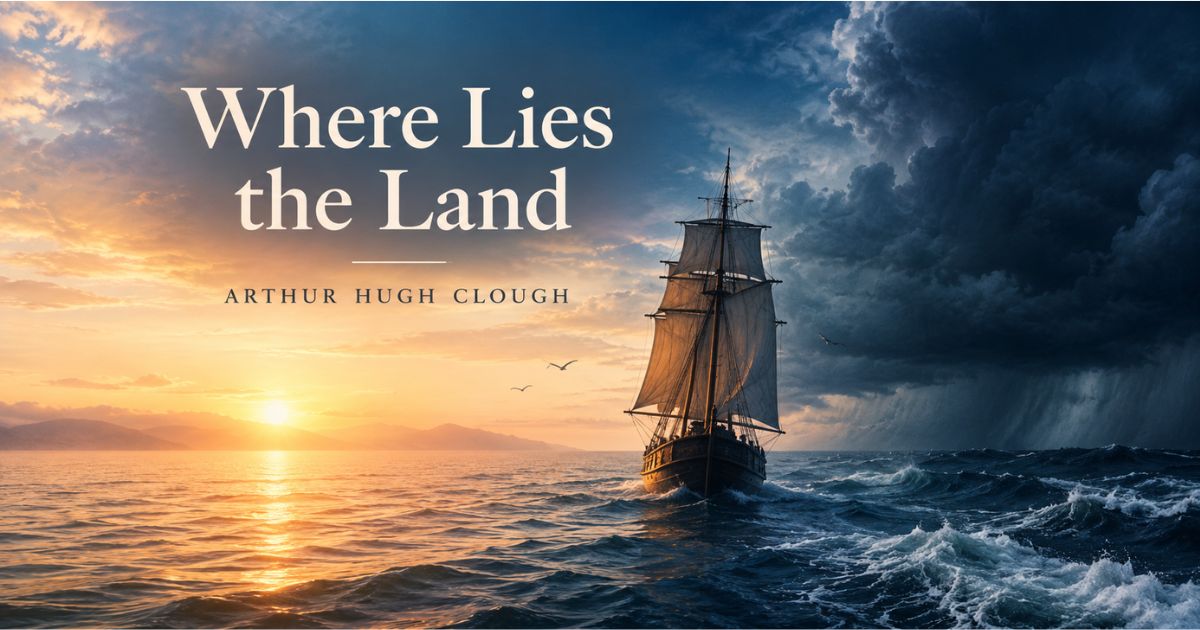
Introduction
“Where lies the land to which the ship would go?” is a short poem by Arthur Hugh Clough (1819–1861), an English Victorian poet. Rather than describing an actual voyage, the poem uses a ship sailing toward an unknown destination as an extended metaphor for human life; no one truly knows where they are heading or where they came from, and the poem is more interested in how people face that uncertainty than in resolving it.
Key Takeaways
- The poem was written by Arthur Hugh Clough, not Thomas Hardy, and was published posthumously in his 1862 collection Poems.
- It consists of just two eight-line stanzas, built around a repeated refrain that opens and closes the poem.
- Its central image is a ship as a metaphor for life; the sailors know neither where they’re going nor where they came from, only that they are “far, far” from both.
- The poem contrasts two moods: peaceful companionship on a calm day, and proud endurance during a storm.
- Its tone is often read as broadly hopeful, though the repeated uncertainty in the refrain gives it a more complicated undertone than a simple “everything will be fine” reading.
Who Wrote It : Arthur Hugh Clough’s Life and Work
Arthur Hugh Clough was born on January 1, 1819, in Liverpool, England, and died of malaria in Florence, Italy, on November 13, 1861, at age 42. He attended Rugby School under headmaster Thomas Arnold, where he formed a lifelong friendship with Arnold’s son, the poet Matthew Arnold, and later studied at Balliol College, Oxford. Growing religious doubt led him to resign his Oxford fellowship in 1848, after which he worked as an educator and, later, as an examiner for the British Education Office.
Clough’s poetry reflects the religious and intellectual uncertainty of the mid-Victorian period. His longer works include The Bothie of Tober-na-Vuolich (1848) and Amours de Voyage (1858), both written in classical hexameters. He never published most of his shorter poems in his lifetime; they appeared posthumously in Poems (1862), which was popular enough to be reprinted sixteen times within forty years of his death. He was also the first cousin by marriage of Florence Nightingale and assisted her philanthropic work in his later years.
Full Text and Structure of “Where Lies the Land”
The poem is deliberately compact with just two stanzas of eight lines each and its structure does a lot of the poem’s work. It opens and closes with the same two questions, creating a circular, unresolved feeling rather than a narrative that reaches a conclusion:
Where lies the land to which the ship would go?
Far, far ahead, is all her seamen know.
And where the land she travels from? Away,
Far, far behind, is all that they can say.
This refrain returns almost unchanged at the end of the poem, which is a deliberate choice: nothing about the ship’s uncertainty has actually been resolved by the events described in between, only lived through.
Meaning and Major Themes
The Ship as Life’s Journey
The poem’s central device is a single extended metaphor: the ship represents human life, and the sea voyage represents the process of living it. The sailors cannot see their destination or their point of origin only that both are “far, far” away which mirrors how little certainty people actually have about where their life is heading or what shaped where they started. The poem never answers the question in its own title; instead, it suggests that living with the question, rather than solving it, is the real subject.
Fair Weather and Storm : Contrasting Moods
The middle of the poem shifts between two very different scenes. On a calm day, sailors walk “link’d arm in arm” across the deck, watching the ship’s wake “far widening” behind them an image of companionship and quiet enjoyment despite the surrounding uncertainty. Then the poem turns to a storm, where “wild north-westers rave” and a “dripping sailor on the reeling mast / Exults to bear, and scorns to wish it past.” This is the poem’s sharpest emotional turn: rather than dreading the storm, the sailor takes pride in enduring it, treating hardship itself as something worth meeting head-on rather than escaping.
Poetic Devices and Tone
Clough builds the poem around a small number of deliberate techniques:
- Repetition and refrain: The opening question returns almost word-for-word at the close, reinforcing that the uncertainty itself is the point, not a problem to be solved.
- Rhetorical questions: The poem opens with two questions it never directly answers, inviting the reader to sit with the same uncertainty the sailors face.
- Extended metaphor: Every detail the ship, the wake, the storm maps onto an aspect of a human life rather than describing an actual voyage.
- Contrast: Calm and storm, companionship and solitary endurance, are set directly against each other to show two different ways of meeting uncertainty.
In tone, the poem is often described as one of Clough’s more hopeful works, since the sailors respond to hardship with pride rather than despair. That said, a closer reading complicates a purely “optimistic” label: the refrain’s unresolved uncertainty never actually lifts, so the poem’s hopefulness sits alongside rather than replacing its doubt, which fits Clough’s broader reputation as a poet of mid-Victorian religious and intellectual uncertainty.
Why the Poem Still Matters
The poem endures because its central question: not knowing where life is taking you, or fully understanding where you came from doesn’t depend on any particular era or belief system. Readers do not need to share Clough’s specific Victorian religious doubts to recognize the feeling of moving forward without a clear destination. The poem’s answer isn’t reassurance that the destination is fine; it’s a demonstration of how to meet that uncertainty with companionship in good times and pride in hard ones.
FAQs
Q: Who wrote “Where Lies the Land”?
A: The poem was written by Arthur Hugh Clough (1819–1861), an English Victorian poet educated at Rugby School and Balliol College, Oxford. It was published posthumously in his 1862 collection Poems. Clough is known for exploring religious and intellectual doubt in his poetry, and this poem’s central uncertainty about the ship’s destination reflects that same concern.
Q: What is “Where Lies the Land” about?
A: The poem uses a ship sailing toward an unknown destination as a metaphor for human life. The sailors know neither where they are going nor where they came from, only that both are far away. The poem is less concerned with answering its own title question than with showing how people can respond to that uncertainty with companionship during calm periods and pride during hardship.
Q: What is the main theme of the poem?
A: The main theme is uncertainty about life’s direction, paired with the idea that this uncertainty can be met with courage rather than despair. The poem contrasts a peaceful, companionable scene with a storm the sailors take pride in enduring, suggesting that meaning comes from how one faces the unknown, not from resolving it.
Q: What poetic devices does Clough use in the poem?
A: Clough relies on a repeated refrain that opens and closes the poem, rhetorical questions that are never directly answered, an extended ship-as-life metaphor, and a sharp contrast between calm and stormy scenes. Together, these devices reinforce the poem’s central idea that uncertainty is ongoing rather than something the poem resolves.
Q: Is “Where Lies the Land” an optimistic poem?
A: It is often read as one of Clough’s more hopeful poems, since the sailors respond to a storm with pride instead of fear. However, the poem’s repeated, unresolved refrain means the underlying uncertainty never fully lifts, so its hopefulness exists alongside doubt rather than replacing it consistent with Clough’s broader reputation as a poet of Victorian religious and intellectual uncertainty.
Final Thoughts
“Where Lies the Land” endures not because Arthur Hugh Clough answers the question in its title, but because he shows what it looks like to keep sailing without an answer finding company on calm days and pride in rough ones. That refusal to resolve its own central uncertainty is exactly what gives the poem its lasting, quietly unsettled power.
Recent Article : How Creatures Move Poem: Complete Class 3 Guide

Jennifer Aston is a passionate poetry curator and writer with a deep love for the written word. She believes poetry has the power to heal, inspire, and connect people across all walks of life. Through PoemSteric, she brings together timeless and modern verses for every emotion and every moment.