
Introduction
How Creatures Move Poem is a simple Class 3 English poem by Aileen Fisher that describes the different ways creatures travel from one place to another. The poem shows that animals and other creatures have different bodies and movements, such as walking, flying, swimming, and hopping.
Instead of giving a scientific explanation, Fisher uses playful observations to help young readers notice animal movements around them. The poem connects everyday nature with rhythm, imagination, and simple vocabulary.
For example, a child watching a bird, fish, rabbit, or insect can quickly notice that each creature has its own way of moving. Therefore, the poem encourages children to observe nature carefully rather than seeing all creatures as moving in the same way.
Key Takeaways
The poem teaches an easy but important idea: different creatures move in different ways. Their bodies, legs, wings, fins, and other physical features help them move according to their needs.
Different Ways Creatures Move
Children can understand the poem by grouping movements into simple categories:
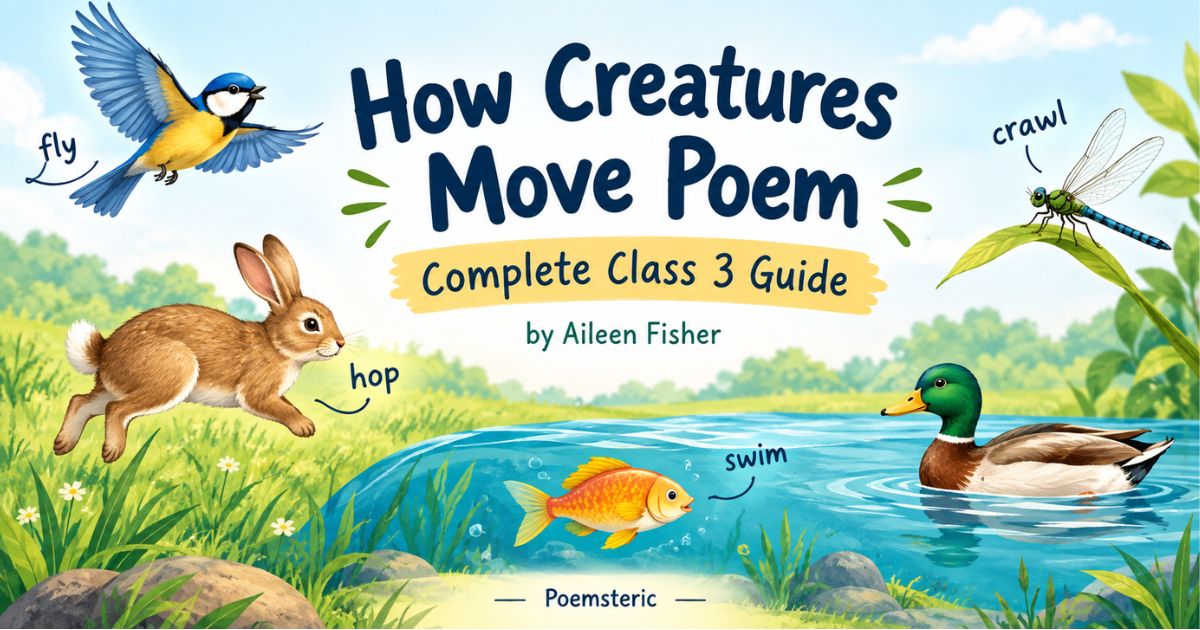
- Birds fly using their wings.
- Fish swim through water using their bodies and fins.
- Rabbits hop with their strong hind legs.
- Insects crawl or walk using their small legs.
- Humans walk and run using their legs.
These examples make the movement of creatures easy to recognize in everyday life.
The poem also uses movement as a source of fun. A child does not need complicated scientific terms to understand that creatures have different methods of travelling.
What the Poem Teaches
The poem develops observation skills as well as language skills. Students learn words connected with motion while thinking about familiar animals.
In my reading of children’s poetry, poems like this work best when students connect the words with something they have actually seen. For instance, watching a bird fly after reading about flying creatures makes the poem easier to remember.
The central lesson is simple: nature is full of variety, and every creature has its own way of moving.
Aileen Fisher’s Poem: Meaning and Explanation
Aileen Fisher wrote many poems for young readers, often using simple language, rhythm, and observations from everyday life. In this poem, she focuses on ways animals move rather than giving detailed descriptions of their appearance.
The poem invites children to think about movement as something interesting. A creature may walk, hop, swim, crawl, or fly. As a result, ordinary actions become enjoyable subjects for poetry.
The poem is especially suitable for Class 3 because its central idea is easy to visualize. A teacher can ask students to act out different movements while reading. One student might pretend to hop like a rabbit, while another moves their arms like a flying bird.
This approach turns the Class 3 English poem into an interactive learning activity.
A useful comparison is:
Bird → flying
Fish → swimming
Rabbit → hopping
Insect → crawling
The poem therefore combines language learning with basic observation of the natural world. It also helps children understand that creatures are adapted to different environments.
How Creatures Move Poem: Theme, Examples, and Learning Points
The main theme is variety in movement. Fisher shows that creatures do not all travel in the same way. Instead, their movements reflect their bodies and surroundings.
The poem can also introduce children to simple ideas about adaptation. A fish lives in water, so swimming is its natural form of movement. A bird has wings, so flying allows it to travel through the air.
How to Study the Poem Step by Step
Students can understand the poem using this simple method:
- Read the poem aloud. Listen for repeated sounds and movement words.
- Identify each creature. Make a list of the animals or creatures mentioned.
- Match each creature with its movement.
- Imagine the movement. Act it out if possible.
- Find the main idea. Notice how every creature moves differently.
- Explain the lesson. State how the poem makes learning about nature enjoyable.
This method is useful for answering questions about How Creatures Move summary, theme, and meaning.
The poem also develops vocabulary. Words connected with flying, hopping, swimming, walking, and crawling help children describe movement more precisely.
Most importantly, the poem teaches curiosity. A child who begins asking, “How do creatures move?” is already learning to observe the world like a young scientist.
FAQs
Q: Who wrote How Creatures Move?
A: How Creatures Move was written by Aileen Fisher, an American poet known for writing poetry for children. Her poems often use accessible language, rhythm, and subjects that young readers can easily understand. In How Creatures Move poem, she focuses on the different ways creatures travel. This makes the poem useful for introducing children to movement vocabulary while also encouraging them to observe animals in the world around them.
Q: What is How Creatures Move poems about?
A: The poem is about the different ways creatures move from place to place. It encourages children to notice that animals do not all travel in the same manner. Some creatures walk, while others fly, swim, hop, or crawl. The How Creatures Move poem explanation is therefore centered on variety in nature. Its simple presentation makes the idea easy for Class 3 students to understand and remember.
Q: What does the poem teach Class 3 students?
A: The poem teaches students that every creature has its own way of moving. It also develops observation, vocabulary, listening, and imagination. Children can connect each movement with a familiar animal and even act out the actions while learning. As a result, How Creatures Move Class 3 lessons can combine English learning with simple nature study. The poem shows that everyday observations can become interesting subjects for poetry.
Q: How do creatures move differently?
A: Creatures move differently because their bodies are suited to different environments and activities. Birds use wings to fly, fish move through water, rabbits can hop, and insects may crawl or walk. These differences make the natural world diverse. In How Creatures Move poems, movement becomes the main way of showing this variety. Students can understand the poem more easily by matching each creature with its characteristic movement.
Q: Why is How Creatures Move suitable for Class 3?
A: The poem is suitable for Class 3 because its subject is familiar and easy to visualize. Young students already see birds flying, animals walking, insects crawling, and other creatures moving around them. The poem gives these observations a rhythmic and memorable form. Therefore, it helps students learn English while developing curiosity about nature. It also provides useful vocabulary for describing different animal movements in simple language.
Final Thoughts
How Creatures Move poem makes a basic idea enjoyable: every creature has its own way of travelling. Aileen Fisher uses an accessible style that helps young readers connect poetry with real animals and everyday observation.
For Class 3 students, the best way to learn the poem is to read it aloud, identify the creatures, match their movements, and explain the central idea in their own words. That simple process turns the poem into both an English lesson and a lesson in observing nature.
Recent Article : The Poem Evokes a Sense of Black and White: Justify

Jennifer Aston is a passionate poetry curator and writer with a deep love for the written word. She believes poetry has the power to heal, inspire, and connect people across all walks of life. Through PoemSteric, she brings together timeless and modern verses for every emotion and every moment.