
Introduction
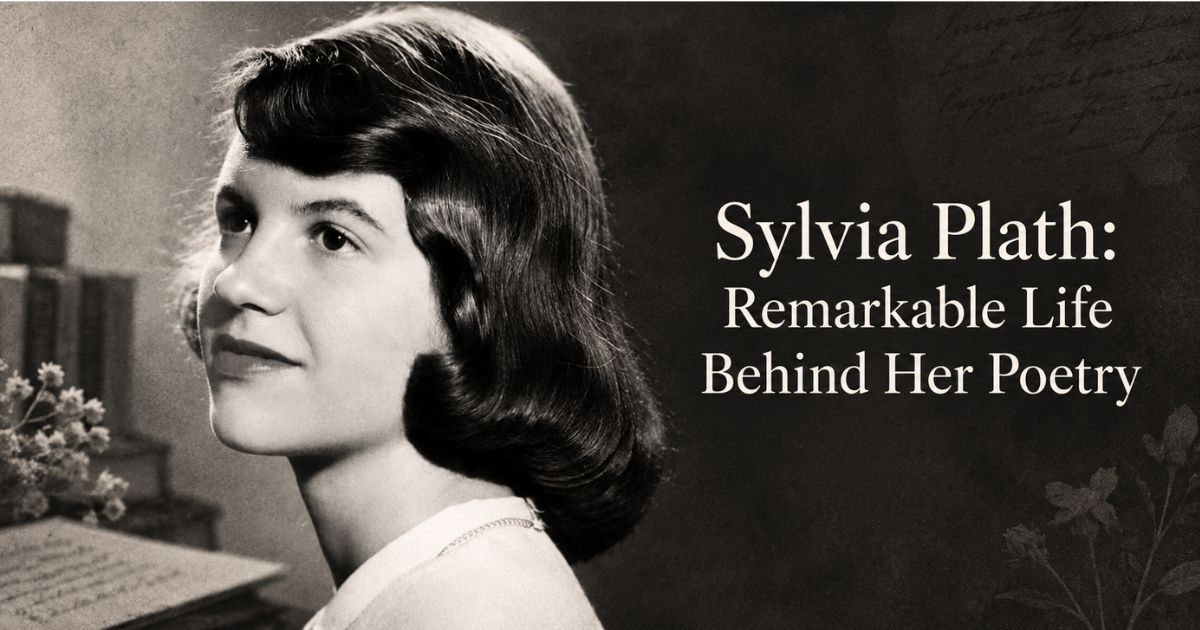
Sylvia Plath was an American poet and novelist whose precise imagery, intense voice, and exploration of identity, relationships, mortality, and inner conflict made her one of the most studied writers of the twentieth century. Born in 1932 and dying in 1963, she produced a comparatively small body of work that has had a lasting influence, especially through The Bell Jar and the poetry collection Ariel.
Key Takeaways
- Sylvia Plath was born in Boston in 1932.
- She became known for both poetry and fiction.
- The Bell Jar was her only published novel.
- Ariel became one of her most influential poetry collections.
- Her poetry is frequently associated with confessional poetry, although her work is more technically complex than that label alone suggests.
- Personal experience, identity, relationships, death, nature, and transformation recur throughout her writing.
- Her literary reputation expanded significantly after her death.
Who Was Sylvia Plath?
Sylvia Plath was born on October 27, 1932, in Boston, Massachusetts. She displayed an early interest in writing and eventually attended Smith College before moving to Cambridge in England on a Fulbright scholarship.
Her literary career developed through poetry, short fiction, journals, essays, and eventually her novel The Bell Jar. She also married poet Ted Hughes, and their relationship became an important part of the biographical context surrounding her later writing.
Plath died in London in 1963 at the age of 30. Her posthumously published poetry contributed greatly to her international reputation.
Sylvia Plath and Her Literary Development
Plath’s early writing already showed strong technical discipline. She worked carefully with rhythm, imagery, metaphor, sound, and poetic form.
Over time, however, her voice became increasingly direct and distinctive. The poems associated with her later period often use compressed images, dramatic speakers, startling contrasts, and carefully controlled sound.
The development was not simply a movement toward autobiography. Plath transformed personal material through artistic construction. The result is poetry that can feel intimate while remaining highly crafted.
The Bell Jar and Esther Greenwood
The Bell Jar was published in the United Kingdom in 1963 under the pseudonym Victoria Lucas. The novel follows Esther Greenwood and presents her experiences with academic pressure, social expectations, relationships, identity, and psychological crisis.
The novel draws on aspects of Plath’s own life, but it should not be treated as a straightforward autobiography. Esther is a fictional character, and Plath shaped real experiences into a literary narrative.
The novel initially received mixed attention, but its reputation grew substantially after Plath’s death. It was published in the United States in 1971 and has remained widely read.
Ariel and the Power of Plath’s Poetry
Ariel is the collection most strongly associated with Plath’s mature poetic reputation. The collection was published posthumously in 1965.
The poems contain striking images of darkness, transformation, nature, the body, identity, motherhood, fear, and renewal. Poems such as “Ariel,” “Lady Lazarus,” “Daddy,” “Tulips,” and “Morning Song” demonstrate the range of Plath’s later poetic style.
The title poem “Ariel” was first published in the 1965 collection and later appeared in The Collected Poems.
The Language of Ariel
Plath’s language can be simultaneously precise and unsettling. Ordinary objects become symbols, while natural scenes often develop psychological force.
Her imagery includes mirrors, flowers, blood, animals, landscapes, domestic objects, and changing light. These images rarely have only one fixed meaning. Their significance changes according to the poem’s speaker, situation, and emotional movement.
Why Ariel Still Matters
The importance of Ariel comes partly from its technical control. The poems are intensely emotional, yet they are also constructed through sound, rhythm, repetition, metaphor, and dramatic movement.
This combination helps explain why Plath’s poetry continues to receive close literary study rather than being read only as autobiography. The Poetry Foundation similarly emphasizes the technical and artistic qualities of her poems.
Major Themes in Sylvia Plath’s Poetry
Plath’s poetry includes several recurring themes:
- Identity and self-perception
- Love and marriage
- Motherhood
- Death and mortality
- Nature and transformation
- Isolation
- Gender expectations
- Memory
- Creativity
- Rebirth and renewal
- The body and its representation
These themes often overlap. A poem about a domestic object may become a meditation on identity. A natural image may develop into a reflection on fear or transformation.
Sylvia Plath and Confessional Poetry
Plath is frequently discussed alongside confessional poets such as Robert Lowell and Anne Sexton. The term refers broadly to poetry that brings private experience into literary expression.
However, describing Plath simply as a confessional poet can be limiting. Her poems are not raw diary entries. They use elaborate imagery, dramatic structures, symbolism, sound patterns, and carefully controlled language.
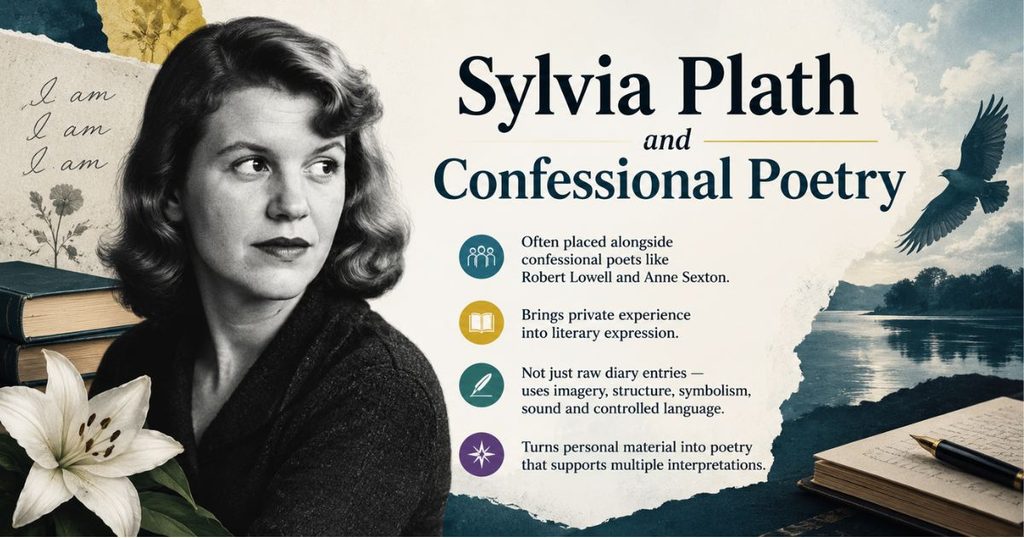
Her achievement lies partly in turning personal material into poetry that can support multiple interpretations.
Personal Experience and Artistic Transformation
Plath’s biography naturally attracts attention because of the connection between her life and writing. Yet readers should distinguish biography from literary interpretation.
For example, The Bell Jar contains autobiographical elements, but Esther Greenwood remains a fictional character. Similarly, poems may emerge from real emotions or events without functioning as literal records.
Reading Plath only through biography can therefore reduce the complexity of the poems. The literary construction deserves equal attention.
Sylvia Plath’s Literary Legacy
Plath’s reputation expanded significantly after her death. Her poetry collection Ariel became central to her posthumous literary reputation, while The Bell Jar reached a broad readership and remained continuously in print.
In 1982, Plath was awarded the Pulitzer Prize for Poetry posthumously for The Collected Poems. Her influence now extends across poetry, fiction, feminist literary studies, twentieth-century literature, and discussions of autobiographical writing.
Her lasting significance is not based only on the circumstances of her death. Her poems continue to attract readers because of their imagery, musicality, emotional force, and intellectual complexity.
FAQs
Q: What is Sylvia Plath best known for?
A: Sylvia Plath is best known for her poetry collection Ariel and her novel The Bell Jar. Her poetry is recognized for intense imagery, precise language, complex symbolism, and recurring themes of identity, relationships, mortality, nature, and transformation. Her literary reputation grew substantially after her death in 1963.
Q: What is The Bell Jar about?
A: The Bell Jar follows Esther Greenwood as she struggles with academic pressure, social expectations, relationships, identity, and psychological crisis. The novel contains autobiographical elements from Plath’s life, but Esther is a fictional character. The book was first published in the United Kingdom in 1963 under the pseudonym Victoria Lucas.
Q: Why is Ariel important in Sylvia Plath’s career?
A: Ariel represents the mature poetic style for which Plath became particularly famous. Its poems use vivid imagery, compressed language, strong rhythms, and dramatic emotional shifts. The collection was published posthumously in 1965 and became central to Plath’s literary reputation.
Q: Was Sylvia Plath a confessional poet?
A: Plath is commonly associated with confessional poetry because her work frequently draws on personal experience. However, the label does not fully describe her technique. Her poems transform experience through metaphor, symbolism, rhythm, sound, dramatic voice, and carefully structured imagery.
Q: When did Sylvia Plath die?
A: Sylvia Plath died in London in February 1963 at the age of 30. Her death strongly affected the later reception of her work, but her poetry should also be evaluated as literature in its own right. The technical quality and complexity of her poems remain important reasons for their continued study.
Final Thoughts
Sylvia Plath’s literary legacy rests on much more than the dramatic story of her short life. Her poetry demonstrates remarkable control of imagery, sound, metaphor, and emotional tension, while The Bell Jar shows her ability to transform personal experience into fiction.
Her work continues to invite different readings because it combines intimate experience with sophisticated literary technique. Readers can approach Sylvia Plath through biography, poetry, fiction, feminism, modern literature, or questions of identity, but her writing remains strongest when the artistry of the work receives as much attention as the life behind it.
Recent Article : Allen Ginsberg: Remarkable Life and Literary Legacy

Jennifer Aston is a passionate poetry curator and writer with a deep love for the written word. She believes poetry has the power to heal, inspire, and connect people across all walks of life. Through PoemSteric, she brings together timeless and modern verses for every emotion and every moment.