
Introduction
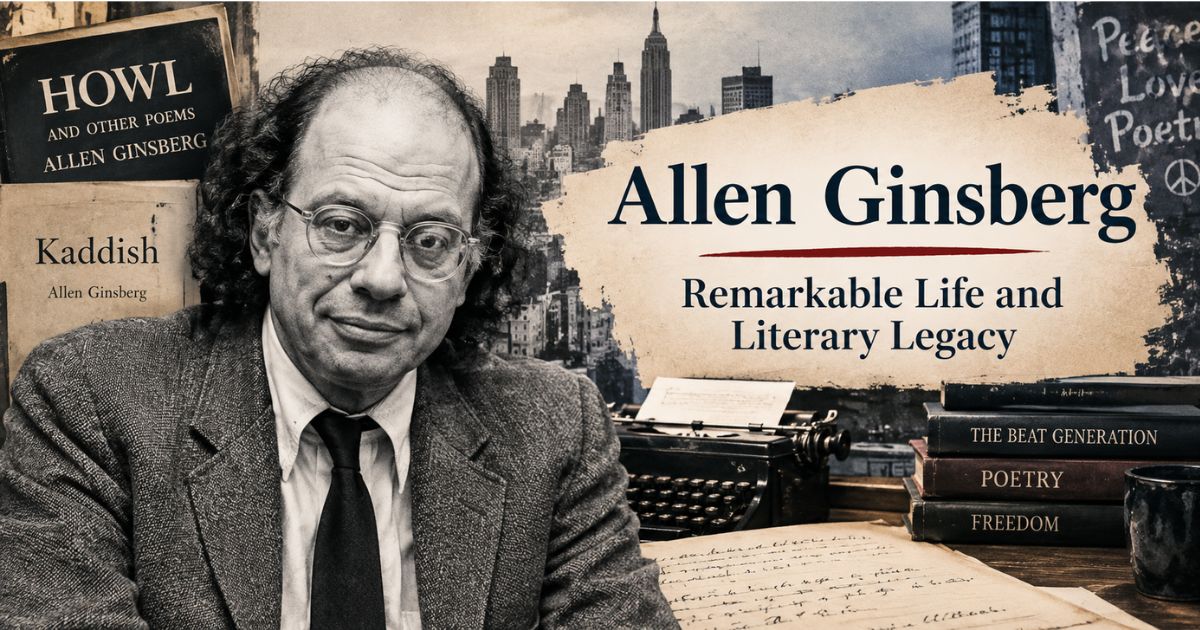
Allen Ginsberg was an American poet and a leading figure of the Beat Generation, best known for Howl, Kaddish, and his outspoken approach to poetry, politics, spirituality, sexuality, and social freedom. Born in 1926 and active until his death in 1997, Ginsberg helped transform the possibilities of American poetry through long lines, conversational language, public performance, and uncompromising subject matter.
Key Takeaways
- Allen Ginsberg was a major Beat Generation poet.
- Howl and Other Poems brought him national attention in 1956.
- His work challenged conventional ideas about acceptable poetic language and subject matter.
- Walt Whitman and William Carlos Williams strongly influenced his poetic development.
- Kaddish explores the life and death of his mother, Naomi Ginsberg.
- Ginsberg combined poetry with activism, spirituality, teaching, and public performance.
- His influence extended beyond literature into American counterculture.
Who Was Allen Ginsberg?
Allen Ginsberg was born in Newark, New Jersey, in 1926 and grew up in nearby Paterson. He came from a literary household. His father, Louis Ginsberg, was a teacher and published poet, while his mother, Naomi, had a significant influence on his childhood and later poetry.
Ginsberg studied at Columbia University, where he met writers who would become central figures in the Beat movement, including Jack Kerouac and William S. Burroughs. His friendships with these writers helped create a literary network that challenged conventional post war American culture.
Allen Ginsberg and the Beat Generation
The Beat Generation emerged in the postwar United States and became associated with writers who questioned social conformity, consumer culture, conventional morality, and established literary forms.
Ginsberg became one of its most recognizable voices. His poetry was direct, energetic, public, and often deliberately uncomfortable. Rather than hiding controversial subjects behind conventional poetic language, he brought them into the open.
His connection with Jack Kerouac, William S. Burroughs, Gregory Corso, and other writers helped establish the literary identity commonly associated with the Beats.
Howl and Ginsberg’s Literary Breakthrough
Howl and Other Poems was published by City Lights Books in 1956 and became Ginsberg’s defining early work. The poem’s long lines, intense repetitions, shifting images, and direct language created a distinctive poetic voice.
The poem’s publication also led to an important censorship case. In 1957, customs officials seized copies of Howl, and Lawrence Ferlinghetti, who published the book, faced prosecution over its distribution. Judge Clayton W. Horn eventually ruled that the poem was not obscene. The trial helped make Howl a landmark in debates about literary freedom.
The Style of Howl
Ginsberg’s long poetic lines often resemble the movement of spoken thought. Instead of relying on short, carefully contained lines, he allowed ideas and images to expand across the page.
The poem also draws attention to people living outside social conventions. Its language can be shocking, but that shock is connected to Ginsberg’s broader interest in honesty, freedom, and the realities of modern life.
Why Howl Remains Important
Howl matters not only because of its literary reputation but also because of its historical role. Its publication became connected with debates about censorship, free expression, and what could be printed and sold as poetry.
The poem also helped establish Ginsberg as a public literary figure rather than simply a writer working within academic circles.
Kaddish and Personal Poetry
If Howl gave Ginsberg a public voice, Kaddish revealed a more intimate dimension of his writing. The poem is based on the Jewish prayer for the dead and tells the story of his mother, Naomi. Her mental illness and repeated institutionalization deeply affected Ginsberg’s life and became important elements in his poetry.
Kaddish combines personal memory, family history, religious language, grief, and poetic experimentation. Its subject is intensely private, yet Ginsberg turns personal experience into a broader meditation on love, loss, identity, and mortality.
Allen Ginsberg’s Major Themes
Several recurring themes help explain the breadth of Ginsberg’s work:
- Freedom and social conformity
- Sexual identity and openness
- War and political protest
- Spiritual searching
- Mental illness and family
- Urban American life
- Death and grief
- Friendship and love
- Censorship and free expression
- Buddhist spirituality
These subjects are rarely separated neatly. A poem may move from a personal memory into a political statement and then toward a spiritual reflection.
Poetry, Activism, and Public Life
Ginsberg did not separate literature completely from public life. He participated in demonstrations and became associated with antiwar and free-speech causes. His activism included protests connected with military policy and political institutions.
He also traveled widely and became involved with different spiritual traditions. In 1972, he took Buddhist Refuge and Bodhisattva vows. His spiritual interests became an important part of his later life and artistic identity.
Ginsberg, Spirituality, and Teaching
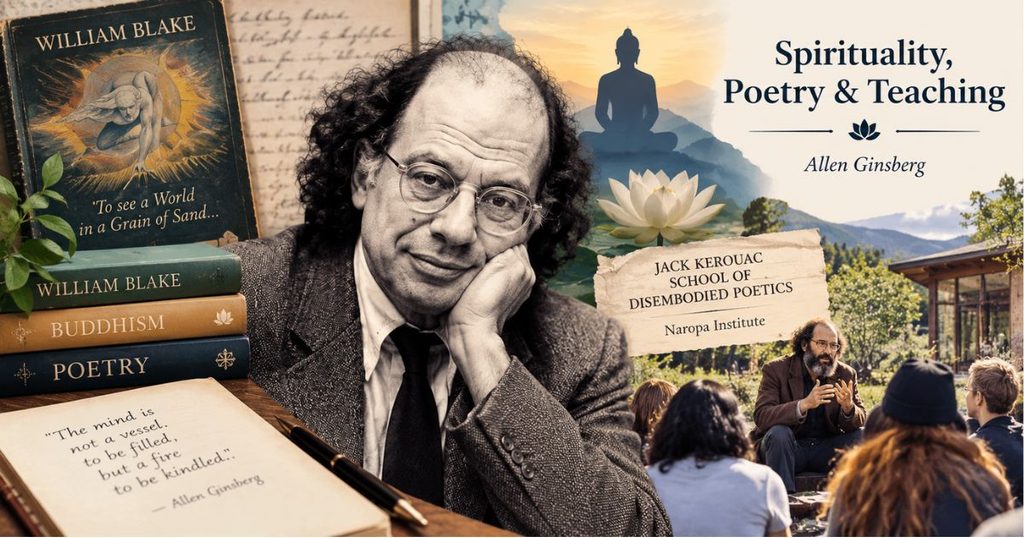
Spiritual exploration became increasingly important to Ginsberg. His interest in William Blake contributed to his fascination with visionary experience, while later Buddhist practice influenced his understanding of attention, perception, and poetry.
In 1974, Ginsberg and Anne Waldman helped establish the Jack Kerouac School of Disembodied Poetics at Naropa Institute. The school created a space where experimental poetry, performance, and alternative approaches to literary education could develop.
Allen Ginsberg’s Literary Legacy
Ginsberg’s legacy reaches beyond the Beat Generation. His poems demonstrated that literary poetry could be public, conversational, political, autobiographical, spiritual, and performative at the same time.
His work also influenced later poets and readers who saw poetry as a form of public speech. He challenged the idea that poetry needed to remain separate from social controversy.
His influence can be seen in spoken-word traditions, performance poetry, protest poetry, and writers who use autobiographical experience as literary material.
FAQs
Q: What is Allen Ginsberg best known for?
A: Allen Ginsberg is best known for Howl and Other Poems, his connection with the Beat Generation, and his influence on postwar American poetry. Howl became especially important because of its experimental style and the 1957 obscenity trial surrounding its publication. His later work, including Kaddish, expanded his reputation as a poet of personal memory, spirituality, politics, and social criticism.
Q: When was Allen Ginsberg born?
A: Allen Ginsberg was born in 1926 in Newark, New Jersey. He grew up in Paterson and later attended Columbia University, where he met writers including Jack Kerouac and William S. Burroughs. These relationships became important to the development of the literary culture associated with the Beat Generation.
Q: What is Howl about?
A: Howl addresses alienation, social conformity, suffering, sexuality, spirituality, and the experiences of people living outside mainstream American culture. Its long lines and highly charged language became central features of Ginsberg’s poetic style. The poem also became a landmark in debates about censorship after its publisher faced an obscenity prosecution.
Q: Why is Allen Ginsberg important to American poetry?
A: Ginsberg expanded the range of subjects and voices that could appear openly in American poetry. His work connected personal experience with social criticism and public performance. He also helped popularize a poetic style influenced by spoken language, long lines, repetition, and direct emotional expression.
Q: What other major poem did Ginsberg write?
A: Kaddish is one of his most important poems. It focuses on his mother, Naomi Ginsberg, and uses the structure and associations of the Jewish prayer for the dead. The poem combines family history, grief, mental illness, religious language, and personal memory.
Final Thoughts
Allen Ginsberg’s importance lies in the unusual range of his poetic life. He was a Beat poet, public performer, political activist, spiritual seeker, teacher, and writer of deeply personal poetry.
From Howl to Kaddish and his later work, Ginsberg treated poetry as a living form of expression rather than a restricted literary exercise. His willingness to place private experience and public controversy inside poetry helped reshape the cultural possibilities of American writing.
For readers discovering Allen Ginsberg today, his work offers a valuable way to study the relationship between poetry, identity, freedom, spirituality, and society.
Recent Article : Best Bengali Poem Captions: Beautiful Authentic Ideas

Jennifer Aston is a passionate poetry curator and writer with a deep love for the written word. She believes poetry has the power to heal, inspire, and connect people across all walks of life. Through PoemSteric, she brings together timeless and modern verses for every emotion and every moment.