
Introduction
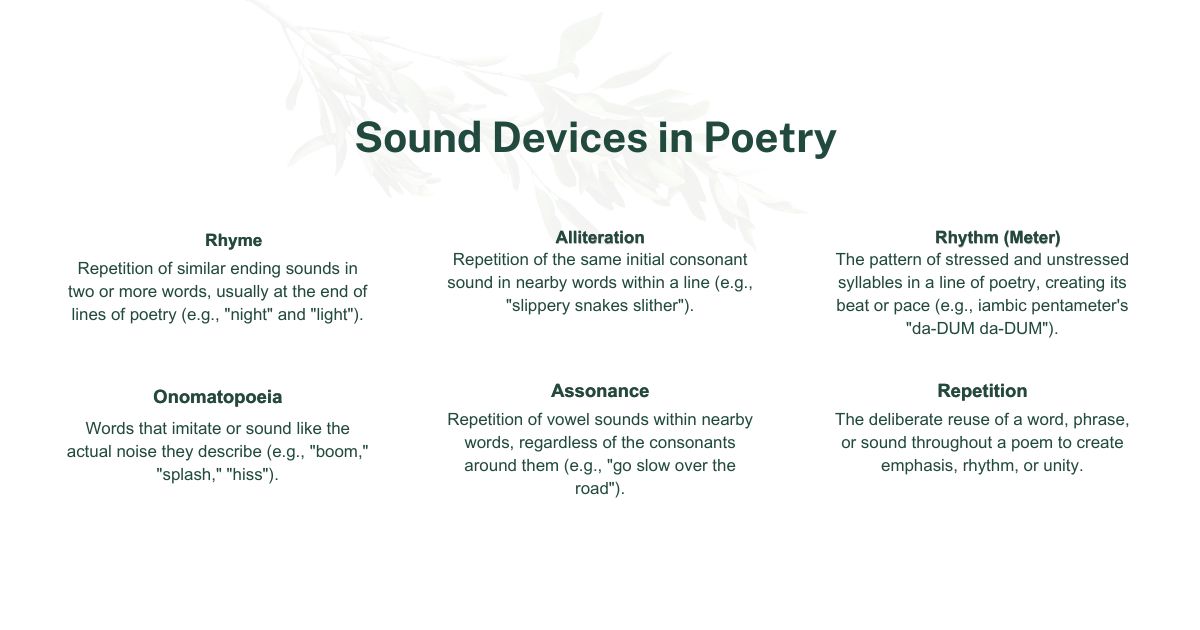
Sound devices in poetry are the techniques poets use to shape how a poem sounds when read aloud, not just what it means on the page. The ten core techniques alliteration, assonance, consonance, onomatopoeia, rhyme, rhythm and meter, repetition, anaphora, sibilance, and euphony/cacophony work by controlling repeated sounds, stresses, and rhythms to reinforce a poem’s mood, pace, and meaning. Below, each technique is explained with a clear definition, a real example from a well-known public-domain poem, and a quick note on why it works.
Key takeaways
Sound devices in poetry work on the ear first and the mind second; they shape a reader's emotional response before the reader has consciously parsed the meaning of a line.

The ten techniques covered here fall into three broad groups: repeated sounds (alliteration, assonance, consonance, sibilance), repeated words or phrases (repetition, anaphora), and structural sound patterns (rhyme, rhythm and meter, onomatopoeia, euphony/cacophony).

Public-domain classics such as Edgar Allan Poe's "The Raven," William Blake's "The Tyger," and Samuel Taylor Coleridge's "Kubla Khan" remain some of the clearest teaching examples because their sound patterns are dense and easy to isolate.

Reading a poem aloud, slowly, is still the single best way to detect sound devices; silent reading hides most of them.

Sound devices are not decorative extras; strong poets choose them deliberately to control pacing, tension, and tone.
What are sound devices in poetry, exactly?
Sound devices in poetry are any technique that uses the physical sound of language, not just its dictionary meaning to create an effect. A poet chooses a word partly for what it says and partly for how it sounds next to the words around it: sharp or soft, fast or slow, harsh or musical.
This matters because poetry, historically, was an oral art form before it was a written one. Ancient epic poems, from Homer’s “Iliad” to Anglo-Saxon works like “Beowulf,” relied on rhythm, alliteration, and repetition so that performers could memorize and recite thousands of lines without a written text to check against. In my own reading of both old and contemporary poetry, the poems that hold up best out loud are almost always the ones where sound devices are doing real structural work, not just adding polish.
Today, sound devices in poetry still serve three main jobs:
- Mood control – soft, flowing sounds (called euphony) create calm; harsh, clashing sounds (cacophony) create tension.
- Emphasis – repeating a sound or word draws the reader’s attention to a specific idea.
- Memorability – rhyme and rhythm make lines easier to recall, which is why so many proverbs, nursery rhymes, and advertising slogans borrow poetic sound techniques.
Alliteration: repeating consonants at the start of words
Alliteration is the repetition of the same consonant sound at the beginning of two or more nearby words. It is one of the oldest and most recognizable sound devices in poetry, dating back to Old English verse, where alliteration not rhyme was the main structural device holding a line together.
A clear modern example appears in Robert Frost’s line about the woods, where the repeated “d” and “s” sounds slow the reader down to match the poem’s snowy, sleepy mood. Alliteration also survives in everyday phrases outside poetry “busy as a bee,” “cool, calm, and collected” which shows how naturally the human ear responds to repeated opening sounds.
How to spot alliteration in a line
- Read the line slowly and mark the first consonant sound of each stressed word.
- Look for two or more of those sounds matching within the same line or nearby lines.
- Say the line aloud alliteration should physically feel like your mouth is repeating a motion.
Alliteration works because it creates a light, rhythmic pulse without needing a formal rhyme scheme, which is why it shows up as much in free verse as it does in traditional forms.
Assonance: repeating vowel sounds
Assonance is the repetition of vowel sounds within nearby words, regardless of the consonants around them. Where alliteration repeats the start of a word, assonance repeats the internal “music” of a word.
Edgar Allan Poe’s “The Raven” is one of the most quoted examples in English poetry classrooms specifically because of its dense long “o” and long “e” assonance, which stretches certain syllables out and gives the poem its slow, mournful, almost chanted quality. Assonance is subtler than rhyme, which is exactly its advantage: it creates cohesion between words without the sing-song effect a full rhyme can sometimes produce.
For example, in the phrase “the light of the fire,” the repeated long “i” sound links “light” and “fire” even though the words don’t rhyme and don’t share starting consonants. As a result, a poet can use assonance to smooth a line’s flow without locking themselves into a strict rhyme scheme.
Consonance: repeating consonant sounds anywhere in a word
Consonance is the repetition of a consonant sound anywhere in a word beginning, middle, or end not just at the start, which is what separates it from alliteration. A commonly cited teaching example is the phrase “pitter-patter,” where the repeated “t” sound appears in the middle of both words rather than at the front.
Consonance is especially useful for connecting words that don’t share vowel sounds or opening letters, giving a poet more flexibility than rhyme or alliteration alone. In practice, many lines combine consonance with assonance at the same time, layering two sound devices in poetry into a single phrase.
Consonance versus alliteration: a quick comparison
| Feature | Alliteration | Consonance |
| Sound repeated | Consonant | Consonant |
| Position in word | Start only | Anywhere (start, middle, end) |
| Example | “wild and windy” | “pitter-patter,” “linger longer” |
However, the line between the two is not always sharp; many alliterative phrases are technically a specific type of consonance, since alliteration is really consonance limited to word-initial sounds.
Onomatopoeia: words that sound like what they mean
Onomatopoeia is a word that imitates the actual sound it describes: “buzz,” “hiss,” “crash,” “murmur,” “clang.” It is arguably the most intuitive of all sound devices in poetry because the connection between sound and meaning is direct rather than patterned.
Alfred, Lord Tennyson used onomatopoeia heavily in “The Princess,” where the repeated soft, murmuring sounds of doves and bees are meant to physically recreate the drowsy hum of a summer garden. Onomatopoeia also appears constantly outside poetry; comic books (“pow,” “boom”), advertising, and children’s books all rely on it because readers process these words almost as sound effects rather than abstract vocabulary.
A simple way to test whether a word qualifies as true onomatopoeia: say it out loud and ask whether someone who didn’t speak the language could still guess roughly what it describes. Words like “crash” or “hiss” usually pass that test; a word like “loud” does not, even though it describes sound.
Rhyme: end rhyme and internal rhyme
Rhyme is the matching of final sounds between words, and it remains the sound device most people associate with poetry by default. There are two main categories worth knowing:
- End rhyme occurs at the end of lines, following a pattern (a rhyme scheme) such as ABAB or AABB. This is the structure behind most nursery rhymes, sonnets, and song lyrics.
- Internal rhyme occurs within a single line, rather than at line breaks. Poe’s “The Raven” again offers a clear teaching example, since its opening stanza rhymes words in the middle of lines as well as at the end, creating a much denser sound pattern than end rhyme alone.
Rhyme also comes in different strengths. A “perfect rhyme” matches sounds exactly (“cat/hat”), while a “slant rhyme” or “near rhyme” matches only part of the sound (“heart/hurt”). Modern and contemporary poets frequently favor slant rhyme because it keeps some of the rhyme’s musical cohesion without the sometimes-predictable feel of perfect end rhyme.
Step-by-step: identifying a rhyme scheme
- Label each line of a stanza with a letter, starting with A for the first line.
- Read the end word of each subsequent line; if it rhymes with a previous line, give it the same letter.
- Assign the next unused letter to any line that introduces a new rhyme sound.
- Read the resulting letter pattern (for example, ABAB or AABB) to identify the rhyme scheme.
Rhythm and meter: the poem’s heartbeat
Rhythm is the overall pattern of stressed and unstressed syllables in a line, and meter is the formal, named version of that pattern most famously iambic pentameter, the ten-syllable, five-stress line William Shakespeare used throughout his sonnets and plays.
Meter matters because it sets an expectation, and poets often break that expectation on purpose for effect. For example, when Shakespeare’s regular iambic rhythm suddenly shifts in a single line, that shift usually signals emotional disruption in the scene, a technique still used by contemporary poets working in free verse, who may set up a rhythmic pattern only to deliberately interrupt it at a key moment.
Common meters include:
- Iambic – unstressed, then stressed (da-DUM), as in most Shakespearean sonnets.
- Trochaic – stressed, then unstressed (DUM-da), which gives lines a faster, more insistent feel.
- Anapestic – two unstressed syllables followed by a stressed one, common in comic and rollicking verse like Dr. Seuss.
- Dactylic – a stressed syllable followed by two unstressed ones, associated with classical epic poetry.
Readers often tell us that meter is the hardest sound device to hear at first, but tapping the stressed syllables out loud with a finger, the way you would count a musical beat, makes the pattern much easier to feel.
Repetition: saying it again on purpose
Repetition is the deliberate reuse of a word, phrase, or line for emphasis. Unlike rhyme or alliteration, which repeat sound, repetition repeats meaning directly, making it one of the most emotionally forceful sound devices in poetry.
Dylan Thomas’s “Do not go gentle into that good night” builds nearly its entire structure around a repeated refrain line, returning to the same phrase throughout the poem to intensify its urgency with each repetition. Repetition works because human memory and emotion both respond strongly to recurrence. A single statement can be read as neutral, but the same statement returned to three or four times starts to feel insistent, almost pleading.
Anaphora: repeating the opening words of a line
Anaphora is a specific, narrower form of repetition: repeating the same word or phrase at the start of successive lines or clauses. It is common in both poetry and rhetoric Martin Luther King Jr.’s “I Have a Dream” speech is one of the most famous examples of anaphora in American public speaking, built almost entirely around the repeated opening phrase that gives the speech its name.
In poetry, Walt Whitman used anaphora extensively in “Leaves of Grass,” frequently opening consecutive lines with the same word to build a cumulative, chant-like momentum across long stretches of free verse. Anaphora is especially useful in poems without a formal rhyme scheme, since it provides a structural anchor that rhyme would otherwise supply.
Sibilance: the hiss and whisper of “s” sounds
Sibilance is a specific type of consonance built around hissing sounds primarily “s,” but also “sh,” “z,” and soft “c.” Poets reach for sibilance when they want a line to feel quiet, secretive, slippery, or unsettling, since the physical sound of repeated “s” mimics a hush or a hiss.
Coleridge’s “Kubla Khan” uses heavy sibilance in its description of a sacred, mysterious river, where the repeated soft consonants create a sound that mirrors the physical motion of flowing water. Because sibilance is so sonically distinctive, it is also one of the easier sound devices in poetry for beginners to train their ear to catch. Once you notice it in one poem, you tend to hear it everywhere afterward.
Euphony and cacophony: pleasant versus harsh sound
Euphony refers to language that sounds smooth, pleasant, and musical, typically built from soft consonants (l, m, n, w, y) and long vowels. Cacophony is its opposite: language that sounds harsh, jarring, or difficult to say, typically built from hard consonants (k, g, t, p, b) clustered close together.
John Keats is frequently cited as a master of euphony, particularly in “Ode to a Nightingale,” where the soft, flowing consonant choices reinforce the poem’s dreamy, drifting tone. By contrast, poets describing war, machinery, or violence often lean into cacophony on purpose – Wilfred Owen’s World War I poetry uses harsh consonant clusters to make battlefield scenes sound as physically uncomfortable to read as they were to experience.
As a result, euphony and cacophony function as a kind of emotional dial that a poet can turn up or down within the same poem, softening a line for tenderness or roughening it for conflict.
Do sound devices actually change how a poem feels?
Yes, and this is worth addressing directly, since it’s one of the most common questions readers have about sound devices in poetry. Studies in cognitive linguistics have shown that readers respond to the physical sound of language on a near-instinctive level, sometimes forming an emotional impression of a passage before fully processing its literal meaning. This is sometimes called sound symbolism: readers consistently rate words with harsh, plosive sounds (like “clang” or “crack”) as feeling more aggressive than soft, sonorant words (like “lull” or “murmur”), even when the meanings are unfamiliar or invented.
This is why professional poets revise for sound as carefully as they revise for meaning. A word can be technically correct and still wrong for a line if its sound clashes with the mood the poet is building. However, this doesn’t mean every sound device needs to be consciously noticed by the reader to work in fact, the most skillful use of sound devices in poetry usually operates below conscious awareness, shaping how a reader feels without the reader stopping to ask why.
How to identify sound devices in poetry: a step-by-step method
For students and new readers, spotting sound devices can feel overwhelming at first. This simple method breaks the process into manageable steps:
- Read the poem silently once, just to understand the basic meaning and subject.
- Read it aloud slowly, exaggerating the sounds slightly this is where alliteration, assonance, and sibilance become obvious.
- Mark repeated consonant sounds at the start of words (alliteration) and anywhere else in words (consonance).
- Mark repeated vowel sounds within nearby words (assonance).
- Tap out the stress pattern with your finger or pencil to identify the meter.
- Circle any repeated words or phrases, especially at the start of lines (anaphora) or scattered throughout (repetition).
- Note the overall sound impression: does the poem feel smooth (euphony) or harsh (cacophony)? Which specific word choices create that impression?
Following these steps in order, rather than trying to catch every device on a single read-through, makes the process far less overwhelming, especially for students preparing for an exam or a close-reading assignment.
FAQs
Q: What are the most common sound devices in poetry?
A: The most common sound devices in poetry are alliteration, assonance, consonance, onomatopoeia, rhyme, rhythm and meter, repetition, anaphora, sibilance, and the euphony-cacophony contrast. These ten techniques cover most of the sound-based tools poets use, from ancient oral epics to contemporary free verse, and they frequently appear in combination within a single line.
Q: What is the difference between alliteration and consonance?
A: Alliteration repeats a consonant sound specifically at the start of nearby words, while consonance repeats a consonant sound anywhere in a word beginning, middle, or end. Alliteration is technically a narrower category within the broader idea of consonance, which is why the two are so often confused by students first learning sound devices in poetry.
Q: Why do poets use sound devices instead of just choosing words for meaning?
A: Poets use sound devices in poetry because sound shapes emotional response independently of literal meaning. A harsh-sounding word can make a scene feel more violent even before the reader consciously registers what happened, while soft, flowing sounds can calm a passage down, giving poets a second, physical layer of control over how a poem lands.
Q: What’s an easy way to find rhyme schemes in a poem?
A: Label the first line A, then check whether each following line’s ending sound matches a previous line; give matching lines the same letter and unmatched lines the next new letter. Reading the resulting pattern such as ABAB or AABB reveals the rhyme scheme, one of the more approachable sound devices in poetry for beginners to identify.
Q: Is onomatopoeia the same as sound symbolism?
A: They’re related but not identical. Onomatopoeia is a specific word that directly imitates a real-world sound, such as “buzz” or “crash.” Sound symbolism is the broader phenomenon behind several sound devices in poetry, where certain sounds are consistently perceived as harsh or soft, aggressive or gentle, regardless of whether the word is imitating an actual noise.
Q: Do modern poets still use traditional sound devices, or is that only in older poetry?
A: Modern and contemporary poets use sound devices in poetry just as deliberately as classical poets did, even in free verse without rhyme or fixed meter. Techniques like assonance, sibilance, repetition, and anaphora are especially common in contemporary poetry because they shape sound and emphasis without requiring a formal rhyme scheme.
Final thoughts
Sound devices in poetry are not decoration layered on top of meaning; they are one of the primary tools a poet has for controlling how a reader feels, moment to moment, as they move through a poem. Once you train your ear to notice alliteration, assonance, consonance, onomatopoeia, rhyme, rhythm, repetition, anaphora, sibilance, and the balance between euphony and cacophony, you start to hear poetry the way its writers actually built it: sound first, meaning close behind. The fastest way to strengthen that skill is to read poems aloud, slowly, and pay attention to what your own mouth and ear are doing.
Recent Article : Prose and Poetry: The Real Difference (And Where They Blur)

Jennifer Aston is a passionate poetry curator and writer with a deep love for the written word. She believes poetry has the power to heal, inspire, and connect people across all walks of life. Through PoemSteric, she brings together timeless and modern verses for every emotion and every moment.