
Introduction
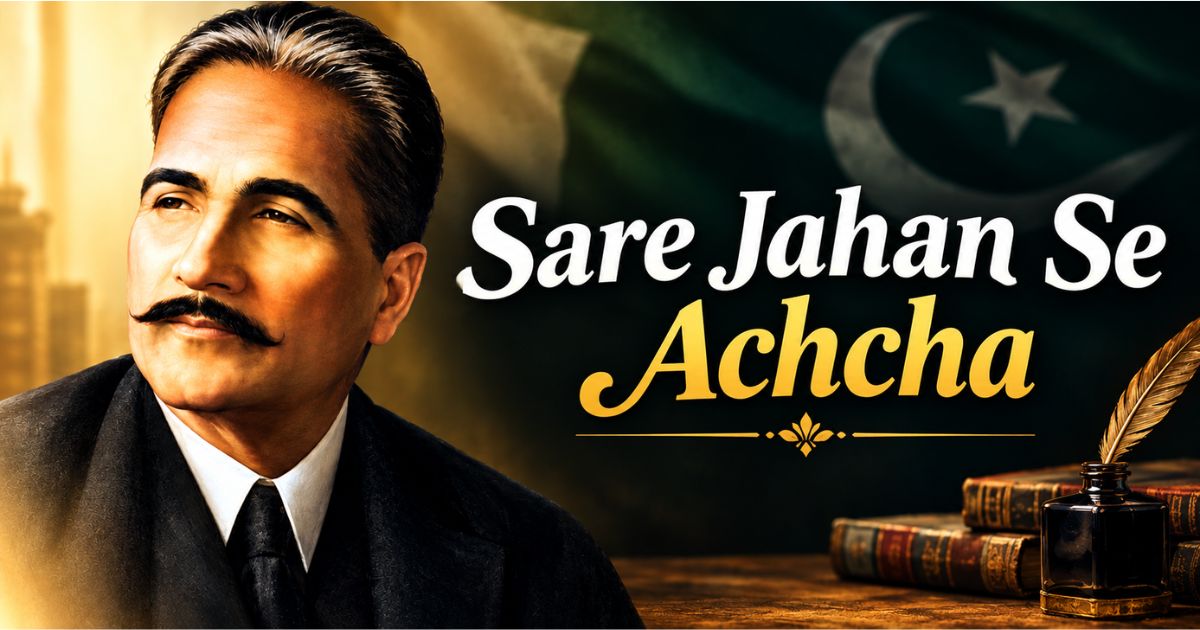
Muhammad Iqbal wrote “Sare Jahan Se Achcha,” the famous patriotic poem also known as “Tarana-e-Hindi.” Iqbal wrote it in 1904, and it became one of the best-known patriotic compositions associated with the Indian subcontinent.
The poem is often confused with India’s national anthem, “Jana Gana Mana,” which was written and composed by Rabindranath Tagore. The two works belong to different poets and have different historical statuses.
Key Takeaways
- Muhammad Iqbal wrote “Sare Jahan Se Achcha.”
- Its formal title is “Tarana-e-Hindi.”
- The poem was written in 1904 as a patriotic song for children.
- Its famous opening expresses affection for Hindustan and its shared cultural landscape.
- The poem includes the well-known idea that religion should not teach people to maintain hostility toward one another.
- “Sare Jahan Se Achcha” is not India’s national anthem.
- India’s national anthem is “Jana Gana Mana,” written and composed by Rabindranath Tagore. It was adopted by the Constituent Assembly on 24 January 1950.
- Iqbal later wrote “Tarana-e-Milli,” a different poem with a broader Muslim communal identity.
- The contrast between the two poems is useful for understanding changes in Iqbal’s political and intellectual thought.
- “Sare Jahan Se Achcha” remains an important part of South Asian literary and cultural memory.
Who Wrote Sare Jahan Se Achcha?
The answer is Muhammad Iqbal, widely known as Allama Iqbal. The poem is catalogued by Rekhta under its title “Tarana-e-Hindi” and attributed directly to Iqbal. Rekhta notes that the poem was written in 1904 as a patriotic song for children.
Iqbal was one of the major Urdu and Persian poets of the modern period. His literary career eventually developed into a much broader body of philosophical, religious, political, and cultural writing.
“Sare Jahan Se Achcha” belongs to an earlier stage of his intellectual development. Its language emphasizes attachment to Hindostan and presents the country as a shared homeland.
Muhammad Iqbal and Tarana-e-Hindi
The complete title “Tarana-e-Hindi” can be understood as “Song of India.” The poem begins with the famous line “Sare jahan se achchha Hindostan hamara,” expressing pride in the homeland.
The poem also draws upon images of India’s landscape, including mountains, rivers, the Ganges, and the garden-like beauty of the country. Its message includes an explicit rejection of religious hostility, making it especially significant when studied in its original historical context.
Importantly, the poem should be read as a work from 1904, not interpreted only through Iqbal’s later political thought. His ideas changed considerably over the following decades, so placing the poem in its chronological context helps avoid oversimplification.
When and Where Was It First Published?
Rekhta dates the poem to 1904. Its literary record places “Tarana-e-Hindi” among Iqbal’s early poems, and the poem was subsequently included in his collection Bang-e-Dra.
Some popular accounts give simplified publication stories, so it is useful to distinguish composition from later collection publication. The reliable literary record clearly identifies 1904 as the year in which the poem was written.
This distinction matters because a poem can be written, performed, printed in a periodical, and later collected in a book at different times.
Why Sare Jahan Se Achcha Is Often Misattributed
The poem is sometimes incorrectly associated with Rabindranath Tagore, largely because both poets wrote celebrated works connected with Indian identity and patriotic expression.
However, the authorship is clear: Iqbal wrote “Tarana-e-Hindi,” while Tagore wrote “Jana Gana Mana.” Rekhta’s literary record attributes “Tarana-e-Hindi” to Iqbal, while Indian government sources identify Tagore as the composer of the national anthem.
The confusion becomes stronger because both poems are frequently discussed in school lessons, patriotic events, literary articles, and online quotations.
A simple way to remember the distinction is:
Sare Jahan Se Achcha → Muhammad Iqbal
Jana Gana Mana → Rabindranath Tagore
The poets also belonged to different literary traditions and expressed ideas in different historical circumstances. Therefore, treating the two poems as interchangeable creates both an authorship error and a historical misunderstanding.
Sare Jahan Se Achcha vs. India’s National Anthem
“Sare Jahan Se Achcha” and “Jana Gana Mana” are two different compositions.
| Detail | Sare Jahan Se Achcha | Jana Gana Mana |
| Writer | Muhammad Iqbal | Rabindranath Tagore |
| Original title | Tarana-e-Hindi | Jana Gana Mana |
| Language/tradition | Urdu | Bengali/Sanskritized Bengali |
| Date associated with composition | 1904 | 1911 |
| Status | Famous patriotic song | National Anthem of India |
India’s National Portal and government publications identify “Jana Gana Mana” as the national anthem, composed by Rabindranath Tagore. The Constituent Assembly adopted it on 24 January 1950.
“Sare Jahan Se Achcha” has a different status. It is a celebrated patriotic song and has a major place in India’s cultural history, but it is not the national anthem.
The distinction is especially important for students because questions about authorship, national symbols, and literary history often appear together.
Iqbal’s Later Tarana-e-Milli and Changing Ideas
One reason “Sare Jahan Se Achcha” deserves historical context is that Iqbal’s later poetry did not always express the same conception of community found in his 1904 poem.
His later “Tarana-e-Milli” begins with a very different formulation, presenting a worldwide Muslim community rather than the territorial nationalism emphasized in “Tarana-e-Hindi.” Rekhta dates Tarana-e-Milli to the later period represented in Bang-e-Dra and gives its opening as “Chin-o-Arab hamara, Hindostan hamara.”
This does not mean that the earlier poem should be dismissed or rewritten according to Iqbal’s later ideas. Instead, the two poems can be studied together to understand the development of his political and philosophical thinking.
Chronology is therefore essential. Iqbal in 1904 was not necessarily expressing precisely the same intellectual position that appears in his later poetry.
Historical Legacy of the Patriotic Song
“Sare Jahan Se Achcha” became deeply embedded in South Asian cultural memory. Its simple patriotic imagery, memorable rhythm, and emphasis on Hindostan helped it travel beyond the literary circles in which Urdu poetry was originally read.
The poem’s historical importance also comes from its place in Iqbal’s early career. It demonstrates that his poetry included a strong territorial and cultural attachment to India before his later writing developed other concepts of community and identity.
The poem continues to be recognized in Indian public and cultural life. A Delhi Judicial Academy publication, for example, records “Sare Jahan Se Achcha” among national songs sung at the Constituent Assembly’s historic 14–15 August 1947 proceedings.
Its legacy is therefore literary as well as cultural. For students and readers, the best way to understand it is to identify its author correctly, place it in 1904, distinguish it from the national anthem, and read it alongside Iqbal’s later work.
FAQs
Q: Who wrote Sare Jahan Se Achcha?
A: Muhammad Iqbal, also known as Allama Iqbal, wrote “Sare Jahan Se Achcha.” The poem’s formal title is “Tarana-e-Hindi,” and Rekhta dates it to 1904. It became one of the best-known patriotic poems associated with the Indian subcontinent.
Q: Did Rabindranath Tagore write Sare Jahan Se Achcha?
A: No. Rabindranath Tagore did not write “Sare Jahan Se Achcha.” Muhammad Iqbal wrote that poem. Tagore wrote and composed “Jana Gana Mana,” which was adopted as India’s national anthem by the Constituent Assembly on 24 January 1950.
Q: What is the original name of Sare Jahan Se Achcha?
A: The poem is known as “Tarana-e-Hindi,” meaning roughly “Song of India.” It is commonly identified by its opening words, “Sare Jahan Se Achcha.” Rekhta catalogs it under “Tarana-e-Hindi” and attributes it to Allama Iqbal.
Q: When was Sare Jahan Se Achcha written?
A: Muhammad Iqbal wrote “Tarana-e-Hindi” in 1904. Rekhta specifically describes it as a patriotic song written for children in that year. It later became part of Iqbal’s collected poetic legacy.
Q: Is Sare Jahan Se Achcha India’s national anthem?
A: No. “Sare Jahan Se Achcha” is a famous patriotic song, but India’s national anthem is “Jana Gana Mana” by Rabindranath Tagore. The Constituent Assembly adopted “Jana Gana Mana” as the national anthem on 24 January 1950.
Q: What is Tarana-e-Milli by Iqbal?
A: “Tarana-e-Milli” is a later poem by Iqbal that differs significantly from “Tarana-e-Hindi” in its conception of community. While “Tarana-e-Hindi” emphasizes Hindostan as a homeland, “Tarana-e-Milli” presents a broader Muslim collective identity. Studying both poems chronologically helps readers understand changes in Iqbal’s intellectual outlook.
Final Thoughts
The answer to who wrote the poem Sare Jahan Se Achcha is straightforward: Muhammad Iqbal wrote it in 1904, under the title “Tarana-e-Hindi.”
The most important correction is not to confuse Iqbal’s poem with Rabindranath Tagore’s “Jana Gana Mana.” Tagore’s composition, adopted in 1950, is India’s national anthem; “Sare Jahan Se Achcha” is a separate and historically important patriotic song.
Reading Iqbal’s 1904 poem alongside his later “Tarana-e-Milli” also reveals why literary history requires chronology and context. The poem remains significant not simply because it is familiar, but because it records an important stage in the development of one of the subcontinent’s most influential poets.
Recent Article : John Elia Biography: The Untold Story of Jaun Elia

Jennifer Aston is a passionate poetry curator and writer with a deep love for the written word. She believes poetry has the power to heal, inspire, and connect people across all walks of life. Through PoemSteric, she brings together timeless and modern verses for every emotion and every moment.