
Introduction
In Octavio Paz’s poem “Brotherhood,” the stars write the destiny or place of human beings within the vast universe. When the speaker looks at the night sky, he realizes that his own life is also part of this cosmic writing.
The poem is very short, but its ideas are large. Paz connects human mortality, the enormous night, the stars, and the ancient astronomer Claudius Ptolemy to explore humanity’s place in the universe.
The poem is originally titled “Hermandad” in Spanish, and the English version was translated by Eliot Weinberger. The Poetry Society of America presents the poem with the dedication “Homage to Claudius Ptolemy,” which is important for understanding its central idea.
Key Takeaways
- The stars symbolically write human destiny or the place of each person in the universe.
- The poem was written by Octavio Paz, the Mexican Nobel Prize-winning poet.
- The stars are presented as if they can write, making them a personification of cosmic order.
- “I too am written” means the speaker recognizes that he is part of a larger cosmic pattern.
- The poem contrasts the shortness of human life with the enormous scale of the universe.
- Claudius Ptolemy is important because the poem is dedicated to him.
- “Unknowing I understand” suggests an intuitive realization rather than a scientific explanation.
- The poem’s central concern is humanity’s relationship with the vast universe.
What Do the Stars Write in ‘Brotherhood’?
The stars write the destiny or place of human beings within the universe. In the poem, the speaker looks upward and perceives the stars as if they are writing a cosmic message.
This does not mean that Paz is literally describing stars writing words in the sky. Instead, “write” is a metaphor for the larger order, pattern, or meaning that the speaker senses in the universe.
The Direct Answer
The direct exam answer is:
The stars write the destiny or place of every human being in the universe.
The poem moves from the speaker’s awareness of his short life to his recognition that he is also part of the cosmic “writing.” Educational explanations of the poem commonly interpret the stars as writing human destiny or each person’s place in the world.
This interpretation is also supported by the poem’s own movement: the speaker first looks at the stars and sees them “writing,” then realizes that he too is written. The two ideas are directly connected.
What the Stars Symbolize
The stars symbolize more than objects shining in the night. They represent a larger cosmic order that the human mind cannot completely understand.
Paz gives the stars the human ability to write. This is an example of personification. By doing so, he turns the night sky into something resembling a vast text.
The speaker cannot literally read this cosmic text. Instead, he experiences an intuitive realization that his own existence belongs to something much larger than himself.
That is why the phrase “Unknowing I understand” is so important. He does not claim scientific knowledge of the universe. His understanding is intuitive and existential.
Why Claudius Ptolemy Matters to the Poem
The poem begins with a dedication to Claudius Ptolemy, the ancient astronomer associated with a major mathematical model of the cosmos. The Poetry Society of America explicitly presents “Brotherhood” with the dedication “Homage to Claudius Ptolemy.”
Ptolemy matters because the poem is concerned with the relationship between human beings and the larger cosmic structure.
The dedication therefore prepares the reader to think about astronomy, order, and humanity’s position within the universe. A scholarly discussion of Paz’s poem similarly connects the Ptolemy dedication with the poet’s interest in correspondences and patterns within the universe.
Ptolemy is not presented as the person literally writing the speaker’s destiny. Instead, his name establishes a connection between the poem and humanity’s attempt to understand the heavens.
‘I Too Am Written’: The Central Metaphor
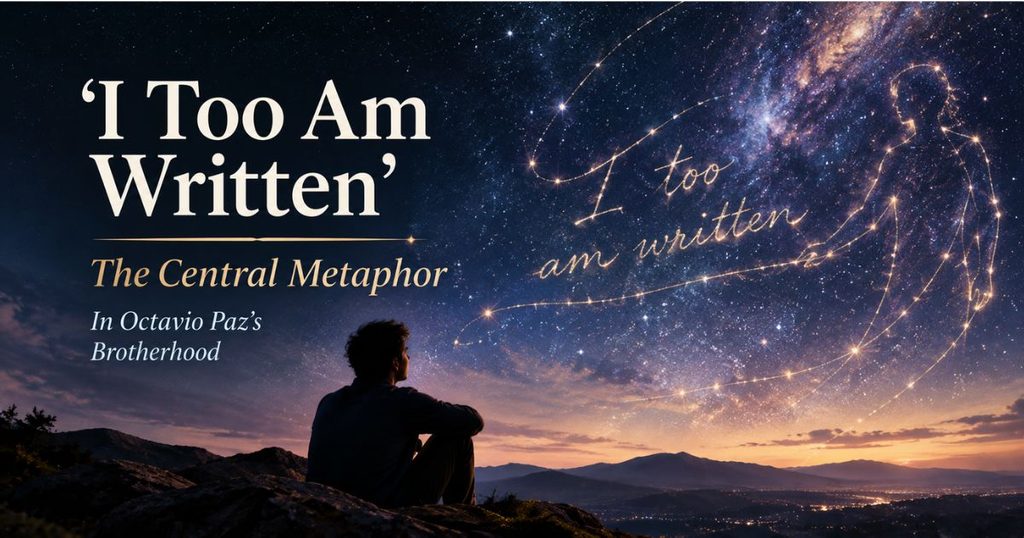
The statement “I too am written” is the poem’s central metaphor.
The speaker first sees the stars as writers. Then he realizes that he is not merely an observer looking at the cosmic text. He is also part of it.
This changes the relationship between the human being and the universe. The speaker may be small and temporary, but he is not completely separate from the cosmos.
The metaphor can therefore be understood in two related ways. First, the speaker’s life seems to belong to a larger cosmic pattern. Second, his existence has a place within a universe whose full meaning remains beyond human understanding.
The final idea that someone is “spelling” him out makes the metaphor even more intimate. The universe is imagined not simply as something enormous and distant, but as something in which the individual is somehow included.
Human Life, Destiny, and the Vast Universe
The poem begins by emphasizing the short duration of human life. Against that brief existence stands an enormous night.
This creates the poem’s central contrast:
Human life → brief and limited
Universe → enormous and seemingly boundless
The speaker recognizes his own smallness when compared with the universe. Yet the realization is not simply negative. His discovery that he is “written” gives his existence a connection with the larger cosmic order.
Some educational interpretations read this as a suggestion of predestination: if the stars write human destiny, then a person’s life may already form part of a larger order.
However, the poem itself leaves the cosmic writer deliberately undefined. It says that “someone” spells the speaker out rather than explicitly naming God or another controlling power. Therefore, it is safer to describe this as a metaphorical or philosophical suggestion rather than claim that the poem gives a simple theological doctrine.
How to Explain the Answer in an Exam
For a short-answer question such as “What do the stars write in the poem ‘Brotherhood’?”, give the answer directly before explaining it.
A strong response can follow these steps:
- State the answer: The stars write human destiny or each person’s place in the universe.
- Explain the metaphor: The stars are presented as cosmic writers.
- Connect it to the speaker: He realizes that he too is part of this cosmic writing.
- Mention mortality: His life is short compared with the enormous universe.
- Explain the Ptolemy reference: The dedication connects the poem with humanity’s attempt to understand the cosmos.
A concise exam answer could be:
The stars symbolically write the destiny or place of human beings in the universe. When the speaker looks at them, he intuitively realizes that he too is part of this cosmic pattern. The idea emphasizes human mortality, cosmic vastness, and the mysterious relationship between the individual and the universe.
FAQs
Q: What do the stars write in the poem “Brotherhood”?
A: The stars symbolically write the destiny or place of human beings within the universe. The speaker sees them as cosmic writers and then realizes that he too is part of what is being written. The idea emphasizes that individual human life is connected to a much larger cosmic order.
Q: Who wrote the poem “Brotherhood”?
A: “Brotherhood,” originally titled “Hermandad,” was written by Mexican poet Octavio Paz. The English version commonly studied in this context was translated by Eliot Weinberger. The Poetry Society of America identifies Paz as the poet and provides the Weinberger translation.
Q: What does “I too am written” mean in “Brotherhood”?
A: It means that the speaker realizes his existence is also part of the larger cosmic pattern represented by the stars. He is not merely looking at the universe from outside; he belongs to it. The statement also suggests the possibility of destiny or a predetermined cosmic order.
Q: Why is Claudius Ptolemy mentioned in “Brotherhood”?
A: Ptolemy is important because the poem carries the dedication “Homage to Claudius Ptolemy.” His association with astronomy and models of the cosmos reinforces the poem’s concern with the heavens, cosmic order, and humanity’s place within the universe.
Q: What does “Unknowing I understand” mean?
A: The phrase suggests that the speaker reaches an understanding without being able to explain the universe through ordinary knowledge or scientific reasoning. He cannot literally read the stars, but he intuitively understands that his own existence is connected with the cosmic pattern he sees above him.
Final Thoughts
The stars in “Brotherhood” symbolically write the destiny or place of human beings within the universe. Paz turns the night sky into a vast cosmic text and then makes the speaker realize that he is part of that text.
The poem’s power comes from this simple movement: a short-lived human being looks toward an enormous universe and discovers a connection rather than complete separation. Through the images of writing and being written, Paz explores mortality, cosmic order, human limitation, and the mystery of existence.
Recent Article : Who Wrote Sare Jahan Se Achcha? The Truth Revealed

Jennifer Aston is a passionate poetry curator and writer with a deep love for the written word. She believes poetry has the power to heal, inspire, and connect people across all walks of life. Through PoemSteric, she brings together timeless and modern verses for every emotion and every moment.