
Introduction
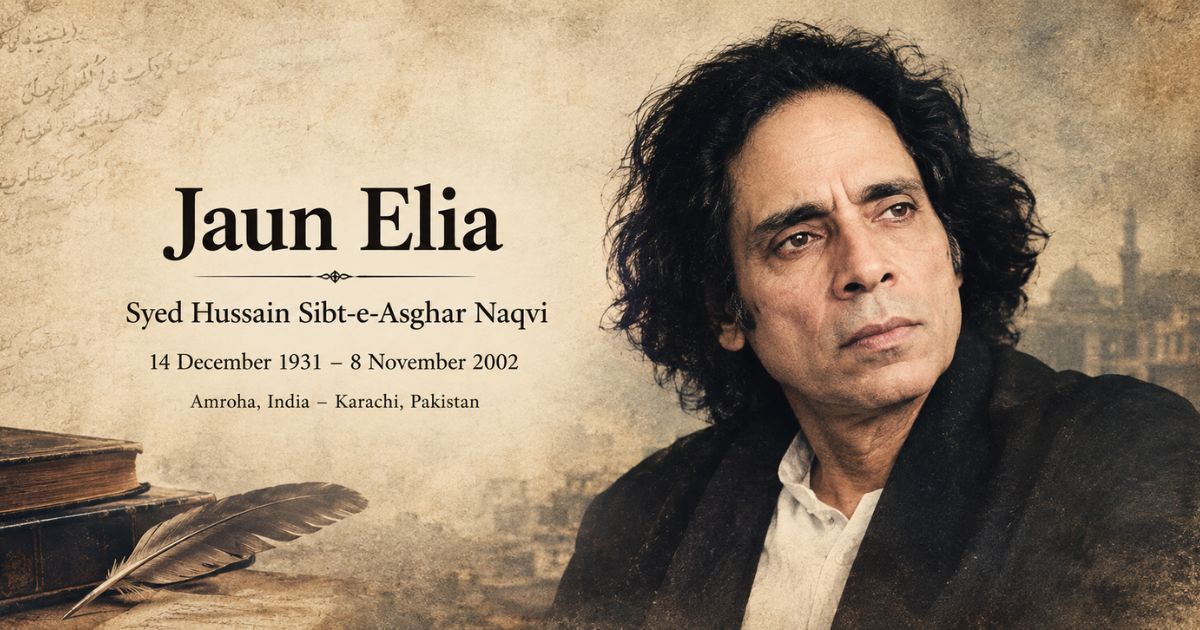
John Elia is a common English spelling variant for Jaun Elia, the pen name of Syed Hussain Jaun Asghar, one of the most distinctive modern Urdu poets. Born in Amroha in 1931, he later moved to Pakistan and settled in Karachi, where he developed the literary career for which he became widely known.
His poetry combines emotional directness with interests in philosophy, history, religion, and intellectual debate. Although he wrote extensively for decades, his first poetry collection, Shayad, appeared only in 1991, making his later literary recognition particularly significant. Several other collections, including Yaani, Gumaan, Lekin, and Goya, were published after his death.
This John Elia biography therefore needs to begin with a clarification: “John Elia” and “Jaun Elia” refer to the same poet. “Jaun Elia” is the spelling most commonly used by Urdu literary sources and by Rekhta.
Key Takeaways
- Jaun Elia is the standard English transliteration commonly used for the Urdu poet; “John Elia” is a spelling variant.
- His full name is given by major literary references as Syed Hussain Jaun Asghar.
- He was born on 14 December 1931 in Amroha, in present-day Uttar Pradesh, India.
- He developed interests in history, philosophy, religion, and several classical languages.
- He migrated from India to Pakistan in 1957 and settled in Karachi.
- His poetry includes ghazals, nazms, and other forms of Urdu verse.
- His first poetry collection, Shayad, was published during his lifetime in 1991.
- Yaani, Gumaan, Lekin, and Goya were published posthumously.
- His writing is known for emotional immediacy, intellectual questioning, unconventional expression, and philosophical concerns.
- He was also an editor, translator, and scholar rather than only a poet.
- He died in Karachi on 8 November 2002.
Who Was John Elia (Jaun Elia)?
Jaun Elia was a major Urdu poet whose work became particularly influential among readers who valued poetry that sounded intimate, questioning, and intellectually restless.
Rekhta describes him as one of the prominent modern Urdu poets and emphasizes his unconventional approach and broad intellectual interests. His work includes both ghazals and nazms, and his writing often moves between personal emotion and larger questions about belief, identity, society, and existence.
His career was not limited to poetry. After migrating to Pakistan, he worked with the Ismailia Association of Pakistan, supervising writing and compilation, and later remained associated with the Urdu Dictionary Board. He also edited Aalami Digest with writer Zahida Hina.
John Elia and Jaun Elia: The Name Explained
“John Elia” and “Jaun Elia” are not two different poets. They are different Roman-script spellings used for the same Urdu writer.
The spelling Jaun Elia is the form used by major Urdu literary resources such as Rekhta. Its profile identifies his pen name as “Jaun” and his real name as Syed Hussain Jaun Asghar.
The English spelling “John Elia” can arise because “Jaun” is sometimes transliterated according to how the Urdu name sounds to English readers. Search engines and informal biographies may consequently use “John,” but readers researching the poet should generally search for Jaun Elia as well.
This distinction matters for research. Searching only “John Elia” can miss Urdu books, literary archives, and authoritative material catalogued under “Jaun Elia.”
Childhood, Education, and Intellectual Interests
Jaun Elia was born in Amroha to Shafiq Hasan Elia, a scholar with broad interests in literature and languages. Rekhta states that Jaun received his early education under his father’s guidance and later acquired the qualifications Adeeb Kamil in Urdu, Kamil in Persian, and Fazil in Arabic.
His intellectual interests extended beyond literary composition. Sources describe his deep engagement with history, philosophy, and religion, interests that influenced the unusual intellectual character of his poetry.
He also wrote prose and translated older Arabic and Persian works. This scholarly side is important because reducing him to a poet of romantic or melancholic verses leaves out a substantial part of his intellectual identity.
Poetry, Philosophy, and Literary Style
Jaun Elia’s poetry is distinctive because emotional expression and intellectual questioning frequently operate together.
His ghazals can address love, separation, loneliness, disappointment, and relationships, but they often contain a skeptical or philosophical turn. Rather than presenting emotion as simple sentiment, his poetry can question the assumptions behind the emotion itself.
His interests in history, philosophy, and religion also gave his writing a broader intellectual vocabulary. Rekhta specifically connects these disciplines with the unusual character of his personality and poetry.
The ghazal was central to his literary presence, but he also wrote nazms and other forms. Rekhta’s catalogue currently lists hundreds of ghazals and dozens of nazms attributed to him, demonstrating the breadth of the surviving poetic record.
His style is often recognized for its conversational immediacy. Instead of always sounding ceremonious or distant, his poems can feel like direct speech shaped into literary form. That quality helped his verses travel beyond specialist literary circles.
At the same time, readers should avoid reducing all of his work to sadness or romantic despair. His writing includes philosophical, historical, religious, social, and intellectual dimensions that require a broader reading.
Why Jaun Elia Became So Popular
Jaun Elia’s popularity developed from an unusual combination of literary sophistication and accessibility.
He could use the vocabulary and conventions of classical Urdu poetry while creating a voice that felt immediate to contemporary readers. That balance allowed his verses to circulate widely through literary gatherings, recitations, books, and later digital platforms.
Another important factor was his personality and public image. He became known for an unconventional persona, and this contributed to the way readers encountered his poetry. Rekhta explicitly describes him as popular among the masses for his unconventional ways.
His publication history also helped create a distinctive posthumous literary story. Although he had been writing poetry for decades, his first major collection, Shayad, did not appear until 1991. Much of his surviving poetic material was published later, meaning generations of readers encountered substantial portions of his work after his death.
Digital circulation has further increased his visibility. Short excerpts of Urdu poetry can now reach readers who may never have encountered a complete ghazal collection. However, isolated couplets can remove poems from their original context.
For serious study, therefore, readers should move from individual quotations to complete poems and published collections.
Major Poetry Collections and Literary Legacy
Shayad holds a special place in Jaun Elia’s bibliography because it was the first poetry collection published during his lifetime. Rekhta dates its publication to 1991.
After his death, several important collections appeared. These include:
- Yaani — published posthumously in 2003.
- Gumaan — published posthumously in 2004.
- Lekin — published posthumously in 2006.
- Goya — published posthumously in 2008.
- Farnood — a posthumously compiled prose volume published in 2008.
The publication history is important because it shows that the literary record continued expanding after his death. Khalid Ahmed Ansari played a significant role in compiling and preparing previously unpublished material for publication. Rekhta credits Ansari with compiling several posthumous collections and prose works.
Yaani is especially significant for readers exploring his poetry because its expanded edition contains additional verses and represents an important part of the posthumous publication history.
His legacy therefore cannot be measured only by the books he personally published. A considerable portion of the work through which later readers came to know him was edited and published after his death.
Family, Karachi Years, and Personal Life
Jaun Elia came from an intellectually active family. His father, Shafiq Hasan Elia, was a scholar, while his brother Rais Amrohvi was also a noted poet. Another brother, Syed Muhammad Taqi, was associated with philosophy and translation.
He migrated from India to Pakistan in 1957 and settled in Karachi. This move became a major turning point in his life and career. He subsequently worked with the Ismailia Association of Pakistan and later the Urdu Dictionary Board.
He married Urdu writer and columnist Zahida Hina in 1970. Rekhta records that the couple later separated in 1992.
His Karachi years were important not only personally but also culturally. Karachi provided an active literary environment in which Urdu poets, writers, editors, and intellectuals interacted through magazines, literary gatherings, publishing, and broadcasting.
Readers should nevertheless distinguish documented biography from the highly personal image that sometimes surrounds Jaun Elia online. Anecdotes about his temperament or private life should not automatically be treated as established historical facts unless supported by reliable sources.
Death and Lasting Influence
Jaun Elia died in Karachi on 8 November 2002. Rekhta’s biographical record gives his lifespan as 1931–2002 and identifies Karachi as the place of death.
His literary influence continued to grow after his death because previously unpublished writings became available. Yaani, Gumaan, Lekin, and Goya expanded the body of poetry available to readers, while Farnood brought additional prose material into circulation.
His influence is especially visible in the continued online circulation of his ghazals and individual couplets. Rekhta’s archive preserves a substantial collection of his ghazals, nazms, and other writings, giving researchers access to material beyond the quotations commonly shared on social media.
His legacy is therefore broader than a reputation for melancholic or romantic poetry. He represents a meeting point between Urdu’s classical literary inheritance and a modern voice shaped by philosophy, skepticism, scholarship, and personal candor.
In my own reading of literary biographies, Jaun Elia is especially interesting because the published record reveals two writers at once: the immediately quotable poet familiar to general readers and the intellectually ambitious scholar whose interests extended into philosophy, religion, history, translation, and prose.
FAQs
Q: Is John Elia the same person as Jaun Elia?
A: Yes. “John Elia” is a Roman-script spelling variant used for the Urdu poet more commonly written as Jaun Elia. Rekhta identifies his pen name as “Jaun” and his real name as Syed Hussain Jaun Asghar. For reliable literary research, “Jaun Elia” is generally the more useful spelling because major Urdu archives and catalogues use it.
Q: When and where was Jaun Elia born?
A: Jaun Elia was born on 14 December 1931 in Amroha, in present-day Uttar Pradesh, India. Rekhta’s biography and tribute page both give this date and place. He grew up in an intellectually rich family and received early education under the guidance of his father, Shafiq Hasan Elia.
Q: What is Jaun Elia famous for?
A: Jaun Elia is famous primarily for his Urdu poetry, especially his ghazals and nazms. His writing combines emotional candor with philosophical and intellectual questioning. He is also known for his unconventional literary personality and for works including Shayad, Yaani, Gumaan, Lekin, and Goya. His broad interests in philosophy, history, and religion distinguish his work from a purely romantic reading of his poetry.
Q: What was Jaun Elia’s first poetry collection?
A: His first poetry collection was Shayad, published in 1991. It was the only major poetry collection published during his lifetime. Several other important collections appeared posthumously, including Yaani in 2003, Gumaan in 2004, Lekin in 2006, and Goya in 2008.
Q: Where did Jaun Elia live after migrating from India?
A: Jaun Elia migrated from India to Pakistan in 1957 and settled in Karachi. He worked at the Ismailia Association of Pakistan from 1963 to 1968, later remained associated with the Urdu Dictionary Board, and edited Aalami Digest with Zahida Hina. Karachi became the main setting for the later part of his literary and professional life.
Q: When did Jaun Elia die?
A: Jaun Elia died on 8 November 2002 in Karachi, Pakistan. He was 70 years old. His death did not end the publication of his work because a substantial amount of poetry and prose was subsequently compiled and published by Khalid Ahmed Ansari.
Final Thoughts
The most important point in researching a John Elia biography is recognizing that John Elia and Jaun Elia refer to the same Urdu poet. The spelling “Jaun Elia” is the more established form in major Urdu literary resources.
Born in Amroha in 1931 and later established in Karachi, Jaun Elia developed a literary voice shaped by Urdu tradition, philosophy, history, religion, and personal experience. His delayed publication history makes his career unusual: Shayad appeared during his lifetime, while several major collections reached readers only after his death.
His lasting importance comes from the combination of emotional accessibility and intellectual depth in his writing. To understand him fully, readers should look beyond isolated quotations and explore his complete ghazals, nazms, prose, translations, and the broader literary context in which he worked.
Recent Article : Jan Nisar Akhtar Biography: Life, Poetry and Legacy

Jennifer Aston is a passionate poetry curator and writer with a deep love for the written word. She believes poetry has the power to heal, inspire, and connect people across all walks of life. Through PoemSteric, she brings together timeless and modern verses for every emotion and every moment.