
Introduction
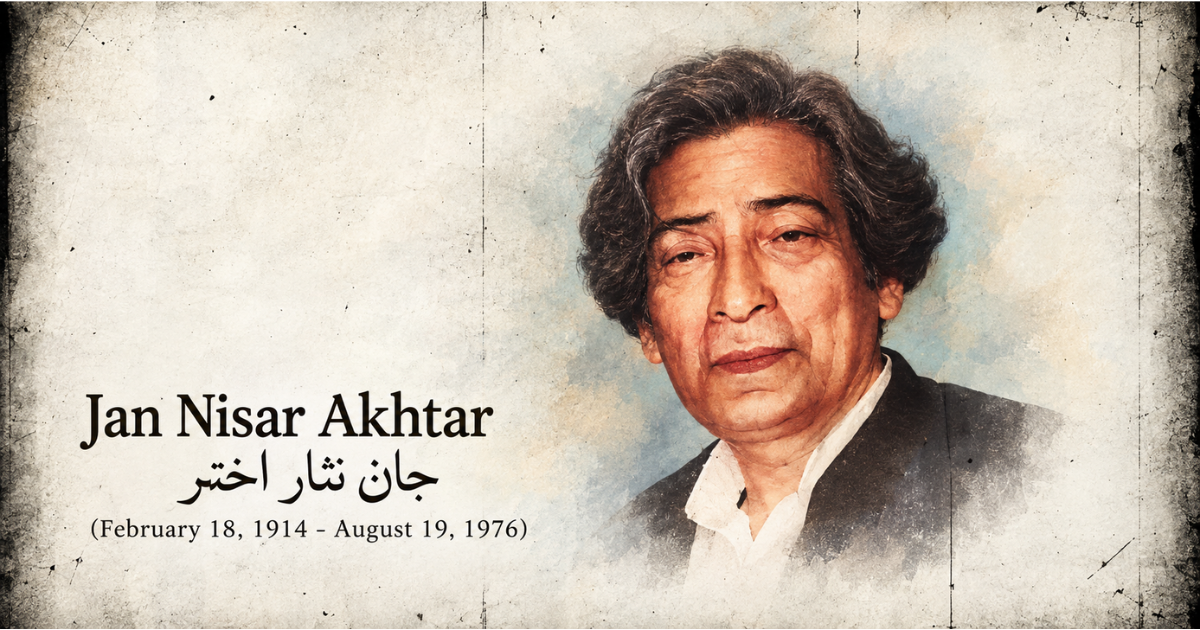
Jan Nisar Akhtar was an influential 20th-century Urdu poet, ghazal and nazm writer, Progressive Writers’ Movement participant, and Hindi-film lyricist. He was born in Gwalior in 1914 and died in Bombay in 1976. His literary career connected modern Urdu poetry with progressive thought and popular cinema.
His poetry collections include Nazr-e-Butaan, Salaasil, Javidaan, Pichhli Pehar, Ghar Angan, and Khaak-e-Dil. The last became particularly important in his literary career and received the Sahitya Akademi Award for Urdu in 1976.
Akhtar also became widely known for writing film lyrics. His work for films such as Yasmin and C.I.D. helped connect his literary sensibility with mainstream Hindi cinema.
Key Takeaways
- Jan Nisar Akhtar was an important Urdu poet and film lyricist.
- He was associated with the Progressive Writers’ Movement.
- He studied at Aligarh Muslim University.
- His father was the Urdu poet Muztar Khairabadi.
- His great-grandfather was the scholar and poet Fazl-e-Haq Khairabadi.
- He was the father of poet and lyricist Javed Akhtar and writer Salman Akhtar.
- His poetry includes ghazals and nazms dealing with love, society, dignity, and everyday life.
- Khaak-e-Dil received the 1976 Sahitya Akademi Award in Urdu.
- He wrote lyrics for numerous Hindi films during a career spanning several decades.
- His legacy extends across Urdu literature, Indian cinema, and a multigenerational literary family.
Who Was Jan Nisar Akhtar?
Jan Nisar Akhtar was an Indian Urdu poet whose work developed during a period of major political, literary, and cultural change.
He wrote both ghazals and nazms, two important forms in Urdu poetry. His writing combined romantic and personal subjects with concerns associated with progressive literature, including dignity, freedom, social inequality, and ordinary family life.
His career also crossed literary boundaries. After establishing himself as a poet and teacher, he moved into Hindi cinema and became a professional lyricist. This gave his words a much larger popular audience.
Birth, Education, and Family Background
Sources commonly record Jan Nisar Akhtar as being born in Gwalior on 18 February 1914. Available biographical material states that he attended Victoria Collegiate High School in Gwalior and later studied at Aligarh Muslim University, where he completed B.A. Honours and M.A. studies. He also began doctoral work but did not complete it.
He came from a long-established family of Urdu literary and scholarly figures. His father, Muztar Khairabadi, was an Urdu poet, while his great-grandfather Fazl-e-Haq Khairabadi was a prominent scholar, poet, and intellectual associated with the events of 1857.
His education at Aligarh was significant because the university was an important intellectual environment for modern Indian Muslim thought and Urdu literary culture.
Date Discrepancy in Major Sources
The birth date deserves careful treatment because biographical sources do not all agree.
Several commonly consulted sources, including the main biographical record and reference versions derived from it, give 18 February 1914.
However, other online biographies give 14 February 1914. For example, PoetrySoup lists February 14, while a PoemHunter biographical PDF also uses February 14.
Therefore, a responsible biography should not present the disagreement as settled fact. 18 February 1914 is the more commonly documented date in the sources reviewed here, but the existence of the 14 February version should be acknowledged.
His death date is much more consistently reported as 19 August 1976, in Bombay, at the age of 62.
Literary Career and Progressive Writers’ Movement
Jan Nisar Akhtar’s literary identity developed alongside the Progressive Writers’ Movement, an influential current in South Asian literature that encouraged writers to engage with social realities and questions of inequality, freedom, and human dignity.
Akhtar’s poetry reflected this environment while retaining the traditional richness of Urdu poetic forms. His writing did not abandon romantic expression; instead, personal and social concerns could exist within the same poetic world. Sources describe his work as secular and concerned with subjects including freedom, dignity, economic exploitation, and everyday family life.
After returning to Gwalior, he worked as an Urdu lecturer. Later, he moved to Bhopal and worked at Hamidia College before eventually relocating to Bombay. Biographical accounts also connect him with other progressive writers active in Bombay, including Mulk Raj Anand, Krishan Chander, Rajinder Singh Bedi, and Ismat Chughtai.
This literary environment helped place his poetry within a wider movement that viewed literature as capable of addressing contemporary social questions.
Jan Nisar Akhtar as a Film Lyricist
Akhtar’s career in cinema began after his move to Bombay, where he worked as a lyricist for Hindi films. His breakthrough is commonly associated with A. R. Kardar’s Yasmin (1955). He subsequently wrote for films involving composers such as C. Ramchandra, O. P. Nayyar, N. Dutta, and Khayyam.
Among the songs associated with his film career are “Aankhon Hi Aankhon Mein” from Guru Dutt’s C.I.D. (1956) and songs from later films including Prem Parbat and Noorie. Sources attribute approximately 151 songs to his career.
Some lists also identify songs released after his death. That does not necessarily mean he wrote them after 1976; film production, recording, and release dates can differ. For example, sources identify “Ae Dil-e-Nadaan” from Razia Sultan (1983) as his last song, although the film appeared years after his death.
This distinction is important when documenting his filmography. His contribution belongs to his lifetime’s creative work even when a song or film was released posthumously.
Major Works, Themes, and Khaak-e-Dil
Jan Nisar Akhtar’s published poetry includes Nazr-e-Butaan, Salaasil, Javidaan, Pichhli Pehar, Ghar Angan, and Khaak-e-Dil. His writing spans ghazal and nazm and brings together romantic feeling, social awareness, and reflections on ordinary human relationships.
Khaak-e-Dil holds particular importance. The Sahitya Akademi’s official awards list records Jan Nisar Akhtar as the 1976 recipient of the Urdu award for Khak-e-Dil.
The collection is sometimes described in English as The Ashes of Heart. Available biographical sources describe it as containing representative poetry from different periods of his career.
His poetry is also notable for bringing literary sophistication into subjects close to everyday life. Love, family, social relationships, freedom, and dignity can appear alongside the formal traditions of Urdu verse.
Literary Family: Muztar, Fazl-e-Haq, Javed and Salman
Jan Nisar Akhtar belonged to a remarkable literary lineage.
His father, Muztar Khairabadi, was an established Urdu poet. Muztar was himself the grandson of Fazl-e-Haq Khairabadi, linking Jan Nisar to an earlier generation of scholarship and Urdu-Persian literary culture.
Fazl-e-Haq Khairabadi was a scholar, poet, and important figure associated with the 1857 uprising. Javed Akhtar’s official biography describes the family as extending across several generations of Urdu poets, writers, and figures involved in India’s political history.
Jan Nisar’s own sons continued this literary and intellectual tradition. Javed Akhtar became a major poet, lyricist, and screenwriter, while Salman Akhtar became known as a writer and psychoanalyst.
This family history is significant not simply because of famous names. It shows how literary knowledge, Urdu language traditions, and creative practices continued across generations.
Awards, Legacy, and Lasting Importance
The most clearly documented major literary recognition in Akhtar’s career was the 1976 Sahitya Akademi Award in Urdu for Khak-e-Dil. The Sahitya Akademi’s official awards list records the award directly.
His legacy, however, extends beyond one prize. He occupies an unusual position between serious Urdu literature and popular Hindi cinema. His poetry belongs to the history of modern Urdu writing, while his lyrics reached audiences through film music.
His association with progressive literary circles also places him within a major chapter of South Asian literary history. His work demonstrates how an Urdu poet could engage with classical forms while addressing modern social and emotional realities.
The continued publication and cataloguing of his poetry by literary institutions also reflects his enduring place in Urdu literature. Sahitya Akademi’s Urdu publications, for example, continue to include collections and selections connected with major Urdu poets.
For readers today, his importance can therefore be understood through three connected areas: Urdu poetry, progressive literary culture, and Hindi-film lyricism.
FAQs
Q: Who was Jan Nisar Akhtar?
A: Jan Nisar Akhtar was a major 20th-century Urdu poet, ghazal and nazm writer, and Hindi-film lyricist. He was associated with the Progressive Writers’ Movement and wrote poetry dealing with love, social concerns, dignity, freedom, and everyday life. He also wrote lyrics for Hindi films, including Yasmin and C.I.D. His poetry collection Khaak-e-Dil received the Sahitya Akademi Award for Urdu in 1976.
Q: When was Jan Nisar Akhtar born?
A: The most commonly documented date in the sources reviewed is 18 February 1914, in Gwalior. However, some biographical sources give 14 February 1914. Because these sources conflict, it is more accurate to acknowledge both dates rather than silently treating one as universally settled. His death date, 19 August 1976, is much more consistently reported.
Q: Who was Jan Nisar Akhtar’s father?
A: His father was Muztar Khairabadi, an Urdu poet. Muztar was himself part of a longstanding scholarly and literary family. Jan Nisar was also a great-grandson of Fazl-e-Haq Khairabadi, the scholar and poet associated with the events of 1857.
Q: What is Jan Nisar Akhtar’s most famous poetry collection?
A: Khaak-e-Dil is among his most important poetry collections and received the 1976 Sahitya Akademi Award in Urdu. Other published works associated with him include Nazr-e-Butaan, Salaasil, Javidaan, Pichhli Pehar, and Ghar Angan.
Q: Was Jan Nisar Akhtar part of the Progressive Writers’ Movement?
A: Yes. He is identified with the Progressive Writers’ Movement, and his poetry reflects several concerns associated with progressive Urdu literature, including freedom, dignity, social inequality, and economic exploitation. He also interacted with other progressive writers during his years in Bombay.
Q: Who are Jan Nisar Akhtar’s famous literary descendants?
A: His sons include Javed Akhtar and Salman Akhtar. Javed Akhtar became a prominent poet, lyricist, and screenwriter, while Salman Akhtar became known as a writer and psychoanalyst. Their family lineage also reaches back to Muztar Khairabadi and Fazl-e-Haq Khairabadi.
Final Thoughts
Jan Nisar Akhtar’s life connects several important strands of modern South Asian culture: Urdu poetry, progressive literary thought, and Hindi cinema.
His biography also illustrates why careful sourcing matters. While 18 February 1914 is the more commonly documented birth date in the sources reviewed, other references give 14 February, so the discrepancy should remain visible rather than being silently corrected.
From Khaak-e-Dil and his other Urdu collections to his film lyrics and literary family, Akhtar left a body of work that crosses the boundaries between elite literary culture and popular art. His 1976 Sahitya Akademi Award provides formal recognition of his literary contribution, while his poetry and songs continue to connect readers and listeners with the language and traditions of Urdu expression.
Recent Article : Poems About Change: Moving, Powerful Picks to Read

Jennifer Aston is a passionate poetry curator and writer with a deep love for the written word. She believes poetry has the power to heal, inspire, and connect people across all walks of life. Through PoemSteric, she brings together timeless and modern verses for every emotion and every moment.