
Introduction
Who is the Pope’s Mouthpiece in the Poem? In The Rape of the Lock, Clarissa is generally considered Pope’s mouthpiece, particularly through her speech in Canto V. In this speech, she argues that beauty is temporary and that good sense, good humour, and personal merit are more valuable than outward appearance.
This is the straightforward interpretation expected in most exam answers. Clarissa expresses the moral perspective that Alexander Pope wanted to make clearer in the final version of the poem. Her speech was added in 1717, several years after the poem first appeared, and Pope explained that the addition was intended to reveal the poem’s moral “more clearly.”
However, calling Clarissa simply “Pope’s mouthpiece” can overlook some of the poem’s complexity. She clearly voices an important moral position, but her speech does not necessarily resolve all the tensions created by Pope’s satire, irony, and treatment of fashionable society.
Key Takeaways
- Clarissa is generally regarded as Pope’s mouthpiece in The Rape of the Lock.
- Her most important appearance is her speech at the beginning of Canto V.
- She criticizes excessive concern with beauty, fashion, and social display.
- She emphasizes good sense, good humour, and merit.
- The Pope added her speech in 1717.
- Pope himself indicated that the addition was meant to make the poem’s moral clearer.
- Clarissa’s speech does not mean every aspect of her character is an uncomplicated representation of Pope.
- The speech is based on the famous speech of Sarpedon to Glaucus in Homer’s Iliad, adding another layer to its meaning.
Who Is the Pope’s Mouthpiece in the Poem?
Clarissa is Pope’s mouthpiece in The Rape of the Lock. She delivers the poem’s most direct moral commentary in Canto V.
At a moment when the conflict over Belinda’s lock has become increasingly ridiculous, Clarissa asks why beauty and social admiration matter so much. She argues that physical beauty inevitably fades and that people should instead cultivate qualities that have greater lasting value.
Her argument is especially important because the rest of the poem often presents fashionable society through mock-heroic exaggeration. The card game, the lock of hair, the battle, the sylphs, and the exaggerated emotions all turn a small social incident into an epic-style conflict.
Clarissa briefly steps outside that comic escalation. Her speech tells the reader to consider what actually deserves value.
Clarissa in The Rape of the Lock
Clarissa is one of the fashionable women involved in the social world of the poem. Earlier in Canto III, she assists the Baron by giving him the scissors-like instrument with which he cuts Belinda’s lock.
Her role therefore becomes particularly interesting in Canto V. After the dispute intensifies, she attempts to introduce reason into the conflict.
Her speech is not simply another complaint about the stolen lock. Instead, she asks whether beauty and elaborate appearance can provide permanent happiness.
She points toward the inevitable decline of physical beauty and argues that good sense and good humour are more valuable qualities.
Why Clarissa Is Considered Pope’s Mouthpiece
Clarissa is considered Pope’s mouthpiece because her speech expresses the moral lesson that Pope explicitly wanted the expanded poem to communicate.
The scholarly record is unusually useful here. A study published through the University of Calgary notes that Pope said he added Clarissa’s speech in 1717 “to open more clearly the Moral of the Poem.”
Her argument also fits the broader satirical purpose of the poem. The Rape of the Lock turns the fashionable concerns of its characters into mock-epic material, exposing the disproportion between their social anxieties and the seriousness with which they treat them. The Poetry Foundation describes the poem as addressing the “flimsiness of social status” and contemporary social behaviour.
Thus, for an examination, calling Clarissa Pope’s mouthpiece is accurate and useful.
Clarissa’s Speech and the Moral of the Poem
Clarissa’s speech argues that beauty alone is insufficient. She asks why women are praised for appearance if beauty eventually fades, and she proposes that good sense should preserve what beauty gains.
Her moral argument can be reduced to several connected ideas:
- Physical beauty is temporary.
- Fashion and outward appearance cannot provide lasting value.
- Good sense is more durable than superficial beauty.
- Good humour can help people respond to loss and conflict.
- Personal merit matters more than physical charm.
The Poetry Foundation’s text of Canto V shows Clarissa explicitly contrasting beauty with “merit” and emphasizing good humour.
Yet the poem immediately complicates her advice. Belinda and Thalestris reject Clarissa’s intervention, and the comic conflict continues.
That contrast is important. Clarissa provides the moral perspective, but the characters do not simply accept it.
Why Pope Added Clarissa’s Speech in 1717
The Rape of the Lock originally appeared in 1712 as a two-canto poem. Pope expanded it into a five-canto version in 1714, adding the elaborate mock-epic machinery of sylphs and gnomes. Clarissa’s speech was added later, in 1717.
Pope’s own explanation is central to understanding the addition. According to scholarly discussion of the poem, he added the speech to make the moral clearer.
This suggests that Pope wanted readers to see beyond the entertaining surface of the mock-epic.
The addition therefore gives the poem a more explicit moral voice. Instead of leaving the satire to operate entirely through irony and exaggeration, Pope allows Clarissa to articulate a direct lesson about beauty, character, and good humour.
Is Clarissa Really Pope’s Simple Mouthpiece?
For an exam, yes: Clarissa is Pope’s mouthpiece. However, a more advanced interpretation should add an important qualification.
Clarissa should not necessarily be treated as a perfectly uncomplicated version of Pope himself. Her speech is presented through a fictional character, and its placement inside the poem creates irony as well as moral clarity.
Modern scholarship has noted that Clarissa has received sharply different critical treatments. Some readers see her as the sensible voice who exposes the superficiality of the other characters, while others question the assumptions and social expectations contained in her advice.
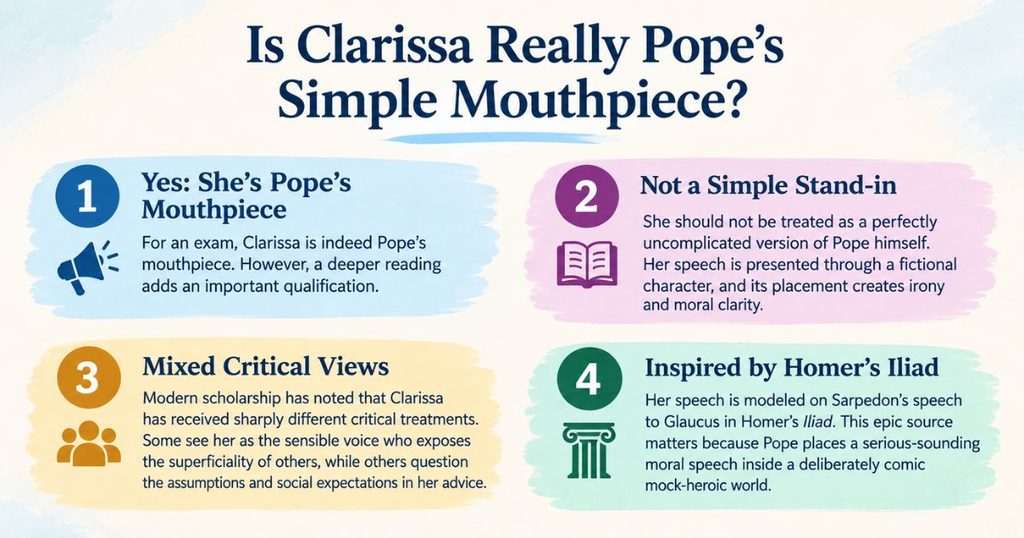
Her speech is also modeled on Sarpedon’s speech to Glaucus in Homer’s Iliad. That epic source matters because Pope places a serious-sounding moral speech inside a deliberately comic mock-heroic world.
Therefore, the safest sophisticated interpretation is:
Clarissa functions as Pope’s moral mouthpiece, but she should not automatically be reduced to a simple autobiographical stand-in for the poet.
How to Write the Exam Answer
For a question asking “Who is the Pope’s mouthpiece in the poem?”, begin with the direct answer.
A strong exam response can follow this structure:
- Name Clarissa immediately.
- Mention her speech in Canto V.
- Explain that she criticizes excessive concern with physical beauty and fashion.
- Mention good sense, good humour, and merit.
- State that Pope added the speech in 1717 to make the moral clearer.
- Add the scholarly qualification if the question requires deeper analysis.
Exam-Ready Answer
Clarissa is generally considered Pope’s mouthpiece in The Rape of the Lock, particularly through her speech in Canto V. She argues that physical beauty and fashionable display are temporary, whereas good sense, good humour, and merit have lasting value. Pope added her speech in 1717 to make the moral of the poem clearer. Although Clarissa represents the Pope’s moral viewpoint, she should not necessarily be treated as a completely simple or literal representation of the poet himself.
FAQs
Q: Who is Pope’s mouthpiece in The Rape of the Lock?
A: Clarissa is generally considered Pope’s mouthpiece, especially in her speech in Canto V. She expresses the moral perspective that values good sense, good humour, and merit above temporary physical beauty and fashionable display. The Pope added this speech in 1717 to make the moral of the poem clearer.
Q: Why is Clarissa called Pope’s mouthpiece?
A: Clarissa is called Pope’s mouthpiece because her speech directly communicates the moral ideas associated with the poem. She reminds the fashionable characters that beauty fades and that good sense and good humour are more lasting qualities. Her speech therefore provides an unusually direct statement of the poem’s moral position.
Q: When was Clarissa’s speech added to the poem?
A: Clarissa’s speech was added in 1717, after the poem had already appeared in its expanded five-canto form in 1714. The University of Toronto’s RPO edition identifies it as a 1717 addition and notes Pope’s explanation that it clarified the poem’s moral.
Q: What is the main message of Clarissa’s speech?
A: Clarissa argues that physical beauty is temporary and that people should value qualities such as good sense, good humour, and merit. Her speech shifts attention away from the stolen lock and toward the larger question of what deserves lasting admiration.
Q: Is Clarissa exactly the same as the Pope?
A: Not necessarily. Clarissa functions as Pope’s moral mouthpiece, but she remains a fictional character within a complex mock-heroic poem. Her speech can therefore be understood as expressing the Pope’s intended moral perspective without treating every aspect of her character as a direct representation of the Pope himself.
Q: Why is Clarissa’s speech important in Canto V?
A: It interrupts the escalating comic conflict with a direct moral argument. Instead of focusing only on Belinda’s lost hair, Clarissa asks readers to consider the temporary nature of beauty and the greater value of character. Her speech consequently makes the poem’s moral purpose more explicit.
Final Thoughts
Clarissa is generally considered Pope’s mouthpiece in The Rape of the Lock. Her Canto V speech provides the clearest expression of the poem’s moral perspective, emphasizing good sense, good humour, and merit over temporary beauty and fashionable display.
For an exam, that is the essential answer. For deeper analysis, however, remember that Clarissa is a fictional speaker whose speech was added in 1717 and modeled on an epic speech from Homer. She therefore expresses the Pope’s moral viewpoint without necessarily being a simple one-to-one portrait of the Pope himself.
Recent Article : Brotherhood Poem: Beautiful Meaning of the Stars Revealed

Jennifer Aston is a passionate poetry curator and writer with a deep love for the written word. She believes poetry has the power to heal, inspire, and connect people across all walks of life. Through PoemSteric, she brings together timeless and modern verses for every emotion and every moment.