M
Love Poems Technology AI-Technology

Synonyms in Poetry: How the Right Word Changes Everything
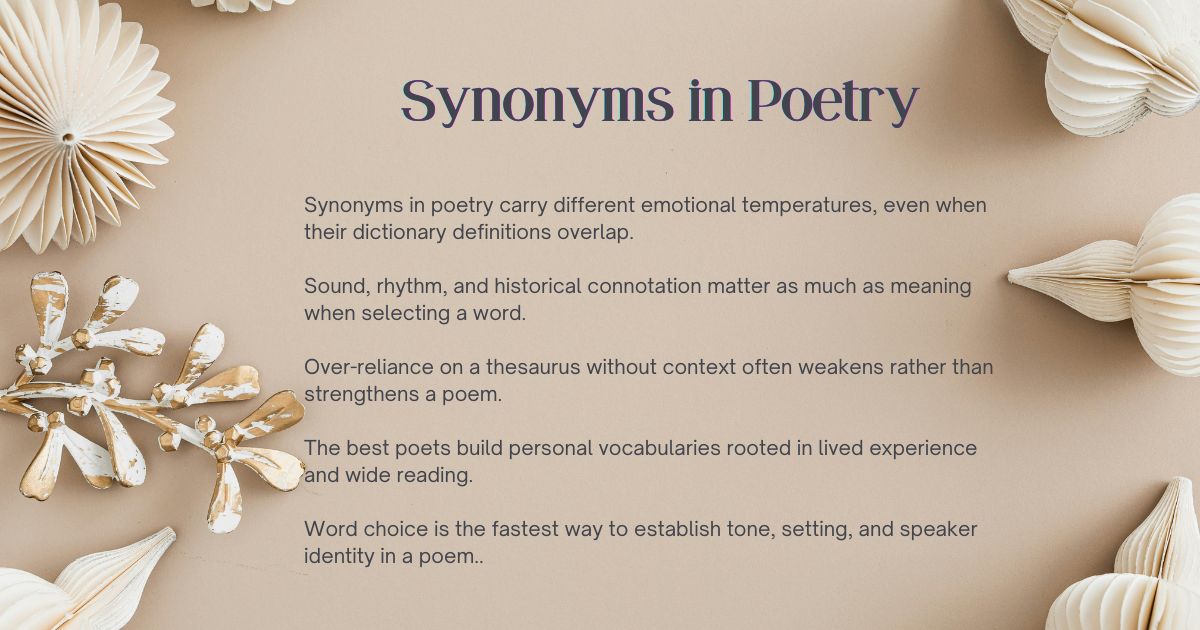
Synonyms in poetry key takeaways infographic with elegant botanical paper art on a warm cream background

Introduction Synonyms in poetry are not simply interchangeable words. They are the hidden levers that shift emotion, tone, and meaning within a single line. The difference between “gloomy” and “melancholy” can transform a reader’s entire experience of a poem. In my own reading of contemporary and classic verse, I have noticed that the most memorable … Read more

Poetry Slam Near Me: How to Find One in Your City Tonight

Poetry slam near me event flyer with performer on stage and crowd

Introduction To find a poetry slam near me tonight, check Poetry Slam, Inc.’s certified slam directory, search Eventbrite and Meetup for “poetry slam” plus your city name, and check the social media pages of local bars, coffee shops, bookstores, and college campuses. Many slams run weekly or monthly, so they aren’t always well indexed by … Read more

Consonants in Poetry: 5 Real Examples That Explain Consonance

Consonants in poetry title graphic with sound waveform visuals

What Is Consonance in Poetry? Consonants in poetry usually refers to consonance, a sound device where poets repeat consonant sounds within or at the end of nearby words, regardless of the vowels around them. Unlike rhyme, consonance doesn’t require matching vowel sounds, only matching consonants. A simple example is “lock” and “pick,” which share a … Read more

Example of an Ode in Poetry: 8 Famous Odes Explained Simply

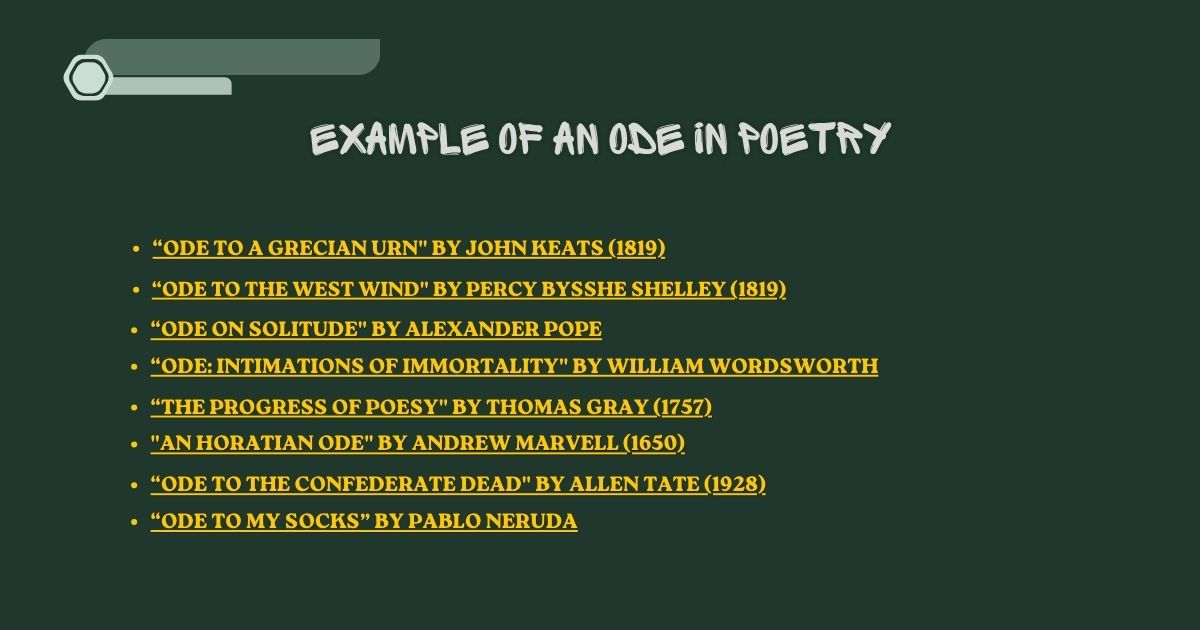
Example of an ode in poetry: list of 8 famous odes by Keats, Shelley, Neruda

What Is an Ode in Poetry? An ode in poetry is a formal poem written to praise or celebrate a person, place, object, or idea. It typically uses direct address, elevated language, and a serious, admiring tone. A clear example of an ode in poetry is John Keats’s “Ode to a Grecian Urn,” which speaks … Read more

Sound Devices in Poetry: 10 Techniques With Real Examples

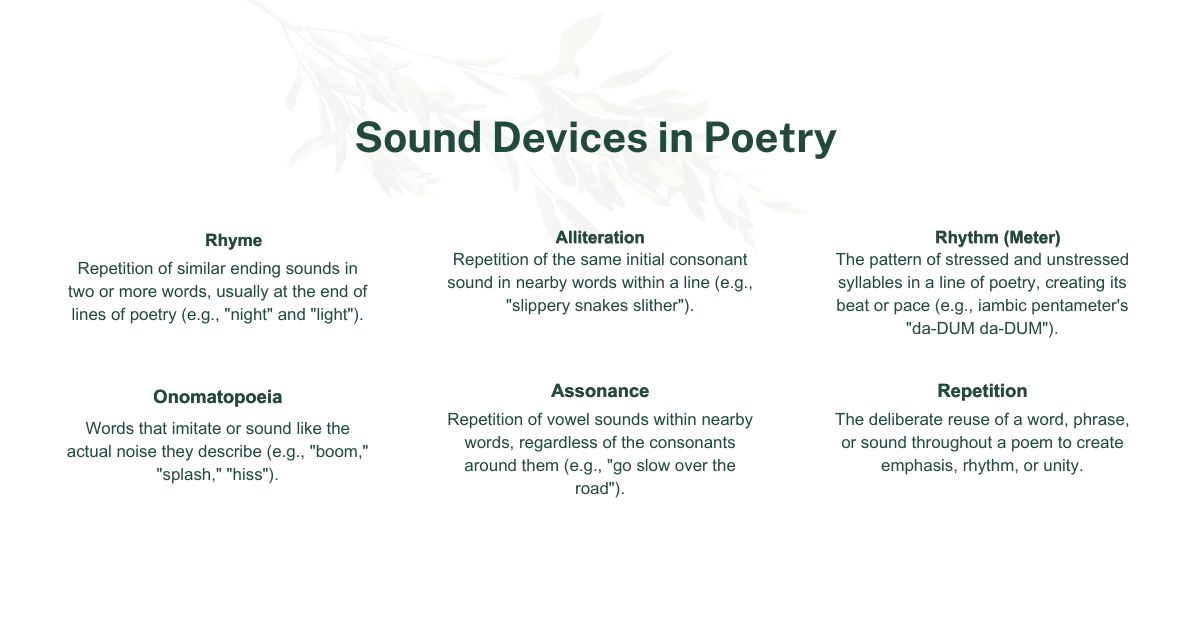
Six sound devices in poetry defined: rhyme, alliteration, rhythm, onomatopoeia, assonance, repetition

Introduction Sound devices in poetry are the techniques poets use to shape how a poem sounds when read aloud, not just what it means on the page. The ten core techniques alliteration, assonance, consonance, onomatopoeia, rhyme, rhythm and meter, repetition, anaphora, sibilance, and euphony/cacophony work by controlling repeated sounds, stresses, and rhythms to reinforce a … Read more

Prose and Poetry: The Real Difference (And Where They Blur)

Prose and poetry comparison title graphic with icy blue background

Introduction Prose and poetry differ mainly in how they use line breaks, rhythm, and compression: prose flows in complete sentences and paragraphs, while poetry uses controlled line breaks, sound patterns, and dense imagery to carry meaning. However, the boundary isn’t as clean as most definitions suggest; forms like the prose poem and rhythmic literary prose … Read more

Greek Poetry Collection: 9 Anthologies Worth Reading Today

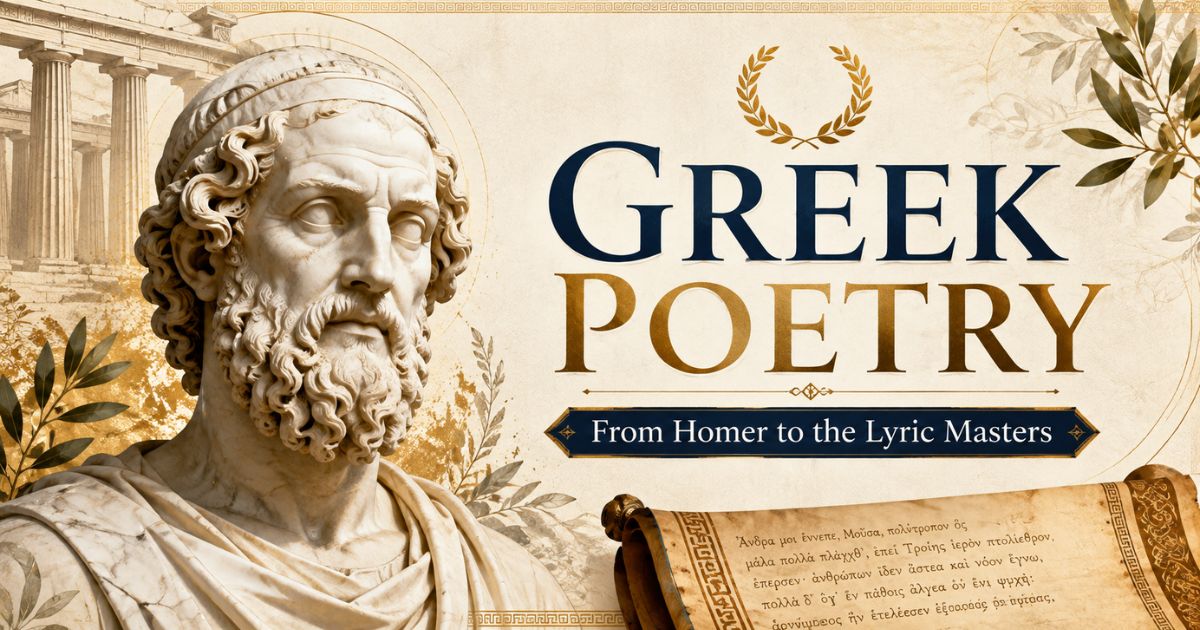
Greek poetry collection cover featuring an ancient Greek poet bust and Homer's Odyssey scroll

Introduction The nine essential anthologies for building a serious Greek poetry collection are The Greek Anthology (Loeb Classical Library), Greek Lyric (Loeb, translated by David A. Campbell), The Penguin Book of Greek Verse, Poems from the Greek Anthology (Kenneth Rexroth), The Greek Poets: Homer to the Present, the Loeb Greek Bucolic Poets, Select Epigrams from … Read more

Poetry That Uses Imagery: 7 Poems That Paint With Words

Poetry that uses imagery banner with pink cosmos flower against blue sky

Introduction Poetry that uses imagery relies on specific, sensory language color, texture, sound, movement to let readers see, hear, or feel a scene rather than simply being told about it. The seven poems below, from John Keats’s “To Autumn” to William Carlos Williams’s “The Red Wheelbarrow,” show seven different ways poets have used imagery across … Read more

Roman Poetry Collection: 6 Ancient Poets You Need to Read

Roman poetry banner with laurel-crowned figure in toga beside classical column

Introduction A strong Roman poetry collection should include six essential voices: Virgil, Horace, Ovid, Catullus, Juvenal, and Martial. Together they cover roughly 250 years of Latin literature, from the personal, emotional lyrics of the late Roman Republic to the sharp social satire of the early Empire. Each poet approached a different genre: epic, lyric ode, … Read more

Japanese Poetry Collections: 7 Anthologies Every Reader Should Know

Japanese poetry collections banner with open anthology, book stack, and Mount Fuji

Introduction The seven essential Japanese poetry collections every reader should know are the Man’yōshū, the Kokin Wakashū, the Shin Kokin Wakashū, the Hyakunin Isshu, T.E. McAuley’s “An Anthology of Classical Japanese Poetry,” Steven D. Carter’s “Traditional Japanese Poetry: An Anthology,” and Donald Keene’s “Anthology of Japanese Literature.” Together, these seven works span roughly 1,300 years, … Read more