
Introduction
Synonyms in poetry are not simply interchangeable words. They are the hidden levers that shift emotion, tone, and meaning within a single line. The difference between “gloomy” and “melancholy” can transform a reader’s entire experience of a poem.
In my own reading of contemporary and classic verse, I have noticed that the most memorable poems rarely use the first word that comes to mind. Instead, they reach for the precise term that carries the right weight of sound, history, and feeling. This article will show you exactly how poets make these choices and how you can apply the same discernment to your own writing.
Key Takeaways
Before we explore the full depth of this topic, here are the essential points every poet and reader should remember:
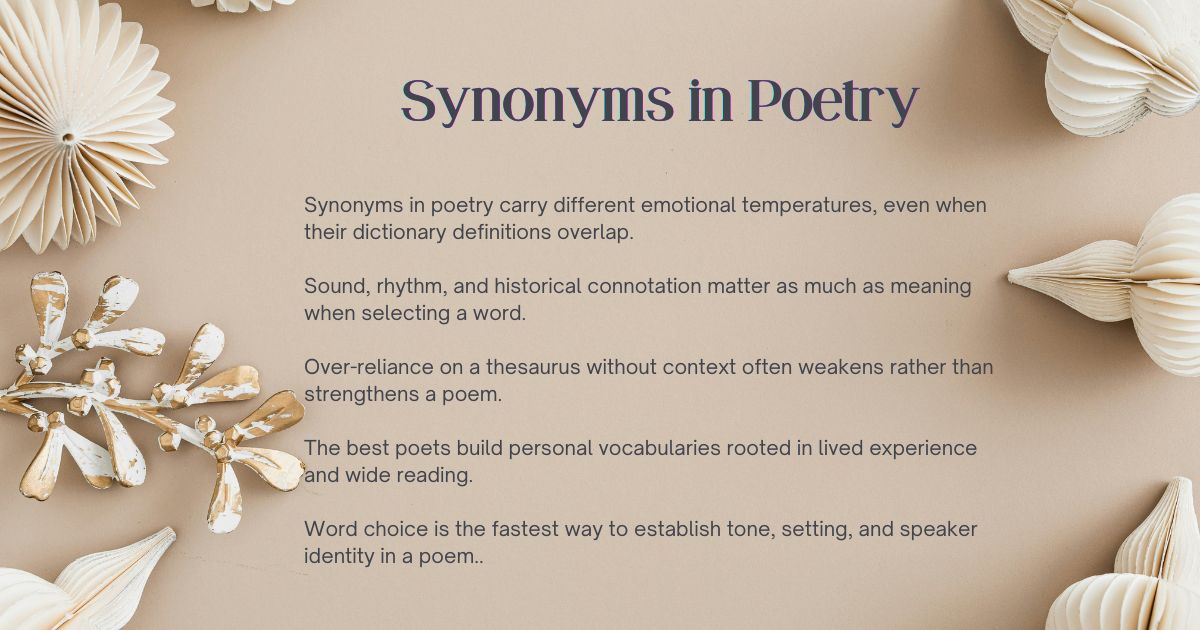
Synonyms in poetry carry different emotional temperatures, even when their dictionary definitions overlap.

Sound, rhythm, and historical connotation matter as much as meaning when selecting a word.

Over-reliance on a thesaurus without context often weakens rather than strengthens a poem.

The best poets build personal vocabularies rooted in lived experience and wide reading.

Word choice is the fastest way to establish tone, setting, and speaker identity in a poem.
Word Choice and the Poet’s Craft
Every poem is a series of decisions. The poet chooses where to break a line, which image to foreground, and most fundamentally which words to use. These decisions accumulate into what we call voice. However, voice is not merely style. It is the result of thousands of micro-choices about diction, register, and sound.
When a poet selects “wandered” instead of “walked,” they introduce a quality of aimlessness. When they choose “shattered” over “broke,” they invoke violence and fragmentation. These are not random preferences. They are calculated moves within the architecture of a poem. The craft of poetry demands that each word earns its place.
Consider the opening of William Wordsworth’s “I Wandered Lonely as a Cloud.” The verb “wandered” establishes a passive, receptive state of mind. “Walked” would have implied purpose. “Roved” would have suggested restlessness. Wordsworth’s choice shapes the entire emotional frame of the poem before the second line even begins.
Why Synonyms in Poetry Matter More Than You Think
In everyday conversation, synonyms function as convenience tools. They help us avoid repetition. In poetry, however, synonyms in poetry are instruments of precision. No two words share exactly the same field of meaning, sound, and association. “Happy” and “joyful” may seem identical in a dictionary, but they resonate differently in a line of verse.
The reason lies in connotation. Connotation is the emotional and cultural baggage a word carries beyond its literal definition. “Happy” feels light, casual, almost childlike. “Joyful” carries a weight of celebration and solemnity. A poem about grief might use “joyful” ironically. It would struggle to achieve the same effect with “happy.”
Moreover, synonyms in poetry affect meter and musicality. “Dark” is a single stressed syllable. “Shadowy” is three syllables with a different stress pattern. Swapping one for the other can destroy or restore the rhythmic pulse of a line. This is why poets often speak of “hearing” the right word rather than merely thinking it.
The Emotional Weight of Near-Synonyms
Near-synonyms are words with similar meanings but different emotional temperatures. They are the poet’s most subtle tool. Let us examine a concrete example. Suppose you are writing about the end of a relationship. You might describe the parting as “sad,” “tragic,” “melancholy,” “somber,” or “bleak.”
Each word paints a different room. “Sad” is a small room with plain walls. “Tragic” is a vast hall with columns of fate. “Melancholy” is a room filled with soft light and old photographs. “Somber” is dim and formal. “Bleak” is cold and exposed. The core event does not change, but the reader’s emotional entry point shifts dramatically.
In my own reading of contemporary journals, I have observed that emerging poets often settle for the most available word. Mature poets, however, interrogate every option. They ask not just “What does this mean?” but “What does this feel like?” That shift from meaning to feeling is what separates competent verse from unforgettable poetry.
How to Choose the Perfect Synonym: A Step-by-Step Guide
Selecting the right synonym is a skill that improves with practice. The following process will help you move beyond guesswork and develop a reliable method for word choice.
1: Define the Core Emotion
Before you open a thesaurus, identify the exact emotion you want the line to produce. Is it longing or desperation? Peace or resignation? The more precise your emotional target, the better your word selection will be. Write the emotion in plain language on a separate sheet of paper.
2: Test the Sound and Rhythm
Say your candidate words aloud. Notice where the stress falls. Notice whether the vowels are bright or dark. “Moan” has a long, open vowel that sustains sound. “Groan” is harsher, more abrupt. Both express pain, but their acoustic properties differ. Match the sound to the mood.
3: Check Historical and Cultural Connotations
Research when your candidate word entered the language and how it has been used. “Fair” carries medieval associations of beauty and justice. “Beautiful” is more universal but less textured. A word’s history is part of its present meaning.
4: Read Aloud for Musicality
Place the word in the full line and read it aloud three times. Listen for awkward combinations of consonants. Listen for unintended echoes or rhymes. The right word should feel inevitable, as if no alternative were possible.
Famous Poets Who Mastered Synonym Selection
The history of poetry is, in part, a history of extraordinary word choices. Studying how master poets selected their terms offers practical lessons for any writer.
Robert Frost and the Power of Plain Language
Robert Frost built his reputation on words that seem simple until you examine them closely. In “Stopping by Woods on a Snowy Evening,” he writes that the woods are “lovely, dark and deep.” Each of those three adjectives could be replaced. “Lovely” might become “beautiful.” “Dark” might become “shadowed.” “Deep” might become “dense.” But the replacements would flatten the line.
“Lovely” carries a slightly old-fashioned, understated quality. “Dark” is absolute rather than comparative. “Deep” suggests mystery and invitation. Frost understood that plain words, chosen with care, accumulate into profound effects. He did not reach for exotic vocabulary. He reached for the exact plain word.
Emily Dickinson’s Precise Diction
Emily Dickinson was a master of compression. Her poems often turn on a single word choice that reorients the entire stanza. In “Because I could not stop for Death,” she describes the setting sun as passing the carriage. She does not say “the sun set.” She says “We passed the Setting Sun.” The word “Setting” becomes an adjective, personified and deliberate.
Dickinson’s alternative words in verse often carry theological or scientific undertones. She was deeply read in both traditions, and her diction reflects that dual inheritance. Her precision invites readers to slow down and weigh every term.
Modern Poets and Experimental Word Choice
Contemporary poets such as Tracy K. Smith and Ocean Vuong continue this tradition of precision while expanding the available vocabulary. They draw from technical language, diasporic tongues, and digital culture to find the exact term their poem requires. This demonstrates that the principle of precise synonym selection is timeless, even as the available word pool evolves.
Common Mistakes When Using Synonyms in Poetry
Even experienced poets fall into predictable traps when handling synonyms. Recognizing these mistakes is the first step toward avoiding them.
Overwriting and the Thesaurus Trap
The most common error is treating a thesaurus as a source of upgrades. Writers assume that a longer or rarer word is automatically better. This is false. “Utilize” is not an improvement on “use.” “Penultimate” is not more poetic than “last but one.” Overwriting draws attention to the poet’s effort rather than the poem’s effect.
The solution is simple. Ask whether the replacement word clarifies or complicates. If it complicates without adding meaning, keep the simpler term. Poetry prizes clarity, not obscurity.
Ignoring Meter and Cadence
A second common error is choosing a synonym that disrupts the poem’s rhythm. If you have established a pattern of iambs, inserting a three-syllable word where one syllable is required will break the music. Always read substitutions in context. The isolated word may be perfect. The line may reject it.
Synonyms in Poetry Across Different Forms
Different poetic forms impose different constraints on word choice. Understanding these constraints helps poets select synonyms that serve the form rather than fight it.
Haiku and the Economy of Words
A haiku offers only seventeen syllables. Every word must carry multiple layers of meaning. The Japanese tradition of kigo, or seasonal words, functions as a compressed synonym system. “Cherry blossoms” does not merely mean flowers. It signals spring, transience, and beauty in a single phrase.
When writing haiku in English, poets must apply similar compression. Choosing “fog” over “mist” changes the temperature and visibility of the scene. Choosing “cries” over “calls” introduces urgency. There is no room for approximation.
Sonnets and the Pressure of Rhyme
The sonnet’s rhyme scheme creates both opportunity and constraint. A poet may need a synonym specifically to complete a rhyme without distorting meaning. Shakespeare often exploited this pressure brilliantly. In Sonnet 18, “temperate” rhymes with “date,” linking weather and time through sound.
This pressure can also produce weakness. Poets sometimes choose a rhyme-driven synonym that strains sense. The best sonneteers plan their rhymes in advance, ensuring that synonym choices serve both sound and meaning.
Free Verse and Unlimited Possibility
Free verse removes formal constraints, but this freedom brings its own challenge. Without meter or rhyme to guide decisions, the poet must develop internal criteria for word choice. Every synonym must be justified by the poem’s own emerging logic. This requires even greater discipline, because there are no external rules to fall back on.
Building Your Own Poetic Vocabulary
A rich personal vocabulary is the poet’s most valuable resource. It cannot be downloaded or purchased. It must be built over time through deliberate practice.
Start by keeping a word journal. When you encounter a striking word in your reading, record it with its context. Note the sentence it appeared in, the author’s name, and the emotional effect it produced. Review this journal monthly.
Next, study the etymology of words you use frequently. Understanding a word’s root often reveals unexpected connections. “Melancholy” comes from Greek roots meaning “black bile,” linking it to ancient medicine and temperament. That history adds depth when you use the word in a poem.
Finally, read outside your comfort zone. Science writing, cookbooks, legal documents, and field guides all contain precise terminology that can refresh your poetic diction. The wider your reading, the larger your available synonym pool.
FAQ: Your Questions About Synonyms in Poetry Answered
This section addresses the most common questions readers and emerging poets ask about synonyms in poetry and their role in crafting memorable verse.
Q: What are synonyms in poetry and why do they matter?
A: Synonyms in poetry are words with similar meanings that poets use to achieve precise emotional, rhythmic, or tonal effects. They matter because no two words are truly identical in sound, history, or connotation. Choosing “melancholy” instead of “sad” shifts a poem’s register from casual to literary. Choosing “whispered” instead of “said” introduces intimacy and secrecy. These small decisions accumulate into the poem’s overall impact.
Q: How do I know which synonym is the right one for my poem?
A: Test each candidate against four criteria: emotional accuracy, sound quality, historical connotation, and contextual fit. Read the line aloud multiple times. The right synonym will feel inevitable, as though no other word could occupy that space. If you find yourself defending a choice with logic rather than feeling, continue searching.
Q: Should I use a thesaurus when writing poetry?
A: A thesaurus is a useful starting point but a dangerous endpoint. It lists options without context. Use it to jog your memory, then test each candidate word through reading aloud and emotional verification. Never select a word simply because it is longer or rarer than your original choice.
Q: Can the wrong synonym ruin a poem?
A: Yes. An imprecise synonym can flatten emotion, disrupt meter, or introduce unwanted associations. Imagine replacing “lonely” with “alone” in Wordsworth’s famous opening line. “Alone” lacks the emotional vulnerability of “lonely.” The entire poem would feel colder. Precision in synonym choice is not vanity. It is structural integrity.
Q: How can I build a better vocabulary for writing poetry?
A: Read widely and keep a word journal. Study etymology. Listen to how people speak in different contexts. The best poetic vocabulary grows from curiosity about language itself, not from memorizing lists. Over time, you will develop an instinct for which word belongs where.
Q: Do synonyms in poetry work differently in other languages?
A: Yes. Every language has its own field of near-synonyms shaped by culture and history. Translating poetry often involves choosing between imperfect equivalents. This is why many poets argue that poetry is what is lost in translation. The principle of precision, however, remains universal.
Final Thoughts
Synonyms in poetry are far more than decorative alternatives. They are the mechanism by which poets calibrate emotion, control rhythm, and establish trust with the reader. Every word choice is a small act of authority. The poet who chooses precisely earns the reader’s attention. The poet who chooses carelessly loses it.
The journey toward better word choice is endless. There is always a more precise term, a richer connotation, a more musical syllable. That is not a source of frustration. It is the reason poetry remains vital after thousands of years. Language continues to offer new possibilities, and the attentive poet continues to discover them.
In my own reading of both classic and contemporary collections, I return most often to poets who make me pause over a single word. That pause is the sign of a choice that matters. It is the mark of a writer who understood that the right word does not merely name reality. It reshapes how we feel about it.
Recent Article : Poetry Slam Near Me: How to Find One in Your City Tonight

Jennifer Aston is a passionate poetry curator and writer with a deep love for the written word. She believes poetry has the power to heal, inspire, and connect people across all walks of life. Through PoemSteric, she brings together timeless and modern verses for every emotion and every moment.