
Introduction
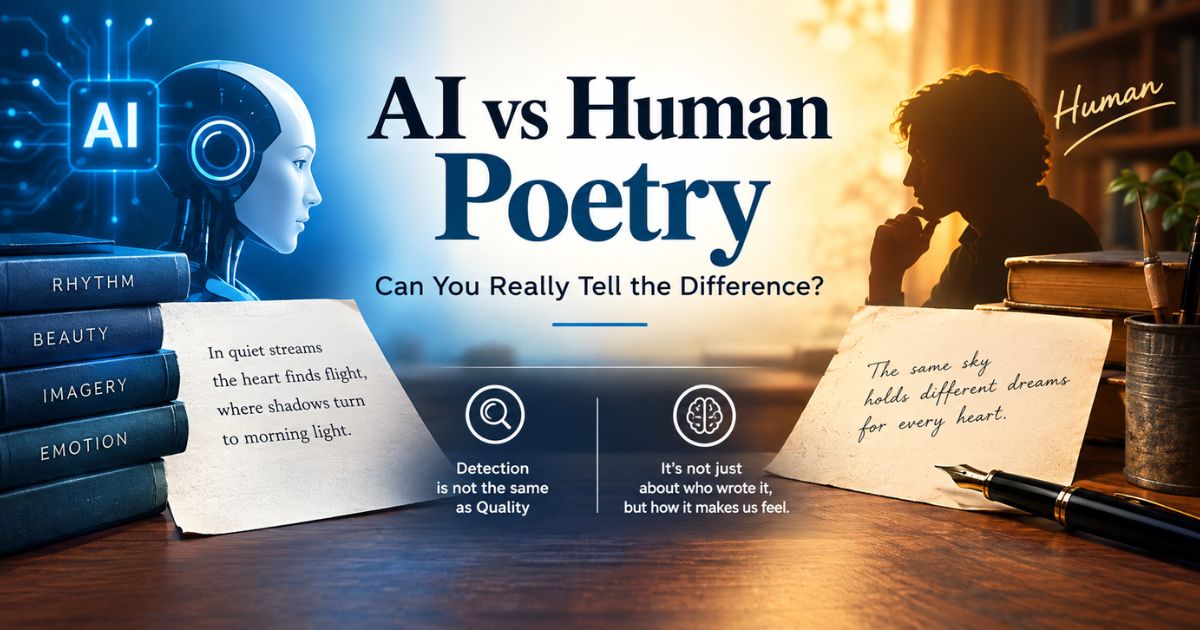
AI vs human poetry is no longer a simple question of whether readers can tell who wrote a poem. Recent research shows that people can struggle to distinguish AI-generated poetry from human poetry, but that does not prove AI poetry is objectively better.
The most important evidence comes from a 2024 Scientific Reports study by Brian Porter and Edouard Machery. It found that non-expert readers identified AI-generated poems with only 46.6% accuracy, slightly below chance. In a separate evaluation, participants also gave AI-generated poems higher ratings on several qualities, including rhythm and beauty.
That result sounds dramatic, but two different questions are involved:
Detection question: Can readers identify whether a poem was written by AI or a person?
Quality question: Is the poem actually better as poetry?
Those questions should not be treated as identical.
The study itself offers an important explanation. The AI poems were generally simpler and easier for non-experts to process, while some human poems were more complex. Many participants also had limited experience reading poetry. Therefore, an accessible AI poem could receive a favorable response without demonstrating greater literary depth.
This distinction is essential when discussing the future of poetry, literary value, creativity, and artificial intelligence.
Key Takeaways
- AI-generated poems can be difficult for people to distinguish from human poems.
- Porter and Machery’s 2024 study recorded 46.6% identification accuracy among participants in its authorship experiment.
- AI poems received higher ratings on several aesthetic measures in that study, including rhythm and beauty.
- Detection accuracy is not the same as literary quality.
- The researchers suggested that simpler, more accessible AI poems may have appealed to non-expert readers.
- Human poetry can contain ambiguity, unusual syntax, cultural references, layered meanings, and deliberate difficulty.
- A September 2026 arXiv study of Japanese haiku found that newer models, including GPT-5 and Gemini 2.5, could also produce poems that people struggled to classify reliably.
- The newer study also found a separation between aesthetic judgments and correct authorship detection.
- AI can reproduce recognizable poetic forms and surface qualities very effectively.
- Human readers should evaluate poetry through more than authorship detection alone.
- A poem’s value may depend on interpretation, context, intentionality, emotional resonance, and the possibility of rereading.
What the Research Shows About AI vs Human Poetry
The strongest starting point is the 2024 Porter and Machery study. It tested whether non-expert readers could distinguish poems generated by GPT-3.5 from poems written by ten well-known poets. The first experiment involved 1,634 U.S.-based participants.
Participants were asked to identify whether poems were written by AI or humans. Their overall accuracy was 46.6%, which was slightly below the 50% level expected from simple guessing. The researchers therefore concluded that participants were not reliably distinguishing the two sources.
The second experiment asked a different question. Participants evaluated poems on qualities such as overall quality, rhythm, imagery, sound, profundity, beauty, meaningfulness, originality, and emotional effect.
Here the results became more complicated.
AI-generated poems received higher ratings on many of the measured dimensions. The largest difference concerned rhythm, where AI poems received substantially higher ratings than the poems by the famous poets used in the experiment.
However, this does not establish the statement:
“AI poetry is better than human poetry.”
It establishes something narrower: participants in this particular experiment evaluated the AI poems more favorably on several measured dimensions.
That distinction matters because aesthetic judgment is influenced by the reader, the poem, the comparison set, the instructions, and the reader’s familiarity with poetry.
Detection Is Not the Same as Quality
Suppose 100 readers read two poems without knowing their authors. If 46 correctly identify the AI poem, that tells us something about authorship detection.
It does not automatically tell us which poem has greater artistic value.
Similarly, if readers rate one poem as more beautiful, that tells us about their reported aesthetic response. It does not create an objective ranking of literary quality.
This is especially important in poetry because quality can involve features that are difficult to measure through a short questionnaire.
A poem might deliberately use an unusual metaphor, fragmented syntax, historical reference, ambiguity, or an unresolved ending. A reader unfamiliar with those techniques could find the poem confusing rather than profound.
The 2024 researchers themselves proposed a mechanism involving simplicity. They suggested that AI poems were easier for non-experts to understand, while participants could interpret the complexity of human poems as incoherence.
What the 2024 Study Actually Demonstrates
The safest interpretation is therefore:
The study demonstrates that AI poetry can produce surface qualities that non-expert readers find appealing and that humans may struggle to identify its authorship. It does not establish that AI has surpassed human poets in overall literary quality.
That is a much more precise conclusion.
The study also had a specific population and design. Its participants were U.S.-based readers recruited through Prolific, and the poems represented selected human poets and GPT-3.5 imitations. The findings should therefore be understood within that experimental setting rather than treated as a universal measurement of every human poet, every AI model, or every kind of poetry.
Why AI Poetry Can Seem Better to Some Readers
One of the most interesting parts of the research concerns simplicity and accessibility.
A poem produced by an AI system often aims for clarity, coherence, familiar imagery, and recognizable emotional language. Those features can make a poem immediately understandable.
That can be useful. A reader may encounter a poem about loneliness and quickly recognize the emotion, the metaphor, and the intended conclusion.
Human poets, however, do not always make their meaning immediately available.
A poem may deliberately create uncertainty. It might use an image that becomes meaningful only after several readings. It might refer to history, mythology, another poem, a particular culture, or a private experience that cannot be reduced to one obvious interpretation.
In that situation, difficulty is not necessarily a defect.
Readers who regularly study poetry may know that an apparently confusing poem can become richer with rereading. The value may lie partly in the questions the poem creates rather than the speed with which it provides answers.
This is one reason the phrase “AI poetry is preferred” requires caution. Preference in a controlled experiment reflects what participants liked under those conditions. It does not settle the broader literary question of what poetry ought to accomplish.
The 2024 paper itself says the simplicity of AI-generated poetry may have made it easier for non-experts to understand and may have contributed to their preference.
There is also an important distinction between surface emotional clarity and emotional depth.
An AI system can produce a recognizable image of grief, love, loneliness, hope, or loss. It can combine familiar poetic language into a polished form. Yet whether that language expresses a distinctive human experience is a separate question.
This does not mean every human poem has greater emotional depth. Human poetry can also be predictable, repetitive, sentimental, or technically weak.
The more useful point is that authorship alone cannot determine quality.
Likewise, AI authorship alone cannot determine poor quality.
AI vs Human Poetry: A Clear Comparison
A useful way to understand AI vs human poetry is to compare specific dimensions rather than ask for one overall winner.
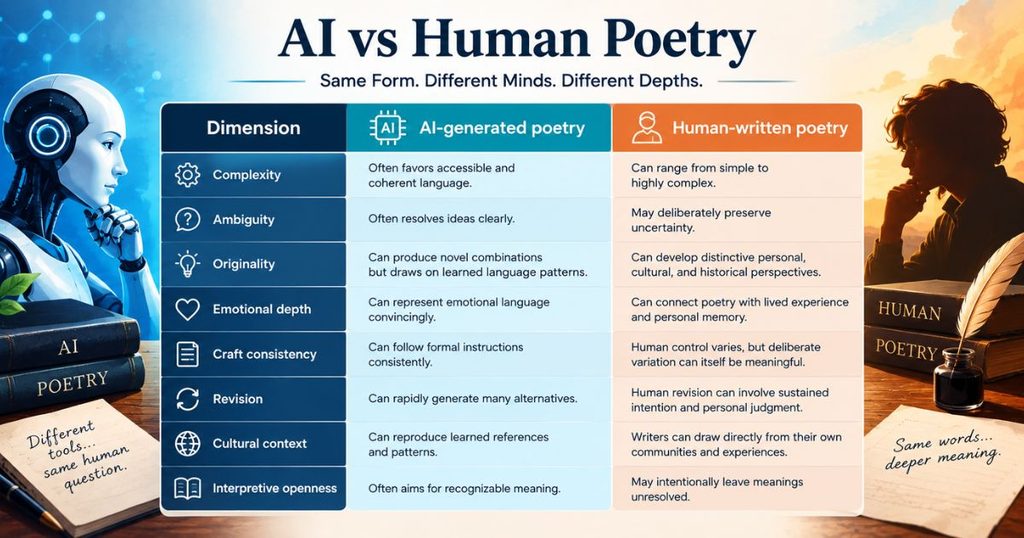
This table should not be read as a universal scorecard. Both categories contain enormous variation.
For example, an experienced poet may deliberately break grammar because the broken syntax represents psychological fragmentation. An AI system might “correct” that grammar because it has been prompted to produce fluent, polished writing.
Conversely, a human beginner may produce a poem that is awkward and conventional, while an AI system may produce a technically smoother sonnet.
Therefore, technical fluency and literary significance are different dimensions.
Readers should also distinguish originality from novelty. An AI model can generate a sentence that no individual reader has previously encountered. That does not necessarily mean the underlying idea is unprecedented.
At the same time, human poets also work within traditions. Shakespeare, Dickinson, Neruda, Angelou, Eliot, and thousands of other poets inherited forms, images, genres, and literary conventions.
The meaningful comparison is therefore not “machine versus pure originality.” It is how each kind of writer uses language, structure, context, intention, and experience.
What Newer Evidence Says About AI vs Human Poetry
The discussion did not end with GPT-3.5.
A September 2026 arXiv paper examined authorship attribution and aesthetic evaluation using Japanese haiku generated by several contemporary large language models. The models included GPT-5, Gemini 2.5, StableLM-7B, LLM-JP, Gemma-2B, and LLaMA-2.
The study found substantial variation among models. GPT-5, Gemini 2.5, and StableLM-7B performed at approximately chance level for human recognition, while some other models were more detectable. The researchers also found that fluency, coherence, and perceived poeticness predicted whether a poem was perceived as human, but did not reliably predict whether it actually was human-written.
That finding is important because it resembles the central distinction in the earlier research.
A poem can feel human without actually being human-authored.
The newer research is narrower than the 2024 study because it focuses on Japanese haiku and students at Japanese universities in Tokyo. It therefore should not be generalized to all poetry or all readers.
Nevertheless, it provides useful evidence that newer models have not made human detection straightforward. Instead, the relationship between poetic quality judgments and authorship detection remains complicated.
There is also growing discussion about whether AI should be judged only by the ability to imitate poetic surfaces. For example, a 2026 close-reading experiment by poet and researcher Sam Illingworth examined how Claude interpreted ten poems and argued that AI systems can reproduce established critical readings while missing elements such as embodied experience, cultural specificity, and what remains unsaid. Importantly, that work is an individual exploratory study rather than a definitive experimental verdict about all AI systems.
This suggests another useful distinction:
Writing a poem and reading a poem are different capabilities.
A model may generate fluent metaphor, rhyme, imagery, and structure. Whether it can independently understand why a particular image matters to a person, culture, or historical moment is a separate research question.
For readers, the practical lesson is simple: newer AI models make authorship detection increasingly difficult, but that difficulty should not be mistaken for proof that machines have settled the question of literary value.
FAQs
Q: Is AI poetry better than human poetry?
A: Current research does not justify a universal claim that AI poetry is better than human poetry. Porter and Machery found that participants rated AI poems more favorably on several dimensions, but that was a study of reader responses under specific conditions. Their findings do not establish an objective hierarchy between AI and human poetry. Newer research also separates aesthetic impressions from correct authorship detection.
Q: Can people tell AI poetry from human poetry?
A: Often, not reliably. In the 2024 Porter and Machery study, participants identified AI-generated poems with 46.6% accuracy. A newer 2026 haiku study similarly found approximately chance-level recognition for several contemporary models, including GPT-5 and Gemini 2.5. However, results vary by model, poem, language, reader, and experimental design.
Q: Why did readers prefer AI-generated poems in the 2024 study?
A: The researchers suggested that AI poems tended to be simpler and easier for non-experts to process. Participants may therefore have preferred accessible language over the complexity found in some human poems. This does not prove that AI created deeper poetry. Instead, it shows how readability, familiarity, and expectations can influence aesthetic judgment.
Q: What does AI vs human poetry research actually prove?
A: The strongest evidence shows that modern AI can produce poetry that many readers find fluent, coherent, and aesthetically appealing. It also shows that authorship detection can be unreliable. However, the research does not provide a single objective test proving that AI or humans produce universally superior poetry. Literary quality involves multiple dimensions that cannot be reduced to detection accuracy.
Q: Can AI write emotionally powerful poetry?
A: AI can generate poems that readers experience as emotionally powerful. It can reproduce familiar emotional language and construct imagery around themes such as grief, love, fear, and hope. Whether that emotional effect comes from the same kind of lived experience associated with human authorship is a different philosophical and literary question. Current reader studies can measure perceived emotion more easily than the source of that emotion.
Q: Does difficulty make human poetry better?
A: Not automatically. Difficult poetry can be profound, but it can also simply be unclear. Likewise, accessible poetry can be powerful without being simplistic. The important point is that complexity and accessibility should be evaluated in relation to a poem’s purpose, structure, imagery, context, and effect rather than treated as automatic measures of quality.
Final Thoughts
The evidence on AI vs human poetry supports a more careful conclusion than either extreme.
AI systems have become highly capable at producing fluent, coherent, aesthetically appealing poems. Research shows that many readers struggle to identify AI authorship, and newer models continue to challenge reliable detection in some poetic settings.
However, indistinguishability is not the same as superiority.
The 2024 research is especially valuable because it reveals how easily detection and preference can become confused. A reader may prefer an accessible poem without that preference proving greater literary depth. Human poetry may also reward rereading through ambiguity, cultural context, unusual form, and meanings that cannot be captured in an immediate reaction.
For that reason, the strongest way to evaluate poetry is not simply to ask, “Was this written by AI?” A better approach is to ask what the poem does with language, form, imagery, emotion, context, ambiguity, and meaning.
AI can produce convincing poetry. The larger literary question is what readers choose to value in that poetry—and why.
Recent Article : Ekphrastic Poetry: Turning Art Into Living Words

Jennifer Aston is a passionate poetry curator and writer with a deep love for the written word. She believes poetry has the power to heal, inspire, and connect people across all walks of life. Through PoemSteric, she brings together timeless and modern verses for every emotion and every moment.