
Introduction
Is ChatGPT Poetry Good? Yes, ChatGPT can write good poetry but it is not consistently great poetry. It is especially strong at following poetic forms, producing rhyme, organizing meter, and creating readable drafts. However, it can still struggle with genuinely fresh metaphor, meaningful ambiguity, distinctive voice, and the depth that can come from lived human experience.
That is the fairest answer as of September 2026.
Earlier reactions to ChatGPT poetry were often much harsher. Critics of early versions described their poems as clichéd, predictable, or overloaded with familiar metaphors. More systematic research has since shown a more complicated picture: ChatGPT can successfully generate many poetic forms, but its poetry also tends to be more uniform than human poetry.
A large 2024 study by Melanie Walsh, Anna Preus, and Elizabeth Gronski analyzed about 5,700 poems generated by GPT-3.5 and GPT-4 across 24 forms and styles. The researchers found that the models could reproduce formal features such as the appropriate length of sonnets, villanelles, and sestinas. At the same time, AI poems showed recurring preferences for rhyme, quatrains, iambic meter, first-person plural language, and familiar words such as “heart,” “embrace,” “echo,” and “whisper.”
So the real answer depends on what you mean by good.
If you mean technically competent, readable, and responsive to instructions, ChatGPT can be very good. If you mean unmistakably original, emotionally complex, culturally grounded, and artistically surprising, the answer is much less certain.
Key Takeaways
- ChatGPT can write good poetry, particularly when the task has clear formal requirements.
- It is effective at producing recognizable forms such as haiku, sonnets, villanelles, and other structured poems.
- Research has found that GPT models can follow line-count and structural conventions surprisingly well.
- ChatGPT poetry can become repetitive because models tend to favor familiar poetic vocabulary and structures.
- Strong rhyme or meter does not automatically make a poem meaningful.
- Fresh metaphor, ambiguity, cultural specificity, and distinctive voice remain harder problems.
- A 2025 study found ChatGPT-4o performed better than ChatGPT-3.5 on several tested poetry-generation tasks, including improving a flawed ballad’s rhyme scheme.
- The same study found that ChatGPT-3.5 could confidently give incorrect explanations of poetic techniques, including hallucinated examples of alliteration and assonance.
- Research published in 2026 found ChatGPT interpretations of modern Chinese poems aligned with poets’ intended meanings in more than 73% of evaluated cases, while performance was weaker on capturing poeticity itself.
- Therefore, AI poetry should be judged poem by poem, not by the label “AI.”
- The strongest practical approach is to use ChatGPT as a drafting and revision partner while applying human judgment to the finished poem.
Is ChatGPT Poetry Good?
The short answer is sometimes and increasingly so.
ChatGPT has improved considerably from the earliest versions that attracted attention in 2022. However, improvement does not mean that every poem it produces is automatically strong.
The 2024 Walsh, Preus, and Gronski study is useful because it moves beyond isolated examples. Instead of judging one funny or awkward AI poem, the researchers generated thousands of poems and compared them with a large sample of human poetry. They found that GPT-3.5 and GPT-4 could produce poems in 24 different forms and styles.
That matters because poetry is not simply free-flowing emotional language. Many forms have specific structural requirements. A sonnet, for example, traditionally has 14 lines, while a villanelle uses repeated lines and a tightly controlled structure.
ChatGPT can handle such instructions remarkably well.
What ChatGPT Does Well in Poetry
The strongest area is formal control.
Ask ChatGPT for a sonnet with 14 lines, a particular rhyme scheme, or a specific meter, and it can produce a plausible attempt almost instantly. The 2024 research specifically found that GPT models could produce poems with appropriate lengths for sonnets, villanelles, and sestinas.
A 2025 study by Christina Johanna van Staden provides another useful comparison. In that research, ChatGPT-3.5 successfully generated several English poetry forms, while ChatGPT-4o performed better when asked to improve a ballad’s rhyme scheme and preserve its lyrical qualities.
This makes ChatGPT particularly useful for:
- Testing a poetic form.
- Generating several structural possibilities.
- Exploring rhyme patterns.
- Creating first drafts.
- Reworking awkward lines.
- Trying different tones or perspectives.
- Experimenting with unfamiliar forms.
For a beginner, this can be genuinely valuable.
Suppose a student wants to understand how a villanelle works. Instead of only reading a definition, the student can ask for a sample, identify the repeating lines, examine the rhyme pattern, and then attempt one independently.
In that situation, ChatGPT functions less like a replacement poet and more like an interactive writing tool.
However, technical success is only one part of poetry.
Where ChatGPT Poetry Still Struggles
The biggest weakness is ess.
The 2024 research found that GPT poetry was considerably more constrained and uniform than human poetry. Its repeated use of rhyme, quatrains, iambic meter, first-person plural pronouns, and familiar poetic vocabulary suggests that the system has recognizable stylistic habits.
This explains why some AI poems can sound polished but strangely familiar.
Consider phrases built around “whispering winds,” “echoes of the heart,” “dancing stars,” or “silent tears.” None of these expressions is automatically bad. The problem occurs when a poem depends on familiar poetic language without giving the reader a new reason to notice it.
A strong human poem can take an ordinary image and make it strange, precise, or personally meaningful.
ChatGPT can do this sometimes. It can also produce ten variations that sound different on the surface but rely on the same underlying poetic habits.
There is another problem: explanations are not always reliable.
The 2025 study found that ChatGPT-3.5 sometimes hallucinated convincingly when explaining its own poems. Researchers reported that both ChatGPT-3.5 and its justifications could contain incorrect claims about poetic devices such as alliteration and assonance. ChatGPT-4o performed better, but the study still illustrates why literary analysis produced by AI should be checked rather than accepted automatically.
This matters because a poem can sound sophisticated while its explanation is inaccurate.
A further limitation concerns poeticity itself. A 2026 ACL study involving modern Chinese poetry found that ChatGPT’s interpretations aligned with poets’ intended meanings in more than 73% of evaluated cases, but its performance was less satisfactory in capturing poeticity.
That distinction is important.
Understanding what a poem appears to mean is not necessarily the same as understanding why its language feels poetic.
How Should You Judge an AI Poem?
The best way to answer “is ChatGPT poetry good?” is to stop judging the author first and judge the poem itself.
A useful test is to read the poem without knowing whether ChatGPT wrote it. Then ask what actually remains after the first impression disappears.
A Practical AI Poetry Checklist
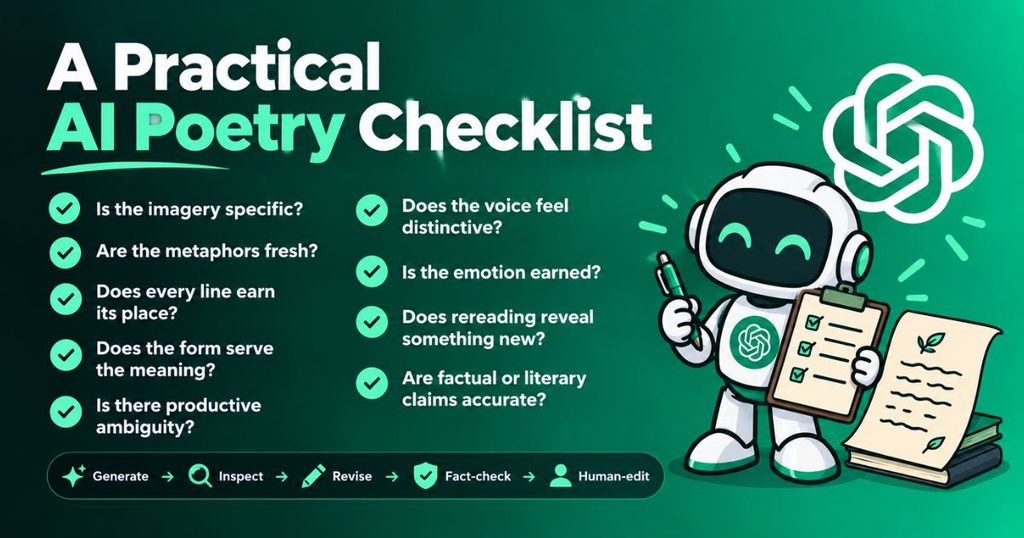
Use these questions:
- Is the imagery specific? Replace generic images with details that could belong to this poem alone.
- Are the metaphors fresh? Look for comparisons that create a new connection rather than repeat familiar poetic language.
- Does every line earn its place? Remove lines that merely sound poetic.
- Does the form serve the meaning? A perfect rhyme scheme is not useful if it forces weak wording.
- Is there productive ambiguity? Good poetry does not always explain everything immediately.
- Does the voice feel distinctive? Could the poem belong to thousands of other poems?
- Is the emotion earned? Strong emotional words do not automatically create genuine emotional depth.
- Does rereading reveal something new? A poem that becomes richer on a second or third reading often has more lasting value.
- Are factual or literary claims accurate? If the poem is accompanied by an explanation, verify it independently.
This final point is particularly important.
A useful AI workflow is generate → inspect → revise → fact-check → human-edit.
For example, if ChatGPT produces a poem about a specific historical event, do not assume that the poetic description is historically accurate. Likewise, if it claims that a line contains a particular meter or literary device, scan the line yourself.
In my own reading of AI-generated poetry, the most interesting results usually appear after the obvious first draft is rejected or heavily revised. The first version may be fluent, but the human decision about what to remove, sharpen, complicate, or replace is often where the poem becomes more individual.
The technology is also changing quickly. Research comparing ChatGPT-3.5 with ChatGPT-4o already found meaningful improvement in certain poetry tasks. Therefore, a verdict based on one model or one year’s examples should not be treated as permanent.
As newer models improve, their control of rhythm, imagery, voice, and revision may improve as well.
The more durable question is not simply “Can ChatGPT write a good poem?”
It is “What does the human writer do with the poem after the machine produces it?”
FAQs
Q: Is ChatGPT poetry good?
A: Yes, ChatGPT can produce good poetry, especially when the task involves clear form, rhyme, meter, or structural requirements. However, quality varies considerably. Its poems can rely on familiar metaphors, repeated vocabulary, and predictable emotional language. Research also shows that GPT poetry is more uniform than human poetry. Therefore, ChatGPT can create a strong poem, but readers should judge each poem for originality, imagery, voice, and emotional depth rather than assuming quality from fluent wording alone.
Q: Can ChatGPT write better poetry than humans?
A: There is no reliable general test showing that ChatGPT writes better poetry than humans. ChatGPT can outperform many people at speed, formal consistency, and following detailed structural instructions. However, human poetry varies enormously, and literary quality involves more than technical accuracy. A human poet may deliberately use ambiguity, cultural context, personal experience, or unusual language that a simple form-based comparison cannot measure.
Q: Is ChatGPT good at writing poems with rhyme and meter?
A: Yes. Formal poetry is one of ChatGPT’s stronger areas. Research found that GPT models could produce poems with appropriate lengths for forms such as sonnets, villanelles, and sestinas. A 2025 study also found ChatGPT-4o could improve a flawed rhyme scheme more successfully than ChatGPT-3.5 in the tested ballad task. Still, writers should check the actual meter and rhyme rather than trusting the model’s explanation.
Q: Why does ChatGPT poetry sometimes sound clichéd?
A: ChatGPT learns patterns from large amounts of language, so it can reproduce familiar poetic conventions extremely well. The 2024 research found recurring preferences for words and structures such as “heart,” “embrace,” “echo,” “whisper,” rhyme, quatrains, and iambic meter. These features are not inherently bad, but repeated use can make poems sound predictable. Strong human editing can remove generic language and replace it with more precise imagery.
Q: Can ChatGPT understand poetry?
A: ChatGPT can often identify themes, explain imagery, discuss symbolism, and produce plausible interpretations. A 2026 study of modern Chinese poetry found that its interpretations aligned with poets’ intended meanings in over 73% of evaluated cases. However, the researchers also found weaker performance in capturing poeticity. So ChatGPT can interpret poetry effectively in many cases, but interpretation should still be checked against the poem’s language, context, and available authorial evidence.
Q: Should I use ChatGPT to write my poetry?
A: That depends on your purpose. ChatGPT can be useful for brainstorming, exploring forms, generating alternatives, and receiving revision suggestions. However, if the poem is being submitted as your own creative work, follow your school, publisher, contest, or workplace rules about AI assistance. For learning, using ChatGPT as a feedback or experimentation tool can be more valuable than simply submitting its first draft unchanged.
Final Thoughts
So, is ChatGPT poetry good? Yes, but “good” is not the same as “consistently original” or “better than human poetry.”
As of September 2026, the evidence shows that ChatGPT is increasingly capable of handling poetic forms, rhyme, meter, interpretation, and revision. Yet research also identifies recurring stylistic patterns, uniformity, hallucinated explanations, and limitations in capturing poeticity.
The best approach is therefore neither to dismiss AI poetry nor to treat fluent AI writing as automatically excellent.
Read the poem closely. Test its imagery, form, voice, ambiguity, and emotional depth. Then revise what does not work.
That is the most honest answer: ChatGPT can write good poetry, but human judgment still matters enormously in deciding whether a particular poem is truly worth reading.
Recent Article : AI vs Human Poetry: What the Research Really Shows

Jennifer Aston is a passionate poetry curator and writer with a deep love for the written word. She believes poetry has the power to heal, inspire, and connect people across all walks of life. Through PoemSteric, she brings together timeless and modern verses for every emotion and every moment.