
Introduction
Ekphrastic poetry is poetry written in response to a work of art, usually a painting or sculpture. The poet may describe the artwork, speak to it, or imagine the story behind it. As a result, the poem becomes a second way of seeing the same image. In simple terms, the poet looks first, then writes what the looking revealed.
However, most guides stop at Homer’s shield and Keats’s urn. This article goes further. It separates actual from notional ekphrasis, places two poems about one painting side by side, and closes with a step-by-step method for writing your own.
Key Takeaways
- This form responds to an artwork, and painting and sculpture form its core tradition.
- Actual ekphrasis answers a real artwork, while notional ekphrasis invents one.
- Homer’s Shield of Achilles is the classic notional example; Auden and Williams on Bruegel’s Icarus are actual.
- Two poems on one painting can differ sharply, because one argues and the other observes.
- A strong draft moves from careful looking to a question the image cannot answer.
- The practice extends to film, dance, and music, although critics debate the label.
Ekphrasis Meaning: Actual vs. Notional Ekphrastic Poetry
The word ekphrasis comes from Greek roots meaning roughly “to speak out” or “to describe in full.” In ancient rhetoric, it named any vivid description that let listeners “see” a battle, a city, or a statue. Over time, the meaning narrowed. Today, critics often describe it as words that represent an image, a view associated with James Heffernan’s 1993 book Museum of Words.
Ekphrastic poetry narrows the idea further, because its source is a specific artwork. Within it, two types matter most: actual and notional. The comparison below shows the difference at a glance.
Quick comparison:
| Actual ekphrasis | Notional ekphrasis | |
| Source | A real, existing artwork | An imagined or invented artwork |
| Can readers check it? | Yes, in a museum or archive | No, it exists only in the text |
| Classic example | Auden and Williams on Bruegel | Homer’s Shield of Achilles |
Actual ekphrasis responds to something you can visit. Rilke’s “Archaic Torso of Apollo” (1908), widely linked to an ancient torso in the Louvre, is a well-known case, and John Ashbery’s “Self-Portrait in a Convex Mirror” (1975) answers a small painting by Parmigianino. Notional ekphrasis, in contrast, describes an artwork that exists only in the poem. The critic John Hollander helped popularize that term in the late 1980s.
Homer’s Iliad offers the oldest famous example. In Book 18, the god Hephaestus forges a shield for Achilles, decorated with earth, sea, sky, and two cities, one at peace and one at war. The great river Ocean runs around its rim. Notably, the eighteenth-century critic Gotthold Lessing observed that Homer shows the shield being made, so a still object becomes a sequence of events.
Keats’s “Ode on a Grecian Urn” (written 1819, published 1820) usually lands in the same camp. Scholars have proposed several real objects behind it, but no single urn matches. Therefore, most readers treat it as an imagined composite. The distinction matters, because notional ekphrasis frees the poet to invent, whereas actual ekphrasis invites readers to compare poem and source.
Two Poets, One Painting: Auden and Williams on Bruegel’s Icarus
Both poems respond to the same painting, traditionally attributed to Pieter Bruegel the Elder and dated around 1558. Many art historians now consider the Brussels canvas an early copy of a lost original. Icarus appears only as a pair of legs splashing near a ship, while a ploughman and a shepherd carry on. Consequently, the picture practically invites a poem about indifference.
W. H. Auden wrote “Musée des Beaux Arts” in Brussels in December 1938. His poem opens inside the museum and makes a general claim: the Old Masters understood that suffering happens while others eat, open windows, or simply walk on. The poem has two stanzas, and the second turns to Bruegel’s painting as proof. As a result, the painting becomes evidence for a thesis, delivered in a dry, conversational voice with irregular rhymes.
William Carlos Williams took a different path in “Landscape with the Fall of Icarus,” collected in Pictures from Brueghel (1962). He begins with the words “According to Brueghel” and stays with what the picture shows: spring, a farmer ploughing, the sun. Meanwhile, Icarus barely registers, and his drowning shrinks to a quiet, unnoticed splash. Williams draws no morals, and his short lines let the image speak. Notably, the title he borrows is the painting’s own, and it already puts the landscape first.
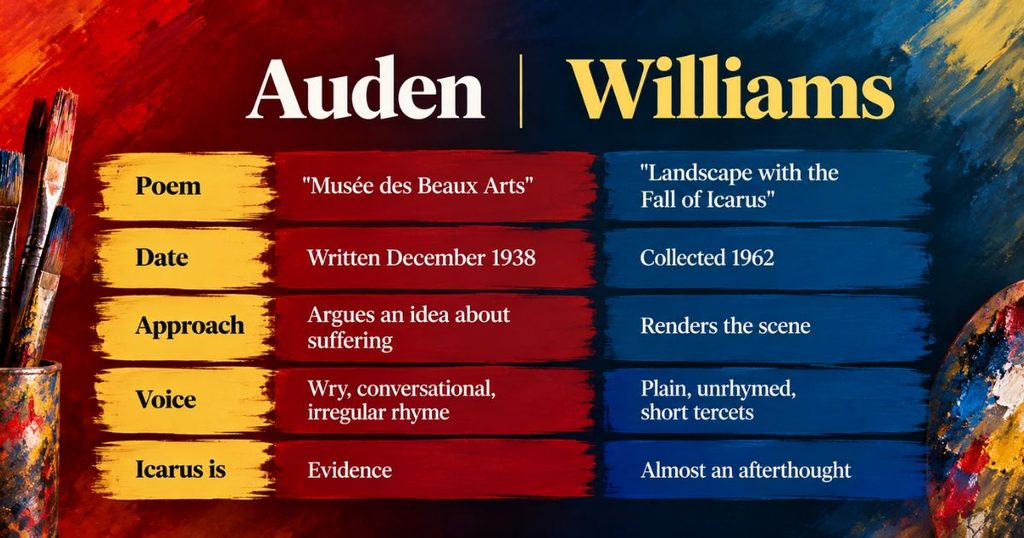
Readers often notice that neither poet is wrong. Both write actual ekphrasis, yet Auden interprets while Williams observes. In other words, identical source material produces different poems because each poet asks the picture a different question.
How to Write Ekphrastic Poetry: A Step-by-Step Method
Writing a strong poem about art takes more than admiring the picture. Instead, treat the artwork as a subject you must investigate. Follow these steps in order.
- Choose an artwork you can revisit. Pick a painting or sculpture with a good online image or a nearby museum. Many major collections, including the Metropolitan Museum of Art, offer free high-resolution images. Beginners usually do better with actual ekphrasis, because the source keeps them honest.
- Look silently for ten minutes. Do not write yet. Notice where your eye lands first and where it travels next.
- List ten literal details. Record colors, shapes, positions, and gestures. For example, before Edward Hopper’s Nighthawks (1942), you might note the red-haired woman, the man’s back, and the empty street outside the bright diner.
- Find the unanswered question. Ask what the image withholds: what happened just before, who is missing, or what the figures are not saying.
- Choose a stance. You can describe the work, address it, speak as a figure inside it, speak as the artist, or argue with it. Each stance produces a different voice. For instance, speaking as the ploughman in Bruegel’s painting would yield a very different poem from addressing Icarus directly.
- Draft from concrete details. Build the first version from your list, and keep one detail as the poem’s central image.
- Add a turn. Move from what the picture shows to what it means to you. Otherwise, the poem stays a caption.
- Revise and credit. Cut phrases such as “the painting shows,” then read the poem aloud. Finally, name the artwork, artist, and year in the title or an epigraph.
As a result, a poem on Nighthawks might begin with the diner’s harsh light and end by wondering why no door is visible. That final question is the turn, and it belongs to the poet rather than the painter.
Most weak drafts share three mistakes. First, they read like a list of colors, so nothing changes from line to line. Second, they explain the painting instead of experiencing it. Third, they ignore context such as the title, date, and museum label. Therefore, check the label before you revise, because a single fact can reshape the poem.
Beyond Painting: Film, Dance, and Music
The core tradition centers on painting and sculpture, but the same habits transfer. A poet can respond to a film still, a dance performance, or a piece of music. However, these forms unfold in time, so the poem must choose a single moment or follow one repeated movement. For example, a poem about a symphony might trace one recurring phrase from the first bar to the last.
Some critics prefer to reserve the term for visual art, whereas others use it more loosely. Therefore, if you write about a dance or a song, name your source clearly. Then apply the same steps: observe closely, find the unanswered question, and let the poem turn.
FAQs
Q: Where does the word “ekphrasis” come from?
A: Ekphrasis comes from Greek roots meaning roughly “to speak out” or “to describe fully.” Ancient rhetoric teachers used it for any vivid description, whether of a battle, a place, or a statue, that made listeners feel they could see it. Modern ekphrastic poetry keeps that goal but narrows the subject to a specific artwork. As a result, today’s poems still try to make readers see something that is not physically in front of them.
Q: What is the difference between actual and notional ekphrasis?
A: Actual ekphrasis responds to a real artwork that readers can look up or visit, such as Bruegel’s Icarus painting behind Auden’s and Williams’s poems. Notional ekphrasis describes an artwork that exists only in the text, such as Achilles’ shield in Homer’s Iliad. The difference affects how readers judge the poem. With actual ekphrasis, they can compare words and images; with notional ekphrasis, the poem is the only evidence.
Q: What are the best-known examples of ekphrastic poetry?
A: The best-known examples of ekphrastic poetry include Homer’s description of Achilles’ shield, Keats’s “Ode on a Grecian Urn,” Auden’s “Musée des Beaux Arts,” and Williams’s “Landscape with the Fall of Icarus.” Rilke’s “Archaic Torso of Apollo” and Anne Sexton’s poem on Van Gogh’s “The Starry Night” are also widely taught. Together, they cover imagined artworks, real paintings, and sculpture, so they make a useful starting reading list.
Q: Is Keats’s “Ode on a Grecian Urn” actual or notional ekphrasis?
A: Most critics treat it as notional ekphrasis. Keats drew on ancient art he had seen or studied, and scholars have suggested several possible sources, but no single known urn matches his description. Therefore, the urn is best read as an imagined composite. This helps explain why the poem feels free to ask questions the artwork could never answer, such as who the figures are and where they are going.
Q: Can poets write ekphrasis about music, film, or dance?
A: Yes, although opinions differ. Traditionally, ekphrastic poetry responds to visual art such as painting and sculpture, and some critics keep the term for that. Others apply it to film, dance, and music because the poem still translates one art form into words. If you try this, remember that these arts move through time, so choose one moment or one repeated gesture and describe it precisely.
Final Thoughts
Ekphrastic poetry works because a poem and a picture see differently. Homer invented a shield, Keats imagined an urn, and Auden and Williams looked at the same painting and found an argument and a scene. Consequently, the artwork never limits the poem; it gives the poet something to answer.
Therefore, begin with careful looking, list what is actually there, and ask what the image withholds. Then choose a stance, add a turn, and credit your source. Whether the artwork is real or notional, the discipline is the same: see clearly, then speak. In the end, the poem should give readers something the image alone could not.
Recent Article : Villanelle Examples: How Repetition Becomes Art

Jennifer Aston is a passionate poetry curator and writer with a deep love for the written word. She believes poetry has the power to heal, inspire, and connect people across all walks of life. Through PoemSteric, she brings together timeless and modern verses for every emotion and every moment.