
Introduction
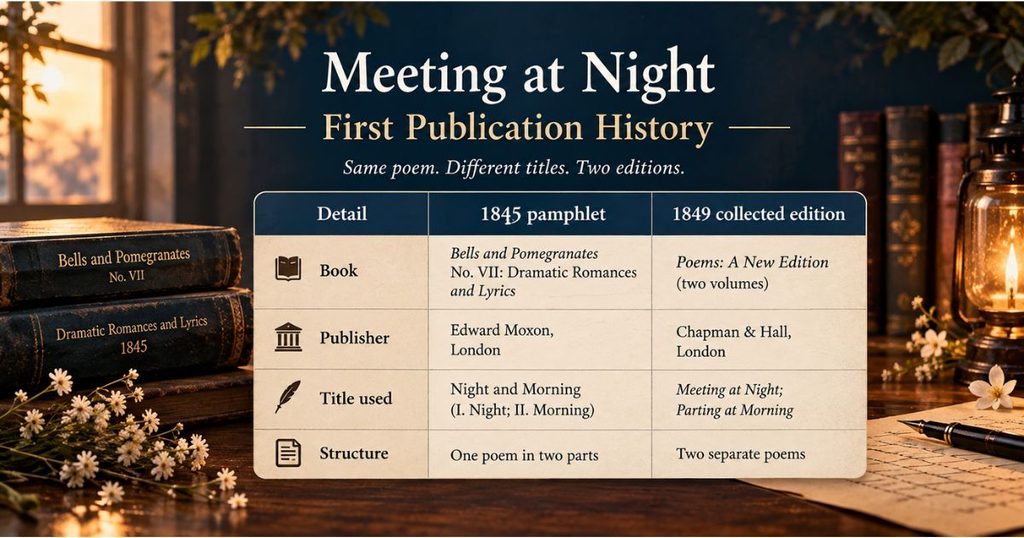
Robert Browning’s poem “Meeting at Night” was first published in 1845 in Dramatic Romances and Lyrics. That book was No. VII of his Bells and Pomegranates pamphlet series, issued in London by Edward Moxon. However, the poem did not carry its familiar title. Browning printed it as the first half of a two-part poem called “Night and Morning.”
So, where was Meeting at Night first published, and why do websites disagree? The confusion comes from the title change. Browning split the poem into two separate pieces only in 1849, so later anthologies tell a different story from the original pamphlet.
This guide traces the Meeting at Night first publication step by step. First, you will see the pamphlet, its publisher, and its date. Next, the guide explains what the poem was first called and when it became two poems. Along the way, Browning’s courtship of Elizabeth Barrett adds useful context. Finally, a simple method shows how to check these facts yourself.
Accuracy matters here. For example, a student who cites the wrong book may lose marks on an essay. Likewise, an editor who prints the wrong title risks losing readers’ trust. As a result, a few minutes of checking is well worth the effort.
Key Takeaways
Here are the verified facts in brief:
- Original publication: Meeting at Night first appeared in print in 1845, in Dramatic Romances and Lyrics. Edward Moxon published that pamphlet in London.
- Series: That pamphlet was No. VII of Bells and Pomegranates, an eight-part series Browning released between 1841 and 1846. The series mixed plays with shorter dramatic poems.
- Original title: In 1845, the poem was called “Night and Morning,” with parts labeled “I. Night” and “II. Morning.” This is the Meeting at Night original title.
- Later change: Browning separated the parts in his 1849 collected edition, Poems: A New Edition. That edition introduced the titles “Meeting at Night” and “Parting at Morning.”
- Common mistake: Some sources give 1849 as the first publication year. However, 1849 only marks the first appearance under the current titles.
- Author: Robert Browning (1812–1889) wrote the poem, and it remains a well-known Victorian love poem.
- Context: Browning began writing to Elizabeth Barrett in January 1845, the year the pamphlet appeared. Many readers link the poem’s romantic mood to that courtship.
- Modern reading: Because most anthologies print the two poems separately, many readers never see the original one-poem structure. As a result, older facts often get lost.
- Verification: Bibliographies, library catalogues, and reference works confirm these details, so you can check them yourself in minutes.
Dramatic Romances and Lyrics: Where Was the Poem Meeting at Night First Published?
The direct answer is a small paperbound pamphlet titled Dramatic Romances and Lyrics. It appeared in London in 1845 as No. VII of the Bells and Pomegranates series, and Edward Moxon was the publisher. Robert Browning, who wrote Meeting at Night, issued these booklets in small editions. As a result, his poems became widely known only after later collected editions.
Other famous poems shared that Browning 1845 poetry pamphlet, including “How They Brought the Good News from Ghent to Aix” and “The Lost Leader.” This shows that No. VII was a major collection, even though it looked modest.
The timing also adds context. Browning first wrote to Elizabeth Barrett in January 1845. According to biographical accounts, he later sent her manuscripts from this collection for proofreading. In other words, the Meeting at Night publication history begins just as their courtship did.
Readers who compare this pamphlet with a modern anthology are often surprised. The pamphlet lists “Night and Morning,” while the anthology shows two separate titles. That gap helps explain why some summaries repeat the wrong details.
Night and Morning: The Original 1845 Title
In 1845, Browning did not print two poems. Instead, the Night and Morning Browning poem appeared as one work in two parts, and the table of contents listed it as a single item. The heading was “Night and Morning,” with sections marked “I. Night” and “II. Morning.”
The first section is the poem we now call “Meeting at Night.” It follows a man who crosses the sea by boat, walks along a beach, and crosses three fields to reach his beloved’s home. The second section became “Parting at Morning” and shows him leaving at dawn.
Together, the two parts describe one cycle: arrival in darkness, then departure in daylight. Some critics of the time objected, however, because the lovers seemed unmarried and the meeting was secret.
The 1849 Split Into Two Poems
Browning changed the arrangement in 1849. In his collected Poems: A New Edition, a two-volume set from Chapman & Hall, he separated the halves and retitled them “Meeting at Night” and “Parting at Morning.” This Meeting at Night 1849 version is the form most readers meet today.
However, the split changes how readers experience the poem. When you read only “Meeting at Night,” you miss the second half that completes the story. For that reason, some scholars describe the two as companion poems best read together.
Publication History Check: Where Was the Poem Meeting at Night First Published, Step by Step
You do not need to trust any single website. Here is how to verify a poem’s first publication in six steps. Each step uses a different kind of source, which makes the result more reliable.
- Start with a scholarly bibliography. The best source for Browning’s early editions is a detailed bibliography. It should list Bells and Pomegranates No. VII: Dramatic Romances & Lyrics (London: Moxon, 1845).
- Confirm the series. Check a reference work such as the Concise Oxford Companion to English Literature. It lists the series and dates Dramatic Romances and Lyrics to 1845.
- Find the pamphlet itself. Search library catalogues and digital archives for the 1845 pamphlet or a facsimile. Then read the table of contents.
- Look for the original title. Find “Night and Morning” with its two numbered parts. You will not find “Meeting at Night” there as a separate heading.
- Compare the 1849 edition. Open Poems: A New Edition (Chapman & Hall, 1849). Here, the two halves appear as separate poems.
- Write the citation. Record the title, series, publisher, city, and year. Also note whether you used a first edition or a later one.
The table below compares the two printings.
Two mistakes are common. First, 1849 marks the first appearance under the current titles, not the first printing of Meeting at Night. Second, do not confuse Dramatic Romances and Lyrics (1845) with Dramatic Lyrics (1842). Both belong to Bells and Pomegranates, but they are different volumes.
For example, imagine a student who finds 1849 on a poetry website. By following steps three to five, the student can see the poem was already in print four years earlier. Finally, the student should state whether the source is a Browning poems first edition or a modern reprint.
FAQs
Q: When was Meeting at Night first published?
A: Robert Browning’s “Meeting at Night” first appeared in print in 1845. It was part of Dramatic Romances and Lyrics, the seventh pamphlet in his Bells and Pomegranates series. However, it was not printed under that title. It appeared as “Night and Morning,” the first half of a two-part poem. The separate title “Meeting at Night” arrived in 1849, when Browning’s collected Poems appeared.
Q: Where was Meeting at Night first published, and who published it?
A: The short reply to “where was the poem Meeting at Night first published” is a London pamphlet from 1845. Edward Moxon published it as part of Bells and Pomegranates, a series of eight paperbound parts issued between 1841 and 1846. Browning released the series in small editions, so the poems became widely known only after later collected editions such as the 1849 Poems.
Q: What was Meeting at Night originally called?
A: In 1845, the poem was called “Night and Morning.” The heading covered two numbered parts, “I. Night” and “II. Morning.” Browning later separated them, so the first part became “Meeting at Night” and the second became “Parting at Morning.” When readers ask “where was the poem Meeting at Night first published,” the best clue is that older title. Look for it in the table of contents of Dramatic Romances and Lyrics. Searching only for the modern title will miss it.
Q: Why did Browning split Night and Morning into two poems?
A: Sources consulted for this guide confirm the split but do not record a clear reason from Browning himself. The change appeared in his 1849 collected Poems: A New Edition. However, some critics argue that separating the halves weakens the poem, since the second part completes the story of the meeting. In that sense, the split changes how readers experience the whole. As a result, many scholars suggest reading the pair together.
Q: Is Meeting at Night in Dramatic Lyrics or Dramatic Romances and Lyrics?
A: It belongs to Dramatic Romances and Lyrics (1845), not Dramatic Lyrics (1842). The two are different pamphlets in the same Bells and Pomegranates series. Dramatic Lyrics is No. III and includes “My Last Duchess,” while Dramatic Romances and Lyrics is No. VII. This distinction matters when you research “where was the poem Meeting at Night first published,” because mixing up the titles leads to the wrong year.
Final Thoughts
The answer to “where was the poem Meeting at Night first published” is clear once you know the title history. Browning printed it in 1845 in Dramatic Romances and Lyrics, No. VII of Bells and Pomegranates, under the heading “Night and Morning.” Only in 1849 did it become the standalone poem readers know today.
This story shows why original sources matter. Anthologies are convenient, but they often hide earlier forms of a text. Therefore, checking the Meeting at Night original publication, the series, and the publisher gives you the full picture.
For students, the practical lesson is simple. Cite the edition you actually used, and mention the original title when it helps. Teachers and editors can follow the same rule to improve accuracy and build trust.
Context also deepens the poem. Browning wrote it while his correspondence with Elizabeth Barrett was growing, and early critics questioned its secret meeting. Reading this Victorian love poem beside its companion, “Parting at Morning,” brings that world to life.
If you research Browning’s other early work, apply the same steps to each poem. Start with the Bells and Pomegranates numbers, then compare later editions. With this method, you can confirm the Meeting at Night first publication, or any other original printing, with confidence.
Recent Article : The Man Who Thinks He Can: Full Poem & True Author

Jennifer Aston is a passionate poetry curator and writer with a deep love for the written word. She believes poetry has the power to heal, inspire, and connect people across all walks of life. Through PoemSteric, she brings together timeless and modern verses for every emotion and every moment.