
Introduction
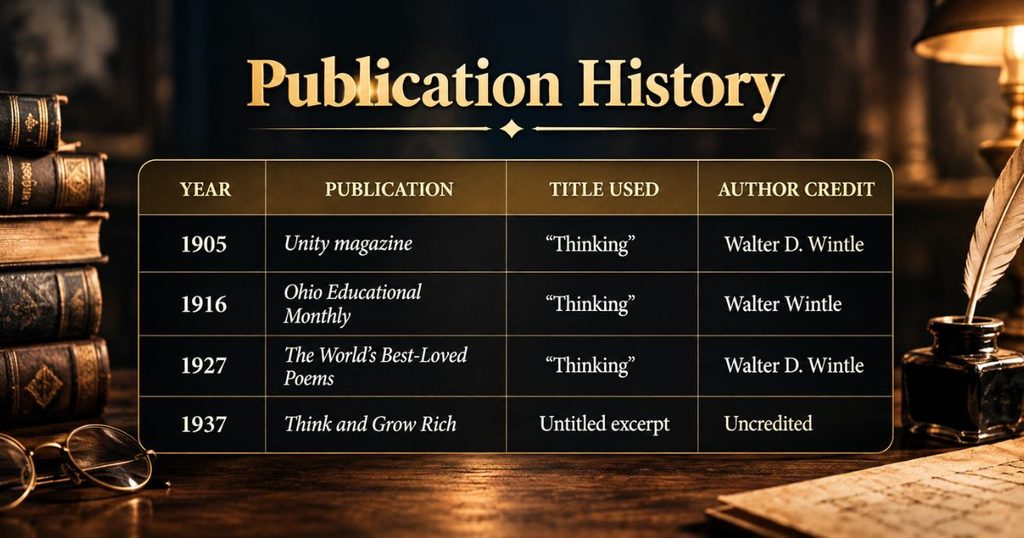
The man who Thinks He can poem was written by Walter D. Wintle, and its original title was actually “Thinking” not “The Man Who Thinks He Can.” The earliest confirmed printing appeared in 1905 in Unity magazine, published by the Unity School of Christianity. Almost nothing else is documented about Wintle’s life, which is part of why this poem’s history has become tangled over the past century.
In researching this piece, I found that most pages online simply reprint the verse without checking where it actually came from. That gap matters, because this poem has been mistitled, misspelled, and even stripped of its author’s name entirely in some famous reprintings. Below, you’ll get the full, accurate text, plus a clear, sourced account of who wrote it and how it spread.
Key Takeaways
- The poem’s true original title is “Thinking,” first published in 1905.
- Its author, Walter D. Wintle, remains almost entirely undocumented as a historical figure.
- The now-popular title “The Man Who Thinks He Can” was added later and was never used by Wintle himself.
- Napoleon Hill printed the poem in Think and Grow Rich (1937) without any author credit, which caused decades of “anonymous” misattribution.
- Some editions misspell the author’s name as “Walter B. Wintle” instead of the correct “Walter D. Wintle.”
- Bruce Lee is documented to have handwritten his own copy of the poem, showing its reach well beyond literary circles.
The Man Who Thinks He Can Poem | Full Text
Here is the poem in full, based on the earliest known 1905 printing, which is widely regarded as the most accurate surviving version:
If you think you are beaten, you are;
If you think you dare not, you don’t.
If you’d like to win, but you think you can’t,
It is almost a cinch you won’t.
If you think you’ll lose, you’ve lost;
For out in this world we find
Success begins with a fellow’s will
It’s all in the state of mind.
If you think you’re outclassed, you are;
You’ve got to think high to rise;
You’ve got to be sure of yourself before
You can never win a prize.
Life’s battles don’t always go
To the stronger or faster man;
But soon or late the man who wins,
Is the one who thinks he can.
This poem is in the public domain, so you’re free to read, print, or share it without permission. As a result, it has been copied millions of times over the past century often without any note about where it actually came from, which is exactly the gap this article aims to close.
Who Really Wrote “The Man Who Thinks He Can”?
The short, verified answer is Walter D. Wintle, a poet who was active in the late 19th and early 20th centuries. However, that’s nearly the full extent of what’s reliably known about him. No biography, birth record, or personal history has been definitively tied to his name, which is unusual for someone whose single poem has been read by millions.
Walter D. Wintle | What We Actually Know
Readers often tell us they assumed a poem this famous must have a well-documented author behind it. That assumption doesn’t hold here. What we do know comes entirely from the publications that printed his work, not from any independent biographical record. The earliest confirmed appearance under his name was in 1905, in Unity magazine. It appeared again in 1916 in the Ohio Educational Monthly, and again in 1927 in James Gilchrist Lawson’s anthology The World’s Best-Loved Poems, published by Harper & Brothers. Each of these early sources consistently credits “Walter D. Wintle,” which is a strong signal that this is the correct name even though nothing further about his life survives.
Why the Poem Is Often Credited as Anonymous
The biggest reason this poem lost its author’s name is Napoleon Hill’s 1937 bestseller, Think and Grow Rich. Hill printed the poem without any credit at all, and because that book went on to sell tens of millions of copies, an entire generation of readers encountered the poem as an “anonymous” piece of motivational writing. From there, the anonymous framing simply repeated itself across decades of second hand reprintings, moving further from the original, credited source each time.
The Original Title Was “Thinking,” Not “The Man Who Thinks He Can”
This is one of the most consistently overlooked facts about the poem. Very early, dated printing 1905, 1916, and 1927 titles the poem “Thinking.” The now-common title, “The Man Who Thinks He Can,” appears to have emerged later, likely pulled directly from the poem’s final line, and it eventually became so widely used that most readers today assume it was always the real title.
To put the documented timeline in order:
For accuracy, “The Man Who Thinks He Can” is best treated as a popular, unofficial title rather than the poem’s genuine original name. If you’re citing this poem in any formal or academic context, “Thinking” is the more historically correct title to use.
How This Poem Became Famous
The poem’s spread wasn’t driven by a single moment; it built gradually across very different audiences over more than a century. Its use in Think and Grow Rich is probably the single biggest driver of modern awareness, simply because of how many people have read Hill’s book since 1937. However, the poem also reached readers through entirely separate channels.
A striking example: martial artist and actor Bruce Lee is documented to have handwritten his own copy of the poem on a lined page, titling it “Thinking (The Man Who Thinks He Can).” That artifact, later sold at auction, shows the poem was circulating well outside literary or self-help publishing by the mid-20th century reaching athletes, performers, and everyday readers who found it through word of mouth rather than a bookstore shelf.
In the decades since, the poem has become a staple in sports locker rooms, business coaching materials, and classroom motivational posters. Its short, direct structure of four tight stanzas built entirely around the idea that belief shapes outcome makes it easy to memorize and repeat, which likely explains its unusual staying power compared to other inspirational verse from the same era.
FAQs
Q: Who wrote the man who thinks he can poem?
A: The poem was written by Walter D. Wintle, first published in 1905 under its original title, “Thinking,” in Unity magazine. Very little else is documented about Wintle’s life. Some later editions misspell his name as “Walter B. Wintle,” but the earliest, most consistent sources across three separate early-20th-century publications confirm “Walter D. Wintle” as the correct name.
Q: Is “The Man Who Thinks He Can” the poem’s real title?
A: No. Every early, dated printing of the poem from 1905, 1916, and 1927 uses the title “Thinking.” “The Man Who Thinks He Can” became popular later, likely drawn from the poem’s closing line, and eventually replaced the original title in most modern reprintings, even though Wintle never used that title himself.
Q: Why is this poem sometimes listed as anonymous?
A: Napoleon Hill printed the poem in his 1937 bestseller Think and Grow Rich without crediting an author. Because that book sold widely, generations of readers encountered the poem with no name attached, and that uncredited version was copied repeatedly, which is the main reason “anonymous” attribution spread so widely.
Q: Is the man who thinks he can poem in the public domain?
A: Yes. Given its earliest confirmed publication in 1905, the poem is in the public domain in the United States, meaning it can legally be reprinted, quoted in full, or shared without needing permission or paying royalties, which explains why it appears on so many unattributed websites and inspirational materials.
Q: What is the poem actually about?
A: The poem’s central message is that self-belief directly shapes outcomes that hesitation, self-doubt, and assuming defeat tend to produce exactly those results, while confidence and a “high” mindset improve your real chances of success. It’s built entirely around short, parallel “if you think” statements that build toward its famous closing line.
Q: Did Bruce Lee really write out this poem himself?
A: Yes. A handwritten, unsigned copy of the poem in Bruce Lee’s own writing has been documented and sold at auction. He titled his version “Thinking (The Man Who Thinks He Can),” combining both the original and popularized titles, which shows how widely and informally the poem had already spread by the mid-20th century.
Final Thoughts
The man who thinks he can poem carries more history than its short, four-stanza structure suggests. Behind its familiar lines sits a poet almost nobody can identify beyond a name, a title that quietly changed over a century of reprinting, and a strange path to fame that runs through a bestselling self-help book and a handwritten page found among Bruce Lee’s belongings. Getting these details right doesn’t change how the poem reads; it still lands the same way it did for readers in 1905 but it does mean you’re now working from the real record instead of a repeated guess.
If you’re sharing this poem, printing it, or citing it anywhere, you can now do so with confidence: the author is Walter D. Wintle, the original title was “Thinking,” and its 1905 first printing is exactly where this often-mistold story actually begins.
Recent Article : Sada-e-Sarhad Bus Poem: What It Really Means

Jennifer Aston is a passionate poetry curator and writer with a deep love for the written word. She believes poetry has the power to heal, inspire, and connect people across all walks of life. Through PoemSteric, she brings together timeless and modern verses for every emotion and every moment.