
Introduction
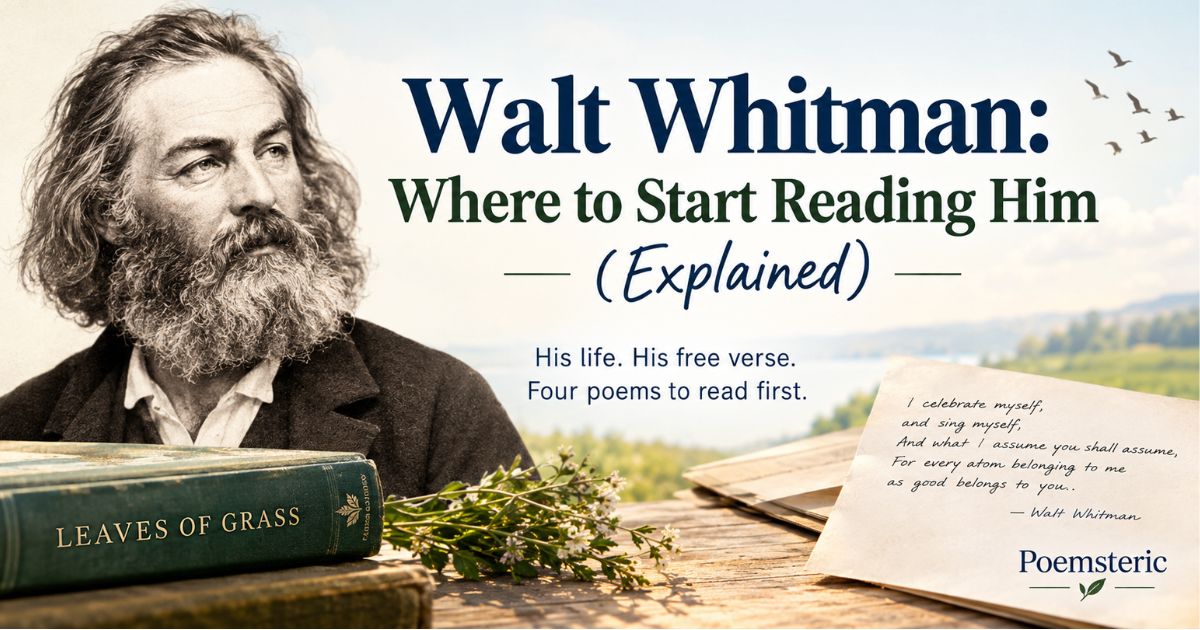
Walt Whitman was a 19th-century American poet best known for Leaves of Grass, a self-published collection he kept revising for nearly four decades, and for pioneering free verse poetry without regular rhyme or meter. If you’re new to him, the honest answer to “where do I start” is: not with all 400-plus poems he eventually wrote.
This guide gives a short, accurate account of who he was, explains free verse in plain terms, and the part most overviews skip points to four specific poems worth reading first, with a reason for each. Readers often land on a Whitman poem in a syllabus or a quote online and want context before going further; this is built to give exactly that, without asking you to read a 500-page biography first.
Key Takeaways
- Whitman (1819–1892) is best known for Leaves of Grass, first self-published in 1855 and expanded across roughly nine editions during his lifetime.
- He’s widely called the “father of free verse” for abandoning regular rhyme and meter in favor of rhythms closer to natural speech and biblical cadence.
- His best-known poems include “O Captain! My Captain!” and “When Lilacs Last in the Dooryard Bloom’d,” both written after Lincoln’s assassination.
- He spent roughly three years during the Civil War visiting and caring for wounded soldiers in Washington, D.C. hospitals.
- If you’re reading him for the first time, start with a small handful of shorter, clearer poems rather than the full length of Song of Myself.
Who Was Walt Whitman?
Whitman was born on May 31, 1819, in West Hills, Long Island, New York, the second of nine children in a working-class family. His formal schooling was limited; he began working as a printer’s apprentice around age 12 and later taught in one-room schoolhouses on Long Island before moving into journalism, eventually editing the Brooklyn Daily Eagle. He also cultivated a deliberately plain, common-man persona he went by “Walt” rather than the more formal “Walter,” and in Song of Myself described himself as “one of the roughs, a kosmos,” a self-image that matches the democratic, unpolished voice running through his poetry.
In 1855, Whitman self-published the first edition of Leaves of Grass — twelve untitled poems that he would keep expanding and revising for the rest of his life. Ralph Waldo Emerson, already a major literary figure, wrote to Whitman after reading it that it was, in his words, “the most extraordinary piece of wit and wisdom that America has yet contributed.” Not every reader agreed: the collection’s frank treatment of the human body drew enough disapproval that Whitman reportedly lost a government clerkship over it.
Whitman wrote with unusual openness about love between men, particularly in poems later grouped as the “Calamus” cluster, and many biographers connect this directly to his own sexuality. Whitman himself never labeled his identity in the terms we’d use today, but this part of his biography is well documented and adds real context to several of his poems, rather than being a side note to skip past.
During the Civil War, Whitman worked as a government clerk in Washington, D.C., and spent roughly three years of his free time visiting wounded soldiers in military hospitals writing letters home for them, sitting with them, and bringing small comforts. That experience shaped Drum-Taps (1865) and its sequel, which includes his two elegies for the assassinated Abraham Lincoln. After a serious stroke in 1873, Whitman moved to his brother’s home in Camden, New Jersey, where he lived until his death on March 26, 1892.
Why Whitman Is Called the Father of Free Verse
Almost every source that covers Whitman calls him the pioneer of free verse, but few actually explain what that term means for someone encountering it for the first time. In my own reading of the poem “Song of Myself,” what stands out immediately isn’t a missing rhyme scheme it’s how much the lines sound like someone actually talking, in long, rolling sentences that build rather than snap shut on a rhyme.
What “Free Verse” Actually Means
Free verse is poetry that doesn’t follow a fixed rhyme scheme or a regular, countable rhythm (the kind you’d find in a sonnet or a traditional ballad). Instead, Whitman built his lines around natural speech patterns and the long, repeating rhythms of biblical poetry sentences that expand, list, and circle back rather than snap into a tight, predictable beat.
Compare that to a traditional 14-line sonnet, where every line has to land in roughly the same length and rhyme on schedule: Whitman simply let a thought run as long as it needed to. This was a real break from nearly every major English-language poet before him, which is exactly why the label “father of free verse” has stuck for over 150 years.
Where to Start: 4 Whitman Poems Worth Reading First
Here’s a short, deliberately limited list, not the 40-plus poems a typical archive hands you with no guidance at all. Read these in order and each one should feel a little less unfamiliar than the last:
- “O Captain! My Captain!” Unusually for Whitman, this one actually rhymes, which makes it the gentlest entry point into his work and his grief over Lincoln’s death.
- “I Hear America Singing” Short, clear, and built around a single accessible idea: the dignity of ordinary work and ordinary people, one of Whitman’s most consistent themes.
- “A Noiseless Patient Spider” A short poem built around one clear image, a spider spinning a web, standing in for the soul reaching out for connection. A good next step once the rhyme-free rhythm of the first two feels familiar.
- “Song of Myself” (the opening lines) His most essential and most quoted work, but also his longest. Read just the famous opening section first, rather than all 52 sections at once, to get a real feel for his voice before committing to the full length.
Two Poems for Lincoln, and Why They Matter
“O Captain! My Captain!” and “When Lilacs Last in the Dooryard Bloom’d” were both written in the months after Lincoln’s assassination in April 1865, and reading them side by side shows two very different sides of Whitman’s range. The first uses traditional rhyme and a ship-and-captain metaphor to reach a wide, grieving public directly; it’s the poem most anthologized in schools for exactly that reason.
The second is a much longer, freer elegy built around recurring natural images (lilacs, a star, a hidden bird) rather than a single controlling metaphor, and it’s generally considered the deeper, more ambitious of the two by scholars, even though it’s less quoted.
FAQs
Q: Who was Walt Whitman?
A: Walt Whitman (1819–1892) was an American poet, essayist, and journalist best known for Leaves of Grass, a poetry collection he first self-published in 1855 and continued revising for nearly forty years. He’s widely regarded as the father of free verse for abandoning traditional rhyme and meter, and he’s remembered alongside Emily Dickinson as one of the two poets who shaped a distinctly American poetic voice in the 19th century.
Q: What is Whitman most famous for?
A: Walt Whitman is most famous for Leaves of Grass and for pioneering free verse in English-language poetry. His two elegies for Abraham Lincoln, “O Captain! My Captain!” and “When Lilacs Last in the Dooryard Bloom’d,” are among his most widely read individual poems, alongside “Song of Myself,” his sprawling, career-defining exploration of the self, the body, and American democracy.
Q: Which Whitman poem should I read first?
A: “O Captain! My Captain!” is the most accessible starting point, since it uses traditional rhyme unlike most of Whitman’s other work. From there, “I Hear America Singing” and “A Noiseless Patient Spider” are both short and built around one clear idea. Save the full length of “Song of Myself” for once his rhythm feels familiar; reading just its famous opening lines first is a reasonable middle step.
Q: Why is Whitman called the father of free verse?
A: Walt Whitman is called the father of free verse because he largely abandoned the regular rhyme and meter that defined most English-language poetry before him, writing instead in long, flowing lines shaped by natural speech and by the rhythms of biblical poetry. This was a genuine break from convention in his era, and it directly influenced generations of later poets, from Allen Ginsberg to Langston Hughes.
Q: Was Whitman a nurse in the Civil War?
A: Not in a formal, credentialed sense, but Whitman did spend around three years during the Civil War visiting wounded soldiers in Washington, D.C. hospitals, offering comfort, writing letters home on their behalf, and bringing small gifts. This experience shaped some of his most personal poems, collected in Drum-Taps, and it’s often described informally as his time as a volunteer nurse.
Final Thoughts
Whitman’s reputation as the father of free verse and the author of Leaves of Grass is well earned, but that reputation alone doesn’t tell a new reader where to actually begin. The honest starting point isn’t the full sweep of his 400-plus poems; it’s a small, deliberately chosen handful that show his range without demanding a full read of “Song of Myself” on day one.
Start with “O Captain! My Captain!” for its accessibility, move to “I Hear America Singing” and “A Noiseless Patient Spider” for a taste of his freer rhythm, and only then take on the opening of his longest and most ambitious work. Read in that order, Walt Whitman stops being an intimidating 19th-century name on a syllabus and starts being a poet whose voice is genuinely easy to recognize after just a few pages plain-spoken, generous, and unmistakably his own.
Recent Article : Who Are Called White Sheep in the Poem Clouds? Explained

Jennifer Aston is a passionate poetry curator and writer with a deep love for the written word. She believes poetry has the power to heal, inspire, and connect people across all walks of life. Through PoemSteric, she brings together timeless and modern verses for every emotion and every moment.