
Introduction
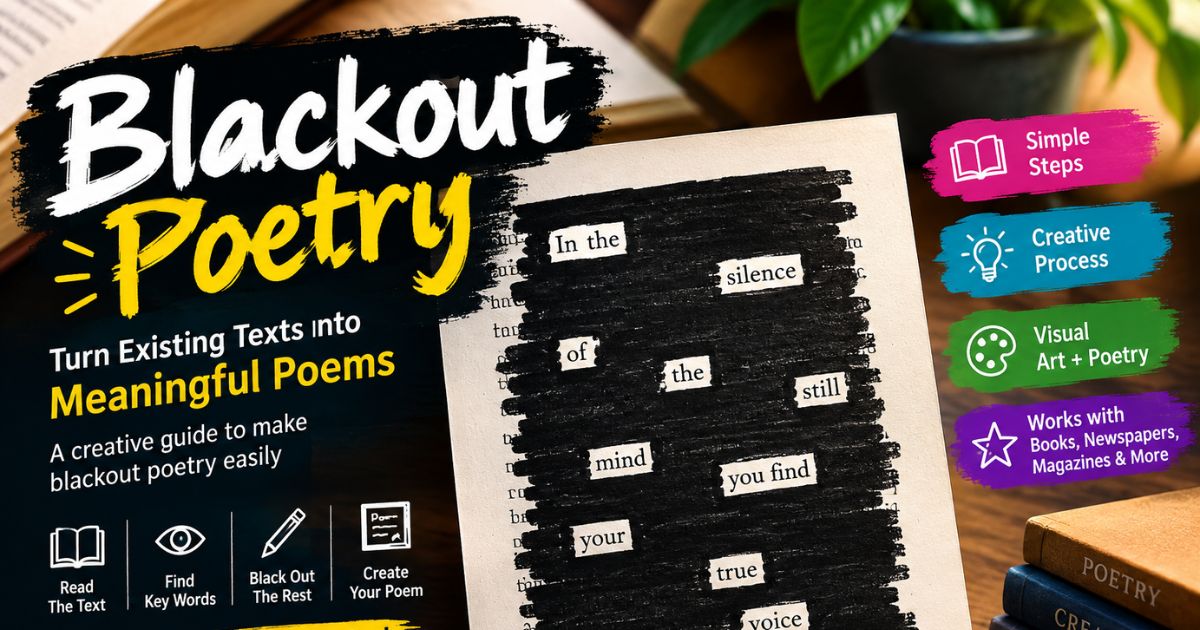
Blackout poetry is a form of erasure poetry in which you create a new poem by selecting words from an existing text and covering the rest. The surviving words become the poem, while the blacked-out page also becomes part of the artwork. It is often made from newspapers, books, magazines, or other printed material.
Unlike traditional poetry, you do not begin with a blank page. Instead, you begin with language that already exists and discover a new meaning inside it. This makes blackout poetry both a writing exercise and a visual art form.
The technique became especially recognizable through the work of Austin Kleon, whose Newspaper Blackout project helped popularize the form for a wider audience. Today, it is used by poets, artists, teachers, and students because the process is accessible and encourages close reading.
Key Takeaways
- Blackout poetry uses an existing text as the source for a new poem.
- It is commonly considered a form of erasure poetry and found poetry.
- The poet keeps selected words and obscures the rest.
- A newspaper, book page, magazine, or photocopy can become the source.
- The remaining words should form a meaningful sequence when read together.
- Visual design can strengthen the poem’s meaning.
- Digital tools can recreate the process without physically marking a page.
- Copyright matters when you publish or commercially distribute work based on someone else’s text.
What Is Blackout Poetry?
Blackout poetry is created by taking an existing page of writing and hiding most of its words while leaving selected words visible. Those surviving words are then read as a new poem.
The technique is sometimes called redacted poetry because the original text looks as though it has been censored. However, the purpose is usually creative rather than merely destructive. The poet transforms the original page into something with a different voice, rhythm, and meaning.
The source can be almost any text containing enough words to work with. For example, poets may use:
- Newspaper articles
- Old books
- Magazine pages
- Letters
- Printed essays
- Public-domain texts
- Photocopied pages
- Their own previous writing
The page itself becomes part of the poem. Instead of simply reading the surviving words, the reader also sees everything that has been deliberately hidden.
This gives blackout poetry two layers. There is the language layer, created by the visible words, and the visual layer, created by the blacked-out or decorated page.
Blackout Poetry vs. Erasure Poetry
The terms are closely related, but they are not always used in exactly the same way.
The Poetry Foundation describes blackout poetry as a form of erasure poetry. Erasure poetry is the broader practice of removing words from an existing text to create a new poem. Blackout poetry specifically emphasizes obscuring the unwanted words, often with black ink.
In simple terms:
| Form | Basic method |
| Erasure poetry | Remove or obscure words from an existing text |
| Blackout poetry | Usually black out unwanted words while preserving selected ones |
| Found poetry | Create poetry from language that already exists |
Therefore, it is reasonable to describe blackout poetry as both erasure poetry and a type of found poetry, although the exact terminology can vary among poets and educators.
How to Make Blackout Poetry Step by Step
Making a blackout poem does not require advanced poetry skills. What matters most is careful reading, word selection, and a willingness to experiment.
A simple process is:
- Choose a suitable page.
- Read through the text slowly.
- Find words that suggest an interesting idea.
- Mark those words without covering them.
- Read the selected words in order.
- Adjust your choices until they form a coherent poem.
- Black out the unwanted text.
- Add visual elements if they support the poem.
The important point is to select your poem before permanently covering the page. Once you black everything out, changing the structure becomes difficult.
Choose and Read Your Source Text
Start with a page containing enough language to give you choices. A newspaper article is useful because it usually contains many nouns, verbs, descriptions, and connecting words.
An old book can also work well, especially when its pages contain rich descriptive language.
Read the page once without trying to make a poem. Then read it again and notice words that attract your attention. You might find a surprising combination such as:
“forgotten / morning / open / river / home”
Those words may have little connection in the original paragraph, but together they can suggest a completely different idea.
You do not have to understand the source text exactly as its original writer intended. However, strong blackout poems often create an interesting relationship with the source rather than ignoring it completely. Writers.com similarly recommends choosing meaningful words, connecting them, and then obscuring the rest.
Select Words and Create the Visual Design
Once you find possible words, lightly circle or box them with a pencil.
Look for:
- A beginning
- A central idea
- Connecting words
- A strong ending
- Repeated sounds or images
- Unexpected combinations
Then read your selected words from left to right and top to bottom, following the natural movement of the page.
After you are satisfied, use a black marker or another medium to cover the unwanted words.
The blackout does not have to be completely plain. Some artists create patterns, drawings, borders, waves, or symbols around the surviving words. The visual design can reinforce the subject of the poem.
For example, a poem about water might use wave-like shapes to hide the unused text. The artwork then becomes part of the poem’s meaning rather than simple decoration.
Blackout Poetry Examples and Prompts
One of the easiest ways to understand blackout poetry is to experiment with different kinds of source material.
Simple Blackout Poetry Prompts
Try these prompts when making your first poem:
- Find a page containing the word “home” and build a poem around it.
- Create a poem about change using a newspaper article.
- Find words connected to nature in an old book.
- Create a poem about memory from a page describing a person.
- Make a hopeful poem from a serious news article.
- Select words that create a question rather than an answer.
You can also impose a creative limitation. For example, choose only words that relate to time, weather, movement, memory, or identity.
The limitation gives you a starting point without telling you exactly what the finished poem must say.
Famous and Useful Examples
Austin Kleon’s Newspaper Blackout is one of the best-known modern examples associated with the form. His work uses newspaper text as the raw material and turns fragments of journalism into concise poems.
There are also important literary examples of erasure that demonstrate how powerful the technique can become. The Academy of American Poets lists Ronald Johnson’s Radi Os, Jen Bervin’s Nets, Travis Macdonald’s The O Mission Repo, and M. NourbeSe Philip’s Zong! among significant works of erasure poetry.
These works also show that erasure can do more than create attractive pages. It can question, reinterpret, or confront the original source.
Digital Blackout Poetry and Free Source Texts
You do not need a physical newspaper or book to make blackout poetry.
A digital version can begin with a document, webpage, scanned page, or other text that you are legally permitted to use. You can then highlight the words you want to keep and cover the rest digitally.
A simple digital workflow is:
- Obtain a text you have permission to modify.
- Copy or import it into an editing program.
- Read through the text and select your words.
- Highlight or mark the selected words.
- Cover the remaining text with shapes or another visual layer.
- Arrange the page so the surviving poem is easy to read.
- Export the finished artwork as an image or PDF.
Digital creation is especially useful for classroom activities because students can experiment without permanently altering books.
Choosing a Good Digital Source
Public-domain texts can be particularly useful because their copyright status generally makes them easier to reuse, subject to the laws applicable to your jurisdiction and the specific edition.
You can also use your own writing, which gives you complete control over the source.
Another option is a text released under a license that permits the kind of reuse you intend. Always check the license rather than assuming that material found online is free to reproduce.
Copyright and Sharing Blackout Poems
Copyright is one of the most important issues to understand before publishing blackout poetry.
A blackout poem can be a new creative work, but it may still be based on copyrighted source material. The fact that you changed or blacked out the original text does not automatically mean that you own unrestricted rights to reproduce the source.
For private experimentation or classroom exercises, the practical situation may differ from public or commercial publication. However, publishing the finished page online, selling it, or reproducing substantial portions of a copyrighted source can raise legal questions.
A safer approach is to use:
- Your own writing
- Public-domain material
- Material with an appropriate reuse license
- Text for which you have permission
Copyright exceptions and fair-use/fair-dealing rules vary by country, purpose, amount used, and other factors. Therefore, this article should not be treated as legal advice.
If you plan to sell a blackout poetry collection or publish substantial work based on copyrighted material, check the applicable law and permissions before publication.
FAQs
Q: What is blackout poetry?
A: Blackout poetry is a form of erasure or found poetry created from an existing text. The poet selects certain words and covers the remaining words, often with black ink. The visible words are then read as a new poem. The original page also becomes part of the visual artwork.
Q: Is blackout poetry the same as erasure poetry?
A: Blackout poetry is generally considered a type of erasure poetry. Erasure is the broader category because words can be removed, covered, cut out, or otherwise obscured in several ways. Blackout poetry usually refers specifically to the visual method of covering unwanted text, often with black ink.
Q: How do you make a blackout poetry?
A: Start with an existing page, read it carefully, and identify words that could form a new idea. Mark those words first, then read them together and adjust your selections. Once the poem works, cover the unwanted text with a marker or another medium. You can then add artwork that supports the poem.
Q: What can I use to make blackout poetry?
A: You can use a newspaper, magazine, old book, printed article, photocopy, or your own writing. A pencil is useful for marking selected words before you commit to the final design. A black marker is the traditional choice for covering unwanted text, although other artistic materials can also work.
Q: Can blackout poetry be digital?
A: Yes. Digital blackout poetry can be created by importing suitable text into an editing program and covering the words you do not want to display. This method is particularly useful when you want to experiment without damaging a physical book or when you are working in a classroom or online environment.
Q: Is blackout poetry considered found poetry?
A: Yes, blackout poetry is commonly described as a form of found poetry because it creates a new poem from language that already exists. It is also closely associated with erasure poetry. The boundaries between these terms can vary, but the central idea is transforming existing language into a new poetic work.
Final Thoughts
Blackout poetry turns an existing page into a new creative space. Instead of starting with an empty sheet, you search for meaning inside language that is already there.
The process is simple: choose a source, find meaningful words, shape them into a poem, and obscure everything else. However, the best results usually come from thoughtful selection rather than randomly keeping attractive words.
If you are new to the form, start with one page and give yourself permission to experiment. You may discover that the most interesting poem was already hiding inside the text.
Recent Article : Walt Whitman: Where to Start Reading Him (Explained)

Jennifer Aston is a passionate poetry curator and writer with a deep love for the written word. She believes poetry has the power to heal, inspire, and connect people across all walks of life. Through PoemSteric, she brings together timeless and modern verses for every emotion and every moment.