
Introduction
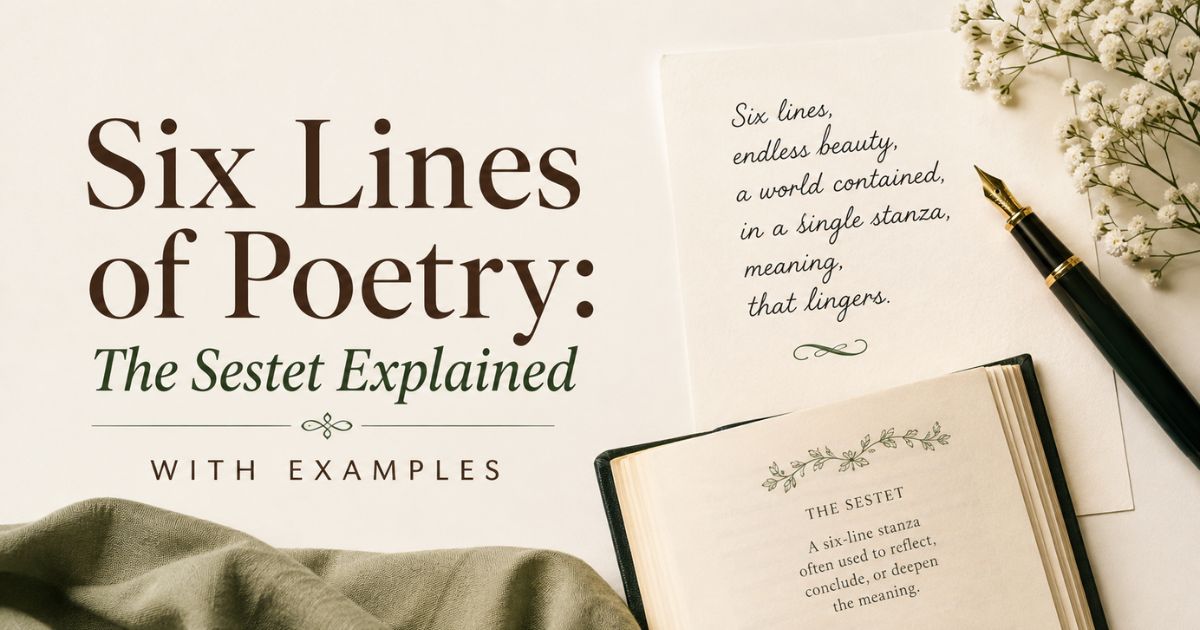
Six lines of poetry are called a sestet, a term that applies both to a standalone six-line poem and to the final six lines of a Petrarchan sonnet. The word comes from the Italian sestetto, meaning “sixth,” and it is one of the most common short stanza lengths in English-language poetry.
This guide breaks down what a set actually is, where the form came from, and how it differs from related terms like the sestet and the octave. You will also find real six lines of poetry examples from Wordsworth and Milton, plus a step-by-step method for writing your own.
Key Takeaways
Six lines of poetry are formally known as a sestet, whether they form a full poem or the second half of a sonnet.

The term "sexain" is sometimes used interchangeably, though strict definitions reserve "sestet" for the closing six lines of a sonnet and "sexain" for a standalone six-line stanza.

Sestets appear in Petrarchan sonnets, sestinas, and countless standalone six-line poems with no fixed rhyme requirement.

Common sestet rhyme schemes include CDCDCD, CDECDE, and CDCDEE, though unrhymed sestets are also common outside the sonnet tradition.

The sestet in a Petrarchan sonnet typically resolves the question or problem raised in the preceding eight-line octave.

Readers often tell us the easiest way to understand a sestet is to read one aloud immediately after its matching octave, since the shift in tone becomes obvious the moment you hear it.
What Are Six Lines of Poetry Called?
Six lines of poetry are called a sestet in nearly every context you will encounter, whether you are reading a full six-line poem or analyzing the final section of a fourteen-line sonnet. The term is broad enough to cover both uses, which occasionally confuses readers who expect one word to mean only one thing.
In the strictest literary definition, a sestet refers specifically to a six-line unit that functions as a complete stanza or a distinct section of a longer poem. However, in everyday use, many writers apply the word to any grouping of six lines, regardless of whether it stands alone or belongs to a larger structure like a sonnet or sestina.
Because the term shows up across so many poetic forms, understanding its pronunciation and origin makes the rest of this guide easier to follow.
How to Pronounce Sestet
Sestet is pronounced “seh-STET,” with the stress on the second syllable. It is a short, two-syllable word despite its slightly unfamiliar spelling, and most readers pick up the correct pronunciation after hearing it once.
Where the Word “Sestet” Comes From
The word traces back to the Italian sestetto, meaning “sixth,” which itself descends from sesto, the Italian word for “six.” This Italian origin is not a coincidence: the form became prominent through the Italian sonnet tradition, particularly through the poet Petrarch, whose name is still attached to the sonnet structure that made the sestet famous across European literature.
A Brief History of the Sestet
The sestet’s history is tied closely to the development of the sonnet in 13th-century Italy. The earliest sonnets are credited to Giacomo da Lentini, a poet working in Sicily under Emperor Frederick II, who is generally recognized as the inventor of the sonnet form itself.
Da Lentini’s original sonnets already used the fourteen-line structure split into an octave and a sestet, though the rhyme conventions shifted over the following century. As a result, by the time Petrarch was writing in the 14th century, the octave-plus-sestet structure was firmly established as the standard Italian sonnet form, which is why it is now most commonly called the Petrarchan sonnet.
The Sestet in the Petrarchan Sonnet
In a Petrarchan sonnet, the poem’s fourteen lines split into an eight-line octave followed by a six-line sestet. The octave typically presents a problem, question, or observation, using the rhyme scheme ABBAABBA. The sestet that follows resolves, reflects on, or complicates that opening idea, and it uses a more flexible rhyme scheme, most often CDCDCD or CDECDE.
This structural split creates what poets call the “turn” or “volta,” a shift in tone, argument, or perspective that occurs at the exact boundary between the octave and the sestet. Understanding this turn is essential for reading Petrarchan sonnets closely, since the sestet almost never simply repeats what the octave already said.
The Main Types of Six-Line Poems
Not every six-line poem is a sestet in the strict, sonnet-specific sense. Three related but distinct forms exist, and knowing the difference will help you use the correct term in your own writing or analysis.
1. The Sestet (General Six-Line Stanza)
Used broadly, “sestet” refers to any six-line stanza, whether it appears alone or as part of a longer poem. This is the most common usage in everyday poetry discussion and the definition most search queries about six lines of poetry are actually asking about.
2. The Sexain
Some literary scholars reserve the word “sexain” for a standalone six-line stanza that is not part of a sonnet, using “sestet” only for the closing six lines of a Petrarchan sonnet specifically. Emily Dickinson’s poem “The Soul has Bandaged Moments” contains a stanza widely cited as an example of a sexain under this stricter definition.
3. Six-Line Stanzas in Sestinas
A sestina is a fixed poetic form made up of six sestets (six-line stanzas) followed by a shorter three-line envoi. Unlike a sonnet’s sestet, the sestina’s six-line stanzas do not rhyme; instead, the poem repeats the same six end-words across all six stanzas in a rotating pattern, creating a hypnotic, circular effect that is very different from the resolution-focused sestet of a Petrarchan sonnet.
Sestet Rhyme Schemes Explained
A sestet’s rhyme scheme depends heavily on which type of poem it belongs to. In a Petrarchan sonnet, the poet has considerably more freedom in the sestet than in the octave, which is fixed at ABBAABBA. This flexibility is one reason sestets are often considered the more expressive half of the sonnet.
Common Sestet Rhyme Patterns
The most frequently used sestet rhyme schemes include:
- CDCDCD – alternating rhyme across three pairs of lines
- CDECDE – a repeating three-rhyme pattern
- CDDCEE – a mixed pattern ending in a closing couplet
- CDDECE – a less common variation still found in classical examples
For example, the final six lines of “London, 1802” by William Wordsworth use a CDCDCD-style pattern, while other Petrarchan sonnets favor CDECDE for a slightly less predictable rhythm. Outside the sonnet tradition, standalone six-line poems frequently drop rhyme altogether, relying instead on rhythm and line length to create structure.
Six Lines of Poetry Examples From Famous Poets
Reading real six lines of poetry examples is the fastest way to see how the sestet functions inside a larger poem. The two examples below come from well-known Petrarchan-style sonnets and clearly show the sestet’s role as the “resolution” half of the poem.
The Sestet in Wordsworth’s “London, 1802”
Thou hadst a voice whose sound was like the sea: Pure as the naked heavens, majestic, free, So didst thou travel on life’s common way, In cheerful godliness; and yet thy heart The lowliest duties on herself did lay.
This sestet closes a sonnet in which Wordsworth addresses the poet John Milton directly, mourning the loss of Milton’s moral clarity in English public life. Notice how the imagery shifts from the grand, sweeping metaphors of the octave toward something quieter and more personal by the final line, a common move in Petrarchan sestets.
The Sestet in Milton’s “Sonnet 19”
But Patience, to prevent that murmur, soon replies, “God doth not need either man’s work or his own gifts. Who best Bear his mild yoke, they serve him best. His state is kingly; thousands at his bidding speed And post o’er land and ocean without rest; They also serve who only stand and wait.”
Also known as “When I Consider How My Light Is Spent,” this sonnet’s sestet directly answers the frustrated question posed in its octave. The famous closing line, “They also serve who only stand and wait,” is one of the most quoted single lines in English poetry, and it only makes sense in the context of the sestet’s resolving function.
Six-Line Poem Examples for Students
Not every six-line poem needs to follow strict sonnet rules. Below is an original, simple example written for classroom use, using an accessible ABABCC rhyme scheme with no formal meter requirement:
The autumn wind begins to blow (A) Across the fields where wildflowers grow (B) The leaves turn gold, then red, then brown (A) As summer slowly settles down (B) The harvest moon climbs high tonight (C) Bathing all the world in light (C)
This kind of accessible six-line poem is useful for teaching rhyme and rhythm without requiring students to understand the full complexity of sonnet structure first.
How to Write Your Own Six-Line Poem
Writing a six-line poem is approachable even for beginners, since the form is short enough to draft in a single sitting. Follow these five steps to build one from scratch.
1 : Choose Your Subject
Pick a single, specific subject rather than a broad theme. A season, an object, or a brief moment works better than an abstract concept, since concrete subjects give you material to describe within just six lines.
2 : Decide on a Rhyme Scheme
Choose whether your poem will rhyme, and if so, pick a pattern such as ABABCC or CDCDCD before you start writing. Deciding this early prevents you from getting halfway through a draft and realizing your rhyme scheme has broken down.
3 : Draft the Six Lines
Write a rough draft without worrying too much about polish. Focus on getting one clear idea per line, and resist the urge to cram too much detail into a single line, since six lines leave very little room for excess.
4 : Add a Turn or Volta
If your six lines are meant to follow an octave, as in a Petrarchan sonnet, make sure the sestet shifts in tone, resolves a question, or offers a new perspective rather than repeating the octave’s point. Even in a standalone six-line poem, a small turn near the final two lines often makes the ending feel more satisfying.
5 : Revise for Rhythm
Read your draft aloud and listen for awkward stresses or rhythm breaks. Because a six-line poem is so short, even a single clunky line stands out immediately, so this step matters more here than it would in a longer poem.
Sestet vs Octave: Understanding the Sonnet’s Two Halves
The octave and the sestet work as a matched pair inside a Petrarchan sonnet, and understanding their contrast makes both halves easier to analyze. Here is a direct comparison:
| Feature | Octave | Sestet |
| Line count | 8 lines | 6 lines |
| Rhyme scheme | ABBAABBA (fixed) | CDCDCD, CDECDE, or similar (flexible) |
| Function | Presents a problem or question | Resolves, reflects, or shifts perspective |
| Position in sonnet | First half | Second half, after the volta |
Because the octave’s rhyme scheme is fixed while the sestet’s is not, many literary scholars consider the sestet the more creatively flexible half of the sonnet, giving poets room to experiment even within a highly traditional form.
Common Mistakes When Writing Six Lines of Poetry
Writers new to the sestet or six-line poem tend to run into a few recurring issues:
- Confusing sestet with sextet. A sextet refers to a group of six musicians or performers, not a poetic form; the terms are unrelated despite the similar spelling.
- Assuming all sestets rhyme. Standalone six-line poems outside the sonnet tradition often skip rhyme entirely.
- Repeating the octave’s point in the sestet. Without a clear turn, the sestet can feel redundant rather than resolving.
- Overpacking each line with detail. Six lines leave little room for excess description, so overly dense lines often hurt readability.
- Ignoring meter consistency. Especially in formal sestets, switching meter mid-poem disrupts the reading rhythm noticeably.
Why the Sestet Remains Popular in Modern Poetry
Despite its centuries-old origin, the sestet has not faded from use. Contemporary poets including Carol Ann Duffy and Marilyn Nelson have written widely anthologized six-line poems, proving the form still has room for fresh subject matter and modern language.
Part of the sestet’s staying power comes from its flexibility outside the sonnet tradition. A poet does not need to write a full sonnet to benefit from the sestet’s compact structure; a standalone six-line poem offers enough space to develop an image or idea fully, while still demanding the same discipline and word economy that shorter forms like the cinquain require. This balance between brevity and depth is exactly why the sestet continues to appear in contemporary poetry collections and creative writing curricula alike.
FAQs
Q: What are six lines of poetry called?
A: Six lines of poetry are called a sestet. This term applies both to a standalone six-line poem and to the final six lines of a Petrarchan sonnet, which follows an eight-line octave. Some scholars use the word “sexain” specifically for standalone six-line stanzas, though “sestet” is the more commonly used term overall.
Q: What rhyme scheme does a sestet use?
A: A sestet’s rhyme scheme is more flexible than the octave that precedes it in a Petrarchan sonnet. Common patterns include CDCDCD, CDECDE, and CDDCEE. Standalone six-line poems outside the sonnet tradition are not required to rhyme at all and often use free verse instead.
Q: What is the difference between a sestet and a sexain?
A: Under strict literary definitions, a sestet refers to the closing six lines of a Petrarchan sonnet, while a sexain refers to a standalone six-line stanza that is not part of a sonnet. In everyday usage, however, many writers use “sestet” to describe any six-line grouping, regardless of this distinction.
Q: Do all sonnets contain a sestet?
A: Only Petrarchan (Italian) sonnets contain a true sestet, since they split their fourteen lines into an eight-line octave and a six-line sestet. Shakespearean (English) sonnets instead use three quatrains followed by a closing couplet, so they do not technically contain a sestet in the traditional sense.
Q: Can six lines of poetry stand alone as a complete poem?
A: Yes, six lines of poetry can absolutely stand alone as a complete poem, separate from any sonnet structure. Many contemporary poets write standalone six-line poems, sometimes rhymed and sometimes not, using the form’s brevity to focus tightly on a single image, moment, or idea.
Final Thoughts
Six lines of poetry, formally known as a sestet, have carried real structural weight in English poetry since the sonnet’s earliest days in 13th-century Sicily. Whether you are analyzing the resolving half of a Petrarchan sonnet or writing a standalone six-line poem for the first time, understanding the sestet’s flexible rhyme options and its role as a “turning point” will make both reading and writing the form far more rewarding. Start with a concrete subject, decide on your rhyme scheme early, and read every draft aloud before calling it finished.
Recent Article : Poetry Cinquain Examples: Definition, Types & How to Write

Jennifer Aston is a passionate poetry curator and writer with a deep love for the written word. She believes poetry has the power to heal, inspire, and connect people across all walks of life. Through PoemSteric, she brings together timeless and modern verses for every emotion and every moment.