
Introduction
A cinquain is a five-line poem, and the best poetry cinquain examples share one thing in common: every word earns its place. Unlike longer forms, a cinquain gives a poet only five lines to build an image, a feeling, or a small story. This makes it one of the most useful forms for beginners and one of the most disciplined forms for experienced writers.
In this guide, we cover every major type of cinquain, the classic, the American (Crapsey), and the didactic with real poetry cinquain examples for each. We also walk through a step-by-step method for writing your own, so you can move from reading examples to creating original work in a single sitting.
Key Takeaways
A cinquain is any five-line poem or stanza, though the term usually refers to one of three specific structured forms.

The word comes from the French cinq, meaning "five," though the modern poetic form was shaped by the American poet Adelaide Crapsey in the early 1900s.

There are three widely recognized types: the standard (classic) cinquain, the American or Crapsey cinquain, and the didactic (word-count) cinquain used in schools.

The American cinquain follows a strict 2-4-6-8-2 syllable pattern across its five lines.

Cinquains do not require rhyme, which makes them approachable for new poets while still teaching rhythm and word economy.

Reading real poetry cinquain examples is the fastest way to understand the form before writing your own.

In our own experience teaching this form to beginner writers, the biggest breakthrough usually comes once a student writes their first American cinquain and sees how the syllable count forces precise word choice.
What Is a Cinquain Poem?
A cinquain poem is a five-line piece of poetry, and that single fact is the only thing all cinquains truly share. Beyond the line count, the form splits into several distinct traditions, each with its own rules for syllables, words, or rhyme.
Some cinquains rhyme in a fixed pattern and use iambic meter, much like a small stanza borrowed from a longer poem. Others reject rhyme entirely and instead count syllables with mathematical precision. A third type skips syllables altogether and counts whole words per line instead. Because of this range, when someone searches for poetry cinquain examples, they are usually looking for one of these three specific structures rather than a general five-line poem.
What unites every cinquain, however, is compression. A poet has five lines to say something worth reading, and that constraint is exactly why the form has survived for over a century in classrooms and literary anthologies alike.
How to Pronounce Cinquain
Cinquain is pronounced “sin-CANE,” not “sin-kwane” as many first-time readers assume. The word borrows its spelling from French but has been anglicized in everyday speech. Teachers introducing the form to students often clear up this pronunciation question in the first minute of a lesson, since it trips up nearly everyone on a first read.
Where Does the Word “Cinquain” Come From?
The term traces back to the French word cinq, meaning “five,” and by extension to cinquain, an old term for a five-line stanza. Medieval French poets used five-line stanzas centuries before Adelaide Crapsey formalized the modern American version. So while the word is old, the strict syllable-based form most people picture today is a 20th-century American invention.
A Brief History of the Cinquain Form
Five-line stanzas appear scattered throughout Western poetry long before the word “cinquain” became attached to a specific rule set. Poets such as John Donne experimented with five-line forms, and English hymn writers occasionally used five-line stanzas for structural variety. These early appearances were loose, however, with no fixed syllable or word count.
The form as most readers know it today did not solidify until the early 1900s, when it was reshaped into something far more exact. That shift is largely credited to one poet, and understanding her contribution explains why so many poetry cinquain examples online trace back to a single name.
Adelaide Crapsey and the American Cinquain
Adelaide Crapsey, an American poet writing in the early 1910s, is the person most responsible for the cinquain as we recognize it today. Inspired by Japanese forms such as haiku and tanka, she created a five-line structure built entirely on syllable count: two, four, six, eight, and two syllables per line, in that order.
Crapsey died in 1914 at just 36 years old, and her collection Verse, published posthumously in 1915, introduced the form to a wider American audience. Because her syllabic pattern was so distinct from the older French-style cinquain, poets now refer to her version as the “American cinquain” or the “Crapsey cinquain” to separate it from earlier five-line traditions. Her short life meant she wrote comparatively few cinquains, but the ones she left behind, including “November Night” and “Triad,” remain the standard reference point for the form.
The 3 Main Types of Cinquain Poems
Most modern poetry cinquain examples fall into one of three categories, and knowing the difference will save you from mixing up rules when you sit down to write. Each type has a different origin, a different structure, and a different typical use case.
1. The Standard (Classic) Cinquain
The standard or classic cinquain is the older, French-descended form. It is written in five lines, usually in iambic meter, and commonly follows a rhyme scheme such as ABABB or ABAAB. Because it relies on rhyme rather than a strict syllable count, this version has more flexibility in line length. Poets including John Donne and Edmund Waller used five-line stanzas that later writers grouped under this classic label.
2. The American (Crapsey) Cinquain
This is the version most people mean when they search for poetry cinquain examples today. It follows Adelaide Crapsey’s exact syllable pattern: 2 syllables in line one, 4 in line two, 6 in line three, 8 in line four, and 2 in line five. It does not rhyme, and it is typically written in a single unrhymed stanza that builds toward a small emotional or visual turn in the final line.
3. The Didactic (Word-Count) Cinquain
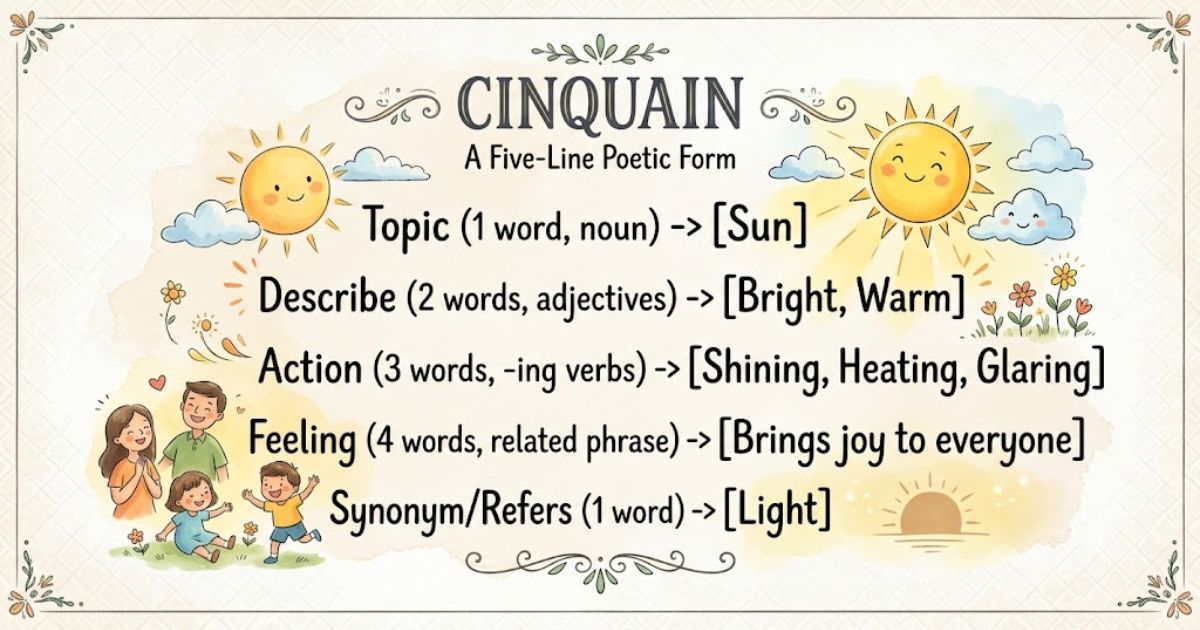
The didactic cinquain swaps syllables for whole words and is the version most commonly taught in elementary and middle schools. Its structure counts words per line instead of syllables: one word (a noun, the topic), two words (adjectives describing it), three words (-ing verbs related to it), four words (a phrase showing feeling), and one word (a synonym or conclusion). Because the rules are easier to apply than syllable counting, this version is the most beginner-friendly of the three.
Here is a quick side-by-side comparison of all three forms:
| Type | Line Pattern | Rhyme Required? | Common Use |
| Standard (Classic) | Flexible line length, iambic meter | Yes, typically ABABB or ABAAB | Literary/historical poetry |
| American (Crapsey) | 2-4-6-8-2 syllables | No | Adult and advanced student poetry |
| Didactic (Word-Count) | 1-2-3-4-1 words | No | Elementary and middle school classrooms |
Poetry Cinquain Examples From Famous Poets
Reading real poetry and examples from the poet who defined the form is the clearest way to understand how the syllable structure creates rhythm on the page. Adelaide Crapsey’s own cinquains remain the benchmark, since they demonstrate the 2-4-6-8-2 pattern exactly as it was intended.
Adelaide Crapsey’s “November Night”
Listen… With faint dry sound, Like steps of passing ghosts, The leaves, frost-crisp’d, break from the trees And fall.
This poem is a textbook American cinquain. Count the syllables and you will find 2, 4, 6, 8, and 2 across the five lines. Notice how the poem builds through sound and image, then lands on a single word, “fall,” that carries both the literal image of falling leaves and a quiet sense of ending.
Adelaide Crapsey’s “The Warning”
Just now, Out of the strange Still dusk … as strange, as still … A white moth flew. Why am I so cold?
Here the syllable pattern again holds firm, and the final two-syllable line delivers an emotional pivot rather than a visual one. This is a common technique across her work: the first four lines set a scene, and the last line reframes it. Studying this turn is one of the fastest ways to improve your own cinquain writing.
Classic Cinquain Examples for Students
While the American cinquain dominates most modern teaching, it helps to see a standard, rhymed cinquain example for contrast. Below is an original example written in the classic ABAAB rhyme scheme, useful for students studying older five-line stanza traditions:
The morning light comes soft and slow (A) Across the fields where wildflowers grow (B) The birds begin their gentle song (A) As dew drops shimmer all day long (A) A quiet world begins to glow (B)
Notice how this version relies on end rhyme and a steady meter rather than syllable counting. It reads more like a small stanza from a longer poem, which is exactly what the classic cinquain historically was before Crapsey’s syllabic version became dominant.
Simple Didactic Cinquain Examples
The didactic cinquain is the easiest entry point for young writers because it counts words, not syllables. Below are two original examples that follow the standard 1-2-3-4-1 word pattern used in most classrooms:
1: Ocean
Ocean Deep, endless Rolling, crashing, calling Waves reach the shore Sea
2: Winter
Winter Cold, quiet Falling, freezing, drifting Snow covers everything Frost
As a result, students can build a complete poem in minutes without needing to count syllables at all, which is exactly why this version is so widely used in primary school poetry units.
How to Write a Cinquain Poem Step by Step
Writing your first cinquain is far easier once you break the process into small, manageable steps. Below is a five-step method that works for both the American and didactic versions of the form.
1 : Choose Your Topic
Start with a single, concrete subject rather than an abstract idea. Objects, weather, animals, and seasons work especially well because they give you clear sensory details to draw from. For example, “rain,” “grandmother,” or “autumn” are easier starting points than something broad like “happiness.”
2 : Follow the Line Structure
Decide which type of cinquain you are writing before you begin, since the structure shapes every choice that follows. If you are writing an American cinquain, plan for five lines of 2, 4, 6, 8, and 2 syllables. If you are writing a didactic cinquain, plan for 1, 2, 3, 4, and 1 word per line instead.
3 : Count Your Syllables or Words
Write a rough draft first, then go back and count carefully. This is the step most beginners rush, and it is also the step that makes or breaks the form. Reading each line aloud and tapping out the syllables on your fingers is a simple, reliable way to check your count.
4 : Add Sensory Detail and Imagery
Once your structure is correct, revise for imagery. Replace vague words with specific sensory details: instead of “the leaves fell,” try “the leaves, frost-crisp’d, break.” Strong poetry cinquain examples almost always rely on precise, physical language rather than general statements.
5 : Edit and Read Aloud
Finally, read your poem out loud. Because a cinquain is so short, every syllable is audible, and awkward phrasing stands out immediately when spoken. Trim any word that does not pull its weight, since a five-line poem has no room for filler.
Common Mistakes to Avoid When Writing a Cinquain
New writers tend to repeat the same few errors when attempting this form for the first time. Watch for these:
- Mixing up the types. Applying a syllable count to a didactic cinquain, or vice versa, breaks the structure entirely.
- Padding lines to hit the count. Adding filler words just to reach eight syllables weakens the poem’s impact.
- Skipping the final turn. The last line should surprise, resolve, or shift the poem in some way, not simply restate line one.
- Forcing rhyme in an American cinquain. This form is intentionally unrhymed; adding rhyme changes it into a classic-style stanza instead.
- Choosing an abstract topic first. Concrete subjects give you images to work with; abstractions often lead to vague, generic lines.
Cinquain vs Other Five-Line Poem Forms
Not every five-line poem is technically a cinquain, and it helps to know where the boundaries sit. A limerick, for example, is also five lines long, but it uses a bouncing AABBA rhyme scheme and a comic tone that has nothing to do with the cinquain’s structured syllable or word counts. Similarly, a tanka, the Japanese form that partly inspired Crapsey, has five lines but follows a 5-7-5-7-7 syllable pattern rather than 2-4-6-8-2.
Because of these overlaps, some broad definitions treat any five-line poem as a cinquain, while stricter definitions reserve the term for the specific structured forms covered in this guide. For clarity and accuracy, it is best to treat “cinquain” as referring to one of the three named types rather than any random five-line arrangement.
Why Teachers and Writers Use Cinquains
Cinquains remain popular in classrooms for a simple reason: they teach precision without overwhelming a beginner. A student can complete a full poem in one class period, yet still practice core poetic skills like word choice, imagery, and structure.
For working poets, the American cinquain offers something different. Its strict syllable count acts as a creative constraint, forcing a writer to cut anything unnecessary. Many poets use the form as a warm-up exercise before tackling longer, looser poems, since the discipline of counting syllables sharpens attention to language in general. Readers often tell us that once they understand the syllable pattern, they start noticing rhythm in other poems they read, which is one of the quieter benefits of studying this small but demanding form.
FAQs
Q: What is a cinquain poem?
A: A cinquain is a five-line poem or stanza. The term covers several distinct forms, including the rhymed classic cinquain, the unrhymed American (Crapsey) cinquain built on a 2-4-6-8-2 syllable pattern, and the didactic cinquain, which counts words rather than syllables per line.
Q: How many lines does a cinquain have?
A: A cinquain always has exactly five lines. This is true across every variation of the form, whether it follows a syllable count, a word count, or a rhyme scheme. The number of lines is the one rule that never changes between types.
Q: Who invented the modern cinquain form?
A: The American poet Adelaide Crapsey is credited with creating the strict syllable-based cinquain in the early 1910s. Inspired by Japanese haiku and tanka, she developed the 2-4-6-8-2 syllable pattern that most people picture when they think of a cinquain today.
Q: Does a cinquain need to rhyme?
A: It depends on the type. The classic (standard) cinquain traditionally rhymes, often in an ABAAB or ABABB pattern. The American cinquain and the didactic cinquain, however, do not require rhyme at all, which makes them more accessible for beginner writers.
Q: What is the easiest type of cinquain for beginners?
A: The didactic cinquain is generally considered the easiest entry point, since it counts whole words per line (1-2-3-4-1) instead of syllables. This makes it a common choice in elementary classrooms, where students can build a complete poem quickly without needing to count syllables.
Final Thoughts
A cinquain proves that a poem does not need length to carry weight. Whether you are working with Adelaide Crapsey’s strict 2-4-6-8-2 syllable pattern, the rhymed classic form, or the beginner-friendly didactic version, the form rewards careful word choice over volume. The poetry cinquain examples in this guide are meant as a starting point, not a ceiling. The fastest way to improve is to write one yourself, count carefully, and read it aloud until every syllable earns its place.
Recent Article : Free Poetry Clipart: 30+ Images, Icons & Printable Templates

Jennifer Aston is a passionate poetry curator and writer with a deep love for the written word. She believes poetry has the power to heal, inspire, and connect people across all walks of life. Through PoemSteric, she brings together timeless and modern verses for every emotion and every moment.