
Introduction
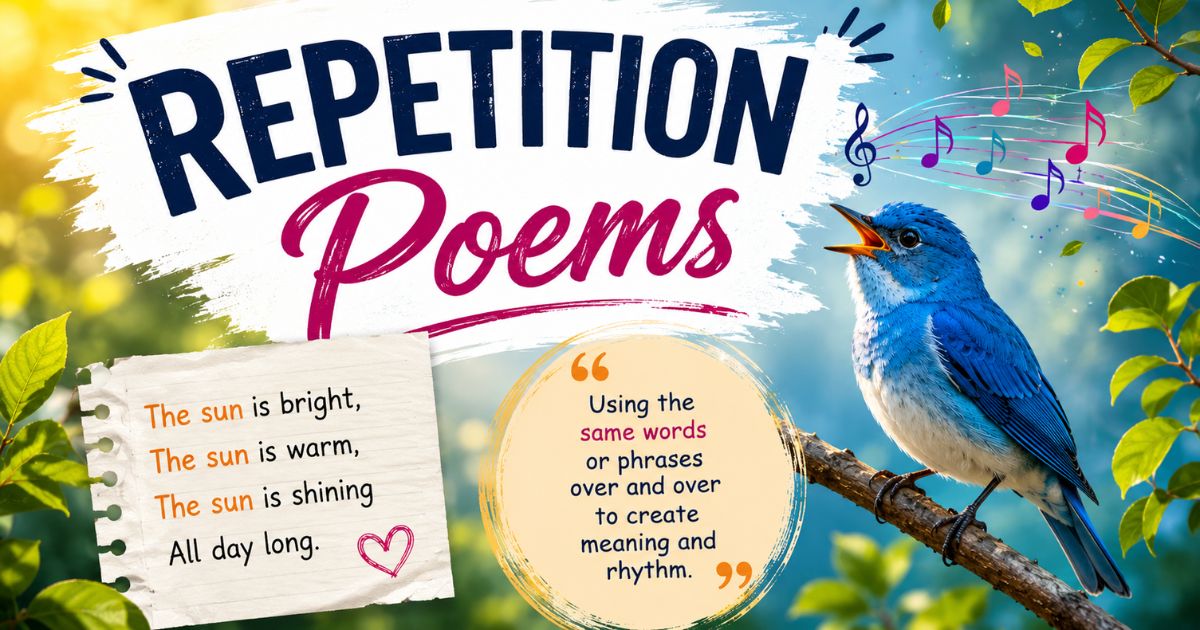
Repetition poems are poems that intentionally repeat a word, phrase, line, or stanza to create rhythm, build emotional emphasis, or reinforce a central idea. Poets use this technique through devices like anaphora, refrain, and strophe to make meaning stick, the same way a chorus lingers in a song long after it ends.
If you’ve ever noticed a phrase echoing through a poem, like Poe’s endless return to a single name, or a nursery rhyme’s insistent chorus, you’ve already experienced repetition poems doing their work. In my own reading of classic and contemporary poetry, I’ve noticed repetition rarely happens by accident; it’s one of the most deliberate tools a poet owns. This guide breaks down what repetition poems actually are, the different techniques poets rely on, ten real examples worth reading, and a simple method for writing your own.
Key Takeaways
● Repetition poems repeat words, lines, or stanzas on purpose to build rhythm and emotion.

● Common devices include anaphora, epistrophe, anadiplosis, antanaclasis, and refrain.

● Famous examples include Poe's "Annabel Lee," Blake's "The Tyger," and Frost's "Acquainted with the Night."

● Repetition helps readers remember a poem's core message, similar to how a chorus works in music.

● Writing your own repetition poem starts with choosing one word or line worth repeating on purpose.
What Is a Repetition Poem?
The Simple Definition
A repetition poem is any poem that deliberately reuses a word, phrase, line, or entire stanza more than once to strengthen its meaning. Unlike accidental repetition in casual writing, poetic repetition is a craft decision. Poets choose exactly which word deserves a second, third, or fourth appearance, and where in the poem it should land.
For example, in Edgar Allan Poe’s “The Raven,” the single word “nevermore” appears again and again, each time deepening the narrator’s despair rather than simply restating it. As a result, repetition becomes less about saying the same thing twice and more about layering meaning with every return. Readers often tell us that once they notice a poem’s repeated phrase, the entire piece suddenly makes more emotional sense.
Repetition vs. Rhyme | What’s the Difference?
It’s easy to confuse repetition poems with rhyming poems, but they work differently. Rhyme matches the sound of ending words, such as “day” and “away,” while repetition reuses entire words or lines exactly as written. A poem can rhyme without repeating a single word, and a poem can repeat heavily without rhyming at all; free verse poems often do exactly this.
However, the two techniques frequently overlap. In many traditional forms, such as the villanelle, repeated lines and a strict rhyme scheme work side by side, each reinforcing the other. Understanding this distinction matters because it changes how you read a poem: rhyme creates musical expectation, while repetition creates emotional insistence, returning readers to an idea until it settles in.
Why Do Poets Use Repetition in Poetry?
Repetition Creates Rhythm and Musicality
Poetry existed as a spoken and sung tradition long before it existed on paper, and repetition is one of the oldest tools for making language memorable. When a phrase returns at regular intervals, it creates a rhythmic pulse similar to a drumbeat or a chorus in a song. This is why oral traditions, from ancient epics to modern spoken word poetry, rely so heavily on repeated lines.
A reader’s ear naturally anticipates the phrase’s return, and that anticipation itself becomes part of the poem’s pleasure. For example, in nursery rhymes and children’s poems, repeated lines aren’t just decorative; they help young readers predict, participate, and remember the poem long after the page is closed.
Repetition Builds Emotional Weight
Beyond rhythm, repetition intensifies feeling. When a poet repeats a word like “love” or “gone,” each repetition adds pressure, the same way saying someone’s name twice in a conversation signals urgency. This is especially visible in grief poems and love poems, where a single repeated line can carry more emotional force than several new sentences.
Maya Angelou’s “Phenomenal Woman” is a strong example: its repeated refrain doesn’t just restate the poem’s message, it insists on it, building confidence with every return. As a result, repetition often does what plain statements cannot; it makes an emotion feel earned rather than announced.
Types of Repetition Poems: 5 Poetic Devices Explained
Not all repetition works the same way. Poets choose specific devices depending on where they want the repeated word to sit and what effect they want it to create. Below are five of the most common repetition techniques found in repetition poems, each with a quick example so you can spot them in your own reading.
Anaphora – Repetition at the Start of Lines
Anaphora repeats a word or phrase at the beginning of successive lines or sentences. It’s one of the most recognizable repetition techniques because it builds momentum with every new line. Martin Luther King Jr.’s “I have a dream” speech, though not a poem, is one of the clearest examples of anaphora in the English language, and countless poets borrow this exact structure.
In poetry, anaphora often appears in poems about hope, protest, or longing, where each repeated opening line adds a new layer to a growing argument. For example, a poem that begins several lines with “I remember” uses anaphora to stack memories, one after another, until they form a complete picture.
Epistrophe – Repetition at the End of Lines
Epistrophe is the opposite of anaphora; it repeats a word or phrase at the end of successive lines or clauses instead of the beginning. This device creates a sense of closure each time the line lands, almost like a musical resolution that keeps returning.
Where anaphora builds forward momentum, epistrophe circles back, reminding the reader of the poem’s central idea right before moving on. Poets often use epistrophe in poems about loss or longing, where ending each line on the same word, a name, a place, a feeling, keeps pulling the reader back to what matters most, even as the surrounding language changes.
Anadiplosis – Linking Lines Together
Anadiplosis repeats the last word of one line as the first word of the next, creating a chain-link effect between ideas. This device is less common than anaphora or epistrophe, but it’s especially effective in poems that want to show cause and effect, or one idea growing directly out of another.
A simple example: “Fear leads to anger. Anger leads to hate.” Notice how each sentence picks up exactly where the last one left off. In repetition poems, anadiplosis often signals a build-up, an emotional or logical escalation, because the reader can feel the poem moving forward one linked step at a time.
Antanaclasis – Repeating a Word with a New Meaning
Antanaclasis repeats the same word twice in a line or stanza, but with a different meaning each time. It’s a subtler, wordplay-driven form of repetition, often used for wit, irony, or emotional contrast.
Benjamin Franklin’s famous line, “We must all hang together, or assuredly we shall all hang separately,” is a classic example; the word “hang” shifts meaning between the two uses. In poetry, antanaclasis rewards close reading, since a casual skim might miss the shift entirely. When done well, it adds depth without adding length, letting one word carry two ideas at once.
Refrain – The Repeated Chorus Line
A refrain is a line or group of lines repeated at intervals throughout a poem, most often at the end of each stanza, functioning much like a chorus in a song. Refrains are common in ballads, villanelles, and song-like poems, where the repeated line acts as an emotional anchor the reader returns to again and again.
Dylan Thomas’s “Do not go gentle into that good night” is one of the most famous refrains in English poetry; its repetition transforms a simple instruction into an urgent plea by the poem’s end. Refrains work because familiarity breeds emotional investment: the more a reader hears a line, the more weight it carries.
10 Powerful Repetition Poems Examples You Should Know
The best way to understand repetition poems is to read them. Below are ten poems, spanning classic and modern poetry, that use repetition to unforgettable effect. Two are explored in more depth because their repetition technique is especially instructive for anyone learning to write their own.
1. “Annabel Lee” by Edgar Allan Poe
Poe’s final complete poem repeats the phrase “in a kingdom by the sea” and the name “Annabel Lee” throughout, turning private grief into something incantatory. The repetition mimics the rhythm of ocean waves, appropriate, since the poem’s entire setting is a seaside kingdom, and reinforces just how consumed the narrator is by loss.
Every time “Annabel Lee” reappears, it feels less like a name and more like an obsession the narrator cannot escape. Written not long before Poe’s own death in 1849, the poem is often read as a meditation on his wife Virginia’s death two years earlier, which makes the repeated devotion in the poem’s language feel especially personal.
2. “The Tyger” by William Blake
Published in Blake’s 1794 collection Songs of Experience, “The Tyger” opens and closes with nearly identical lines, “Tyger Tyger, burning bright,” framing the entire poem as a single, unanswered question. The word “Tyger” itself repeats within the very first line, an immediate emphasis that forces the reader to slow down.
Blake’s repeated structure also shifts by the poem’s end, moving from “could” to “dare,” a subtle variation that changes the entire emotional register of the poem. This kind of near-repetition, where a line returns almost but not quite unchanged, is one of the most sophisticated techniques in English poetry.
The remaining eight examples below show just how many forms repetition can take across different eras of poetry:
1. “In the Bleak Midwinter” by Christina Rossetti repeats the word “snow” five times, reinforcing isolation through relentless white imagery.
2. “Acquainted with the Night” by Robert Frost a terza rima poem that repeats its opening line as its closing line, framing loneliness as a cycle.
3. “Jabberwocky” by Lewis Carroll repeats invented words like “gyre” and “gimble,” using repetition to make nonsense feel structured and memorable.
4. “Do Not Go Gentle into That Good Night” by Dylan Thomas a villanelle built entirely around two repeating refrain lines.
5. “One Art” by Elizabeth Bishop repeats the phrase “the art of losing isn’t hard to master,” each time with less confidence, mirroring the poem’s growing grief.
6. “Still I Rise” by Maya Angelou repeats “I rise” as a rhythmic, defiant refrain.
7. “If” by Rudyard Kipling repeats the conditional word “If” at the start of nearly every stanza, building anaphora across the entire poem.
8. “Sea Fever” by John Masefield repeats “I must go down to the seas again,” turning longing into a returning call.
Common Questions
Is repetition the same as a rhyme scheme?
No. Rhyme scheme is about matching end sounds; repetition is about reusing exact words, phrases, or lines. A poem can use one, both, or neither.
What’s the most common type of repetition in poetry?
Anaphora and refrain appear most often, since both are easy to build a poem’s structure around and create an immediate, recognizable rhythm.
Can a poem have too much repetition?
Yes. When a repeated line stops adding new meaning or emotion, it can start to feel like filler instead of emphasis, which is why skilled poets vary repetition slightly each time it returns.
How to Write Your Own Repetition Poem
Writing a repetition poem is more approachable than it looks. Follow these five steps to get started:
1. Choose one word or phrase worth repeating. Pick something that carries real emotional weight for you, not just a random word; the repetition only works if the phrase deserves the extra attention.
2. Decide where it belongs. Will it open every stanza (anaphora), close every stanza (epistrophe), or return like a chorus (refrain)? This decision shapes the entire poem’s rhythm.
3. Draft freely first, then add repetition second. Write your poem’s ideas out naturally, then go back and identify which line or word already carries the most weight, and repeat that one.
4. Read it aloud. Repetition is fundamentally about sound and rhythm, so reading your draft out loud will immediately reveal whether the repeated line lands naturally or feels forced.
5. Vary the repetition slightly near the end. As Blake did in “The Tyger,” changing just one word in your final repetition (like shifting “could” to “dare”) can turn a simple echo into a powerful final statement.
FAQs
Q: What is an example of repetition in a poem?
A: A clear example is Edgar Allan Poe’s “Annabel Lee,” where the phrase “in a kingdom by the sea” and the name “Annabel Lee” repeat throughout the poem. This kind of repetition in repetition poems reinforces the narrator’s obsessive grief and gives the poem a wave-like, incantatory rhythm from start to finish.
Q: What are the main types of repetition in poetry?
A: The most common types are anaphora (repetition at the start of lines), epistrophe (repetition at the end of lines), anadiplosis (repeating the last word of one line as the first of the next), antanaclasis (repeating a word with a new meaning), and refrain (a repeated chorus-like line). Each creates a different rhythmic and emotional effect.
Q: Why do poets use repetition in poetry?
A: Poets use repetition to build rhythm, emphasize emotion, and help readers remember a poem’s central idea. Repeated lines act like a chorus in a song, anchoring the reader and making the poem’s message feel more insistent and memorable than a single statement ever could.
Q: Is a refrain the same thing as repetition?
A: A refrain is one specific type of repetition, not a synonym for it. While repetition can involve a single word or a subtle phrase change, a refrain is typically a full line or set of lines repeated at consistent intervals, most often at the end of each stanza, similar to a song’s chorus.
Q: Can repetition poems also rhyme?
A: Yes, repetition poems can rhyme, but they don’t have to. Forms like the villanelle combine strict rhyme schemes with repeated refrain lines, while many free verse repetition poems rely purely on repeated words or lines without any rhyme at all.
Final Thoughts
Repetition poems prove that saying something twice, three times, or ten times isn’t repetition for its own sake; it’s one of poetry’s most powerful tools for building rhythm, memory, and emotional truth. From Poe’s obsessive return to Annabel Lee to Blake’s near-identical opening and closing lines, the poets who use repetition well are never just repeating themselves. They’re building toward something.
The next time you read a poem, pay attention to what returns. That repeated word or line is rarely an accident; it’s usually the poem’s whole point, hiding in plain sight.
Recent Article : iReady – Analyzing Structures of Poetry Level G: Complete Guide

Jennifer Aston is a passionate poetry curator and writer with a deep love for the written word. She believes poetry has the power to heal, inspire, and connect people across all walks of life. Through PoemSteric, she brings together timeless and modern verses for every emotion and every moment.