
Introduction
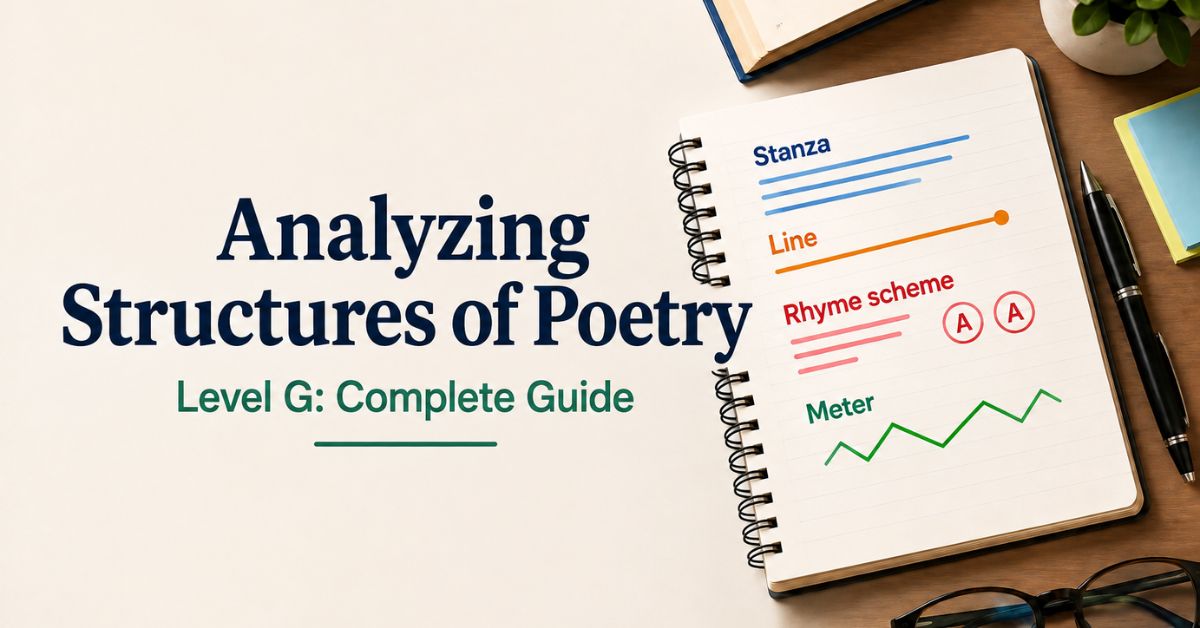
iReady – Analyzing Structures of Poetry Level G teaches students how a poem’s form its stanzas, rhyme scheme, meter, and line breaks shapes its meaning. In short: structure isn’t decoration. It’s how a poet controls pacing, emotion, and emphasis. Once you can name a structure and explain why the poet chose it, the rest of the lesson becomes much easier to answer with confidence.
This guide breaks down every structure type covered at this level, shows you how to analyze a poem step by step, and answers the exact questions students and parents search for most.
Key Takeaways
Poetry structure includes stanza pattern, rhyme scheme, meter, and line breaks each one shapes how a reader experiences the poem.

iReady - Analyzing Structures of Poetry Level G typically covers free verse, sonnets, haiku, villanelles, ballads, and odes.

The core skill being tested isn't memorization it's explaining how structure supports theme and tone with textual evidence.
What Is iReady – Analyzing Structures of Poetry Level G?
iReady – Analyzing Structures of Poetry Level G is a reading-comprehension unit within the iReady curriculum that trains students to identify and interpret how a poem is built. Rather than asking “What happens in this poem?”, the lesson asks “How does the way this poem is built affect what it means?”
Students read short passages, then answer questions about stanza breaks, rhyme patterns, and how form connects to tone. In my own experience walking students through similar reading-comprehension modules, the biggest jump in scores happens the moment a student stops treating structure as background trivia and starts treating it as evidence the same way they’d cite a quote to support an argument.
Why Poem Structure Shapes Meaning and Comprehension
Structure is never neutral. A poet’s choice to write in short, clipped lines versus long, flowing ones changes how fast a reader moves through the poem and that pacing shapes emotion. Short lines can feel urgent or anxious; long, unbroken lines can feel meditative or overwhelming.
For example, a poem written entirely in free verse, with no fixed rhyme or meter, often mirrors a speaker’s unfiltered thoughts. A poem locked into a strict rhyme scheme, however, can suggest control, tradition, or even irony when the tidy form clashes with messy content. Readers often tell us this is the “aha moment” of the whole unit: once you see structure as a choice, every poem becomes more interesting to analyze.
Core Poetic Structures Covered in Level G
Level G focuses on five recurring structures. Knowing the defining features of each one lets you answer structure-identification questions quickly and accurately.
Free Verse
Free verse has no fixed rhyme scheme or meter. Line breaks follow natural speech patterns or emphasize specific images and ideas rather than a set rhythm. Walt Whitman popularized this form in the 19th century, using long, cataloging lines to capture the scale and variety of everyday American life. In a classroom setting, free verse is useful for teaching students that “no structure” is still a structural choice the absence of rules is itself meaningful.
Sonnet
A sonnet is exactly 14 lines, traditionally written in iambic pentameter, with a specific rhyme scheme. The Shakespearean sonnet uses an ABAB CDCD EFEF GG pattern, ending in a rhymed couplet that often delivers a twist or resolution. This final couplet is sometimes called the “turn,” and it’s one of the most commonly tested structural features in Level G materials, because it directly connects form (the last two lines) to meaning (the poem’s conclusion).
Haiku
A haiku is a three-line poem with a 5-7-5 syllable count, originating in Japanese poetic tradition. Its brevity forces precision every syllable has to earn its place. Haiku typically focus on a single moment, often drawn from nature, and rely on imagery rather than explanation to convey feeling. This makes haiku an efficient way to teach students how compression itself is a structural technique.
Villanelle
A villanelle is a 19-line poem made of five three-line stanzas followed by a closing four-line stanza, built around two repeating refrain lines. Dylan Thomas’s famous work using this form demonstrates how repetition can build emotional intensity the returning lines feel more urgent each time they reappear. Villanelles are useful for teaching how repeated structure can reinforce a poem’s central theme, such as resistance or persistence.
Ballad and Ode
A ballad is a narrative poem, often set in quatrains with an ABCB or ABAB rhyme scheme, historically meant to be sung and used to tell a story frequently one involving conflict, tragedy, or heroism. An ode, by contrast, is a formal, often lengthy poem written in praise of a person, object, or idea, typically using elevated language and a more irregular stanza structure than a ballad. Comparing these two forms side by side helps students see how purpose (storytelling versus praise) drives structural choices.
How Rhyme Scheme Shapes a Poem’s Meaning
Rhyme scheme is the pattern of end rhymes in a poem, typically marked with letters (A, B, C) to show which lines rhyme with each other. Beyond making a poem pleasant to hear, rhyme scheme creates expectation readers unconsciously predict what sound is coming next, and poets can use that expectation to build tension or deliver surprise.
To identify a rhyme scheme, label the last word of each line with a letter, starting with A. If line 1 and line 3 rhyme, they both get an A; if lines 2 and 4 rhyme, they both get a B. A consistent ABAB pattern feels orderly, while a shifting or broken pattern can signal instability or emotional disruption within the poem.
Understanding Meter and Rhythm
Meter is the pattern of stressed and unstressed syllables in a line of poetry. It gives a poem its underlying “beat,” similar to rhythm in music. The most common meter tested at this level is iambic pentameter five pairs of unstressed-then-stressed syllables per line, closely mimicking the natural rhythm of spoken English.
Scansion Example – Marking Stressed and Unstressed Syllables
Scansion is the process of marking a line’s stresses to reveal its meter. In an iambic line, you’d mark syllables as unstressed (˘) then stressed (ˊ), repeating five times for pentameter. Practicing scansion on two or three lines from a poem even just tapping out the beats aloud is one of the fastest ways for students to internalize how meter works, rather than trying to memorize the definition alone.
What Is Enjambment and Why It Matters
Enjambment happens when a sentence or phrase continues past the end of a line without a pause, spilling its meaning into the next line. This is different from an end-stopped line, where a natural pause (often marked by punctuation) occurs at the line break.
Enjambment can create momentum, surprise, or ambiguity, because the reader’s eye reaches the end of a line expecting a pause and instead gets pulled forward. This technique is frequently underexplained in other study guides, yet it’s one of the most testable structural devices in Level G materials questions often ask students to explain why a poet chose to break a line mid-thought rather than at a natural pause.
Step-by-Step: How to Analyze a Poem’s Structure
- Read the poem twice. First for overall meaning, second specifically for structural features.
- Count stanzas and lines. Note whether stanza lengths are consistent or vary.
- Mark the rhyme scheme. Label end words with letters (A, B, C) to reveal the pattern.
- Check the meter. Tap or clap the syllables to see if there’s a consistent stressed/unstressed pattern.
- Identify enjambment or end-stops. Note where lines pause naturally versus where meaning spills over.
- Ask “why.” For every structural feature you find, ask how it connects to the poem’s tone or theme.
- Write your answer using evidence. State the structural feature, then explain its effect, using a specific line as proof.
iReady – Analyzing Structures of Poetry Level G: Common Question Types
Most Level G questions fall into a few recognizable categories: identifying a structural feature (e.g., “What is the rhyme scheme of this stanza?”), explaining effect (e.g., “How does the repetition in lines 5–7 affect the poem’s tone?”), and comparing two poems’ structures. Understanding these categories in advance helps students recognize what kind of answer is expected a label, an explanation, or a comparison before they even finish reading the question.
Annotated Example: Breaking Down a Poem’s Structure
Consider a short four-line stanza written in consistent ABAB rhyme with steady iambic rhythm. A student analyzing this stanza should note three things: first, the rhyme scheme (ABAB) creates a predictable, almost musical pattern; second, the steady meter reinforces that sense of order; third, if the poem’s subject is chaotic or emotional despite this tidy structure, that contrast itself becomes meaningful the form pushes against the content, creating tension worth explaining in an answer. This kind of layered observation structure, then contrast, then meaning is exactly what earns full credit on open-response questions.
Comparison Table: Poetry Structures at a Glance
| Structure | Line/Stanza Pattern | Typical Purpose |
| Free Verse | No fixed pattern | Mimics natural speech, emphasizes content over form |
| Sonnet | 14 lines, iambic pentameter | Builds toward a resolution or “turn” |
| Haiku | 3 lines, 5-7-5 syllables | Captures a single vivid moment |
| Villanelle | 19 lines, repeating refrains | Reinforces obsession, grief, or persistence |
| Ballad | Quatrains, ABCB/ABAB rhyme | Tells a story, often musically |
| Ode | Irregular stanzas, elevated tone | Praises a subject formally |
Common Mistakes Students Make When Analyzing Structure
The most frequent mistake is describing structure without connecting it to meaning simply stating “this poem has four stanzas” earns little credit on its own. As a result, students should always pair an observation with an explanation of effect. Another common error is confusing meter with rhyme scheme; they’re related but separate tools, and mixing them up leads to inaccurate answers. Finally, some students skip checking for enjambment entirely, missing one of the most testable structural devices at this level.
Tips for Teachers and Parents Supporting Level G Learners
Encourage students to read poems aloud rhythm and rhyme are far easier to hear than to see on a page. When reviewing a missed question together, ask the student to explain their reasoning rather than simply providing the correct label; this reveals whether the gap is in identification or interpretation. For example, a student might correctly spot a rhyme scheme but struggle to explain why the poet chose it that distinction should guide how you help them practice next.
What Grade Level Is iReady Level G, Really?
iReady’s leveling system doesn’t map one-to-one onto traditional school grades, but Level G typically corresponds to upper-elementary through middle-school reading ability, commonly around grades 6–7 depending on a student’s individual placement results. Because iReady is adaptive, two students in the same physical grade can be working at different iReady levels based on diagnostic performance, which is why it’s worth confirming placement directly with a teacher rather than assuming by age alone.
FAQs
Q: What is the main goal of iReady – Analyzing Structures of Poetry Level G?
A: The unit teaches students to identify structural features stanzas, rhyme scheme, meter, and line breaks and explain how those choices shape a poem’s meaning and tone. It builds evidence-based reading skills that apply to fiction and nonfiction texts as well, not just poetry.
Q: How is free verse different from a sonnet?
A: Free verse has no fixed rhyme or meter, allowing natural, speech-like line breaks, while a sonnet follows a strict 14-line form in iambic pentameter with a set rhyme scheme. The comparison highlights how structural freedom versus structural constraint can each serve different creative purposes.
Q: Why is meter important when analyzing a poem’s structure?
A: Meter establishes a poem’s underlying rhythm, which can mimic natural speech, build tension, or create a musical quality. In iReady – Analyzing Structures of Poetry Level G, recognizing meter helps students explain how rhythm reinforces a poem’s mood or pacing.
Q: What is enjoyment, and why does it matter?
A: Enjambment occurs when a sentence continues past a line break without pausing, creating momentum or surprise. It’s a frequently tested structural device because it directly connects a formatting choice (the line break) to a reading experience (the pause or lack thereof).
Q: How can I practice for iReady – Analyzing Structures of Poetry Level G?
A: Read short poems aloud, mark their rhyme scheme and stanza pattern, and practice explaining why each structural choice affects tone or meaning. Public-domain poetry collections and guided step-by-step analysis, like the process outlined above, build the same skills the unit assesses.
Final Thoughts
Mastering iReady – Analyzing Structures of Poetry Level G comes down to one habit: always connecting what a poem’s structure looks like to why it matters. Once a student can spot a rhyme scheme, meter pattern, or moment of enjambment and immediately explain its effect on tone or theme, the lesson’s questions stop feeling like guesswork and start feeling like straightforward evidence-based writing a skill that carries well beyond this one unit.
Recent Article : 30 Short Poems Every Poetry Lover Should Read in 2026

Jennifer Aston is a passionate poetry curator and writer with a deep love for the written word. She believes poetry has the power to heal, inspire, and connect people across all walks of life. Through PoemSteric, she brings together timeless and modern verses for every emotion and every moment.