
Introduction
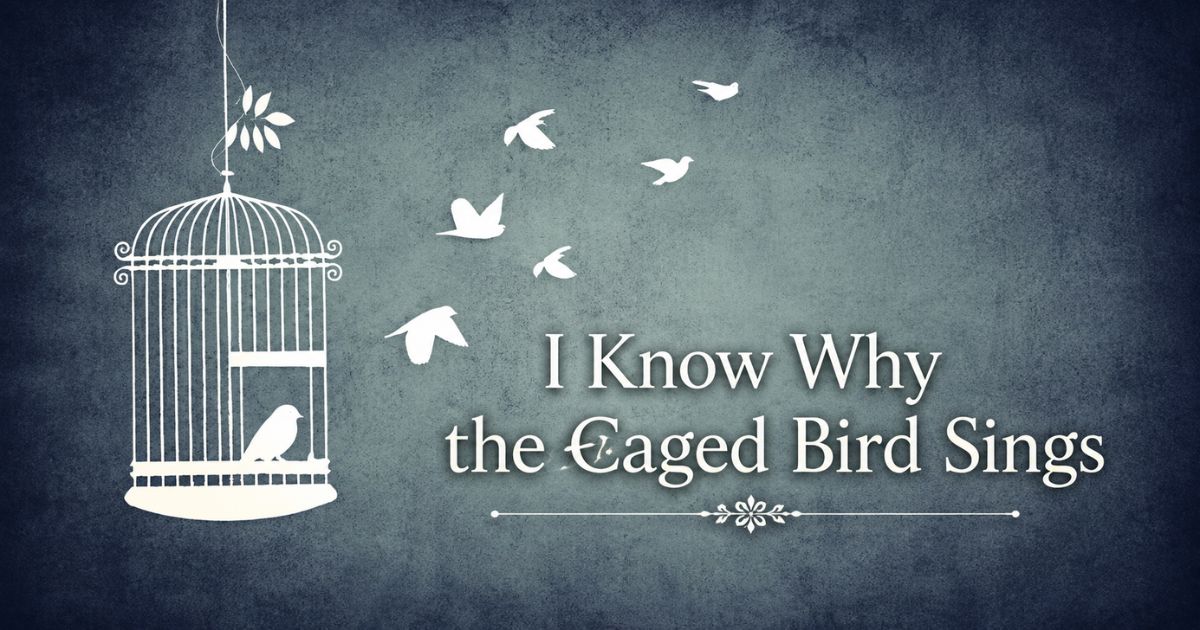
The phrase “I know why the caged bird sings poem” usually refers to Maya Angelou’s famous Caged Bird poem. Its central meaning is that oppressed people may be denied freedom, yet they can still preserve hope and demand liberation through their voices. The poem contrasts a free bird with a caged bird to expose the painful difference between freedom and confinement.
There is one important literary detail to clarify first. I Know Why the Caged Bird Sings is the title of Angelou’s 1969 autobiography, while Caged Bird is the poem published in her 1983 collection Shaker, Why Don’t You Sing?
The connection between the two works is deliberate and meaningful. Angelou repeatedly used the caged-bird image to explore confinement, racism, trauma, identity, and the struggle for freedom. The image itself has an earlier literary history in Paul Laurence Dunbar’s 1899 poem “Sympathy.”
In Caged Bird, Angelou does not simply describe two birds. She creates a powerful contrast between two ways of living. One bird moves freely through the natural world, while the other is physically and psychologically restricted.
The caged bird cannot fly. Its wings are clipped, its feet are tied, and its environment is narrow. However, it still sings, and that final fact is central to the poem’s meaning.
The bird’s song becomes a form of self-expression. It also becomes a declaration that freedom remains desirable, even when freedom has not yet been experienced.
Key Takeaways
- The poem’s meaning can be understood through several connected ideas.
- The free bird represents unrestricted freedom and privilege. It can move through the sky, enjoy nature, and behave as though the world belongs to it, and its freedom seems natural because nothing prevents it from using that freedom.
- The caged bird represents oppression and confinement. Its cage restricts its movement, while clipped wings and tied feet remove its ability to escape.
- The poem explores the desire for freedom. The caged bird sings about something it has not fully experienced but deeply wants.
- The poem connects oppression with emotional and psychological suffering. The cage is not merely a physical structure; images such as “bars of rage” and the “grave of dreams” suggest that confinement affects the bird’s inner life as well.
- Finally, the poem presents voice as a form of resilience. The bird cannot fly, but it can sing, and its voice travels beyond the cage.
The Core Meaning
A strong one-sentence interpretation is: Maya Angelou uses the contrast between a free bird and a caged bird to show the pain of oppression, the value of freedom, and the resilience of those who continue to demand liberation.
Key Themes
- Freedom
- Oppression
- Inequality
- Racism
- Confinement
- Hope
- Resilience
- Self-expression
- Longing
- Social justice
These themes are connected. The desire for freedom becomes most powerful when readers understand the restrictions placed on the caged bird.
I Know Why the Caged Bird Sings Poem: Meaning and Context
Before analyzing the poem, it is essential to separate the poem from Angelou’s autobiography. I Know Why the Caged Bird Sings was published in 1969. It is Angelou’s first autobiography and describes her childhood and adolescence, including experiences shaped by racism, trauma, and discrimination. Caged Bird, meanwhile, appeared in 1983 in the poetry collection Shaker, Why Don’t You Sing?
The shared image is not accidental. Angelou used the caged bird as a recurring symbol of confinement and the struggle to find a voice.
The Poem and the Autobiography Are Different Works
The autobiography tells a sustained life story, while the poem compresses its ideas into a symbolic contrast between two birds. That distinction matters for students.
If someone searches for the i know why the caged bird sings poem, they may actually be looking for Caged Bird. Using the wrong title in an exam answer could create an avoidable factual error. A reliable answer should therefore identify the poem as “Caged Bird,” the poet as Maya Angelou, the collection as Shaker, Why Don’t You Sing?, its publication year as 1983, and the related autobiography as I Know Why the Caged Bird Sings, published in 1969.
Why the Caged Bird Became Angelou’s Powerful Image
The caged bird works because it is easy to understand while carrying several layers of meaning. A bird is naturally associated with flight, and flight suggests movement, choice, space, and freedom. Therefore, placing that bird inside a cage immediately creates a conflict between what the creature should be able to do and what it is actually allowed to do.
The metaphor becomes even stronger when Angelou describes clipped wings and tied feet. The bird is not merely choosing to stay inside; its ability to leave has been deliberately removed. That distinction turns the image into a metaphor for oppression rather than ordinary captivity.
Freedom and Oppression: The Central Meaning
The strongest feature of the poem is its opposition between freedom and oppression. Angelou introduces a free bird that moves naturally through the air. The bird leaps, floats, dips its wing, and claims the sky, and these active verbs create a sense of confidence and possibility.
The caged bird experiences the opposite reality. It moves inside a narrow space, its wings have been clipped, and its feet have been tied. Therefore, the bird has lost the physical ability to exercise the freedom that defines its nature.
What the Free Bird Represents
The free bird can represent people who possess opportunities, rights, mobility, and social power. Importantly, the bird does not need to fight for these privileges; freedom appears normal to it, and that is part of Angelou’s contrast.
A person who has always had freedom may not fully understand what confinement feels like, while someone denied freedom may become intensely aware of every restriction. The free bird also imagines the natural world as belonging to it: it can claim the sky and think about food, wind, trees, and open space. Its imagination is therefore as unrestricted as its body.
What the Caged Bird Represents
The caged bird represents people whose choices and opportunities are restricted by forces beyond their control. The poem can be read specifically through the history of racial inequality in the United States, and study resources commonly connect Angelou’s metaphor with African American experiences of oppression and the wider struggle for civil rights.
However, the metaphor can also reach beyond one historical group it can represent anyone whose freedom is systematically limited. That broader interpretation is possible because Angelou never reduces the bird to a single literal identity. Instead, she creates a symbolic figure that communicates the psychological experience of being denied freedom. The result is a poem about both specific historical injustice and the wider human desire for liberation.
Racism, Inequality, and Social Injustice
The poem’s symbolism becomes especially powerful when read against Angelou’s historical context. Maya Angelou was a Black American writer who lived through periods of severe racial discrimination in the United States, and her work frequently addressed identity, racism, dignity, gender, and the struggle for equality.
For that reason, the caged bird is often understood as a metaphor for oppressed Black Americans. Educational resources also connect the poem with racial inequality and the African American civil-rights tradition.
The Historical Context of Oppression
Angelou’s poem appeared in 1983, after the major civil-rights struggles of the 1950s and 1960s. Yet the publication date does not make the poem historically distant from those issues; its language preserves the emotional reality of inequality.
The caged bird has physical restrictions: it cannot move freely, it cannot use its wings normally, and it cannot see the world in the same way as the free bird. These conditions can be read as symbols of social systems that restrict people’s opportunities. The poem therefore does more than say that freedom is good; it asks readers to notice that freedom is not experienced equally.
Why the Metaphor Is Broader Than One Group
Although racial oppression is an important interpretation, the poem’s symbolism can be applied more broadly. Oppression can involve race, gender, political power, social class, disability, imprisonment, or other forms of imposed limitation.
The important point is not to erase the poem’s historical context; instead, the broader reading should grow from that context. The caged bird represents a person whose potential is restricted, while the free bird represents a person whose environment allows that potential to develop. That contrast encourages readers to ask an important question: who gets to experience freedom naturally, and who has to fight simply to be heard?
The Symbolism of the Caged Bird
The caged bird is the poem’s central symbol. Angelou takes something familiar like a bird and transforms it into a representation of oppression, frustration, hope, and resistance. The symbolism works because the bird’s natural ability is flight, and a bird that cannot fly appears to have been separated from its essential nature.
The Cage, Clipped Wings, and Tied Feet
The cage represents confinement, the clipped wings represent lost ability and restricted potential, and the tied feet represent forced immobility. Together, these images show that oppression can operate at multiple levels: the bird is prevented from moving, and it is also prevented from using the very abilities that should allow it to escape.
The phrase “bars of rage” adds another layer. The bars are not only physical rage has become part of the bird’s psychological environment. This is important because oppression does not merely control where someone can go. It can also affect how that person thinks, feels, hopes, and imagines the future.
The Song as a Voice for Freedom
The bird’s song is the poem’s most hopeful symbol. The bird cannot fly, but it can still produce a voice, and its song expresses longing for something it does not fully know but desperately wants.
That idea is powerful. People do not always need to possess freedom before they can imagine it sometimes the desire for freedom begins with recognizing that one’s current condition is unjust. The song therefore becomes both an emotional expression and a form of resistance. The bird’s voice proves that oppression has not completely destroyed its identity.
Hope, Resilience, and the Power of Expression
The poem would be much darker if the caged bird simply remained silent. Instead, the bird sings, and this action changes the meaning of the cage. The cage remains, the wings remain clipped, and the feet remain tied yet the bird refuses complete silence. Angelou therefore presents expression as a form of resilience.
Why the Bird Continues to Sing
The bird sings because it longs for freedom. Its song is described as fearful, which means the poem does not romanticize resistance; the bird is not fearless, it is frightened and restricted, yet it still sings.
That combination makes the poem’s idea of courage more realistic. Courage does not always mean the absence of fear; sometimes it means continuing to speak despite fear. The song can also represent poetry itself: Angelou is writing a poem about a bird that sings, and in a symbolic sense, the poet is also using her own voice to speak about freedom, inequality, and human dignity. This creates a useful parallel: caged bird → song → voice → expression → demand for freedom.
The Distant Hill and the Reach of the Voice
The bird’s song travels beyond the cage, and this is one of the poem’s most hopeful images. Physical confinement cannot completely contain sound, so the bird reaches an audience that it cannot physically reach through movement. The “distant hill” can be understood as a symbolic space beyond captivity, and the song travels toward that space, carrying the bird’s longing with it.
This also helps explain why art matters in the poem. Art may not immediately remove oppression; however, it can make suffering visible, preserve memory, build solidarity, and communicate a demand for change. Angelou’s poem itself demonstrates that principle.
Poetic Devices That Strengthen the Meaning
Angelou’s message depends heavily on literary technique. The poem’s meaning becomes memorable because its ideas are expressed through concrete images rather than abstract political statements.
Extended Metaphor and Contrast
The extended metaphor is the poem’s central device. The two birds represent contrasting human experiences: the free bird represents liberty, opportunity, and privilege, while the caged bird represents confinement, inequality, and the desire for liberation. The contrast continues throughout the poem, as shown below.
| Free Bird | Caged Bird |
| Open sky | Narrow cage |
| Free movement | Restricted movement |
| Claims the sky | Dreams of freedom |
| Natural confidence | Fear and rage |
| Access to the world | Separation from the world |
| Physical freedom | Physical and psychological confinement |
This repeated contrast makes the poem easy to follow while giving it considerable depth.
Imagery, Personification, and Repetition
Angelou uses vivid imagery to make freedom visible. The free bird moves through wind, sunlight, trees, and open sky, and these details create an expansive visual world. The caged bird, by contrast, occupies a narrow and threatening environment.
Personification also strengthens the poem the birds think, imagine, rage, and sing in ways that mirror human emotional experiences. Repetition is particularly important in the recurring description of the caged bird’s song: the repeated song creates a refrain-like effect and reinforces the central idea that the desire for freedom cannot easily be silenced.
The poem’s structure therefore mirrors its message. The caged bird is trapped in the poem’s world, but its song repeatedly escapes that confinement.
Caged Bird: Stanza-by-Stanza Meaning
The poem is commonly presented in six stanzas, with alternating descriptions of the free and caged birds and repeated sections about the caged bird’s song. The structure itself reinforces the central contrast.
The Free Bird and Unrestricted Life
The opening stanza presents the free bird moving through an open natural environment. The bird leaps onto the wind and moves with the current, enjoying sunlight and claiming the sky every image suggests freedom.
The verbs are especially important: the bird leaps, floats, dips, and dares. These words communicate movement and agency, since the bird decides where it goes and experiences the world directly. The next major free-bird section expands this idea, as the bird thinks about another breeze, trade winds, trees, food, and the open sky. Freedom therefore affects both body and imagination; the free bird does not simply have room to move, it can imagine endless possibilities.
The Imprisoned Bird and Its Song
The caged bird is introduced through a sharp contrast. Instead of flying, it stalks inside a narrow cage. Instead of open movement, it faces bars. Instead of healthy wings, it has clipped wings. Instead of free feet, it has tied feet. Yet the bird opens its throat to sing, and this moment changes the emotional direction of the poem.
The song contains fear, but it also contains desire the bird sings of something unknown yet deeply wanted: freedom. The same basic pattern returns later in the poem: the free bird continues to experience the world as its own, while the caged bird stands among the remains of broken dreams. However, the caged bird still sings, and that repetition is essential, Angelou does not allow the reader to forget the bird’s voice.
What Does the Caged Bird Sing About?
The caged bird sings about freedom. However, the meaning is deeper than simply wanting to leave a physical cage. The bird sings about a life of possibility, longing for a condition in which its wings can work, its feet can move freely, and its imagination can extend beyond confinement.
The phrase describing the bird’s longing for something unknown is especially important. The bird may not possess complete knowledge of freedom because it has lived within restrictions, yet it still knows that its present condition is not enough. That idea applies to many forms of oppression: a person does not need to experience complete equality before recognizing inequality, and a person does not need to experience complete freedom before desiring it. The song therefore represents hope before liberation, which is one of the most important insights in the poem.
The caged bird’s voice also travels beyond its immediate surroundings. Its song reaches the distant hill, suggesting that an oppressed voice can move beyond the boundaries imposed upon it. In this sense, the poem itself becomes an example of the bird’s song – Angelou transforms a symbolic bird into a literary voice that has reached readers around the world.
How to Explain the Poem’s Meaning Step by Step
If you need to answer an exam question about the poem’s meaning, avoid writing only a list of themes. Instead, build your answer logically.
- Identify the poet and poem. Maya Angelou wrote “Caged Bird.” If relevant, clarify that I Know Why the Caged Bird Sings is her 1969 autobiography.
- State the central contrast. Explain that Angelou compares a free bird with a caged bird, since this contrast forms the foundation of the poem.
- Explain freedom. Describe how the free bird moves through the sky and natural world, and mention its freedom of movement and its ability to imagine possibilities.
- Explain oppression. Describing the cage, clipped wings, and tied feet these images show that the caged bird has been deliberately prevented from exercising its natural abilities.
- Explain the symbolism. Connect the caged bird to oppressed people. Racial inequality is a major historical interpretation, but the metaphor can also communicate the broader human experience of imposed confinement.
- Explain the song. The song represents voice, hope, self-expression, and the desire for freedom; this is the poem’s most important hopeful element.
- Explain the ending. The caged bird continues to sing, so oppression has not completely destroyed its ability to hope or speak.
- Give the final message. A strong final sentence could be: Angelou shows that oppression can restrict the body and damage the mind, but the desire for freedom and the power of the human voice can survive even under severe confinement.
This method gives an answer that is specific, evidence-based, and easy to understand.
FAQs
Q: Do I Know Why the Caged Bird Sings a Poem?
A: No. I Know Why the Caged Bird Sings is Maya Angelou’s 1969 autobiography. The poem connected with the search phrase I know why the caged bird sings poem is actually titled Caged Bird. Angelou published that poem in her 1983 collection Shaker, Why Don’t You Sing? The two works share the caged-bird image, which Angelou used to explore confinement, oppression, identity, and the desire for freedom.
Q: What is the meaning of the Caged Bird poem?
A: Caged Bird explores the conflict between freedom and oppression. The free bird can move through an open world and claim the sky, while the caged bird has clipped wings and tied feet. Despite its confinement, the caged bird continues to sing about freedom. The poem therefore suggests that oppression can restrict physical movement and damage emotional well-being, but the desire for freedom and the ability to express that desire can survive.
Q: What does the caged bird symbolize in Maya Angelou’s poem?
A: The caged bird symbolizes a person or group whose freedom and opportunities have been restricted. The poem is frequently interpreted through African American history and racial oppression, especially because of Angelou’s life and literary context. However, the symbol can also represent other forms of imposed confinement. Its clipped wings, tied feet, and narrow cage show how oppression can limit both physical freedom and the ability to pursue one’s potential.
Q: Why does the caged bird sing about freedom?
A: The bird sings because freedom remains deeply desirable even though it has not experienced it fully. Its song expresses fear, longing, hope, and resistance. The bird cannot escape physically, but it can still use its voice. As a result, singing becomes a form of self-expression. The song also travels beyond the cage, suggesting that an oppressed person’s voice can reach others even when physical circumstances prevent direct escape.
Q: What is the main theme of Caged Bird?
A: The main themes are freedom, oppression, inequality, hope, resilience, and self-expression. Angelou creates these themes through the contrast between a free bird and a caged bird. The free bird represents unrestricted movement and privilege, while the caged bird represents confinement and denied opportunity. The repeated song of the caged bird adds hope because it shows that the desire for freedom remains alive despite physical and psychological restrictions.
Q: Who wrote the poem related to I Know Why the Caged Bird Sings?
A: Maya Angelou wrote Caged Bird, the poem related to her famous autobiography I Know Why the Caged Bird Sings. The poem appeared in her 1983 collection Shaker, Why Don’t You Sing? The shared image has an earlier literary source in Paul Laurence Dunbar’s 1899 poem “Sympathy.” Angelou therefore adapted an established African American literary symbol while developing it in her own voice and historical context.
Q: What does the free bird represent?
A: The free bird represents freedom, privilege, opportunity, and unrestricted movement. It can travel through the sky, interact with nature, and imagine the world as open to it. Its confidence contrasts with the caged bird’s fear and frustration. The free bird therefore helps Angelou show that people who possess freedom may experience it as normal, while people who are denied freedom become acutely aware of the restrictions surrounding them.
Final Thoughts
The most powerful meaning behind the “i know why the caged bird sings poem search” is found in Maya Angelou’s actual poem, “Caged Bird.” The poem contrasts a bird that enjoys unrestricted freedom with another that is trapped, injured, and denied the ability to fly. The free bird represents privilege and opportunity, while the caged bird represents oppression and restricted potential.
Yet Angelou does not end with silence. The caged bird sings, and that song represents hope, resistance, identity, and the continuing desire for freedom. Its wings may be clipped, but its voice remains.
The poem is also historically connected to African American experiences of inequality, while its central metaphor remains broad enough to speak to anyone facing imposed limitations. The relationship between the poem and Angelou’s autobiography makes the subject even more significant; the caged-bird image became one of Angelou’s defining literary symbols, while its roots reach back to Paul Laurence Dunbar’s “Sympathy.”
Ultimately, the poem teaches that freedom should never be taken for granted, oppression should not be normalized, and a person’s voice can remain powerful even when physical freedom has been denied. That is why the image of the caged bird continues to resonate with readers.
Recent Article : My Mother at Sixty-Six: Best Analysis and Meaning

Jennifer Aston is a passionate poetry curator and writer with a deep love for the written word. She believes poetry has the power to heal, inspire, and connect people across all walks of life. Through PoemSteric, she brings together timeless and modern verses for every emotion and every moment.