

Introduction
Three short lines can hold a whole world. That is the magic of haiku poems. A frog, a candle, a drop of dew or a crowded subway can turn into a moment you remember for years.
This guide is a complete resource for readers, students and writers. You will learn what a haiku really is, why the famous 5-7-5 rule is only half the story, and who the great masters were. You will also find 30 original haiku with meanings, a simple method for writing your own, and clear answers to the most common questions.
A quick note: the poems below are original compositions written in the spirit of the poets named. They are not those poets’ own words. Where a famous poem is discussed, we describe it in our own words so you can find the real work in trusted anthologies.
Key Takeaways
- A haiku is a short three-line poem that captures one moment, usually from nature.
- The 5-7-5 pattern comes from Japanese sound units, not English syllables. English haiku often run shorter, around 10 to 14 syllables.
- Two traditional tools matter more than counting: kigo (a seasonal word) and kireji (a “cut” that splits the poem in two).
- Four masters shaped the form: Bashō, Buson, Issa and Shiki.
- Modern haiku can be about cities, love, grief and everyday life, not only nature.
- The best haiku shows an image and lets the reader feel the meaning.
- You can write a good haiku in five steps, and this article shows how.
What Is a Haiku?
A haiku is a short Japanese poem of three lines that captures a single moment, usually in nature. Traditionally it follows a 5-7-5 sound pattern, including a seasonal word (kigo) and a cutting word (kireji) that splits the poem into two parts.
Haiku grew out of hokku, the opening verse of a longer group poem called renga. Over time poets began writing the opening verse on its own, and it became an independent art form. The word “haiku” itself became standard in the late 1800s, when Masaoka Shiki modernized the form.
What makes haiku special is what it leaves out. There is no rhyme, no long story and no lecture. The poet shows a small scene and trusts you to feel the rest. Reading haiku teaches you to slow down and notice the world.
The Real Rules of Haiku (Beyond 5-7-5)
Most of us learned at school that a haiku has 17 syllables. That is only partly true.
1. The 5-7-5 pattern. In Japanese, the count is made of sound units called on, which are shorter than English syllables. A Japanese haiku with 17 on is often shorter than 17 English syllables. That is why many English-language poets prefer a looser form, about 10 to 14 syllables, and focus on imagery instead.
2. Kigo (season word). A kigo places the poem in a season. Cherry blossoms suggest spring, fireflies suggest summer, the harvest moon suggests autumn and snow suggests winter. Japanese poets use special season-word lists called saijiki.
3. Kireji (cutting word). A kireji creates a pause between two images, like a breath. In English we usually create it with a dash, an ellipsis or a line break. The magic of a haiku often lives in the gap between its two parts.
4. One moment, plain language. A haiku shows a single observed moment in simple words. It usually avoids heavy metaphors and lets the image carry the feeling.
Do you have to follow every rule? No. Classic masters broke them, and modern poets skip kigo or 5-7-5 all the time. Still, a poem needs some of these features, especially a sharp image and a moment of surprise, to feel like a haiku.
The Four Great Haiku Masters
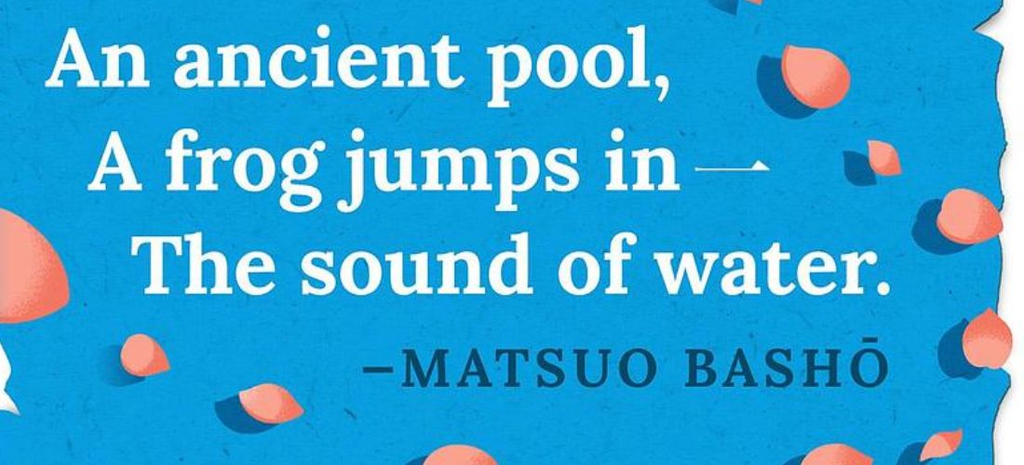
Matsuo Bashō (1644-1694) is the most famous name in haiku. His best-known poem describes a still pond, a frog and the small sound of water that makes the silence feel deeper. He treated haiku as a spiritual practice and traveled Japan writing about what he saw.
Yosa Buson (1716-1784) was also a painter, and his poems feel like small paintings. He loved color, light and gentle romance.
Kobayashi Issa (1763-1828) grew up in hardship, and his haiku are warm, humorous and full of compassion for small creatures such as snails, sparrows and flies. He also wrote deeply about loss.
Masaoka Shiki (1867-1902) modernized haiku. He encouraged poets to write from direct observation instead of stale conventions, and he gave the form the name we use today.
𝟑𝟎 𝐇𝐚𝐢𝐤𝐮 𝐏𝐨𝐞𝐦𝐬 𝐖𝐢𝐭𝐡 𝐌𝐞𝐚𝐧𝐢𝐧𝐠𝐬
1. Still Pond at Midnight (inspired by Bashō)
Still pond at midnight,
One drop breaks the mirror-calm,
Silence answers back.
Meaning: A tiny sound makes the stillness around it feel bigger. Silence is not empty. It listens.
2. One Small Candle (inspired by Buson)
One small candle burns,
Shadows lean toward its warmth,
The night feels gentler.
Meaning: Even a small light can soften the dark, a favorite Buson-style theme of gentle beauty.
3. Moon Over the Path (inspired by Buson)
Moon over the path,
My footsteps grow soft, then still,
Night leans in to hear.
Meaning: Moonlight turns a walk into a moment of quiet reflection.
4. Dew on the Grass Blade (inspired by Issa)
Dew on the grass blade
Holds the sky for one morning,
Then let it go free.
Meaning: Life is beautiful and brief, like a drop of dew that shines and disappears.
5. Small Snail on the Wall (inspired by Issa)
Small snail on the wall,
Climbing higher, taking time,
The peak is patient.
Meaning: Slow progress still counts. Patience carries you further than hurry.
6. Heavy Eyes Close Now (inspired by Shiki)
Heavy eyes close now,
The lamp dims, the room grows soft,
Sleep comes like a friend.
Meaning: Tiredness can feel like kindness when rest finally arrives.
7. Small Web in the Sun (inspired by Shiki)
Small web in the sun,
I brushed it away by chance,
Now the corner waits.
Meaning: A small careless act can leave a surprisingly large feeling of regret.
𝐇𝐚𝐢𝐤𝐮 𝐈𝐧𝐬𝐩𝐢𝐫𝐞𝐝 𝐛𝐲 𝐌𝐨𝐝𝐞𝐫𝐧 𝐏𝐨𝐞𝐭𝐬
8. Rain-Wet Subway Stairs (inspired by Ezra Pound)
Rain-wet subway stairs,
Faces flicker, then vanish,
Small lights in the crowd.
Meaning: Beauty can appear in the middle of a rushed city moment. Pound’s famous metro poem is a two-line imagist piece, and this haiku shares its spirit.
9. Open Mouth to Rain (inspired by Jack Kerouac)
Open mouth to rain,
Cold drops dance across my tongue,
Laughing at the clouds.
Meaning: A playful, sensory moment of pure joy.
10. Your Voice, Soft and Low (inspired by Sonia Sanchez)
Your voice, soft and low,
The clock forgets to move on,
Only we are here.
Meaning: Deep attention to another person can make time seem to stop.
11. One Streak of Bright Light (inspired by Michael Dylan Welch)
One streak of bright light,
I wish, and then wish again,
The whole sky is wide.
Meaning: A meteor shower brings wonder and hope.
12. Bare Branches, Cold Sky (inspired by Paul Holmes)
Bare branches, cold sky,
The year begins without noise,
Breath turns into mist.
Meaning: January arrives quietly, with cold air and a fresh start.
13. Snow Slips Into Streams (inspired by Penny Harter)
Snow slips into streams,
Old ground drinks the cold away,
Roots begin to stir.
Meaning: Winter gives way to spring, and new life begins underground.
14. West Wind in the Pines (inspired by R.M. Hansard)
West wind in the pines,
Whispers pass from tree to tree,
The forest keeps them.
Meaning: Wind becomes a voice that carries secrets through the woods.
15. Ground Shudders Awake (inspired by Steve Sanfield)
Ground shudders awake,
The cups clatter on the shelves,
Then the hush returns.
Meaning: Nature’s sudden power reminds us how fragile calm can be.
16. Old Bone in the Grass (inspired by Ravi Shankar)
Old bone in the grass,
Once it held a whole warm life,
Now it is raining.
Meaning: A quiet reflection on mortality and time.
𝐒𝐞𝐚𝐬𝐨𝐧𝐚𝐥 𝐚𝐧𝐝 𝐍𝐚𝐭𝐮𝐫𝐞 𝐇𝐚𝐢𝐤𝐮
17. Soft Rain on the Pond (spring)
Soft rain on the pond,
A single ripple widens,
Spring wakes the quiet.
18. Cherry Petals Fall (spring)
Cherry petals fall,
Landing on a sleeping stream,
Spring drifts slowly on.
19. Fireflies at Dusk Glow (summer)
Fireflies at dusk glow,
Small lanterns drift through warm air,
Summer breathes softly.
20. Cicadas Sing Loud (summer)
Cicadas sing loud,
The heat trembles on the road,
Shade is a gift now.
21. Red Leaf, One by One (autumn)
Red leaf, one by one,
The maple lets go, calmly,
Autumn understands.
22. Harvest Moon Rising (autumn)
Harvest moon rising,
Silver on the empty field,
Crickets keep the time.
23. First Snow on the Roof (winter)
First snow on the roof,
Every sound wrapped in white wool,
The world holds its breath.
24. Frost on the Window (winter)
Frost on the window,
A garden drawn in silver,
Morning warms are gone.
25. Thunder Rolls Across (storm)
Thunder rolls across,
The hills fold into darkness,
Rain answers the sky.
Meaning of the seasonal set: Each poem uses a season word (blossoms, fireflies, maple, snow) to place the reader in time, then adds a small image and a quiet feeling. This is the kigo technique in action.
𝐋𝐨𝐯𝐞, 𝐒𝐚𝐝𝐧𝐞𝐬𝐬 𝐚𝐧𝐝 𝐄𝐦𝐨𝐭𝐢𝐨𝐧 𝐇𝐚𝐢𝐤𝐮
26. Your Name in My Mouth (love)
Your name in my mouth,
Sweet as the first drop of rain,
Warm on a dry day.
27. Two Cups of Green Tea (love)
Two cups of green tea,
Steam curls in the space between,
Love needs no more words.
28. Empty Chair at Dusk (loss)
Empty chair at dusk,
Your coat still hangs by the door,
Evening comes slowly.
29. Rain Against the Glass (grief)
Rain against the glass,
Memories tap, one by one,
I let them come in.
30. Lone Crow on a Branch (loneliness)
Lone crow on a branch,
Autumn dusk, no other sound,
Just my own breathing.
Meaning of the emotion set: Notice that none of these poems says “I am sad” or “I am in love.” Objects such as a coat, steam or a crow carry the feeling. This is the “show, don’t tell” rule of haiku.
How to Write a Haiku in 5 Easy Steps
- Pick one moment. Choose something you saw, heard or felt today: rain on a bus window, a cup of tea, a bird on a wall.
- Collect concrete images. Write down what you can see, hear, smell, touch or taste. Avoid abstract words such as “beautiful” or “sad.”
- Add a season clue. A word like snow, blossom, monsoon or harvest quietly tells the reader when the moment happened.
- Create a cut. Put two images side by side and leave a gap between them. This can be a dash, an ellipsis or a line break.
- Trim and test. Aim for 5-7-5 if you enjoy the challenge, or keep it shorter. Remove every word that does not help the image. Then read it aloud. A haiku should fit in a single breath.
Common mistakes: explaining the emotion, counting syllables while ignoring imagery, using rhyme, and cramming in a full story.
Haiku vs Senryu vs Tanka
| Form | Lines | Focus |
| Haiku | 3 | Nature, seasons, one observed moment |
| Senryu | 3 | Human nature, humor, everyday behavior |
| Tanka | 5 (5-7-5-7-7) | Personal emotion and reflection |
A haiku watches the world. A senryu smiles at people. A tanka opens the heart with two extra lines.
FAQs
Q. What is a haiku?
A. A haiku is a short three-line poem that captures one moment, usually in nature. Traditionally it has a 5-7-5 sound pattern, a seasonal word (kigo) and a cutting word (kireji).
Q. How many syllables are in a haiku?
A. Traditional Japanese haiku have 17 sound units in a 5-7-5 pattern. In English, many poets follow 5-7-5, but others write shorter haiku of about 10 to 14 syllables because English syllables are longer than Japanese sound units.
Q. Does a haiku have to rhyme?
A. No. Haiku almost never rhyme. The beauty comes from a sharp image, a pause and a sudden shift of feeling. Rhymes can distract from the quiet tone that haiku aim for.
Q. Who is the most famous haiku poet?
A. Matsuo Bashō is widely considered the greatest haiku master. Buson, Issa and Shiki complete the group known as the four great masters of haiku.
Q. What is kigo in haiku?
A. Kigo is a seasonal word that tells the reader when the poem takes place. Examples include cherry blossoms for spring, fireflies for summer, the harvest moon for autumn and snow for winter.
Q. What is kireji in haiku?
A. Kireji means “cutting word.” It creates a pause that divides the poem into two parts. In English, poets usually use a dash, an ellipsis or a line break instead.
Q. Can a haiku be about love or sadness?
A. Yes. Traditional haiku focus on nature, but modern haiku explores love, loss, city life and memory. The key is to show the feeling through images instead of naming it.
Q. Is the plural of haiku “haikus” or “haiku”?
A. Both are used. In Japanese there is no plural form, so “haiku” works for one or many. Many English writers also use “haikus,” and both are accepted.
Final Thoughts
Haiku poems prove that a few quiet words can hold a whole season, a whole memory or a whole feeling. You do not need a perfect 17-syllable count to write one. You need attention, a clear image and the courage to leave some things unsaid.
Start with the 30 examples above, then try your own. Look out of the window, choose one small moment and write it in three lines. The world is full of haiku waiting to be noticed.
Recent Article : Rupi Kaur Poems About Love, Self-Love & Healing

Jennifer Aston is a passionate poetry curator and writer with a deep love for the written word. She believes poetry has the power to heal, inspire, and connect people across all walks of life. Through PoemSteric, she brings together timeless and modern verses for every emotion and every moment.