
Introduction
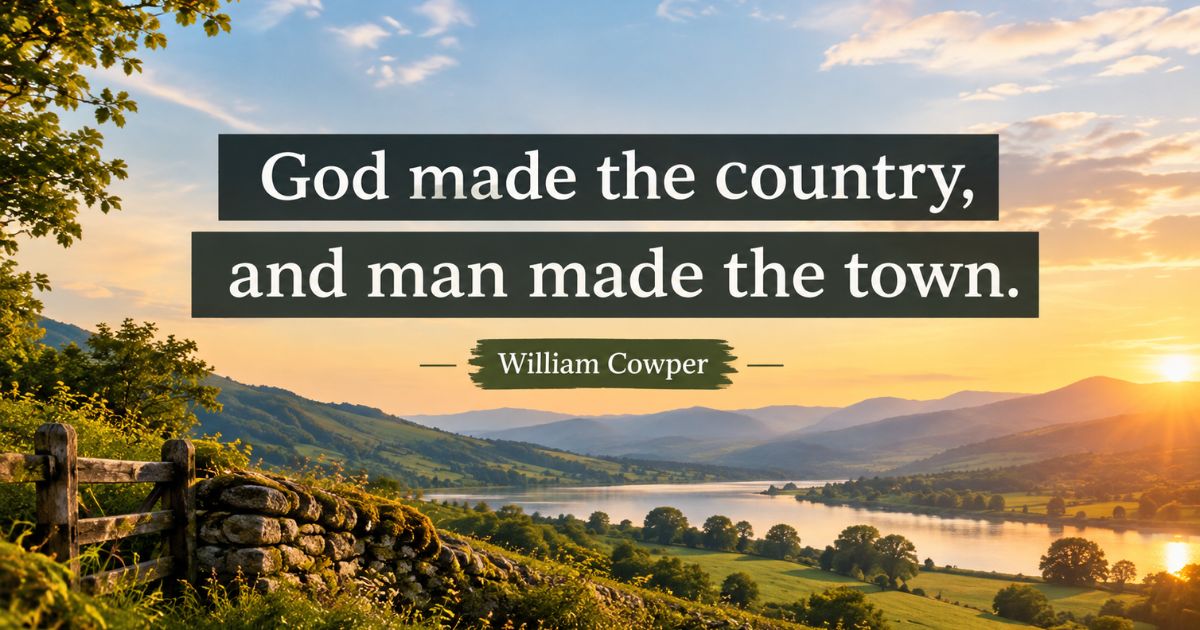
William Cowper wrote the line “God made the country, and man made the town.” It comes from his long poem The Task, published in 1785, specifically from Book I, titled “The Sofa.” The line is not a standalone poem; it is one line within a much longer work of blank verse.
Key Takeaways
- The line belongs to William Cowper’s poem The Task, published in 1785.
- It appears in Book I, “The Sofa,” at line 749 of that book.
- The Task is written in blank verse and runs to 5,185 lines across six books.
- Cowper wrote the poem after his friend Lady Austen suggested he write about a sofa.
- The line contrasts the health and virtue of rural life with the vice Cowper associated with cities.
Who Wrote “God Made the Country”?
William Cowper (1731–1800), an English poet, wrote this line. He is best remembered today for The Task and for hymns such as “God Moves in a Mysterious Way,” written earlier with John Newton as part of the Olney Hymns. Cowper struggled with severe depression for much of his life, and writing poetry, encouraged by his close friend Mary Unwin, became one of his main sources of stability.
Where Does the Line Come From?
The line comes from The Task, Cowper’s major work in blank verse, first published in 1785. Unlike his earlier poems, which mostly used rhymed couplets, The Task allowed Cowper room for long, reflective passages on nature, rural life, and the social problems of his time.
The Task, Book I: “The Sofa”
The Task is divided into six books. Book I, called “The Sofa,” begins with a mock-serious account of the sofa’s history before shifting into reflections on city life, corruption, and the countryside. The line “God made the country, and man made the town” appears at line 749 of this book, right after Cowper’s description of London as a place of both artistic brilliance and moral excess.
How the Poem Came to Be Written
Cowper’s friend Lady Austen challenged him to write a poem about an ordinary object, the sofa, as a lighter change from his usual serious subjects. He accepted the “task,” and what began as a playful exercise grew into a full-length reflection on nature, society, and faith, eventually filling six books.
What Does “God Made the Country, and Man Made the Town” Mean?
Cowper uses this line to argue that rural settings preserve health and virtue better than cities do. In his view, city life offered more opportunity for vice to hide, while country life, closer to nature, encouraged simpler and more honest living. Readers often notice that Cowper is not condemning cities outright; he even praises London’s artistic achievements a few lines earlier. The point is more about contrast than blanket judgment.

Quick definition: Blank verse is unrhymed poetry written in a regular meter, most often iambic pentameter. The Task is written almost entirely in this style, which gives Cowper room for longer, conversational sentences.
Themes in The Task
- Nature versus the city: the poem’s most famous contrast, expressed directly in the line about God and man.
- Domestic comfort: much of Book I lingers on quiet, homely pleasures, fitting its origin as a poem about a sofa.
- Religious reflection: Cowper often frames nature as evidence of a divinely ordered world.
- Social criticism: passages throughout the six books comment on the social and moral issues of Cowper’s era.
- Personal melancholy: scholars often connect Cowper’s praise of quiet rural life to his lifelong struggles with mental health.
FAQs
Q: Who wrote the poem “God made the country”?
A: William Cowper wrote it, though the phrase itself is a single line from his longer poem The Task, published in 1785, rather than a standalone poem in its own right. It appears in Book I, called “The Sofa,” and remains one of Cowper’s most frequently quoted lines.
Q: What is the full quote?
A: The full line reads, “God made the country, and man made the town,” found at line 749 of Book I of The Task. Cowper follows it by explaining that health and virtue are more abundant in rural settings than in cities.
Q: When was The Task published?
A: The Task was first published in 1785. It was Cowper’s major work in blank verse, following his earlier poems written in rhymed couplets.
Q: Why did Cowper write The Task?
A: His friend Lady Austen suggested he try a lighter subject than usual and jokingly set him the “task” of writing about a sofa. The project grew into a six-book poem covering nature, society, and faith.
Q: Is “God made the country, and man made the town” a complete poem?
A: No. It is a single line taken from Book I of The Task, a much longer poem of 5,185 lines across six books. The line is often quoted on its own, which can make it seem like a short, independent poem.
Final Thoughts
William Cowper wrote “God made the country, and man made the town” as part of Book I of The Task, published in 1785. What started as a playful poem about a sofa became one of the most quoted reflections on rural versus city life in English literature. Understanding where the line sits within the larger poem helps explain both its meaning and its lasting popularity.
Recent Article : Light Oh Where Is the Light Poem: Tagore’s Moving Guide

Jennifer Aston is a passionate poetry curator and writer with a deep love for the written word. She believes poetry has the power to heal, inspire, and connect people across all walks of life. Through PoemSteric, she brings together timeless and modern verses for every emotion and every moment.