
Introduction
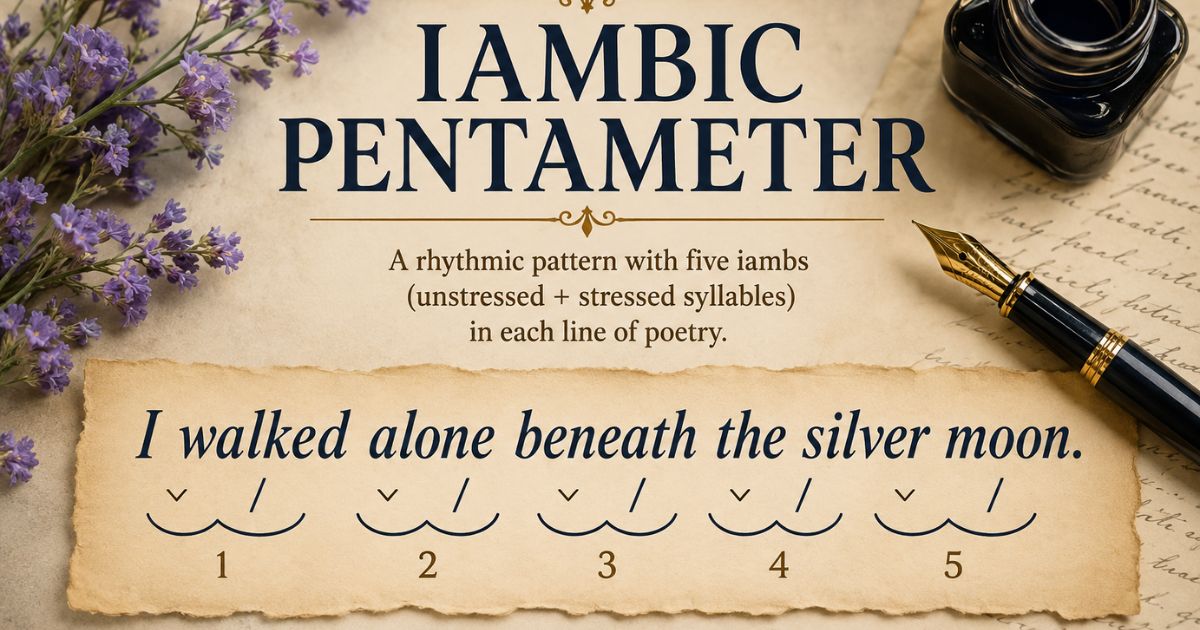
Iambic pentameter is a rhythmic pattern in poetry made up of five pairs of syllables per line, where each pair moves from an unstressed syllable to a stressed one creating a steady “da-DUM” beat repeated five times. It’s the most common meter in English poetry and drama, famously used by Shakespeare, and understanding it is one of the simplest ways to unlock how poetic rhythm actually works. This guide breaks the concept down step by step, using plain language and original examples, so beginners can learn to recognize and even write it themselves.
Key Takeaways
- Iambic pentameter is a line of poetry with five “iambs” pairs of syllables that go from unstressed to stressed.
- The word “iamb” describes the unstressed-then-stressed pattern, and “pentameter” means the line has five of these pairs.
- A typical line of iambic pentameter has ten syllables total, following a soft-LOUD, soft-LOUD rhythm.
- Scansion is the process of marking stressed and unstressed syllables to identify a poem’s meter.
- Shakespeare used iambic pentameter extensively in his plays and sonnets because it closely mirrors natural English speech patterns.
- Poets often vary the strict pattern slightly to avoid sounding mechanical, which is a normal and expected part of the meter.
Definition of Iambic Pentameter
Iambic pentameter is a poetic meter, a repeating rhythmic pattern built from five iambs per line. Each iamb consists of one unstressed syllable followed by one stressed syllable, and when five of these pairs appear in a row, the result is a ten-syllable line with a steady, alternating beat.
This meter is called “iambic” because of the type of syllable pair it uses, and “pentameter” because of how many pairs appear in each line. Together, the term describes both the type of rhythm and the amount of it in a single line of verse.
What Do “Iamb” and “Pentameter” Mean?
The word “iamb” refers to a single unit of rhythm made of two syllables: an unstressed syllable followed by a stressed one, similar to how the word “today” is naturally pronounced soft on the first syllable, strong on the second. This unstressed-then-stressed pattern is the basic building block of the entire meter.
“Pentameter” comes from the idea of five repeated units in a line. The prefix relates to the number five, and “meter” refers to a measured, repeating rhythm. So when the two words combine, “iambic pentameter” simply means: a line built from five repetitions of that soft-strong syllable pair.
Stressed and Unstressed Syllables: The Basic Structure
To understand iambic pentameter, you first need to understand stressed and unstressed syllables. A stressed syllable is the part of a word you naturally emphasize when speaking it aloud, while an unstressed syllable is spoken more softly or quickly. For example, in the word “before,” the first syllable is unstressed and the second is stressed. You naturally say “be-FORE,” not “BE-fore.”
In iambic pentameter, this same unstressed-stressed pattern repeats five times per line, creating a steady rhythm that can be written out as: da-DUM, da-DUM, da-DUM, da-DUM, da-DUM. This pattern isn’t just a technical rule, it’s meant to mirror the natural rise and fall of spoken English, which is part of why the meter has remained so popular for centuries.
How to Identify Iambic Pentameter (Scansion Made Simple)
Scansion is the process of marking a line’s syllables as stressed or unstressed to figure out its meter. To scan a line, read it aloud naturally first, without forcing a rhythm, and notice which syllables you emphasize. Then mark each syllable as either unstressed (often shown with a curved symbol) or stressed (often shown with a straight line or accent mark).
Once marked, group the syllables into pairs from left to right. If you consistently get an unstressed syllable followed by a stressed one, five times in a row, the line is in iambic pentameter. A simple beginner method is to count the syllables first exactly ten is a good sign and then check whether every second syllable naturally carries more emphasis when spoken aloud.
Examples of Iambic Pentameter
Here’s an original line written specifically to demonstrate the pattern: “I walked alone beneath the silver moon.” Read aloud, the natural stresses fall on “walked,” “lone,” “neath,” “sil,” and “moon” five stressed syllables, each preceded by an unstressed one, giving a clean da-DUM rhythm across the whole line.
Here’s a second original example: “The morning light returns to greet the hill.” Again, the stress falls on every second syllable: “morn,” “light,” “turns,” “greet,” and “hill.” Practicing with simple, original lines like these is often easier for beginners than analyzing existing poetry, since you can build the rhythm intentionally before learning to recognize it elsewhere.
Shakespeare and Iambic Pentameter
Shakespeare is the writer most closely associated with iambic pentameter, using it throughout both his plays and his sonnets. Many of his most famous sonnets including the one that opens by comparing a beloved to a summer’s day are built entirely from this meter, which gives the lines a natural, speech-like quality despite their poetic structure.
In his plays, Shakespeare often used iambic pentameter for dialogue spoken by noble or important characters, reserving plainer prose for lower-status characters or comic scenes. This wasn’t accidental: the rhythm of iambic pentameter closely resembles natural spoken English, which allowed formal poetic dialogue to still feel dramatic and believable on stage.
Why Poets Use Iambic Pentameter
Poets use iambic pentameter because its rhythm closely mirrors the natural patterns of spoken English, making it easier for both writers and readers to fall into the rhythm without it feeling forced or artificial. This is part of why it has remained the dominant meter in English poetry for hundreds of years.
Beyond sounding natural, the meter also gives poets a flexible but structured framework. Five feet per line is long enough to develop a complete thought or image, but short enough to maintain a clear, memorable rhythm, a balance that has made it especially useful for both narrative poetry and dramatic dialogue.
Variations and Exceptions
Strict iambic pentameter is actually less common in practice than you might expect. Most poets, including Shakespeare, regularly vary the pattern slightly reversing the stress in the first foot of a line, adding an extra unstressed syllable at the end, or occasionally breaking the pattern entirely for emphasis.
These variations aren’t mistakes; they’re intentional tools. A poet might deliberately break the rhythm to draw attention to an important word or emotional shift, using the reader’s familiarity with the expected pattern to make the disruption noticeable. Understanding this helps beginners avoid assuming that any deviation from perfect da-DUM rhythm means a line isn’t in iambic pentameter at all.
Common Mistakes to Avoid
One common mistake is counting syllables without checking stress patterns. A line can have exactly ten syllables and still not be iambic pentameter if the stresses don’t alternate correctly. Always confirm the stress pattern, not just the syllable count.
Another mistake is forcing an unnatural pronunciation to make a line “fit” the meter. Scansion should reflect how a line is naturally spoken, not how you’d need to mispronounce it to match a rhythm. Finally, many beginners assume every line in a poem must be perfectly regular; as covered above, small variations are normal and often deliberate, so don’t discard a poem’s meter identification just because a line or two doesn’t match exactly.
FAQs
Q. What is iambic pentameter in simple terms?
A. It’s a rhythmic pattern in poetry made of five unstressed-then-stressed syllable pairs per line, creating a steady da-DUM beat.
Q. How many syllables are in a line of iambic pentameter?
A. A typical line has ten syllables, arranged as five pairs of unstressed and stressed syllables.
Q. Why did Shakespeare use iambic pentameter so often?
A. Because its rhythm closely mirrors natural spoken English, allowing formal poetic dialogue to still sound believable and dramatic.
Q. Is every line of iambic pentameter perfectly regular?
A. No, poets often vary the pattern slightly for emphasis or natural phrasing, which is a normal and expected part of the meter.
Q. What is scansion?
A. Scansion is the process of marking a line’s syllables as stressed or unstressed to identify its metrical pattern.
Final Thoughts
Iambic pentameter is easier to understand once you break it into its two building blocks: the iamb, a simple unstressed-then-stressed syllable pair, and the idea of five of these pairs repeating in a single line. By practicing scansion on short, original lines and paying attention to how English is naturally spoken, beginners can quickly learn to recognize and even write one of poetry’s most enduring and influential rhythms.
Recent Article : The Raven by Edgar Allan Poe: Meaning and Analysis

Jennifer Aston is a passionate poetry curator and writer with a deep love for the written word. She believes poetry has the power to heal, inspire, and connect people across all walks of life. Through PoemSteric, she brings together timeless and modern verses for every emotion and every moment.