
Introduction
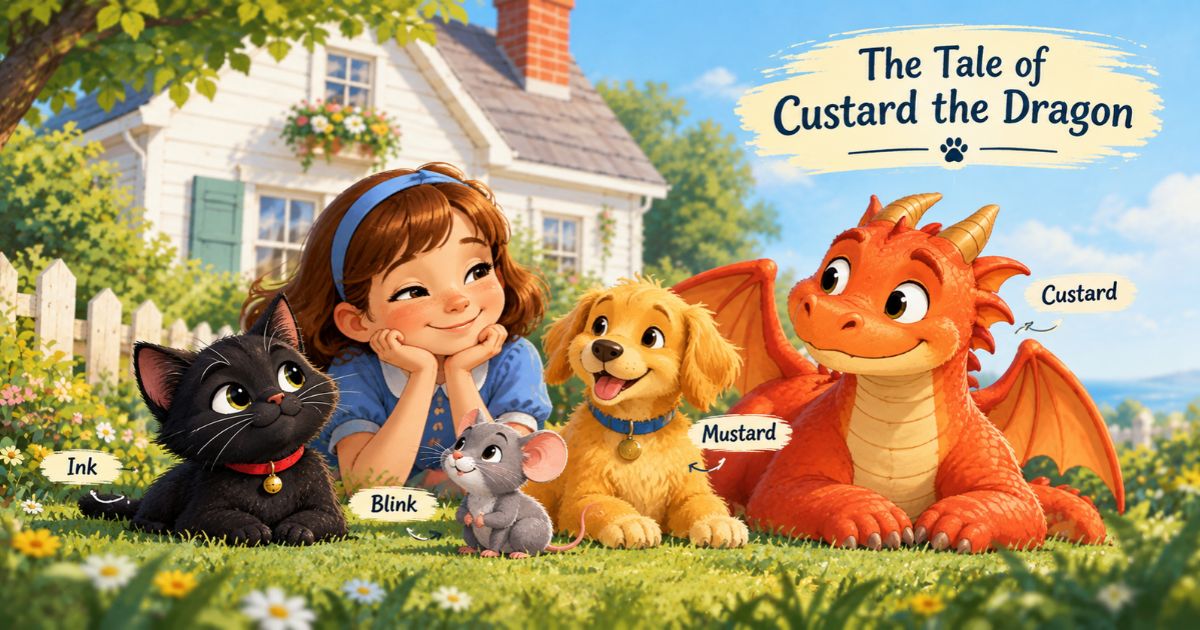
If you’re searching for who are Ink and Blink in the poem, here’s the direct answer: Ink is a little black kitten, and Blink is a little grey mouse. They are two of the four pets belonging to a young girl named Belinda in Ogden Nash’s poem “The Tale of Custard the Dragon.” Alongside them live Mustard, a small yellow dog, and Custard, a timid pet dragon.
Nash first published this ballad in 1936 in Child Life Magazine, and it has remained one of his most widely read poems for children ever since. Readers often notice that the poem’s charm comes as much from its rhyming character names as from its story, and Ink and Blink are a perfect example of that wordplay in action.
This article explains exactly who Ink and Blink are, what role they play in the story, why Nash chose these particular names, and how they compare to the poem’s real hero, Custard.
Key Takeaways
- Ink is Belinda’s little black kitten, and Blink is her little grey mouse. Both are minor characters who boast about their own courage.
- The four pets in the poem are Ink, Blink, Mustard the dog, and Custard the dragon, all living with a girl named Belinda.
- “The Tale of Custard the Dragon” was first published in 1936 in Child Life Magazine and later collected in several picture-book editions.
- Ink and Blink’s names rhyme with each other, matching the poem’s playful ballad structure and its use of paired, rhyming character names.
- Custard, the character everyone mocks for cowardice, turns out to be the bravest pet when real danger arrives, which is the poem’s central irony.
- The poem inspired the later song “Puff, the Magic Dragon,” popularized by Peter, Paul and Mary in 1963.
Who Is Belinda? Meet the Poem’s Main Character
Belinda is the young girl at the center of “The Tale of Custard the Dragon.” She lives in a small white house together with four unusual pets, and the poem opens by introducing each one of them in turn. This simple setup gives Nash room to build a household full of contrasting personalities before the story’s real conflict begins.
Ogden Nash (1902–1971) was an American poet celebrated for his playful, unconventional approach to rhyme. He was widely regarded, even in his own lifetime, as one of the most recognizable voices in humorous English-language verse, and his work often relied on inventive wordplay rather than serious or formal language. “The Tale of Custard the Dragon” reflects that style perfectly, using a light, musical ballad form to tell what is really a thoughtful story about courage and appearances.
The poem’s structure is an important context for understanding Ink and Blink’s role. As a ballad, it tells a complete story through rhyming stanzas meant to be read aloud, which is part of why the pets’ names rhyme with one another in pairs. Belinda herself does not have a dramatic personality arc; instead, she and her pets set the stage for Custard, whose journey from mocked coward to unlikely hero forms the heart of the poem.
Because Belinda’s household includes both ordinary animals and a dragon, the poem also plays with the idea of what “normal” looks like. In my own reading of the poem, Belinda’s calm acceptance of a dragon as just another pet is part of what makes the story’s humor work so well from the very first stanza.
Ink and Blink in the Poem: Who They Are and What They Do
Ink and Blink are introduced early in the poem as two of Belinda’s smaller pets, and their personalities are established quickly through their own boasting. Ink is described as a little black kitten, and his dark coloring almost certainly inspired his ink-themed name. Blink, meanwhile, is a small grey mouse whose quick, darting movements suit a name built around blinking or flickering motion.
Alongside Mustard the dog, Ink and Blink spend the early part of the poem claiming to be fearless. According to the poem’s plot, all three animals present themselves as brave in ways that Custard, by contrast, refuses to claim for himself. This contrast is the engine of the poem’s humor: while Ink, Blink, and Mustard talk confidently about their courage, Custard openly admits that he would rather feel safe than feel brave.
That balance shifts dramatically once real danger appears. When a pirate breaks into Belinda’s house, the animals who spent the poem boasting about their bravery react very differently than they claimed they would, retreating out of harm’s way rather than confronting the threat. Custard, previously teased and given a mocking nickname for his timidity, is the one who actually stands his ground and drives the intruder off.
Step-by-Step: How to Identify Each Pet’s Personality in the Poem
If you’re reading the poem for the first time, or studying it for class, these steps make it easier to track each character’s role:
- Read the opening stanzas carefully. Nash introduces Belinda and all four pets by name within the first few lines, so this is where you learn who’s who.
- Notice the boasting language. Ink, Blink, and Mustard are each given lines where they claim to be brave, often through exaggerated comparisons.
- Pay attention to Custard’s honesty. Unlike the other pets, Custard openly says he prefers safety, which sets up the poem’s central irony.
- Watch how each pet behaves when the pirate arrives. This is the turning point where claimed bravery and real bravery are tested against each other.
- Compare the ending to the beginning. The final stanzas reveal who was actually brave, which reframes everything said earlier in the poem.
Why are They Named Ink and Blink? The Reason Behind the Rhyme
Ogden Nash was known for building humor directly into his choice of names, and Ink and Blink are a clear example of that technique. The two names rhyme with each other, which fits naturally into the poem’s bouncy, musical ballad rhythm and makes the lines easy and fun to read aloud.
The names also connect loosely to each animal’s traits. Ink’s black fur mirrors the color of writing ink, while Blink’s quick, twitchy movements as a small mouse suit the idea of blinking or darting quickly out of sight. Mustard and Custard follow the same pattern: Mustard is named for his yellow color, and Custard’s name rhymes with Mustard’s, tying the two together as a matched pair the way Ink and Blink are matched.
This kind of paired, rhyming naming is a hallmark of Nash’s style more broadly. He frequently built jokes and rhythm directly into names and unusual word choices rather than relying only on traditional poetic imagery, and “The Tale of Custard the Dragon” is often cited as one of the clearest examples of that technique in his body of work.
Meet the Other Pets: Mustard and Custard the Dragon
Mustard is Belinda’s small yellow dog, and like Ink and Blink, he spends much of the poem asserting his own courage. His name, like the other pets’ names, ties directly to his appearance, since his yellow coloring mirrors the condiment he’s named after.
Custard is the poem’s most important character, despite being introduced last and mocked the most. He is described as a small, dragon-shaped pet who, unlike a storybook monster, has no interest in fighting or danger. Instead, he repeatedly asks for nothing more than a safe, comfortable place to stay, which earns him ridicule from Belinda and the other three pets, including a mocking nickname used to tease him throughout the poem.
Quick definition: A ballad is a poem that tells a story in rhyming verse, often written so it can be read or sung aloud in a simple, musical rhythm. “The Tale of Custard the Dragon” follows this tradition closely, using short, rhyming stanzas to carry its narrative from introduction to twist ending.
When the pirate breaks into the house, the poem’s irony reaches its peak. The three pets who spent the story boasting about their bravery do not confront the danger, while Custard, previously dismissed as a coward, is the only one willing to face the threat directly. After the danger passes, Custard goes right back to wishing for safety and comfort, while the other pets resume their earlier boasting as though nothing had changed. This ending is widely read as Nash’s gentle commentary on the difference between talking about courage and actually showing it.
Ink and Blink vs. Custard: A Quick Bravery Comparison
The clearest way to understand Ink and Blink’s role in the poem is to compare their behavior directly against Custard’s, both before and after the pirate arrives.
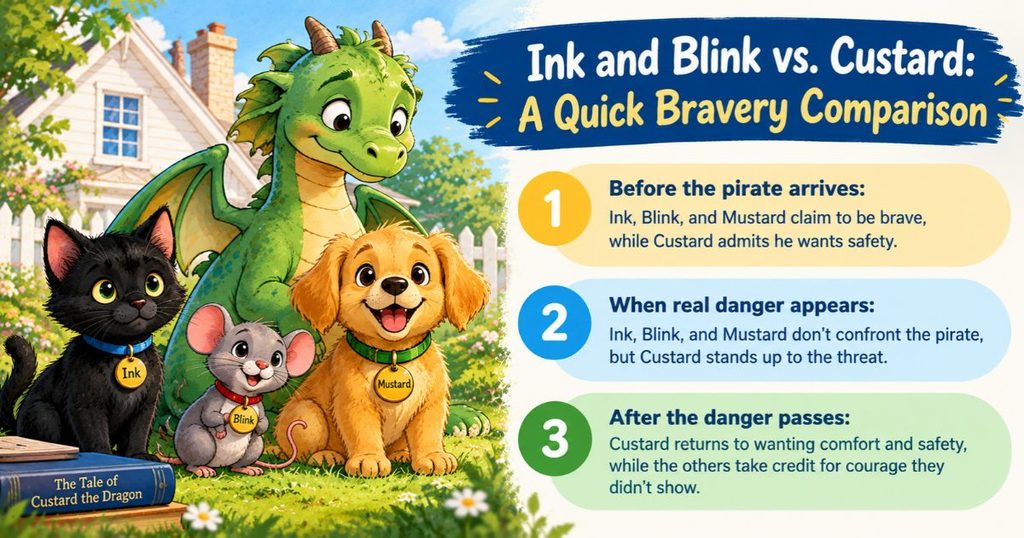
Before the pirate arrives:
- Ink, Blink, and Mustard openly claim to be fearless and brave.
- Custard is the only pet who admits he wants safety rather than danger.
- The other pets tease Custard for his honesty about being afraid.
When real danger appears:
- Ink, Blink, and Mustard do not confront the pirate despite their earlier boasting.
- Custard, previously mocked, is the one who stands up to the threat.
- The household’s true balance of courage is revealed for the first time.
After the danger passes:
- Custard returns to wishing for comfort and safety, unchanged by his own bravery.
- The other pets resume claiming credit for courage they did not show.
- The poem ends on an ironic note about who was truly brave all along.
This comparison is exactly why Ink and Blink matter to the story, even though they are minor characters. Their boasting sets up the contrast that makes Custard’s quiet courage so effective, and without their exaggerated claims, the poem’s central irony would lose most of its impact.
FAQs
Q: Who are Ink and Blink in the poem?
A: Ink and Blink are two of Belinda’s pets in Ogden Nash’s poem “The Tale of Custard the Dragon.” Ink is a little black kitten, and Blink is a little grey mouse. Along with Mustard the dog, they spend much of the poem claiming to be brave, which sets up a strong contrast with Custard, the dragon who admits he would rather feel safe than fearless.
Q: Why did Ogden Nash name the characters Ink and Blink?
A: Nash was known for playful, rhyming wordplay in his poetry, and Ink and Blink follow that pattern closely. The two names rhyme with each other, matching the poem’s musical ballad rhythm, and each name loosely reflects the animal’s traits: Ink’s black fur and Blink’s quick, darting movements as a small mouse.
Q: What kind of animal is Blink in the poem?
A: Blink is a small grey mouse who lives with Belinda alongside her other three pets. Like Ink and Mustard, Blink claims to be brave early in the poem, which later contrasts sharply with how the smaller pets react once real danger, in the form of an intruding pirate, actually appears in the story.
Q: What is the significance of Ink and Blink in the poem’s ending?
A: Ink and Blink’s early boasting is essential to the poem’s irony. Because they claim to be fearless before the pirate arrives, their retreat when real danger appears highlights just how differently they act compared to Custard, whose honesty about wanting safety turns out to reflect real, quiet courage rather than cowardice.
Q: Is “The Tale of Custard the Dragon” based on a true story?
A: No, the poem is an original work of fiction written by Ogden Nash, first published in 1936 in Child Life Magazine. It is not based on a real event or real animals. Its lasting popularity comes from its playful rhyme scheme, memorable characters like Ink and Blink, and its lighthearted message about true courage.
Q: What poem or song did “The Tale of Custard the Dragon” inspire?
A: Nash’s poem is often credited as an inspiration behind “Puff, the Magic Dragon,” a poem written by Leonard Lipton that was later set to music and popularized by the folk group Peter, Paul and Mary in 1963. Both works center on a gentle, non-threatening dragon character, a theme Nash helped popularize decades earlier.
Final Thoughts
Ink and Blink are small but essential characters in Ogden Nash’s “The Tale of Custard the Dragon.” Ink is Belinda’s black kitten, and Blink is her grey mouse, and together with Mustard the dog, they spend the poem boasting about a bravery they never actually get the chance to prove.
Their role matters because it sets up one of the poem’s clearest lessons: talking about courage and actually showing it are two very different things. Custard, mocked throughout the story for wanting safety, ends up being the only pet willing to face real danger when it counts.
Understanding who Ink and Blink are in the poem opens the door to appreciating Nash’s larger point about appearances, honesty, and quiet bravery, wrapped inside a rhyming, lighthearted story that has entertained readers since 1936.
Recent Article : How Many Religious Poems Did Marvell Write?

Jennifer Aston is a passionate poetry curator and writer with a deep love for the written word. She believes poetry has the power to heal, inspire, and connect people across all walks of life. Through PoemSteric, she brings together timeless and modern verses for every emotion and every moment.