
Introduction
Andrew Marvell wrote how many religious poems, here is the direct answer: most scholars point to six poems. The literary critic J. B. Leishman classified these six works as Marvell’s religious poetry in his study The Art of Marvell’s Poetry. However, the exact number shifts depending on which scholar’s list you use, since some university reading lists count only four, while Marvell’s earliest printed collection groups seven poems together at its opening.
Andrew Marvell is best remembered today as one of England’s great Metaphysical poets, alongside John Donne and George Herbert. Most of his surviving verse is political or pastoral, not religious. That makes his small cluster of devotional poems easy to overlook, and it also explains why no single, universally agreed number exists.
This article gives you the clearest answer available, names every poem usually included in that count, and explains exactly why scholars disagree. Readers often notice that Marvell’s religious poems read more like careful arguments than hymns of praise, and understanding that habit of mind is the key to understanding why classification here is genuinely difficult.
Key Takeaways
- Andrew Marvell wrote six poems commonly classified as religious, according to J. B. Leishman’s influential study.
- The six poems are: “The Coronet,” “On a Drop of Dew,” “A Dialogue Between the Resolved Soul, and Created Pleasure,” “A Dialogue between the Soul and Body,” “Music’s Empire,” and “Bermudas.”
- Some course reading lists narrow this to four poems, dropping “Music’s Empire” and “The Resolved Soul” into other categories.
- Marvell’s poems were published posthumously in 1681, three years after his death, by his housekeeper Mary Palmer.
- The majority of Marvell’s known poetry is political or pastoral in theme, not religious. Religious poems make up a small minority of his output.
- No poem was labeled “religious” by Marvell himself. The classification is a modern scholarly tool, not an original grouping.
Who Was Andrew Marvell? A Brief Introduction to the Poet
Andrew Marvell (1621–1678) was an English poet and politician, born near Kingston upon Hull, the son of a clergyman. He studied at Trinity College, Cambridge, before his father drowned in a boating accident on the Humber, which cut his formal studies short.
During the 1650s, Marvell tutored Mary Fairfax, daughter of the parliamentary general Lord Fairfax, and it was during this period that he wrote several of his best-known lyrics, including “The Garden” and his Mower poems. He later became Latin secretary to Oliver Cromwell’s government, working alongside the poet John Milton, whom he later helped free from prison after the Restoration.
Marvell also served as Member of Parliament for Hull from 1659 until his death in 1678, a role he held while living through the English Civil War, the Commonwealth, and the Restoration of Charles II. Throughout this turbulence, he became known for favoring religious toleration and criticizing abuses of royal power, even as his own religious poems remained private and unpublished during his lifetime.
None of Marvell’s poetry appeared in print while he was alive. His poems were only collected and published in 1681, three years after his death, in a volume produced by his housekeeper, Mary Palmer, who claimed at the time to be his widow. It took until the 19th century, largely through the advocacy of essayist Charles Lamb, for Marvell’s reputation as a major poet to take hold.
Andrew Marvell Wrote How Many Religious Poems? Here’s the Direct Answer
The most widely cited answer is six. This figure comes from J. B. Leishman’s chapter on Marvell’s “religious” poems, which groups the works by shared subject matter: the soul, divine love, temptation, and salvation. Leishman’s classification remains the most frequently referenced count in academic discussions of Marvell’s devotional verse.
That said, the number is not fixed the way a publication date or a birth year would be. Different scholars, editors, and course syllabi apply slightly different criteria, so you will encounter counts of four, six, and even seven depending on the source. Understanding why requires looking at how the classification actually works.
J. B. Leishman’s List of Six Religious Poems
Leishman’s six religious poems are:
- “The Coronet”
- “On a Drop of Dew”
- “A Dialogue Between the Resolved Soul, and Created Pleasure”
- “A Dialogue between the Soul and Body”
- “Music’s Empire”
- “Bermudas”
This grouping appears in Leishman’s study of Marvell’s poetry, where each poem is examined for its treatment of faith, the soul, or divine order. It has become the reference point most later writers use, even when they end up disagreeing with parts of it.
Step-by-Step: How Scholars Classify a Marvell Poem as Religious
Literary classification is rarely automatic. Here is roughly how scholars decide whether a Marvell poem belongs in the religious category:
- Identify the central subject. Does the poem focus on the soul, salvation, divine love, or Christian virtue, rather than romance, politics, or nature for its own sake?
- Check its placement in the 1681 edition. Mary Palmer’s printers grouped several devotional-sounding poems near the front of Miscellaneous Poems, which later editors have treated as a meaningful clue.
- Compare it to established devotional traditions. Poems using emblem imagery or metaphysical conceits about the soul, such as the dewdrop in “On a Drop of Dew,” align with religious poetry conventions from the period.
- Cross-reference modern classifications. Leishman’s list is the most cited, but course reading lists at universities such as Winthrop sometimes use narrower groupings of four poems.
- Flag mixed-theme poems separately. Works like “Clorinda and Damon,” which blends pastoral dialogue with a debate over virtue, are sometimes counted as religious and sometimes left out entirely.
This step-by-step process explains why you will never find one “official” number. Classification depends on which step a given scholar weighs most heavily.
The Six Religious Poems of Andrew Marvell, Explained
Each of the six poems on Leishman’s list approaches faith from a different angle. Here is a short, accurate summary of each one.
- “The Coronet” The speaker sets out to weave a garland of flowers and poems as an offering to Christ, only to discover a serpent hidden inside it. The poem reads as a meditation on how pride can corrupt even sincere religious devotion.
- “On a Drop of Dew” Marvell compares a single dewdrop, trembling on a leaf and longing to dissolve back into the sky, to the human soul’s longing to return to heaven. In my own reading of the poem, the dewdrop feels less like a static symbol and more like a small, anxious creature trying to hold its shape.
- “A Dialogue Between the Resolved Soul, and Created Pleasure” Presented as a debate, this poem stages Pleasure’s temptations against the Soul’s determination to remain steadfast. In the 1681 edition, it opens the sequence of devotional poems, functioning almost like an introduction to the group.
- “A Dialogue between the Soul and Body” A tense argument in which the Soul and Body each accuse the other of being a prisoner. Unlike many devotional dialogues of the period, this one refuses to declare a clear winner, which is part of why literary scholars still debate its meaning today.
- “Music’s Empire” A shorter poem that traces music’s rise from simple beginnings to a kind of civic and cosmic order. Its religious weight is lighter than the other five poems, which is one reason some reading lists leave it off shorter classifications.
- “Bermudas” Puritan emigrants row toward the Bermuda islands, singing a hymn of thanksgiving for divine providence guiding them to a fertile refuge. The poem likely drew on Marvell’s time at the household of John Oxenbridge, who had made two earlier voyages to Bermuda himself.
Religious Poems vs. Political and Love Poems: A Quick Comparison
Marvell’s religious poems form only a small slice of his overall output. Most of his poetry falls into two other categories: political verse and pastoral or love poetry. A quick comparison makes the balance clear.
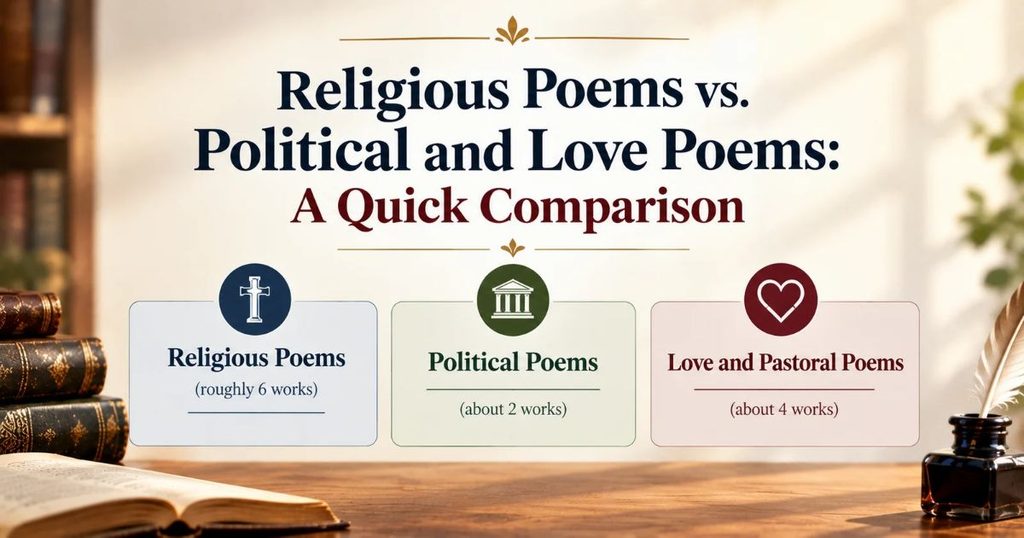
Religious poems (roughly 6 works): “The Coronet,” “On a Drop of Dew,” “A Dialogue Between the Resolved Soul, and Created Pleasure,” “A Dialogue between the Soul and Body,” “Music’s Empire,” “Bermudas.” These poems center on faith, the soul, and divine order.
Political poems: “An Horatian Ode upon Cromwell’s Return from Ireland,” widely regarded as one of the greatest political poems in English, along with “The First Anniversary of the Government under His Highness the Lord Protector.” These poems respond directly to the English Civil War and Cromwell’s rule.
Love and pastoral poems: “To His Coy Mistress,” Marvell’s most famous poem, along with “The Garden,” “The Definition of Love,” and the four Mower poems. These focus on romance, rural retreat, and the passage of time rather than faith.
Out of roughly fifty poems attributed to Marvell, only about six are classified as explicitly religious. That is a useful number to keep in mind: religious poetry was clearly not the center of his creative output, even though the poems he did write on the subject are among his most technically accomplished. Scholars have also revised Marvell’s overall canon over time. The Nigel Smith edition of his collected poems reexamined authorship questions directly, adding some previously doubted poems to the canon and removing others, which is one more reason exact counts can shift between editions.
FAQs
Q: How many religious poems did Andrew Marvell write?
A: Most scholars cite six religious poems, based on J. B. Leishman’s classification in The Art of Marvell’s Poetry. These are “The Coronet,” “On a Drop of Dew,” “A Dialogue Between the Resolved Soul, and Created Pleasure,” “A Dialogue between the Soul and Body,” “Music’s Empire,” and “Bermudas.” Some narrower reading lists count only four, so if you’re asking how many religious poems Andrew Marvell wrote for a specific course, check which classification your syllabus uses.
Q: What are Andrew Marvell’s most famous religious poems?
A: “Bermudas” and “On a Drop of Dew” are the two most frequently anthologized. “Bermudas” is admired for its vivid imagery of Puritan emigrants at sea, while “On a Drop of Dew” is praised for its extended metaphor comparing a dewdrop to the human soul. “A Dialogue between the Soul and Body” is the most studied academically because of its unresolved ending.
Q: Is “To His Coy Mistress” a religious poem?
A: No. “To His Coy Mistress” is Marvell’s most famous love poem, built around a classic carpe diem argument urging a reluctant lover to seize the moment. It contains no religious subject matter and is not included in any scholarly list of Marvell’s religious poems.
Q: Why is Andrew Marvell classified as a Metaphysical poet?
A: Marvell earned the label “Metaphysical poet” because of his use of elaborate conceits, intellectual argument, and unexpected comparisons, traits he shares with John Donne and George Herbert. His religious poems, especially “On a Drop of Dew,” rely heavily on these techniques, comparing physical objects to abstract spiritual states in careful, logical steps.
Q: Which of Marvell’s poems is considered his most religious?
A: “A Dialogue Between the Resolved Soul, and Created Pleasure” is often treated as the most explicitly religious, since it directly stages a debate between spiritual resolve and worldly temptation. It also opens the devotional sequence in the 1681 printed edition, which some scholars read as a deliberate editorial choice.
Q: Did Andrew Marvell write more political poems than religious ones?
A: Yes. Marvell wrote several significant political poems, including “An Horatian Ode upon Cromwell’s Return from Ireland” and “The First Anniversary,” alongside numerous pastoral and love poems. His six religious poems represent a small fraction of an output of roughly fifty known works, so political and pastoral themes dominate his overall body of poetry.
Final Thoughts
There is no single, official answer carved in stone. What we do know, based on the most widely cited scholarly source, is that Andrew Marvell wrote six poems generally classified as religious: “The Coronet,” “On a Drop of Dew,” “A Dialogue Between the Resolved Soul, and Created Pleasure,” “A Dialogue between the Soul and Body,” “Music’s Empire,” and “Bermudas.”
That number can shift slightly depending on the classification you consult, since religious poetry was never a category Marvell defined himself. It was assigned later by editors and literary scholars studying his devotional themes, Metaphysical conceits, and treatment of the soul.
What matters most for readers and students alike is this: Marvell’s religious poems are a small but technically rich part of a much larger body of political and pastoral verse. Read together, they show a Metaphysical poet working through questions of faith with the same careful, argumentative style he brought to love and politics.

Jennifer Aston is a passionate poetry curator and writer with a deep love for the written word. She believes poetry has the power to heal, inspire, and connect people across all walks of life. Through PoemSteric, she brings together timeless and modern verses for every emotion and every moment.