

Introduction
Enjambment happens when a line of poetry ends before its sentence or clause is finished, so the meaning spills over into the next line without a pause. Its opposite is the end-stopped line, which closes on a natural stop such as a period or comma. The fastest way to understand enjambment examples is to read a line exactly as it’s printed, then read the same words as ordinary prose, and notice how the pause or the lack of one changes what you feel.
That single test drives everything else in this guide. Once you can spot the missing pause, you can start asking a more useful question: what is the poet doing with it?
Key Takeaways
Before going further, here’s the short version. You can return to this list any time you need a quick refresher.
- Enjambment carries a sentence or clause across a line break with no terminal punctuation, while an end-stopped line closes with a pause.
- The effect of enjambment examples is best proven, not just described, read the same lines as prose, then as printed, and compare.
- Enjambment exists on a spectrum, from loose clause-level breaks to tight word-level splits.
- Poets from Milton to Eliot have used it for speed, tension, surprise, and double meaning.
- Caesura is a related but different device: a pause inside a line, rather than a break between lines.
Enjambment Examples: Reading the Line Both Ways
Most articles about enjoyment tell you it “creates tension” or “speeds up the reader,” but they rarely show you the mechanism. Here it is, in two steps.
First, read John Milton’s opening lines from Paradise Lost exactly as printed:
Of Man’s First Disobedience, and the Fruit Of that Forbidden Tree…
Your eye reaches “Fruit” and, for a fraction of a second, the word stands alone full of possibility, almost its own idea before “Of that Forbidden Tree” arrives to pin it down. Now read the same words as a single unbroken sentence: “Of man’s first disobedience, and the fruit of that forbidden tree.” Flattened into prose, “fruit” loses its moment of suspension. It’s just one word among many, not a brief, freestanding idea.
That pause-then-resolve motion is what enjambment examples are actually demonstrating. The line break asks your mind to hold a word in the air for a beat before the next line completes it. In my own reading of Milton, that half-second of suspension on “Fruit” is doing real work: it makes the forbidden object feel weighty and singular before it’s folded back into the grammar of the sentence.
Now try the reverse case, from T. S. Eliot’s The Waste Land:
April is the cruellest month, breeding Lilacs out of the dead land, mixing Memory and desire, stirring Dull roots with spring rain.
Here, four lines in a row break on present-participle verbs breeding, mixing, stirring each one left hanging with no object until the next line supplies it. Read as prose, the sentence is fairly plain: April breeds lilacs, mixes memory and desire, stirs dull roots. Read as printed, each verb gets an isolated beat of its own, and the poem’s famous unease spring as something almost violent comes through in the rhythm itself, not just the words.
The “Read It Both Ways” Test
You can apply this to any poem in three steps:
- Read the passage exactly as lineated, pausing briefly where the poet chose to break the line.
- Rewrite (or simply reread) the same words as continuous prose, with no line breaks at all.
- Compare what changed which word gained emphasis, and what mood or pacing disappeared once the break was removed.
Enjambment Examples Across Six Centuries of Poetry
Enjambment isn’t a modern trick. It appears in epic, sonnet, ode, ballad-meter lyric, and free verse alike, which is exactly why a single example never tells the whole story.
Enjambment in Blank Verse and the Sonnet
Milton’s Paradise Lost, quoted above, is one of the clearest early English examples: unrhymed iambic pentameter (blank verse) that leans on enjambment constantly to keep its long sentences moving across dozens of lines.
Shakespeare uses the same device inside the tighter frame of the sonnet. In Sonnet 116, he writes:
Let me not to the marriage of true minds Admit impediments. Love is not love Which alters when it alteration finds…
“True minds” flows straight into “Admit impediments” with no pause, and “Love is not love” flows straight into “Which alters.” Because a sonnet has so little room, each enjambed line forces the argument forward at exactly the moment Shakespeare wants urgency; the poem is, after all, arguing that real love doesn’t change.
John Keats does something gentler with the form in “Ode to a Nightingale”:
My heart aches, and a drowsy numbness hurts my sense, as though of the hemlock I had drunk…
The line break falls between “pains” and its object, “My sense,” which delays exactly what is being pained. The reader feels the ache first and learns where it lands a half-beat later, a small but deliberate delay that mirrors the drowsiness the poem describes.
Enjambment in Modern and Romantic Free Verse
William Wordsworth’s “Lines Composed a Few Miles Above Tintern Abbey” enjambs across an exclamation for emotional effect:
Five years have passed; five summers, with the length of five long winters! and again I hear these waters…
Notice how “the length” is left open at the line’s end length of what? before “Of five long winters” answers it. The delay makes the passage of time feel, briefly, unmeasured before the poem pins it down.
Emily Dickinson, writing in tight ballad meter, still enjambs when she needs to: in “Because I could not stop for Death,” the line “My labor, and my leisure too, / For his Civility –” carries a list across the break, so that “Civility” lands with unusual weight as the final surprise in the list.
Robert Frost’s “Birches” shows enjambment doing quieter, narrative work:
When I see birches bend to the left and right across the lines of straighter darker trees, I like to think some boy’s been swinging them.
Here the break simply keeps the sentence moving at a conversational pace Frost’s enjambment is subtle enough that many readers don’t consciously notice it, which is itself a lesson: not every enjambed line is meant to jolt you.
Enjambment vs. End-Stopped Lines, Caesura, and the Spectrum of Strength
These three terms get confused constantly, so here’s a direct comparison.
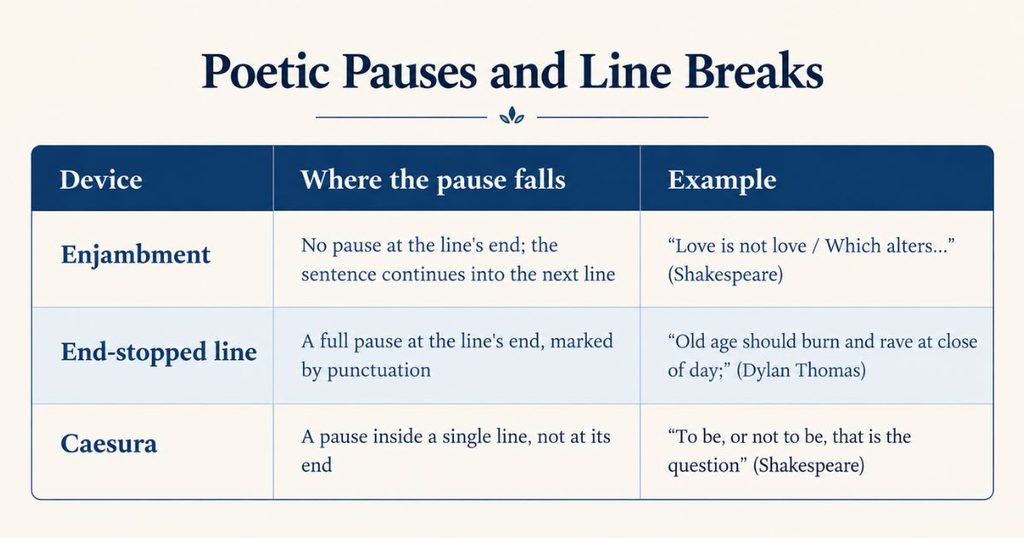
Enjambment itself isn’t all-or-nothing; it exists on a spectrum. A loose or clause-level enjambment breaks after a complete phrase, so the line still makes partial sense on its own, as in Milton’s “Of that Forbidden Tree” following “the Fruit.” A tight or word-level enjambment splits something that would never normally be separated, such as a verb from its object Eliot’s “breeding / Lilacs” is a tight break, because “breeding” alone gives almost no information until “Lilacs” arrives. As a rule, the tighter the split, the more the reader feels the interruption.
Ambiguous cases exist too. A line ending in a comma or a dash, such as Dickinson’s dashes, creates only a partial pause; the sentence grammatically continues, but the punctuation still asks the eye to slow down. Treat these as lightly enjambed rather than fully end-stopped: the break is doing real work even though it isn’t silent.
How to Identify Enjambment and Write About Its Effect
Spotting enjoyment is a skill you can build with a short, repeatable process.
- Read line by line first. Pause briefly at every line break, exactly as printed, before you worry about grammar.
- Check the punctuation at the line’s end. No period, semicolon, question mark, or exclamation point usually signals enjoyment; a comma or dash signals a lighter, partial pause.
- Confirm the grammar continues. If the sentence needs the next line to finish its meaning, the line is enjambed rather than end-stopped.
- Note the two words at the break. The last word of one line and the first word of the next carry the most weight. Write them down before you analyze anything else.
Once you’ve identified the break, writing about its effect follows a similar sequence:
- Quote the lines exactly as printed, using a forward slash ( / ) to mark the line break if you’re quoting inline.
- Name the two words on either side of the break.
- Apply the “read it both ways” test from earlier in this guide, and describe what changes.
- State the specific effect in one sentence: does the break speed the reader up, create suspense, add emphasis, or open a double meaning?
- Connect that effect to the poem’s larger theme. A break that isolates the word “alone” means something different in a poem about grief than it would in a poem about freedom.
Readers often notice that once they’ve done this exercise three or four times, they stop needing the steps, spotting the effect becomes almost automatic.
FAQs
Q: What is a simple example of enjoyment?
A: A simple example is Shakespeare’s “Love is not love / Which alters when it alteration finds” from Sonnet 116. The first line ends with no punctuation, so the sentence’s meaning only completes once you read “Which alters” on the next line. This is one of the clearest examples because the break falls right in the middle of the idea, forcing the reader forward without a pause.
Q: What is the difference between enjambment and an end-stopped line?
A: Enjambment carries a sentence or clause across a line break with no pause, while an end-stopped line closes on a full grammatical pause, usually marked by a period, semicolon, or exclamation point. Dylan Thomas’s “Old age should burn and rave at close of day;” is end-stopped, while Shakespeare’s “Love is not love / Which alters” is enjambed. Comparing enjambment examples against end-stopped lines side by side is the fastest way to hear the difference.
Q: Why do poets use enjambment?
A: Poets use enjambment to control pace, build suspense, add emphasis to a specific word, or create a brief double meaning before the next line resolves it. In Milton’s “Of Man’s First Disobedience, and the Fruit / Of that Forbidden Tree,” the word “Fruit” hangs alone for a moment before its full meaning arrives. The effect can be subtle, as in Frost, or dramatic, as in Eliot.
Q: How can I tell if a poem uses enjambment or caesura?
A: Enjambment is a break between two lines, while caesura is a pause inside a single line Shakespeare’s “To be, or not to be, that is the question” contains a caesura at the comma, not an enjambment. Many poems use both devices together. Checking where the pause physically falls, mid-line or at the line’s end, is the quickest way to tell them apart.
Q: Can enjambment appear outside of formal poetry, like in songs or free verse?
A: Yes. Enjambment is common in free verse and song lyrics, not just in fixed forms like the sonnet or blank verse. Frost’s “Birches,” written in blank verse but with a conversational tone, shows how naturally enjambment examples can be read when the break is subtle rather than dramatic. Songwriters use the same device whenever a lyric’s sentence continues past the end of a sung line.
Q: Is every line without ending punctuation automatically enjambed?
A: Not quite, check whether the grammar and meaning genuinely continue into the next line, not just whether punctuation is missing. A line can lack a period yet still land on a natural phrase boundary that reads almost like a pause. True enjambment specifically interrupts a clause or sentence mid-thought, which is what separates strong enjambment examples from lines that merely lack a comma.
Final Thoughts
Enjambment rewards close, patient reading more than almost any other device in poetry, because its effect only shows up when you notice what’s missing: the pause you expected but didn’t get. The enjambment examples in this guide, from Milton’s suspended “Fruit” to Eliot’s four-line run of hanging verbs, all work the same basic way they ask you to hold a word or phrase in mind for a moment before the next line resolves it.
Once you can hear that missing pause and name the two words on either side of it, you have everything you need to identify enjoyment confidently and to write about its effect with real precision, whether you’re analyzing a Shakespearean sonnet or a piece of contemporary free verse.
Recent Article : Who is the Pope’s Mouthpiece in the Poem? Clarissa Explained

Jennifer Aston is a passionate poetry curator and writer with a deep love for the written word. She believes poetry has the power to heal, inspire, and connect people across all walks of life. Through PoemSteric, she brings together timeless and modern verses for every emotion and every moment.