
Introduction
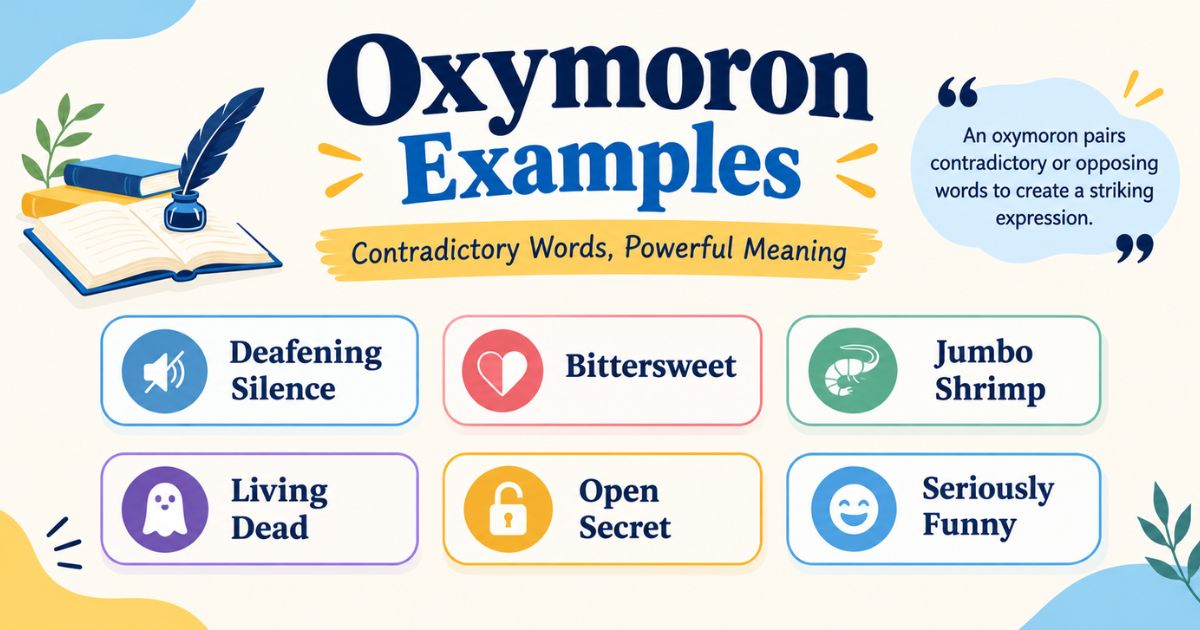
An oxymoron is a figure of speech that pairs two contradictory words, usually an adjective and a noun to create a compressed, often striking new meaning, such as “deafening silence” or “bittersweet.” Unlike a paradox, which needs a full sentence or idea to build its contradiction, an oxymoron packs the tension into just two words sitting side by side. The best oxymoron examples don’t just sound clever; they reveal something a single word alone could never capture.
That distinction matters more than most lists admit. Below, you’ll find these phrases separated by how ordinary or deliberate they are, grouped by the purpose each one serves, and compared directly against the figures of speech people most often confuse them with.
Key Takeaways
Here’s the short version before we get into specifics.
- An oxymoron combines two contradictory words in a single phrase, while a paradox is a whole statement that seems self-contradictory but may still be true.
- Everyday oxymorons, like “act naturally,” have become so familiar they barely register as contradictions anymore.
- Literary oxymora are chosen deliberately, and they carry real historical attribution Shakespeare, Tennyson, and Milton all used the device with intention.
- Oxymorons serve at least four distinct purposes: humor, emotional truth, irony, and dramatic emphasis.
- Grouping these pairings by what they’re doing, rather than listing them alphabetically, is the fastest way to actually understand the device.
Oxymoron Examples vs. Paradox and Contradiction in Terms
These three terms overlap so often that writers use them interchangeably, which is a mistake. Here’s a direct comparison.
| Device | Scope of the contradiction | Example |
| Oxymoron | Two words placed side by side | “Deafening silence” |
| Paradox | A full statement or idea that seems contradictory but may hold a deeper truth | “This statement is false” |
| Contradiction in terms | Two words that describe mutually exclusive concepts, without being a formal literary device | “Military intelligence” |
An oxymoron is compact by design. A paradox, on the other hand, needs room to unfold — it’s an entire claim you have to sit with before you see how it might be true. A contradiction in terms is close to an oxymoron in form but usually appears in everyday or political speech rather than as a deliberate literary choice, and it doesn’t necessarily aim to reveal a deeper meaning the way a crafted oxymoron does.
Everyday vs. Literary Oxymoron Examples
Not every oxymoron carries the same weight. Some have become so ordinary that we barely notice the contradiction; others are chosen precisely because the contradiction still stings.
Everyday Oxymorons You Already Use
You’ve almost certainly said several of these this week without thinking twice:
- Jumbo shrimp — “jumbo” implies large, while shrimp are, by definition, small.
- Act naturally — acting is inherently performed, not natural.
- Same difference — two words that logically cancel each other out.
- Awfully good — “awfully” once meant “in a way that inspires awe or dread,” now softened into a casual intensifier.
- Only choice — a “choice” implies options, while “only” removes them.
- Open secret — something everyone knows, yet still nominally undisclosed.
These phrases have drifted into idioms. As a result, most speakers no longer register any contradiction at all which is exactly what separates them from the next category.
Literary Oxymoron Examples, Explained
Writers, unlike casual speakers, choose their oxymorons on purpose. Three examples make this clear.
In Romeo and Juliet (Act 2, Scene 2), Juliet tells Romeo, “Parting is such sweet sorrow, That I shall say good night till it be morrow.” Shakespeare fuses two opposite emotions: the pleasure of Romeo’s company and the pain of his leaving into a single, inseparable feeling. Readers often notice that this line works precisely because grief and pleasure really can coexist; the oxymoron isn’t decoration, it’s psychologically accurate.
Alfred, Lord Tennyson, writing in Idylls of the King, describes a knight undone by betrayal: “His honour rooted in dishonour stood, / And faith unfaithful kept him falsely true.” Here the contradiction does double duty, describing a man whose loyalty has curdled into its opposite without him fully admitting it the oxymoron mirrors the character’s own self-deception.
John Milton, in Paradise Lost, describes Hell’s fire as producing “darkness visible” rather than light. The phrase forces two mutually exclusive ideas of visibility and darkness into the same three-word space, and the resulting discomfort is the entire point: Milton wants readers to feel how wrong this fire is, a fire that illuminates nothing and warms nothing.
Oxymoron Examples Grouped by Purpose
Once you separate oxymorons by function, patterns emerge that a flat list never shows.
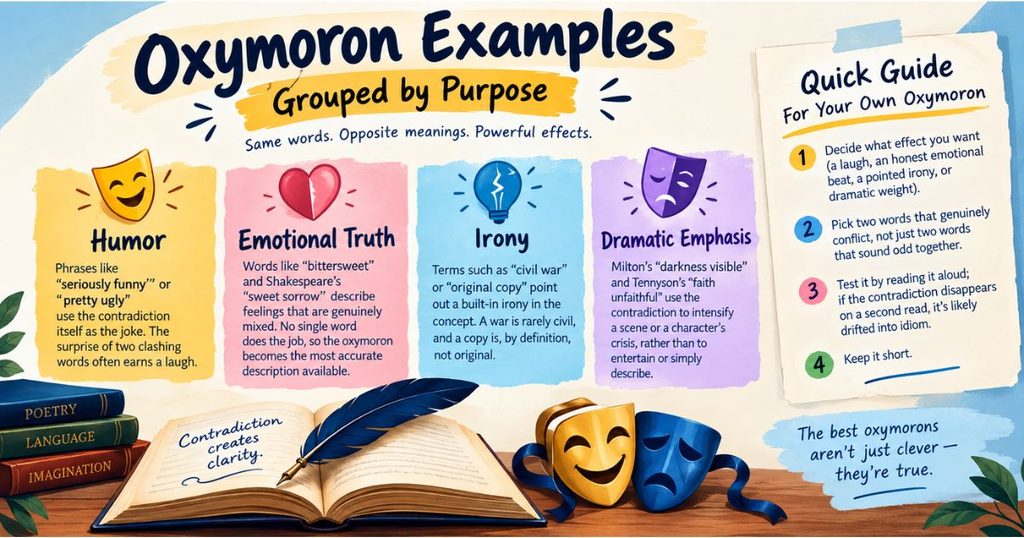
- Humor. Phrases like “seriously funny” or “pretty ugly” lean on the contradiction itself as the joke the surprise of two clashing words is often enough to earn a laugh.
- Emotional truth. “Bittersweet” and Shakespeare’s “sweet sorrow” describe feelings that are genuinely mixed; no single word does the job, so the oxymoron becomes the most accurate description available.
- Irony. Terms such as “civil war” or “original copy” point out a built-in irony in the concept they name a war is rarely civil, and a copy is, by definition, not original.
- Dramatic emphasis. Milton’s “darkness visible” and Tennyson’s “faith unfaithful” use the contradiction to intensify a scene or a character’s crisis, rather than to entertain or simply describe.
If you’re writing your own oxymoron, this grouping doubles as a quick decision guide:
- Decide what effect you want a laugh, an honest emotional beat, a pointed irony, or dramatic weight.
- Pick two words that genuinely conflict, not just two words that sound odd together.
- Test the phrase by reading it aloud; if the contradiction disappears on a second read, it’s likely drifted into idiom rather than staying a deliberate literary device.
- Keep it short. Part of an oxymoron’s power comes from how little room it needs to do its work.
It helps to see this process applied to a real case. Take the phrase “cruel kindness,” which shows up often in poetry about difficult relationships. A writer choosing it for emotional truth wants the reader to feel that an act meant to help can still cause pain, a parent’s tough love, for instance, or a friend’s blunt honesty. Swap “cruel” for a softer word like “firm,” and the tension disappears along with the accuracy; the phrase stops describing anything real.
That test removing the contradiction and also removing the truth of the sentence is the fastest way to judge whether a pairing earns its place in a poem or simply sounds clever for a moment. In my own reading, the pairings that pass this test are the ones that stay memorable long after the poem ends, while the ones that fail it read as ordinary wordplay dressed up as insight.
FAQs
Q: What is a simple example of an oxymoron?
A: “Deafening silence” is one of the simplest and most recognizable oxymoron examples, since “deafening” implies overwhelming loudness while “silence” means the absence of sound. Placing those two ideas side by side forces the reader to imagine a quiet so intense it feels loud. Other simple examples include “bittersweet,” “jumbo shrimp,” and “living dead.”
Q: What’s the difference between an oxymoron and a paradox?
A: An oxymoron compresses a contradiction into two words, while a paradox is a longer statement that seems self-contradictory but may still be logically true, such as “This statement is false.” Most oxymora work instantly, in a single phrase, while a paradox usually asks you to think it through before the contradiction resolves. The two devices are related but not interchangeable.
Q: Are “jumbo shrimp” and “act naturally” real oxymorons?
A: Yes, both qualify as oxymorons, though they belong to the everyday rather than literary category. “Jumbo” and “shrimp” describe opposite sizes, and “act” implies performance while “naturally” implies the absence of performance. These everyday pairings have become so idiomatic that most speakers no longer notice the contradiction at all.
Q: Why do writers use oxymorons in literature?
A: Writers use oxymorons to capture ideas or feelings that a single word can’t hold on its own, such as Shakespeare’s “sweet sorrow” describing the mixed pain and pleasure of a farewell. Oxymorons can also create humor, highlight irony, or intensify a dramatic moment, as Milton does with “darkness visible” in Paradise Lost. Choosing the right oxymoron example depends entirely on the effect a writer wants to create.
Q: What’s a famous oxymoron example from Shakespeare?
A: In Romeo and Juliet, Juliet says, “Parting is such sweet sorrow, / That I shall say good night till it be morrow,” fusing the pleasure of Romeo’s company with the pain of his departure. This remains one of the most quoted lines in English literature because the contradiction is emotionally precise rather than merely clever. Shakespeare uses similar contradictions elsewhere, including “loving hate” in the same play.
Q: Can an oxymoron be more than two words?
A: Yes, though the classic form pairs a single adjective with a single noun. Tennyson’s “faith unfaithful kept him falsely true” stretches the contradiction across an entire line while still functioning as an oxymoron, because the core clash between “faith” and “unfaithful” remains intact. Longer examples like this are more common in poetry than in everyday speech.
Final Thoughts
The oxymoron examples that last, from Shakespeare’s “sweet sorrow” to Milton’s “darkness visible,” all share one quality: the contradiction isn’t a mistake to smooth over, it’s the entire point. Everyday oxymorons like “jumbo shrimp” earn a smile because the clash has faded into habit, while literary ones stay sharp precisely because a skilled writer chose two genuinely opposing words to describe something a single word never could.
Once you start grouping these phrases by what they’re actually doing with humor, emotional truth, irony, or dramatic emphasis the device stops looking like wordplay and starts looking exactly like what it is: one of the most efficient tools language has for holding two true things at once.
Recent Article : Enjambment Examples: See the Line-Break Effect

Jennifer Aston is a passionate poetry curator and writer with a deep love for the written word. She believes poetry has the power to heal, inspire, and connect people across all walks of life. Through PoemSteric, she brings together timeless and modern verses for every emotion and every moment.