
Introduction
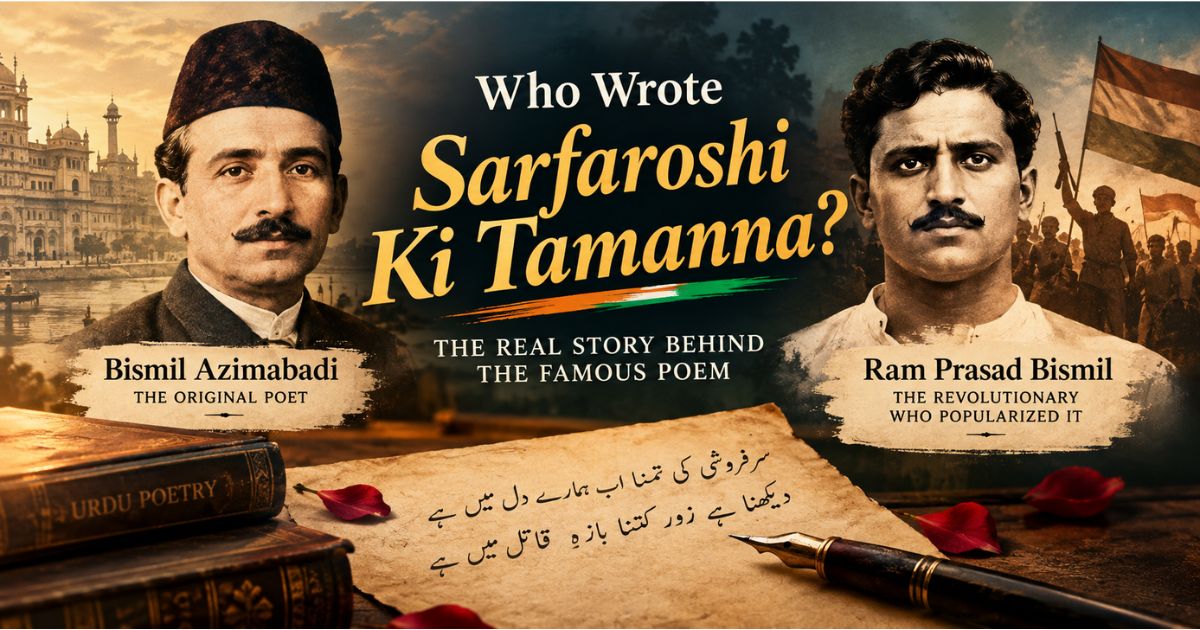
The poem Sarfaroshi Ki Tamanna was written by Bismil Azimabadi, an Urdu poet from Patna, Bihar. It is often wrongly credited to Ram Prasad Bismil, the revolutionary freedom fighter who later made the poem famous among India’s revolutionaries.
This confusion exists because both men used “Bismil” as a pen name. Ram Prasad Bismil also recited the poem during the freedom struggle, including before his execution in 1927. As a result, his name became closely connected with the famous verses.
The distinction matters because the poet and the person who popularized a poem are not necessarily the same person. In this case, Bismil Azimabadi wrote the famous Urdu ghazal, while Ram Prasad Bismil helped turn it into a powerful revolutionary anthem.
The Government of India’s Azadi Ka Amrit Mahotsav archive identifies Bismil Azimabadi as the poet. It states that he wrote the poem after the Jallianwala Bagh massacre and that it was first published in the Urdu daily Sabah in 1921.
Key Takeaways: The Real Story Behind the Poem
The history of Sarfaroshi Ki Tamanna is more complicated than the commonly repeated answer. For many years, students, websites, films, and popular accounts associated the poem with Ram Prasad Bismil. However, literary research has increasingly restored Bismil Azimabadi as its author.
Bismil Azimabadi: The Original Poet
Bismil Azimabadi was an Urdu poet and freedom activist from Patna. His real name was Syed Shah Mohammad Hasan, and he lived from 1901 to 1978. He became known for his Urdu poetry and used “Bismil” as his literary pen name. Rekhta identifies him as the poet of the famous ghazal Sarfaroshi Ki Tamanna.
According to the Government of India’s historical archive, Azimabadi wrote the poem in the context of India’s anti-colonial struggle. The poem was first recited in 1920 at the Congress session in Kolkata and was published in Sabah in 1921.
Thus, the answer to who wrote Sarfaroshi Ki Tamanna is Bismil Azimabadi.
Why Ram Prasad Bismil Is Often Credited
Ram Prasad Bismil was a completely different person. He was born in Shahjahanpur in 1897 and became one of the best-known revolutionary figures of the Indian independence movement. He was executed in 1927 after his involvement in the Kakori case.
His association with the poem became extremely strong because he used revolutionary poetry during the freedom struggle. Most importantly, he recited Sarfaroshi Ki Tamanna before his execution. The poem therefore became associated with his martyrdom.
There was another source of confusion: both men used the same pen name, Bismil. A modern scholarly study argues that later anthologies helped blur the distinction between the two writers and contributed to the continuing misattribution.
In simple terms:
Written by: Bismil Azimabadi
Popularized and strongly associated with: Ram Prasad Bismil
That distinction is the key fact students should remember.
Sarfaroshi Ki Tamanna: History, Publication, and Freedom Movement
The poem belongs to the tradition of Urdu patriotic poetry and is commonly described as a revolutionary ghazal. Its language expresses courage, sacrifice, resistance, and willingness to confront colonial oppression.
The poem emerged during a period when the Indian independence movement was becoming increasingly intense. The Government of India’s historical archive connects its composition with the period following the Jallianwala Bagh massacre and records its publication in Sabah in 1921.
The original context is important because it shows that the poem was not simply a later revolutionary slogan. It was written within a real political environment shaped by British colonial rule and growing resistance.
The poem’s title itself conveys the idea of a strong desire for self-sacrifice. The opening sentiment became particularly powerful among freedom fighters because it expressed the willingness to give one’s life for a larger cause.
However, the poem’s later history is just as important as its original composition. Ram Prasad Bismil helped make it part of the cultural memory of India’s independence movement. Other revolutionaries, including Bhagat Singh and Chandrashekhar Azad, became associated with its use as a revolutionary expression.
The poem was eventually remembered far beyond its original literary setting. It appeared in discussions of revolutionary poetry and later entered popular culture through films and public performances.
This explains why many people still give the wrong answer when asked who wrote the poem Sarfaroshi Ki Tamanna. They remember the person who made the poem famous rather than the person who originally composed it.
A useful way to understand the history is:
- Bismil Azimabadi wrote the poem.
- It was connected to the anti-colonial movement.
- It was published in Sabah in 1921.
- Ram Prasad Bismil helped popularize it.
- His martyrdom strengthened its association with his name.
- Later scholarship worked to restore Azimabadi’s authorship.
Meaning, Form, and Lasting Legacy of the Poem
Sarfaroshi Ki Tamanna is generally identified as an Urdu ghazal, although it is often simply called a poem or patriotic song in popular discussion. Rekhta classifies the work among Bismil Azimabadi’s ghazals.
Its central idea is revolutionary courage. The speaker expresses a readiness to sacrifice personal safety for freedom. Consequently, the poem became particularly meaningful to people involved in India’s independence movement.
The phrase “sarfaroshi ki tamanna” can be understood broadly as a desire for self-sacrifice or a willingness to offer one’s life for a cause. The poem therefore combines patriotic feeling with the emotional intensity of Urdu poetry.
Why the Poem Became a Revolutionary Symbol
The poem became famous because its emotional language matched the atmosphere of the independence struggle. Freedom fighters could use its words to express courage without needing a complicated political explanation.
Its power also came from performance. A poem heard aloud at a political gathering or among imprisoned revolutionaries could become more than literature. It could become a shared expression of determination.
Ram Prasad Bismil’s association with the poem was especially important. According to the Government of India’s archive, he recited it on the way to the gallows in 1927.
Bismil Azimabadi and Ram Prasad Bismil Compared
| Bismil Azimabadi | Ram Prasad Bismil |
| Original poet of the ghazal | Revolutionary who popularized it |
| Urdu poet from Patna | Revolutionary from Shahjahanpur |
| Born in 1901 | Born in 1897 |
| Used “Bismil” as pen name | Also used “Bismil” as pen name |
| Wrote Sarfaroshi Ki Tamanna | Became strongly associated with it |
| Died in 1978 | Executed in 1927 |
This comparison resolves the most common misunderstanding. Both men were important figures, but their roles were different.
In my reading of the historical evidence, the strongest approach is not to dismiss Ram Prasad Bismil’s connection to the poem. Instead, it is better to distinguish authorship from popularization. That gives readers a more accurate account of the poem’s place in Indian literary and political history.
A 2024 scholarly study specifically examines how the poem came to be attributed to Ram Prasad Bismil and argues that later poetry anthologies contributed to the confusion.
FAQs: Who Wrote the Poem Sarfaroshi Ki Tamanna?
Q: Who wrote the poem Sarfaroshi Ki Tamanna?
A: Sarfaroshi Ki Tamanna was written by Bismil Azimabadi, an Urdu poet from Patna. The poem is often attributed to Ram Prasad Bismil because he famously used it during India’s freedom struggle and recited it before his execution. However, historical and literary sources distinguish the two men. The Government of India’s Azadi Ka Amrit Mahotsav archive specifically identifies Bismil Azimabadi as the poet and records its publication in Sabah in 1921.
Q: Why is Ram Prasad Bismil credited with Sarfaroshi Ki Tamanna?
A: Ram Prasad Bismil became closely associated with the poem because he helped popularize it during the independence movement. He also recited it before being executed in 1927. Both men used “Bismil” as a pen name, which added to the confusion. Later publications and popular culture further connected the poem with Ram Prasad Bismil. Modern scholarship, however, distinguishes his role as a revolutionary who popularized the poem from Bismil Azimabadi’s role as its original poet.
Q: Who was Bismil Azimabadi?
A: Bismil Azimabadi was an Urdu poet and freedom activist from Patna, Bihar. His real name was Syed Shah Mohammad Hasan, and he lived from 1901 to 1978. He is best known today for Sarfaroshi Ki Tamanna, which became one of the most recognizable pieces of revolutionary poetry associated with India’s independence movement. Rekhta lists the work among his ghazals and identifies him as its poet.
Q: When was Sarfaroshi Ki Tamanna written?
A: Historical sources generally place the composition around 1921, although the poem was reportedly recited earlier in the independence movement. The Government of India’s historical archive states that Bismil Azimabadi wrote it after the Jallianwala Bagh massacre, that it was first recited at the Congress session in Kolkata in 1920, and that it was published in the Urdu daily Sabah in 1921.
Q: Why is Sarfaroshi Ki Tamanna famous?
A: The poem became famous because it expressed the courage and willingness to sacrifice associated with India’s independence movement. Its association with Ram Prasad Bismil, especially his final days before execution, made it particularly powerful in popular memory. It was also associated with other revolutionaries and later appeared in films and public performances. As a result, the poem became more than an Urdu literary work; it became a symbol of resistance and patriotic sacrifice.
Final Thoughts
The most accurate answer to who wrote the poem Sarfaroshi Ki Tamanna is Bismil Azimabadi. He was the original Urdu poet who composed the famous ghazal, while Ram Prasad Bismil played a major role in making it famous during India’s freedom struggle.
The confusion is understandable because both men used the name Bismil. However, separating authorship from later popularization gives a much clearer picture of the poem’s history. Today, Bismil Azimabadi’s authorship is supported by historical records, literary sources, and recent scholarship.
Recent Article : Where Lies the Land Poem: Powerful Meaning Unpacked

Jennifer Aston is a passionate poetry curator and writer with a deep love for the written word. She believes poetry has the power to heal, inspire, and connect people across all walks of life. Through PoemSteric, she brings together timeless and modern verses for every emotion and every moment.