
Introduction
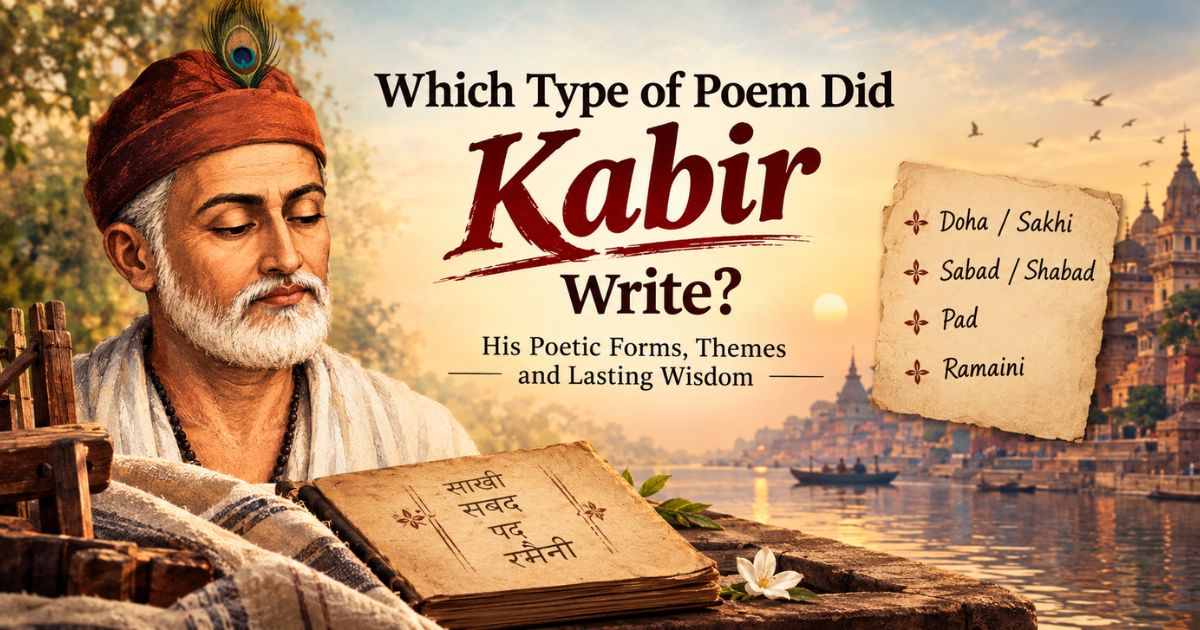
Kabir is best known for his dohas, short and memorable couplets that express spiritual, philosophical, and practical wisdom. If you are asking which type of poem Kabir wrote, the simplest answer is that he wrote mainly dohas, but his poetry also includes sakhis, sabads or shabads, pads, and ramainis.
Kabir’s poetry developed within the Bhakti tradition, especially the Nirguna Bhakti tradition, which emphasizes devotion to a formless divine reality. His verses often question empty rituals, religious hypocrisy, social divisions, ego, and attachment to worldly life.
Another important point is that Kabir’s verses were largely transmitted through oral traditions. As a result, modern collections preserve his poetry through different manuscripts and oral sources rather than through a single original manuscript written by Kabir himself.
Key Takeaways: Kabir’s Main Poetic Forms
Kabir used several forms, but his doha or sakhi is the form most commonly associated with his name. A doha is a compact Hindi verse form built around a self-contained thought, while Kabir’s longer sung compositions appear as sabads, shabads, or pads. The Bijak traditionally organizes Kabir’s material into Ramaini, Shabda, and Sakhi, along with other folk-song material.
Doha and Sakhi
A doha is a short couplet designed to express an idea with unusual economy. The Academy of American Poets describes the traditional doha as a Hindi verse form with twenty-four syllables in each line, divided into characteristic rhythmic sections. Kabir used this compact structure to communicate spiritual truths and observations about ordinary life.
The term sakhi means “witness” and is closely associated with Kabir’s short teaching verses. In many collections, doha and sakhi overlap in description, although the terminology can vary across traditions.
Sabad, Pad, and Ramaini
Sabads or shabads are lyric compositions associated with singing and devotional performance. They can be more expansive than the compact doha and often express spiritual longing, criticism of false religious practice, or mystical insight.
Pads are also associated with song and devotional performance. Ramainis provide another longer form found prominently in the Bijak. These distinctions should not be treated as completely rigid because Kabir’s poetry circulated through oral performance, and terminology differs between traditions.
Simple comparison:
- Doha/Sakhi: short, concentrated teaching verse
- Sabad/Shabad/Pad: lyric or song-oriented poetry
- Ramaini: longer teaching or mystical composition
Kabir’s Poetry: Forms, Themes, and Purpose
The type of poetry Kabir wrote cannot be understood only by looking at poetic structure. His forms were closely connected to his purpose. He wanted spiritual and philosophical ideas to reach ordinary people, rather than remain restricted to learned religious communities.
His language was therefore direct and accessible. His verses use questions, paradoxes, striking images, and everyday situations to challenge accepted assumptions. A university study of Kabir’s poetry notes that his work repeatedly uses questions, paradoxes, and attacks on falsehood to awaken readers from worldly delusions.
Kabir’s major concerns include:
- Devotion to the divine
- The search for inner truth
- Criticism of empty ritual
- The danger of ego and attachment
- Unity beyond religious divisions
- The difference between outward religion and inner experience
His poetry is therefore both devotional and critical. He could express mystical ideas through a song, while a short doha could deliver a sharp lesson about human behavior.
The Bijak is especially important when studying Kabir because it preserves three major sections: Ramaini, Shabda, and Sakhi. Oxford’s scholarly description also emphasizes that the doha or sakhi became a vehicle for popular wisdom throughout North India.
In my own reading of Kabir’s poetry, the strongest feature is its economy: he often takes a complicated spiritual question and turns it into a memorable image or brief statement. That quality helps explain why Kabir’s verses continue to be quoted and taught centuries later.
FAQ
Q: Which type of poem Kabir wrote?
A: Kabir is most famous for his dohas, short couplets that express spiritual wisdom, social criticism, and observations about life. However, Kabir’s poetic corpus also contains sakhis, sabads or shabads, pads, and ramainis. The Bijak, one important collection associated with the Kabir tradition, contains Ramaini, Shabda, and Sakhi sections. Therefore, it is more accurate to say that Kabir wrote in several poetic forms rather than only one.
Q: What is a Kabir doha?
A: A Kabir doha is a short, self-contained verse that communicates an idea, lesson, or spiritual insight in a memorable form. The traditional doha is a Hindi verse structure built around two lines and a characteristic syllabic pattern. Kabir used this form to discuss devotion, ego, truth, worldly attachment, and human behavior. His dohas became especially popular because their language is direct and their ideas can be remembered easily.
Q: Did Kabir write only dohas?
A: No. Although dohas are probably the best-known form associated with Kabir, his poetry includes several forms. These include sakhi, sabad or shabad, pad, and ramaini. The terminology can vary between collections and regional traditions because Kabir’s poetry was transmitted orally for generations. The Bijak, for example, organizes major portions of the corpus under Ramaini, Shabda, and Sakhi.
Q: Why did Kabir write dohas?
A: Kabir’s short verses allowed him to communicate complex ideas in a form that ordinary listeners could remember and repeat. His poetry often challenged religious hypocrisy, attachment, ego, and dependence on external ritual. The compact structure of the doha made such observations sharp and memorable. This helps explain why his verses survived strongly within oral traditions and continue to appear in educational and cultural contexts today.
Q: What are Kabir’s main poetic forms?
A: The major forms associated with Kabir include doha or sakhi, sabad or shabad, pad, and ramaini. The doha is generally a short couplet, while sabads and pads are more closely connected with lyric and musical performance. Ramainis are longer compositions found prominently in the Bijak. However, these categories can overlap because Kabir’s poetry developed through oral performance and different textual traditions.
Final Thoughts
Kabir is best remembered for his dohas, but his poetic contribution is much broader. He used dohas and sakhis for concise wisdom, while sabads, pads, and ramainis allowed more extended devotional and mystical expression.
So, the simplest answer to which type of poem Kabir wrote is: Kabir was famous for dohas, but he composed in several forms, including sakhi, sabad, pad, and ramaini. His poetry remains important because its simple language carries deep ideas about devotion, truth, ego, society, and spiritual freedom.
Recent Article : Who Wrote the Poem Sarfaroshi Ki Tamanna: Truth Revealed

Jennifer Aston is a passionate poetry curator and writer with a deep love for the written word. She believes poetry has the power to heal, inspire, and connect people across all walks of life. Through PoemSteric, she brings together timeless and modern verses for every emotion and every moment.