
Introduction
To discuss the theme of the poem Poor Relations accurately, one important correction comes first: Poor Relations is an essay by Charles Lamb, not a poem. It explores poverty, family relationships, social embarrassment, class differences, and the painful treatment of relatives who lack money.
The essay appears in Lamb’s Essays of Elia and is famous for combining humour and pathos. University literature material also identifies it as one of Lamb’s admired essays because of this mixture, along with his use of irony and metaphor.
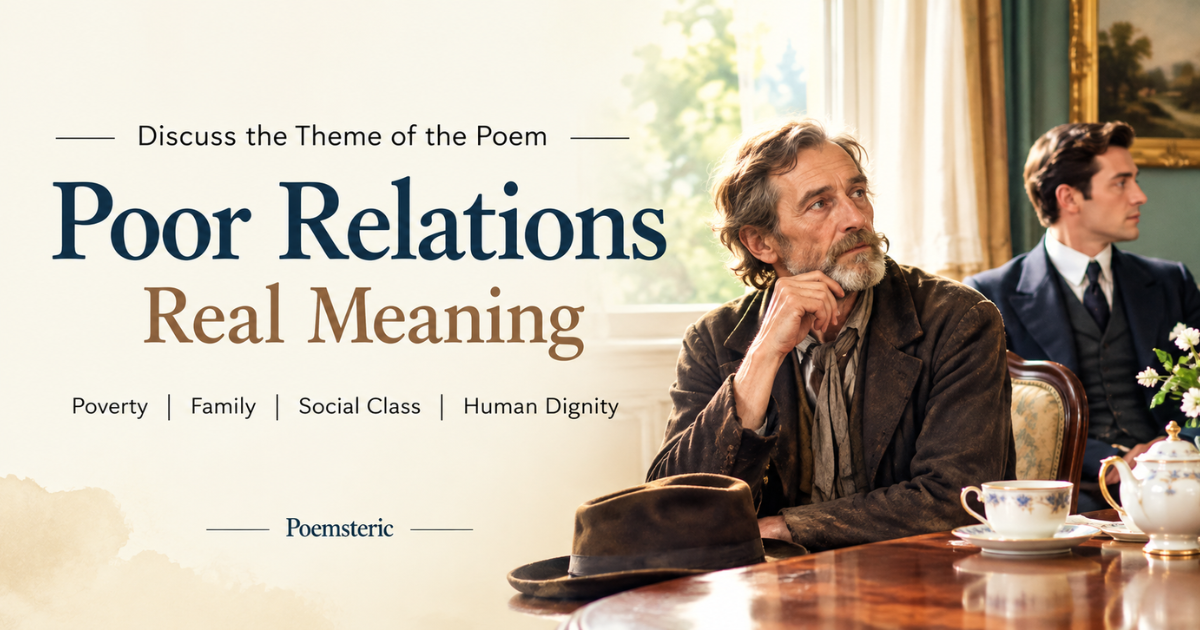
Lamb does not present poverty as a simple financial problem. Instead, he examines what happens when money changes the way family members see one another. A poor relative may share the same blood as a wealthy family, yet poverty can make that person feel like an outsider.
Therefore, the central concern is not merely poor relatives. It is the loss of dignity and equality caused by social and economic differences.
Key Takeaways
The main themes of Poor Relations can be understood through several connected ideas.
- Poverty creates social embarrassment.
- Money can affect family relationships.
- Social class influences how people are treated.
- Humour can hide serious emotional pain.
- Poor relatives may become conscious of their dependence.
- Lamb exposes the cruelty behind polite social behaviour.
- Human worth cannot be measured by financial status.
The essay’s unusual power comes from Lamb’s mixed tone. At first, he jokes about the poor relationship as an inconvenience. However, the humour gradually reveals something more serious.
The narrator describes the poor relative as an unwanted presence in the prosperous household. This exaggerated description is funny on the surface, but it also exposes an uncomfortable truth: families can treat poverty as a source of shame.
A useful way to understand the central contrast is:
Wealth → confidence, social acceptance, independence
Poverty → dependence, embarrassment, social discomfort
However, Lamb does not simply blame poor relatives. His examples show that the real problem lies in a society that judges people according to money, appearance, and status.
Charles Lamb’s Poor Relations: Social Class, Family, and Poverty
Charles Lamb was an English essayist best known for Essays of Elia. In Poor Relations, he examines relatives who are financially less successful than other members of their family.
The Poor Relative as a Social Burden
The essay begins with a deliberately exaggerated description of a poor relationship. Lamb presents such a person as an unwelcome presence in a wealthy household. His language is comic, but the underlying situation is uncomfortable.
The poor relative depends on the hospitality of wealthier family members. As a result, even an ordinary invitation to dinner can become emotionally complicated.
The problem is not simply that the visitor needs food. The poor relation is painfully aware of the difference in status. That awareness can affect manners, conversation, clothing, and behaviour.
Lamb also discusses the difficulties faced by poor female relatives. He argues that poverty is harder to conceal in their appearance and social position. This section shows how strongly nineteenth-century social expectations were connected to clothing, manners, and class.
Humour, Irony, and Pathos
One of Lamb’s greatest strengths is his ability to make readers smile before making them feel uncomfortable.
His exaggerated descriptions create humour, while his personal memories introduce emotional depth. Literary commentary has described Poor Relations as a work that can provoke both smiles and tears.
The essay therefore uses humour and pathos together. The jokes do not erase the suffering of poverty. Instead, they make the reader notice the cruelty beneath ordinary social behaviour.
Lamb’s irony is especially important. His narrator appears to complain about poor relatives, yet the detailed treatment of their humiliation encourages readers to question that attitude.
In other words, the essay can be read as both comic and critical.
Discuss the Theme of the Poem Poor Relations: Detailed Analysis
The strongest way to answer an exam question about this work is to move beyond the simple statement that it is “about poor relatives.”
Dignity, Poverty, and Human Relationships
Poverty affects more than a person’s bank balance. Lamb shows how it can affect confidence, independence, and social identity.
A poor relative may enter a wealthy home knowing that the visit depends on another person’s generosity. That dependence creates embarrassment. The person is related by blood but separated by economic circumstances.
Lamb’s own memories make this issue more personal. He recalls an elderly poor relation who regularly came to his father’s table. The memory begins almost humorously, but the emotional significance becomes clearer as Lamb remembers the man’s dignity and sensitivity.
The example matters because it prevents the essay from becoming a simple joke about poverty. The poor relation is a human being with feelings, pride, and self-respect.
The Difference Between Wealth and Worth
The deeper theme concerns the difference between financial value and human value.
Society may treat wealthy people as important and poor people as inconvenient. Lamb exposes the unfairness of this attitude through exaggeration and irony.
The essay also shows how family relationships can become distorted by money. Ideally, relatives should support one another because they share affection and history. Yet economic inequality can create discomfort even inside families.
A step-by-step way to analyse the theme is:
- Identify the poor relative’s financial position.
- Observe how wealthy relatives respond.
- Notice the embarrassment caused by social inequality.
- Examine Lamb’s humorous language.
- Look for moments where humour changes into sympathy.
- Explain what this contrast says about human dignity.
This approach helps students produce a stronger answer than simply writing that “poverty is the main theme.”
The essay ultimately asks readers to question a society in which a person’s economic condition can determine how welcome they are within their own family.
FAQs
Q: Who wrote Poor Relations?
A: Poor Relations was written by Charles Lamb, the English essayist associated with Essays of Elia. It is important to identify the work correctly because it is an essay, not a poem. Lamb examines the experiences of financially poor relatives and the uncomfortable social position they occupy among wealthier family members. His treatment combines humour, irony, personal memory, and sympathy to explore poverty and family relationships.
Q: What is the main theme of Poor Relations?
A: The central theme is the effect of poverty and social class on family relationships. Lamb shows that poor relatives may be treated as embarrassing or inconvenient despite sharing the same family connections. To discuss the theme of the poem Poor Relations, it is therefore necessary to focus on dignity, social inequality, dependence, and human worth. The essay ultimately challenges the idea that wealth should determine a person’s importance.
Q: How does Charles Lamb use humour in Poor Relations?
A: Lamb uses exaggeration, irony, witty descriptions, and comic situations to portray the awkward position of poor relatives. However, the humour has a serious purpose. It draws attention to the cruelty and embarrassment created by poverty. Lamb’s essay is particularly effective because its comedy gradually gives way to sympathy and pathos. Thus, when readers discuss the theme of the poem Poor Relations, they should explain how humour and seriousness operate together.
Q: Why are poor relations treated differently in the essay?
A: Poor relations are treated differently because their financial condition separates them from wealthier family members. They may depend on others for food, accommodation, or social support. Consequently, their presence can become awkward in households concerned with status and respectability. Lamb uses these situations to expose social inequality. The problem is not simply the relative’s poverty; it is the attitude of people who allow money to determine respect and belonging.
Q: What does Poor Relations say about human dignity?
A: The essay suggests that poverty does not remove a person’s dignity. A poor relative may lack money but still possess pride, intelligence, memories, and emotional sensitivity. Lamb’s personal examples make this point especially clear. Although his narrator often jokes about poor relatives, the deeper treatment encourages sympathy for their difficult position. Their financial dependence should not be confused with a lack of human worth.
Q: Is Poor Relations a poem or an essay?
A: Poor Relations is an essay by Charles Lamb, not a poem. It belongs to the tradition of the personal essay and is associated with Lamb’s Essays of Elia. The work uses personal memories, fictionalized observations, humour, irony, and social commentary. Therefore, students answering an examination question should refer to it as an essay while still using the required search phrase if their question is worded as “discuss the theme of the poem Poor Relations.”
Final Thoughts
To discuss the theme of the poem Poor Relations effectively, the first step is to recognize that Charles Lamb’s Poor Relations is actually an essay. Its deeper subject is the relationship between poverty, social status, family, and human dignity.
Lamb’s genius lies in his mixture of humour and pathos. He makes readers laugh at awkward social situations, then encourages them to recognize the pain behind those situations.
The work remains relevant because economic differences can still affect family relationships today. Its lasting lesson is simple: a person’s financial condition should never determine their human worth.
Recent Article : Is the Poem a Prayer for India Alone? Real Answer

Jennifer Aston is a passionate poetry curator and writer with a deep love for the written word. She believes poetry has the power to heal, inspire, and connect people across all walks of life. Through PoemSteric, she brings together timeless and modern verses for every emotion and every moment.