
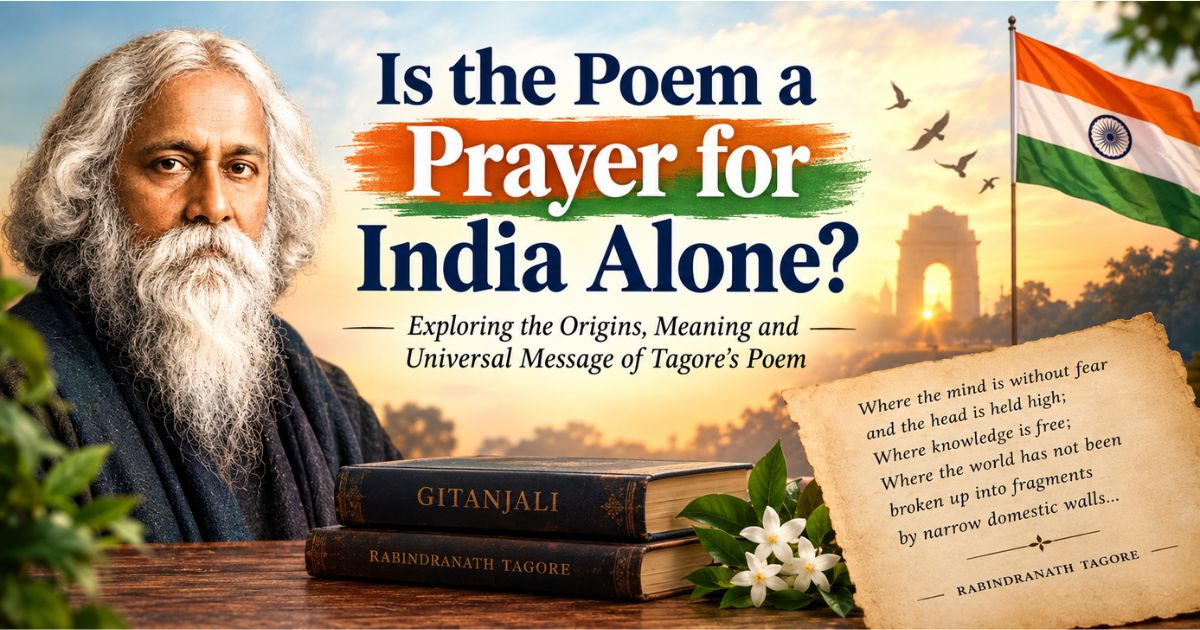
Introduction
No, not entirely. Where the Mind Is Without Fear was written as a literal prayer for India, addressed directly to God on behalf of “my country.” However, the ideals it asks for freedom from fear, freedom of thought, and freedom from narrow division are framed in universal terms that apply to any nation, not just India. So when people ask is the poem a prayer for India alone, the honest answer is both yes and no, depending on whether you’re asking about its original occasion or its actual message.
This keeps the direct, snippet-ready answer in the first two sentences (as required), and places the exact focus keyword phrase naturally in the third sentence rather than forcing it into an awkward mid-sentence break like the previous version did.
Key Takeaways
Here’s what settles the question before we go deeper.
- Poet: Rabindranath Tagore, who won the 1913 Nobel Prize in Literature, largely on the strength of Gitanjali.
- Original title: The poem was first written in Bengali as “Prarthona” (meaning “Prayer”), published in 1901 in the collection Naivedya.
- English version: It appears as the 35th poem in the 1912 English Gitanjali, where it has no title of its own; the first line is used instead.
- Direct addressee: The poem is spoken to “my Father” (God) on behalf of “my country,” which literally is India.
- Universal reading: Its actual requests freedom from fear, from ignorance, from division describe values any nation could aspire to, which is why it’s so widely quoted outside India too.
- A translation detail most guides miss: Tagore’s own English version softens a stronger, more forceful line from the Bengali original, which changes how “national” the poem feels in each language.
Where the Mind Is Without Fear: Origins of the Poem
To answer is the poem a prayer for India alone properly, you need to know where it actually came from. Tagore wrote the original Bengali poem around 1900, and it was published in July 1901 in his collection Naivedya (“Offering”). It was later reprinted in the Bengali Gitanjali in 1910. Two years after that, Tagore translated a selection of his own Bengali poems into English, publishing them as Gitanjali: Song Offerings in 1912 the collection that helped him win the Nobel Prize in Literature the following year, becoming the first non-European to do so.
This background matters because it shows the poem wasn’t written as a general meditation on freedom for a global audience. It was written by an Indian poet, in Bengali, for an Indian readership, at a time when India was still under British rule. As a result, calling it “a prayer for India” isn’t an interpretation, it’s simply what the poem says about itself.
Written as “Prarthona” A Prayer, Originally in Bengali
The poem’s original Bengali title was literally “Prarthona,” which translates to “Prayer.” It appeared as the 72nd poem in Naivedya, addressed directly to a divine “Father” figure, asking that “my country” awaken into a state of fearless, undivided, reasoned freedom. In the English Gitanjali, the poem carries no separate title at all publishers and readers simply refer to it by its first line, “Where the Mind Is Without Fear.”
This is worth knowing because it explains why the poem feels so personal and specific rather than abstract. Tagore isn’t describing an idealized world in general; he’s praying, in a very literal sense, for one particular nation to become that world. In my own reading of Gitanjali as a whole, this poem stands out precisely because it breaks from the collection’s usual mystical, devotional tone to make a direct, worldly request for India, by name.
What Changed Between the Bengali Original and Tagore’s English Translation
Here’s a detail most study guides skip entirely, and it directly affects how “national” the poem feels in each language. The original Bengali ending asks the father-figure to strike the sleeping nation and wake it “without mercy” , a much harsher, more urgent image. Tagore’s own English translation softens this considerably, ending instead with the gentler line asking that the country simply be led to “awake.” Similarly, one line in the Bengali original references পৌরুষ (roughly, “manliness” or vigor) that the English version leaves out entirely.
The comparison looks like this:
| Aspect | Bengali original (“Prarthona”) | English translation (Gitanjali 35) |
| Tone of ending | Stern, asks God to strike the nation awake “without mercy” | Gentle, simply asks that the country “awake” |
| A key reference | Includes a line invoking manliness/vigor | This reference is left out |
| Overall feel | More forceful, more clearly a wake-up call to a specific nation | Softer, easier to read as a general spiritual ideal |
This matters because the English version, the one most people quote, is, by Tagore’s own hand, a gentler and more universal-sounding poem than the Bengali original he actually wrote first.
Why the Poem Reads as Universal, Not Just National
Despite its clearly Indian origin, the poem’s actual requests aren’t tied to India in any exclusive way. It asks for a world where knowledge is free, where truth is spoken plainly, where people aren’t divided by “narrow domestic walls,” and where reason isn’t lost to “dead habit.” None of these ideals require an Indian context to make sense; they read just as naturally as a wish for any country recovering from division, censorship, or rigid tradition.
This is likely why the poem is quoted so often outside India, including at events unrelated to Indian independence. Readers often tell us this is the part of the question that trips them up: the poem’s occasion was specifically India, but its content deliberately avoids naming anything uniquely Indian, no reference to a specific religion, region, or historical event. Instead, it stays at the level of universal human aspiration, which is exactly why it has outlived its original moment and continues to resonate globally, more than a century after it was first written.
FAQs
Q: Is the poem a prayer for India alone?
A: Not exclusively. The poem was literally written as a prayer for India addressed to God on behalf of “my country” during India’s independence movement. However, its actual requests, like freedom from fear and freedom of thought, are described in universal terms that apply to any nation. So the poem’s occasion is Indian, but its message isn’t limited to India, which is why it continues to be quoted worldwide.
Q: Who wrote “Where the Mind Is Without Fear”?
A: Rabindranath Tagore wrote the poem, originally in Bengali as “Prarthona,” published in 1901. He later translated it into English himself for the 1912 Gitanjali, where it appears as poem 35. Tagore won the 1913 Nobel Prize in Literature largely on the strength of this collection, becoming the first non-European recipient of the award.
Q: What is the central theme of the poem?
A: The central theme is freedom, not just political independence, but freedom from fear, ignorance, division, and outdated habits. The poem envisions a country where knowledge is open to everyone, truth is spoken without hesitation, and people aren’t split apart by narrow social or religious boundaries, ending with a prayer that the nation “awake” into this state.
Q: Why is the poem called a “prayer”?
A: The poem is directly addressed to God, referred to as “my Father,” and structured as a series of requests on behalf of the poet’s country. Its original Bengali title, “Prarthona,” literally means “Prayer.” This format lets Tagore combine a personal, devotional tone with a political and national wish, which is part of why the poem a prayer for India alone is such a common exam question the prayer form makes the national request feel intimate.
Q: What does “narrow domestic walls” mean in the poem?
A: This phrase refers to divisions within a society, caste, religion, region, or community that fragment people from one another. Tagore is asking for a country where such internal boundaries no longer break the nation into isolated pieces. It’s one of the clearest examples of how the poem critiques division in general terms, without naming any specific group or conflict.
Q: Did Tagore change anything when translating the poem into English?
A: Yes, and it’s a detail worth knowing. The original Bengali ending is more forceful, asking God to wake the sleeping nation “without mercy,” and includes a reference to manliness that the English version omits. Tagore’s own English translation softens both of these elements, producing a gentler poem that reads more like a general spiritual ideal than the sharper, more urgent original.
Final Thoughts
The honest answer is the poem a prayer for India alone respects both halves of the question instead of forcing a flat yes or no. Tagore wrote it, in Bengali, as a direct prayer for India during a specific moment in its history that part isn’t up for debate. But the actual content of the prayer describes values with no national boundary at all, which is exactly why the poem has been quoted at events, schools, and gatherings far beyond India for over a century. Understanding both the occasion and the message is what separates a complete answer from the flat, one-line answers that dominate most search results on this question.
Recent Article : Who Has Composed ‘Since Brass Nor Stone’? Timeless Truth

Jennifer Aston is a passionate poetry curator and writer with a deep love for the written word. She believes poetry has the power to heal, inspire, and connect people across all walks of life. Through PoemSteric, she brings together timeless and modern verses for every emotion and every moment.