
Introduction
Learning how to write a poem in Hindi begins with expressing genuine emotion through simple words, clear images, and natural rhythm rather than forced rhymes. Anyone who feels deeply can start: choose a personal feeling or scene, write freely in everyday Hindi, then shape it with a basic meter or free verse. This approach works for school assignments, personal journals, or social media sharing, and builds skill faster than memorizing complex rules alone.
Key Takeaways for Aspiring Hindi Poets
Hindi poetry thrives on feeling first and form second. Beginners succeed when they focus on one strong image or emotion, count mantras only after the draft exists, and revise for clarity. Traditional forms such as doha and chaupai offer ready structures, while mukt chhand lets modern writers speak freely. Daily reading of poets like Kabir, Tulsidas, or contemporary voices sharpens the ear for laya. Practice short pieces daily, seek feedback, and treat every draft as practice rather than a final product. These habits turn occasional writing into consistent growth and help readers connect with an authentic voice.
Real experience shows that most first attempts feel awkward. In my own reading of student notebooks and online submissions, the poems that improve fastest start with concrete details rain on a window, a mother’s tired hands, the smell of wet earth rather than abstract words like “dukh” or “khushi.” Replace labels with scenes and the poem gains life. Keep a small notebook or phone note for sudden lines; over weeks those fragments become complete pieces. Consistency matters more than talent at the start.
Understanding Core Elements of Hindi Poetry
Every Hindi poem rests on three pillars: bhaav (emotion), laya (rhythm), and bimb (image). Bhaav is the heart without a true feeling, the words remain empty. Laya creates the musical flow that makes the poem memorable when read aloud. Bimb paints pictures so the reader sees and feels rather than merely understands.
Traditional Hindi poetry also values the emotional flavor that lingers after reading. Shringara (love), karuna (pathos), veera (heroism), and shanta (peace) appear often. Modern free-verse poems still aim for rasa even without a strict meter. Another key idea is that a poem should be singable or at least hummable; this does not mean it needs a tune, only that the lines should flow without stumbling.
Matra counting provides the technical backbone for metered forms. Short vowels (a, i, u) count as one matra. Long vowels (aa, ee, oo, ai, au) count as two. Half letters and certain consonants adjust the total. Mastering this system is not required on day one, yet it helps when polishing a doha or chaupai readers notice the difference between forced and natural rhythm.
Step-by-Step Process to Write a Poem in Hindi
1. Choose one clear seed. Pick a single emotion plus one concrete scene for example, loneliness at a railway station at dusk. Write five sensory notes: sounds of announcements, smell of chai, feel of the bench, color of the sky, temperature of the air.
2. Free-write without rules. Set a ten-minute timer and write in ordinary Hindi. Ignoring rhyme, length, and grammar captures the feeling first.
3. Shape the draft. Decide whether you want a traditional form or free verse. For beginners, free verse or a simple four-line stanza works best.
4. Add musicality. Look for natural alliteration (anupras), soft internal echoes, and a closing image that lands cleanly. Prefer light sound play over forced end rhymes.
5. Revise for clarity and strength. Cut every abstract word you can replace with a picture. Read the poem aloud if any line trips the tongue, change it.
6. Rest and return. Leave the piece for a day, then read it with fresh eyes. Small cuts and word swaps usually improve it more than major rewrites.
This sequence keeps the process creative rather than mechanical. Many writers discover their best lines appear during the free-write stage and survive into the final version.
Popular Hindi Poetry Forms and Structures
Hindi offers both strict and flexible forms. Understanding a few common ones helps you choose the right container for your idea.
Traditional Metered Forms
Doha is the classic two-line (four-charan) form. The pattern is 13-11, 13-11 matras, with the second and fourth charans ending on a short matra. Kabir’s dohas remain models of sharp insight packed into tight space.
Chaupai uses four lines of 16 matras each. Tulsidas employed it extensively in the Ramcharitmanas, and the rhyme often follows an AABB or similar close pattern.
Soratha reverses the doha pattern to 11-13, 11-13 and creates a different musical effect.
Flexible and Modern Options
Mukt chhand (free verse) follows no fixed matra count, yet still needs internal rhythm and strong images. Contemporary poets favor it for personal and social themes.
Ghazal, borrowed from Urdu, builds on couplets (sher) that share qaafiya and radeef. Each sher can stand alone while contributing to an overall mood.
Geet, or song-like poems, prioritize musicality and emotional directness they often appear in films and popular culture.
Choose the form that matches the emotion. A sharp moral insight fits a doha; a flowing personal memory suits free verse. Experiment with several forms using the same seed idea to discover what feels natural.
Mastering Rhythm, Meter, and Literary Devices
Rhythm begins with listening. Read good poems aloud and notice where the voice rises and falls. Matra counting becomes easier with practice: write a line, clap the short and long beats, and adjust until the total matches the chosen form.
Essential Literary Devices
Upama (simile) and rupak (metaphor) create vivid comparisons. Anupras (alliteration) adds music “sawan ki sawari” or “nadi nadi nadi.” Utpreksha (imaginative fancy) and atishayokti (hyperbole) heighten emotion when used sparingly.
Building Imagery and Rasa
Show rather than tell. Instead of writing “I felt sad,” describe the empty cup still warm on the table or the unanswered message glowing on the phone. Concrete details carry rasa more reliably than emotion labels.
Practice by rewriting a prose sentence into poetic lines. Keep the meaning but add sensory texture and sound. Over time the ear learns what works.
Common Mistakes Beginners Make When Writing Hindi Poems
- Forcing rhyme at the expense of meaning, inventing awkward phrases just to end two lines with the same sound, instead of using lighter internal echoes or free verse.
- Stacking abstract nouns “zindagi ka dard,” “prem ki aag” without grounding images, so readers cannot feel what they cannot see.
- Overwriting long sentences that sound impressive on paper often collapse when read aloud; short, clear lines usually carry more power.
- Ignoring revision, first drafts capture energy, but second and third drafts create craft. Reading the poem to a trusted friend or recording yourself can reveal weak spots quickly.
- Copying famous poets too closely is natural, yet the strongest poems carry a personal stamp. Write the way you speak, then refine.
Practical Exercises and Real-World Examples
Exercise 1: Take a daily object, a cup of chai, a school bag, a rainy window and write six free lines describing it through the five senses. Do not force a message.
Exercise 2: Write a four-line free-verse poem about a small regret or joy from the past week. Focus on one turning image at the end.
Exercise 3: Attempt a simple doha on the same theme. Count the mantras carefully and notice how the form tightens the language.
Real scenario: A college student once wrote about missing home. The first draft listed feelings. The revised version described the sound of the pressure cooker and the empty chair at the dining table. That version connected with readers immediately.
Another example, a short free-verse piece about waiting:
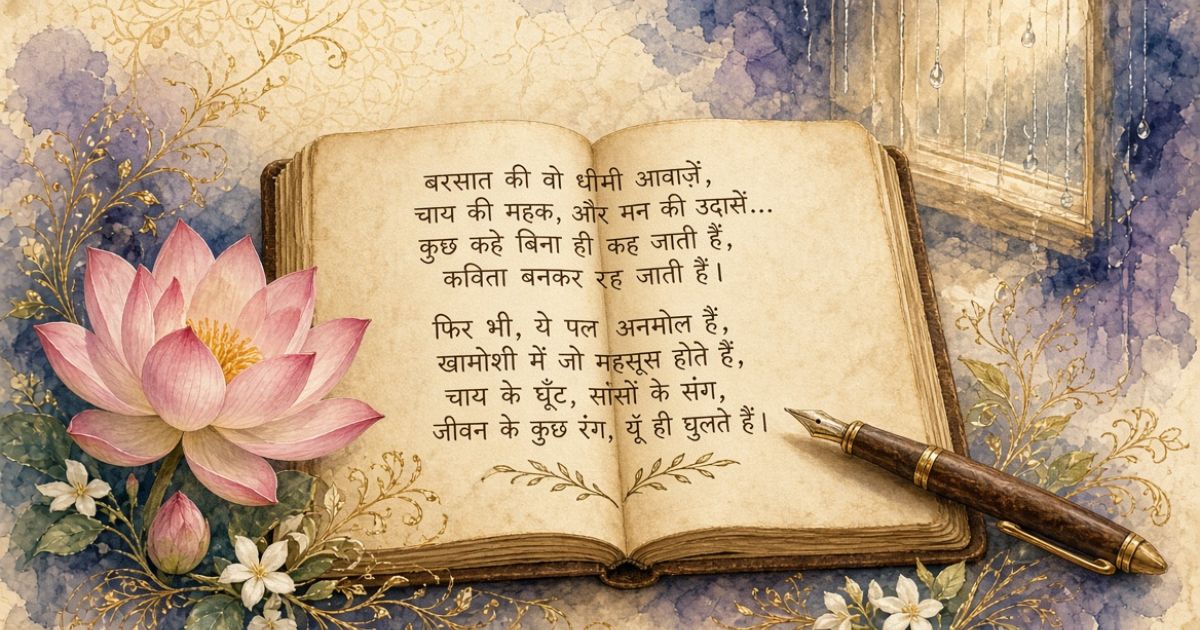
खिड़की पर बारिश लिख रही है
धीरे-धीरे
मैं चाय की प्याली थामे
स्टेशन के अंदर अकेला
The concrete details do the emotional work.
Tools and Resources to Improve Hindi Poem Writing
- Keep a physical or digital notebook for sudden lines.
- Read one classic and one modern poem daily Kabir, Mirabai, Nirala, or contemporary voices on reliable literary sites.
- Join online Hindi poetry groups for gentle feedback.
- Record yourself reading drafts; the ear catches problems the eye misses.
- Use simple matra-counting charts until the skill becomes automatic.
- Avoid relying on AI for complete poems, use it only for word suggestions if stuck, then rewrite in your own voice.
How Does One Choose Themes for Hindi Poetry?
Themes arise naturally from lived experience. Personal moments, the first rain of the season, a conversation with a parent, the quiet of an empty classroom often produce stronger poems than grand abstract topics. Social observations work when grounded in specific scenes rather than slogans. Nature remains a reliable source because it supplies ready images and rhythms.
Start with what you notice repeatedly in daily life. Keep a running list of small observations, and when emotion attaches to one of those observations, you have a seed. Readers respond to honesty more than to fashionable subjects.
Building Confidence Through Daily Practice
Write at least four short pieces every week. Share one occasionally with a friend or group. Celebrate small improvements, a stronger image, a cleaner line, a better ending rather than waiting for a perfect poem. Over months the gap between intention and result narrows. Many working poets still write imperfect drafts; the difference is they keep going.
FAQs
Q: How to write a poem in Hindi for beginners?
A: Beginners should start with a single personal image or emotion, free-write in simple Hindi for ten minutes, then shape the lines into free verse or a short stanza. Focus on sensory details rather than forced rhymes. Read the draft aloud and cut anything that sounds unnatural. Practice this process daily with everyday subjects, and over time the ear for rhythm develops naturally for example, by rewriting one prose memory into poetic lines each week.
Q: What is the easiest form when learning how to write a poem in Hindi?
A: Free verse (mukt chhand) is the easiest starting point because it removes matra pressure. Four-line stanzas with light internal sound play also work well. Once comfortable, try a simple doha to learn discipline. The key is capturing genuine feeling first many successful poets began this way before exploring stricter forms.
Q: How important is rhyme when you write a poem in Hindi?
A: Rhyme helps memory and music but is not required. Forced end rhymes often damage meaning, so it’s better to prefer natural internal echoes, alliteration, and strong closing images. Traditional forms use tukaant carefully; modern free verse relies more on laya and bimb. Balance is the goal.
Q: Can anyone learn how to write a poem in Hindi even without formal training?
A: Yes. Formal training helps with advanced meter, yet the core skills observation, honest feeling, clear language, and revision are available to anyone. Reading good poems, writing regularly, and seeking gentle feedback replace formal classes for most beginners. Consistency beats talent at the start.
Q: How long should a beginner poem be when practicing how to write a poem in Hindi?
A: Four to eight lines is ideal for early practice. Short pieces force focus and make revision manageable. Longer poems can come later once control of image and rhythm improves; many powerful Hindi poems are brief yet memorable.
Q: Where can I find inspiration to write a poem in Hindi daily?
A: Look at ordinary surroundings: a market, a bus ride, weather changes, family gestures. Keep a small observation notebook, and read one classic and one modern poem each day. Personal memory and present-moment noticing supply endless material.
Final Thoughts
Writing Hindi poems is less about rules and more about paying attention. Feel something real, capture it in concrete language, shape the language so it can be read aloud with pleasure, and revise until the feeling reaches the reader cleanly. Traditional forms offer useful training wheels; free verse offers freedom. Both reward patience and honest observation. Starting today with one small scene the next poem will come more easily than the last.
Recent Article : Why I Like the Hospital Poem Summary: Clear & Powerful

Jennifer Aston is a passionate poetry curator and writer with a deep love for the written word. She believes poetry has the power to heal, inspire, and connect people across all walks of life. Through PoemSteric, she brings together timeless and modern verses for every emotion and every moment.