
Introduction
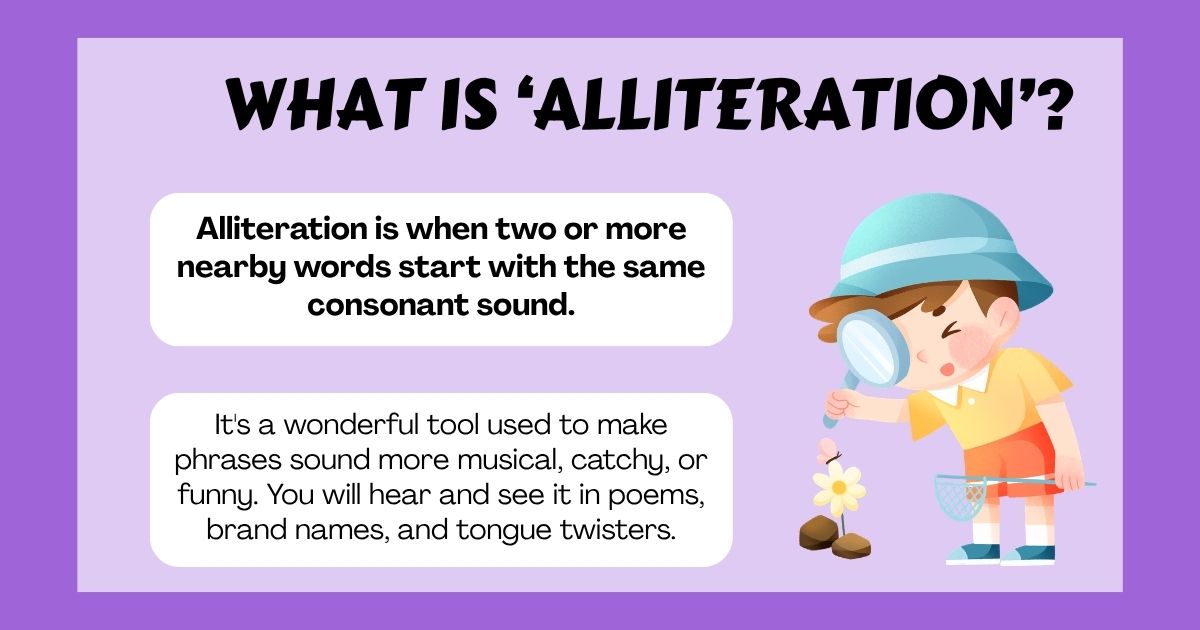
What is alliteration in a poem? It is the repetition of the same consonant sound at the beginning of two or more words that sit close together in a line, used to add rhythm, emphasis, and musical texture to the verse. Poets have leaned on this technique for centuries, from Anglo-Saxon epics to modern nursery rhymes, because repeated initial sounds make lines easier to remember and more pleasant to read aloud. In my own reading of classic and contemporary poetry, alliteration is usually the first sound device readers notice, even before they know its name.
This guide covers the full alliteration definition, how it differs from assonance and consonance, why poets reach for it, and how to find it yourself in a poem you are studying or writing. As a result, by the end you will be able to spot alliterative poetry on sight, not just recognize it when someone points it out. We will also work through real examples, from classic literature to everyday phrases, so the idea sticks.
Whether you are a student preparing for an exam, a teacher building a lesson on figures of speech in poetry, or a hobbyist working on your own alliterative poetry, the goal here is the same: a clear, practical understanding you can actually use. However, alliteration is easiest to learn through examples rather than rules alone, so each section below pairs a short explanation with real lines you can read aloud and test for yourself.
Key Takeaways
- Alliteration is the repetition of matching initial consonant sounds in nearby words, not necessarily matching first letters.
- It is a poetic sound device used to build rhythm, emphasis, and memorability.
- It differs from assonance (repeated vowel sounds) and consonance (repeated consonant sounds anywhere in a word, not just at the start).
- It appears everywhere from Old English epics to nursery rhymes, tongue twisters, and modern song lyrics.
- You can learn to identify it reliably by reading a line aloud and listening for repeated starting sounds.
What Is Alliteration in a Poem? A Clear, Snippet-Ready Definition
In simple terms, alliteration is a figure of speech in which the same consonant sound repeats at the start of two or more words placed close together, usually within the same line or sentence. The key word here is sound, not letter. “Fantastic” and “phone” both start with an “f” sound even though they are spelled differently, so they alliterate. Meanwhile, “cat” and “cell” start with the same letter but different sounds, so they do not. This distinction trips up a lot of students, and it is worth reading any suspected alliterative line aloud before deciding.
Alliteration belongs to a broader family of poetic sound devices that includes rhyme, assonance, consonance, and onomatopoeia. What makes it distinct is its position: alliteration is specifically about the opening sound of a word, which is why it tends to land with more punch at the start of a line or phrase, where a reader’s attention is freshest.
How Alliterative Sounds Work in a Line
When a poet writes a line like “the wild wind whispered through the willows,” the repeated “w” sound does two things at once: it slows the reader down slightly, because the mouth has to reset for each “w,” and it creates a soft, breathy texture that suits the image of wind. That pairing of sound and meaning is not an accident. Skilled poets choose which consonant to repeat based on the mood they want: hard sounds like “b,” “d,” and “g” feel forceful, while soft sounds like “s,” “f,” and “w” feel gentle or hushed.
This is also why alliteration works so well in tongue twisters and alliteration-heavy nursery rhymes. “Peter Piper picked a peck of pickled peppers” is fun to say precisely because the repeated “p” sound forces careful, deliberate mouth movement, which is what makes it hard to say quickly.
Alliteration vs Assonance vs Consonance
These three terms get confused constantly, so it helps to see them side by side. Alliteration repeats a consonant sound at the start of nearby words, as in “busy bees buzz.” Assonance repeats a vowel sound anywhere in nearby words, as in “the light of the fire is a sight.” Consonance repeats a consonant sound anywhere in a word, not just the beginning, as in “pitter patter” or “blank and think.” Knowing this difference matters for exams and for your own writing, since mixing up assonance vs alliteration is one of the most common mistakes students make when analyzing a poem.
Why Do Poets Use Alliteration in Their Writing?
Poets reach for alliteration for a handful of practical reasons, not just decoration. First, it builds rhythm. Repeated initial sounds create a beat that guides how a line is read aloud, even in free verse that has no fixed meter. Second, it draws attention to specific words. When two or three words in a row share a sound, a reader’s ear naturally groups them together, which is a subtle way to highlight an image or idea without stating it outright.
Third, alliteration aids memory. This is precisely why it shows up so heavily in oral traditions, from Anglo-Saxon poetry like Beowulf, which used alliteration instead of rhyme as its main structural device, to modern advertising slogans and brand names such as PayPal or Coca-Cola. A line that sounds good is a line people remember, even if they could not tell you why. Finally, alliteration can set a mood. Soft, repeated consonants can make a scene feel calm or eerie, while harder, repeated consonants can make it feel tense or aggressive, giving poets a tool for shaping atmosphere through sound alone rather than through word choice.
None of this means alliteration should be forced into every line. Overusing it can make a poem feel gimmicky rather than musical, which is why the strongest examples tend to use it sparingly, at moments that matter most. As a result, learning why poets use alliteration is really about learning restraint as much as technique.
Famous Examples of Alliteration in Poetry
Seeing alliteration in real, published poems makes the definition concrete. The examples below range from centuries-old classics to lines you have probably heard without noticing the technique behind them.
Classic Poems That Use Alliteration
Edgar Allan Poe’s “The Raven” opens with “weak and weary,” a pairing that sets the poem’s tired, haunted tone in just two words. Samuel Taylor Coleridge’s “The Rime of the Ancient Mariner” uses the phrase “the furrow followed free,” where the repeated “f” sound mimics the smooth motion of a ship cutting through water. Robert Frost’s “Stopping by Woods on a Snowy Evening” gives us “easy wind and downy flake,” a soft, hushed line that matches the quiet snowfall it describes. Further back, the entire Old English epic Beowulf relies on alliteration rather than end rhyme to hold its lines together, which shows just how old this technique really is.
Modern and Everyday Examples of Alliteration
You do not need to open a poetry anthology to find alliteration. Nursery rhymes lean on it heavily, from “Peter Piper picked a peck of pickled peppers” to “she sells seashells by the seashore.” Everyday idioms use it too, such as “busy as a bee,” “good as gold,” and “dead as a doornail.” Song lyrics, brand names, and even headlines borrow the same trick because it makes phrases catchier and easier to recall. Readers often tell us that once they learn to notice alliteration in these familiar, low-stakes places, spotting it in a formal poem becomes far less intimidating.
How to Find Alliteration in a Poem (Step-by-Step)
Once you understand the alliteration definition, identifying it in an actual poem is mostly a matter of method. Many readers skim a poem silently and expect the pattern to jump out, but alliteration is built for the ear, not the eye, so a rushed silent read will hide it more often than reveal it. The step-by-step process below is the same one used for how to identify alliteration in a classroom or self-study setting, and it works equally well on a short nursery rhyme or a long narrative poem.
If you are analyzing a poem for class or checking your own writing, use this simple process:
1. Read the poem aloud, slowly. Alliteration is a sound device, so your eyes alone will miss it far more often than your ears will.
2. Listen for the opening sound of each word, not the spelling. Mark any word whose starting sound matches a nearby word’s starting sound.
3. Check proximity. Two matching sounds three lines apart is usually coincidence; two matching sounds in the same line or sentence is more likely intentional alliteration.
4. Rule out assonance and consonance. If the repeated sound is a vowel, it is an assonance. If the repeated consonant sound is not at the start of the word, it is consonance, not alliteration.
5. Ask what effect the repetition creates. Does it speed up or slow down the line? Does it match the poem’s mood? This last step turns simple spotting into real literary analysis.
FAQs
Q: What is alliteration in a poem, in one sentence?
A: Alliteration in a poem is the repetition of the same consonant sound at the start of two or more nearby words, used to create rhythm and emphasis. It works by sound, not spelling, so “cat” and “kite” alliterate even though they start with different letters. Poets use it to make lines more musical and easier to remember, which is why it shows up so often in nursery rhymes, tongue twisters, and classic verse.
Q: Is alliteration the same as rhyme?
A: No, alliteration and rhyme are different sound devices. Rhyme matches the ending sounds of words, usually at the end of a line, while alliteration matches the beginning sounds of nearby words. A poem can use one, both, or neither. For example, “the wild wind whispered” is alliteration with no rhyme at all, while a rhyming couplet may or may not include any alliterative lines.
Q: Can alliteration happen with vowels?
A: Traditionally, alliteration refers to repeated consonant sounds, while repeated vowel sounds are called assonance. However, some style guides accept vowel alliteration when words start with the same vowel sound, such as “apples and acorns.” To stay safe in an essay or classroom setting, it is best to treat consonant repetition as alliteration and vowel repetition as assonance, since that is the standard distinction most textbooks teach.
Q: Why do poets use alliteration in their poems?
A: Poets use alliteration to add rhythm, draw attention to key words, and make lines more memorable, since repeated sounds are easier for the ear and brain to hold onto. It can also set a mood, such as soft “s” and “f” sounds for calm scenes or hard “b” and “d” sounds for tension. Beyond style, alliteration ties a line together, giving it a sense of unity that plain wording often lacks, which is really the heart of what is alliteration in a poem meant to achieve.
Q: What are some simple alliteration examples for beginners?
A: Simple alliteration examples include “Peter Piper picked a peck of pickled peppers,” “she sells seashells,” and “busy as a bee.” In poetry, a line like “the gentle giant gazed at the garden” shows the same idea in a less tongue-twisting form. Starting with short, everyday phrases like these is a practical way to answer what is alliteration in a poem for yourself before looking for it in longer, more complex poems.
Q: How many words need the same sound for it to count as alliteration?
A: Most style guides say at least two words with the same initial consonant sound, placed close enough together that a reader notices the pattern, is enough to count as alliteration. There is no strict rule that the words must be next to each other, though closer placement makes the effect stronger. This is one of the finer points people ask about once they already understand what is alliteration in a poem at a basic level. Three or more repeated sounds in a single line is sometimes called “heavy” alliteration and is common in Old English poetry.
Final Thoughts
Alliteration is one of the simplest poetic sound devices to learn and one of the most useful to notice, because it shows up everywhere from Beowulf to breakfast cereal slogans. The core idea never changes: repeated initial consonant sounds in nearby words, used to build rhythm, draw attention, aid memory, or set a mood. Once you start listening for it instead of just reading for it, you will likely start noticing alliterative poetry in places you never expected, and that is usually the moment the concept truly clicks.
The best way to make any of this stick is to practice with short, low-pressure examples before moving to longer poems. Try writing two or three alliterative lines of your own, read them aloud, and adjust the sound until the rhythm feels right. For example, alliteration examples for kids often work well as a starting exercise, since their simplicity makes the pattern easy to see and easy to imitate. From there, applying the same listening habit to a full poem, classic or contemporary, becomes much more natural. That habit, more than any rule, is really the answer to what is alliteration in a poem and how to hear it for yourself.
Recent Article : How to Pronounce Poem? Easy & Clear Guide

Jennifer Aston is a passionate poetry curator and writer with a deep love for the written word. She believes poetry has the power to heal, inspire, and connect people across all walks of life. Through PoemSteric, she brings together timeless and modern verses for every emotion and every moment.