
Introduction
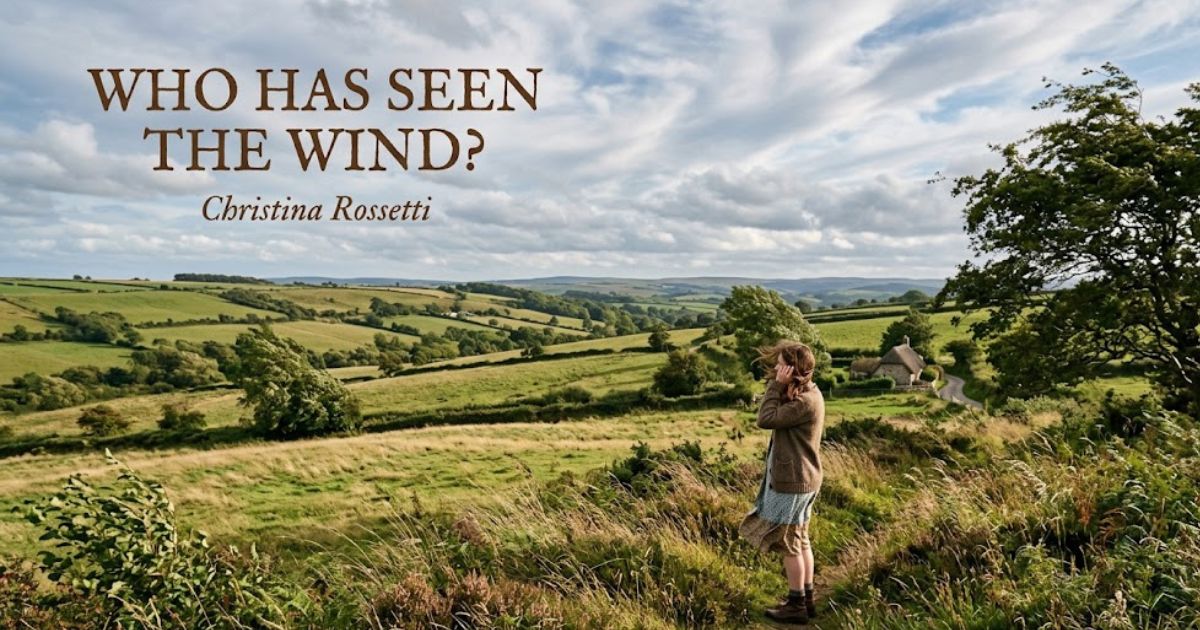
Who Has Seen the Wind is a short nature poem by Christina Rossetti about something people can feel and observe but cannot directly see. The poem explains this idea through trembling leaves and bending trees, showing that invisible forces can be understood through their effects. Rossetti published the poem during the Victorian period, and it is now widely read as both a simple children’s poem and a thoughtful reflection on nature and unseen influence. The poem contains only eight lines, yet those lines raise a larger question about human perception. We cannot see the wind itself, but we know it exists because we see what it does.
That simple observation forms the heart of Rossetti’s poem. It also explains why the Christina Rossetti wind poem remains useful for students studying imagery, symbolism, personification, repetition, and theme.
Key Takeaways
- Christina Rossetti wrote the poem.
- The poem consists of two four-line stanzas, or quatrains.
- Its central idea is that something does not have to be visible to be real.
- The wind is recognized through its effects on leaves and trees.
- Rossetti uses rhetorical questions, repetition, imagery, personification, symbolism, and rhyme.
- The poem has a strong connection with nature and observation.
- The movement from trembling leaves to bending trees suggests different degrees of the wind’s effect.
- The poem can be read literally as an observation about nature.
- It can also support a broader interpretation involving invisible influences, including spiritual ideas.
- Its simple language makes it accessible, while its deeper implications make it suitable for literary analysis.
A useful way to understand the poem is to remember this pattern:
Invisible cause → visible effect → human inference
For example, you may not see the wind, but moving leaves tell you that air is moving. Similarly, people often understand unseen things through the changes they produce.
Who Has Seen the Wind Poem: Summary and Meaning
The poem begins by asking a deceptively simple question: who has actually seen the wind? The speaker immediately answers that neither the speaker nor the reader has seen it.
However, the poem does not claim that the wind is unreal. Instead, Rossetti shows how people recognize the wind through its effects. The leaves tremble when the wind moves through them, while trees bend when the wind passes by.
This distinction between seeing a cause and seeing its effects is central to the poem. We cannot visually capture the wind itself in the ordinary sense, but we can observe evidence of its movement.
What happens in the first stanza?
The first stanza establishes the poem’s basic idea. The speaker asks who has seen the wind and answers, “Neither I nor you.” The speaker then points to trembling leaves as evidence that the wind is moving through the landscape.
The image of trembling leaves is important because leaves respond visibly to even a relatively gentle breeze. Therefore, Rossetti gives the reader something concrete to observe.
The stanza essentially teaches a simple process:
- You cannot directly see the wind.
- You notice the leaves moving.
- You infer that the wind is present.
- The visible movement becomes evidence of the invisible force.
This makes the poem more than a description of weather. It becomes a lesson in observation.
What happens in the second stanza?
The second stanza repeats the question but changes the order of “I” and “you.” Instead of “Neither I nor you,” Rossetti writes “Neither you nor I.” The poem then shifts from trembling leaves to trees that “bow down their heads.”
This second image is stronger. Leaves can tremble gently, but tree bending suggests a more powerful movement.
As a result, the poem expands its central observation. The wind remains invisible, yet its effects can be delicate or powerful.
The final phrase, “passing by,” also emphasizes movement. The wind does not remain in one place. It travels through the natural world, leaving visible evidence behind.
Christina Rossetti and the Poem’s Background
Christina Rossetti was a major Victorian poet who lived from 1830 to 1894. She was born in London and became known for works including Goblin Market and In the Bleak Midwinter. The Academy of American Poets identifies her as a major Victorian poet and lists the poem as public domain.
The exact publication history of this particular poem is worth handling carefully because different educational sources give different dates. Some references identify it with 1872, while the Academy of American Poets page gives a publication date of January 1, 1893.
Therefore, it is safer in a school analysis to identify Rossetti as a Victorian poet rather than confidently attaching one publication date without qualification.
Who was Christina Rossetti?
Rossetti belonged to an important literary family. Her brother Dante Gabriel Rossetti was a poet and artist associated with the Pre-Raphaelite movement.
Her own poetry often combines accessible language with emotional, religious, natural, or symbolic meanings. That combination is particularly useful for understanding this short poem.
The simplicity of the language should not be mistaken for a lack of depth. Rossetti uses an ordinary natural phenomenon to explore a larger question about how humans know things.
Why the poem feels like a nursery rhyme
The poem’s short lines, repetition, rhyme, and question-and-answer pattern give it a nursery-rhyme quality. Educational resources also present it as a poem useful for teaching personification, rhyme, inference, and interpretation.
That structure makes the poem easy to memorize and read aloud.
At the same time, adults can find deeper meanings in its central idea. A child may simply understand that wind moves leaves. An older reader may ask whether Rossetti is suggesting that other unseen forces can be understood through their effects.
That is one reason the poem works at more than one level.
Main Themes and Central Message
The central theme of the poem is the presence and influence of something that cannot be directly seen. Rossetti uses wind as a familiar example of an invisible force that becomes obvious through its effects.
The poem therefore connects nature, observation, perception, and inference.
The invisible power of nature
Nature is not merely background scenery in the poem. It provides the evidence needed to understand the wind.
Rossetti never tries to describe the wind as if it had a visible body. Instead, she shows what happens to leaves and trees when the wind moves.
This is effective because readers already understand the experience. We may not see moving air, but we can feel it against our skin and watch its effects on the environment.
The poem turns that familiar experience into poetry.
Evidence, observation, and inference
Another important theme is inference. The speaker cannot see the wind directly, but the speaker can reason from visible evidence.
This is particularly interesting because the poem encourages readers to think like observers. First, they notice something happening. Next, they identify a likely cause. Finally, they understand the invisible force through its visible consequences.
The process resembles everyday reasoning:
- Observation: Leaves tremble.
- Possible cause: Wind is moving through them.
- Inference: The wind is present even though it cannot be seen.
This is one of the poem’s strongest educational qualities. It teaches an idea about perception without sounding like a lesson.
The universal human experience
Rossetti repeatedly places the speaker and reader together with phrases such as “I” and “you.” That makes the poem universal.
The speaker does not claim special knowledge. Instead, the speaker admits the same limitation as the reader.
Neither person can see the wind directly.
However, both can recognize it.
That shared experience creates a quiet connection between poet and audience. In my own reading of the poem, this is one of its most effective choices because it prevents the speaker from sounding like a lecturer.
Poetic Devices and Literary Techniques
Rossetti achieves a surprising amount in only eight lines. The poem’s literary devices are simple enough for younger readers to identify but rich enough for more advanced analysis.
Rhetorical question and repetition
The opening question, “Who has seen the wind?”, is a rhetorical question. It does not genuinely seek a person who can provide an answer. Instead, it invites readers to consider the difference between seeing something and knowing that it exists.
Rossetti repeats the question at the beginning of the second stanza. This repetition acts almost like a refrain.
The repeated question also gives the poem a circular quality. The reader returns to the same problem but receives additional evidence.
Personification and imagery
The poem uses vivid natural imagery. Readers can imagine leaves trembling and trees bending under the movement of the wind.
There is also personification in the image of trees that “bow down their heads.” Trees do not literally have human heads, but Rossetti describes their movement using human behavior.
That choice makes the natural scene easier to visualize.
The imagery also becomes stronger from the first stanza to the second:
Leaves trembling → trees bowing
The progression gives the wind increasing apparent power.
Symbolism and contrast
The wind can be read literally as moving air, but it can also function symbolically.
It may represent an invisible influence that affects the visible world. This broader reading should be presented as an interpretation rather than an unquestionable fact about Rossetti’s intention.
Some literary analyses connect the poem’s unseen wind with spiritual or divine ideas, while other readings focus on perception and nature.
The important contrast is therefore:
| What cannot be seen | What can be observed |
| The wind | Trembling leaves |
| The moving air | Bending trees |
| The invisible cause | Visible effects |
This contrast gives the poem its philosophical dimension.
Stanza-by-Stanza Analysis
A close reading becomes easier when each stanza is examined for question, answer, evidence, and meaning.
Analysis of the first stanza
The first stanza introduces the problem directly. The speaker asks who has seen the wind and immediately includes both speaker and reader in the answer.
The phrase “Neither I nor you” establishes shared human experience. Nobody in the conversation has actually seen the wind itself.
Yet the speaker does not stop there.
The next two lines provide evidence. When leaves tremble, the speaker knows that the wind is passing through.
This is important because Rossetti changes the reader’s understanding of “seeing.” The wind is not visible, but its effects are visible.
The first stanza therefore moves from question to observation.
It also creates a gentle visual image. A reader can easily imagine leaves shaking on a tree as air moves through them.
Analysis of the second stanza
The second stanza repeats the basic structure but introduces a stronger natural image.
The speaker again asks who has seen the wind. Again, neither person has.
This time, however, trees “bow down their heads.”
The word “bow” carries several possible associations. Literally, it describes trees bending under pressure. Figuratively, bowing can suggest submission, respect, humility, or surrender.
Rossetti does not explain these additional associations. Instead, she leaves them available for the reader to consider.
The final phrase, “passing by,” also gives the stanza a sense of movement and impermanence.
The wind comes through the landscape, affects what it encounters, and continues onward.
What Does the Wind Symbolize?
The wind is first and foremost a real natural force in the poem. However, its invisibility allows it to carry broader symbolic possibilities.
The poem’s strongest symbolic idea is that something can be real and influential without being directly visible.
The wind as an unseen force
The wind can symbolize anything whose existence becomes clear through its effects.
For example, emotions are invisible, but their effects can be visible in facial expressions or actions. Love cannot be physically seen, but its effects can appear in behavior. Time cannot be seen moving, but its effects appear in change.
These comparisons should not replace the literal meaning. Instead, they extend it.
The poem begins with nature and gives readers a framework for thinking about less visible aspects of life.
Possible spiritual interpretation
A spiritual reading is also possible. Some analyses interpret the invisible wind as a metaphor for a divine or spiritual presence that cannot be seen but can be recognized through its effects.
However, readers should distinguish interpretation from confirmed authorial intention.
The poem itself does not explicitly say that the wind represents God. It simply presents the wind as something invisible whose presence can be known indirectly.
Therefore, the safest literary answer is that the wind represents an unseen force, while spiritual meaning is one possible extension of that idea.
Who Has Seen the Wind Poem: Form, Rhyme, and Structure
The poem’s form is deliberately compact. It consists of two four-line stanzas, creating a balanced structure. The repeated opening question connects the two stanzas, while the natural images provide variation.
This structure is important because the poem does not need a long explanation. Its form mirrors its meaning: a small number of visible details can reveal something much larger.
Two quatrains and parallel structure
Each stanza follows a similar pattern:
- A question about seeing the wind.
- An answer involving the speaker and reader.
- A visible natural effect.
- A statement that the wind is moving.
This parallel structure makes the poem easy to understand.
It also allows the second stanza to develop the first rather than simply repeat it.
The first stanza gives us trembling leaves. The second gives us bending trees.
Rhyme, rhythm, and repetition
The poem uses an ABCB-style rhyme pattern within each quatrain, with the second and fourth lines providing the most obvious end rhyme. Poetry analysis sources identify this simple rhyme structure as part of the poem’s musical quality.
The sound pattern contributes to its nursery-rhyme character.
The repeated question also functions rhythmically. Because the poem is short and contains repeated phrases, it can be read aloud smoothly.
The rhythm is not mechanically identical in every line. Instead, Rossetti allows the natural movement of the language to support the poem’s calm, flowing atmosphere.
Why Is the Poem Still Relevant Today?
The poem remains relevant because its central problem is not limited to Victorian literature. People still ask how we know something exists when we cannot directly observe it.
A student can understand the poem through a simple example. Imagine standing beside a tree. You cannot point to a visible object called “wind,” but you can see branches moving.
That is exactly the kind of everyday experience Rossetti transforms into poetry.
The poem is also relevant because modern readers constantly distinguish between direct evidence and indirect evidence.
For example, you may not see someone enter a room, but you may notice the door opening and infer that someone came in. You may not see sound traveling, but you hear its effects.
The poem therefore encourages careful observation rather than passive acceptance.
It also demonstrates an important lesson about poetry: simple language can carry complex ideas.
A young reader may learn about wind and personification. A student preparing for an examination may discuss symbolism, repetition, imagery, and structure. An adult reader may think about invisible forces in human life.
The same eight lines can support all three readings.
FAQs
Q: Who wrote the Who Has Seen the Wind poem?
A: Who Has Seen the Wind poem was written by Christina Rossetti, the Victorian English poet who lived from 1830 to 1894. The poem is commonly presented as an eight-line nature poem and is preserved by major poetry organizations, including the Academy of American Poets and the Poetry Foundation. Rossetti uses the wind to explore something that cannot be seen directly but can be recognized through its effects on leaves and trees.
Q: What is the main message of Who Has Seen the Wind poem?
A: The main message of Who Has Seen the Wind poem is that something does not have to be visible to be real or influential. Rossetti shows that although people cannot see the wind itself, they can recognize it through trembling leaves and bending trees. The poem therefore teaches readers to understand invisible forces through their visible effects. It can also encourage a broader reflection on things such as emotions, influence, or spiritual ideas.
Q: What does the wind symbolize in the poem?
A: In Who Has Seen the Wind poem, the wind can symbolize an invisible force whose presence becomes known through its effects. Its literal meaning remains important because Rossetti is describing a real natural phenomenon. However, readers may extend the image symbolically to ideas such as change, emotion, spiritual influence, or other unseen powers. The poem does not explicitly state one symbolic meaning, so these broader interpretations should be treated as literary possibilities rather than proven authorial intentions.
Q: What poetic devices are used in Who Has Seen the Wind poem?
A: Who Has Seen the Wind poem uses several important poetic devices. These include a rhetorical question, repetition, imagery, personification, symbolism, and rhyme. The repeated opening question establishes the central problem, while trembling leaves and bending trees create natural imagery. The trees “bow down their heads,” which gives nature a human quality. The simple rhyme and repeated structure also give the poem a musical, nursery-rhyme quality.
Q: Why can we not see the wind in the poem?
A: The poem explains that the wind itself cannot be directly seen, but its effects can be observed. Readers see leaves trembling and trees bending, which provides evidence that air is moving through the environment. This distinction between an invisible cause and visible effects is the central idea of the poem. In practical terms, we recognize wind through movement, sound, temperature, and other effects rather than seeing the moving air itself as a solid object.
Q: What is the theme of the poem?
A: The main theme is the relationship between invisible forces and visible effects. Rossetti shows that people cannot see the wind directly, yet they can recognize its presence through nature. Other themes include nature, observation, human perception, universality, and the limits of direct knowledge. The poem’s simplicity makes these ideas easy to understand, while its symbolism allows older readers to explore deeper interpretations.
Final Thoughts
Christina Rossetti’s poem succeeds because it turns an ordinary experience into a thoughtful literary question. Nobody needs to see the wind directly to know that it exists. The trembling leaves and bending trees provide visible evidence of an invisible force. From that simple observation, Rossetti develops ideas about perception, nature, influence, and inference. The poem’s rhetorical question, repetition, imagery, personification, symbolism, and balanced structure all reinforce the same central idea. Most importantly, the poem does not over-explain its meaning. It allows the reader to make the connection.
That is why Who Has Seen the Wind remains useful for both beginners and advanced readers. Its language is simple, but its central question opens the door to much deeper thinking about everything we know through evidence rather than direct sight.
Recent Article : Casuarina Tree Symbol: Powerful Meaning Explained

Jennifer Aston is a passionate poetry curator and writer with a deep love for the written word. She believes poetry has the power to heal, inspire, and connect people across all walks of life. Through PoemSteric, she brings together timeless and modern verses for every emotion and every moment.