
Introduction
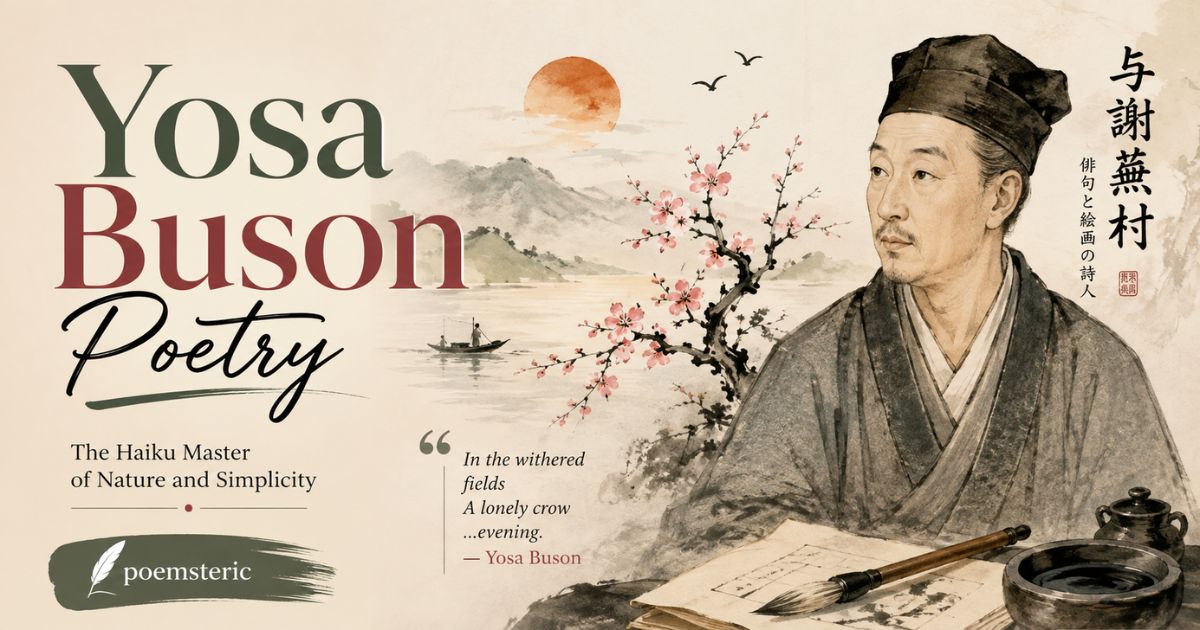
Yosa Buson poetry blends a painter’s eye with a poet’s ear, turning ordinary moments like a hydrangea, a cold pond, or a spring rain into vivid, image-driven haiku. Buson (1716–1783) is ranked alongside Matsuo Basho and Kobayashi Issa as one of the three towering figures of classical Japanese haiku, and he is unique among them for having also been a professional landscape painter. This article breaks down his life, his most celebrated haiku, the painting technique he brought to his verse, and why his work still shapes how people think about nature poetry today.
Key takeaways
Yosa Buson was born in 1716 near Osaka and died in 1783 in Kyoto; alongside Basho and Issa, he is one of the three most studied haiku poets in Japanese literary history.

He supported himself primarily as a painter in the Nanga (literati) tradition, and this visual training shows up directly in his haiku's sharp, composed imagery.

Buson led what scholars call the Tenmei revival, a mid-1700s movement that pulled haikai poetry back toward the depth and craft of Basho after decades of decline into wordplay.

His haiku favors color, distance, and stillness over emotional commentary, letting the picture do the work.

Modern readers can still find his hut, Basho-an, at Konpukuji temple in Kyoto, where he is also buried.
Who was Yosa Buson?
Yosa Buson was born in 1716 in the village of Kema, near the Yodo River outside Osaka, in what was then Settsu Province. His birth name is generally thought to have been Taniguchi, and the “Yosa” he later adopted is believed to reference his mother’s home region, Tango province. He came from a comfortable village family; his father served as the local village head but Buson chose an unpredictable life in art over a settled inheritance.
Around age 20, Buson moved to Edo, the city now known as Tokyo, to study under the haikai master Hayano Hajin. Hajin had trained under two direct disciples of Basho, Takarai Kikaku and Hattori Ransetsu, which meant Buson was only two generations removed from Basho’s own teaching. For roughly five years, until Hajin’s death in 1742, Buson absorbed the technical backbone of the Basho school: seasonal reference, disciplined brevity, and the idea that a haiku should open a scene rather than explain a feeling.
After his teacher died, Buson spent time wandering the region north of Edo, in areas now part of Ibaraki and Tochigi Prefectures, painting for income and writing haikai on the road. It was during this itinerant period that he composed one of his most historically important poems, an elegy for a fellow poet named Hokuju, a piece scholars point to as an early hint of the freer, almost proto-modern verse forms that would appear generations later.
By the late 1750s, Buson had settled permanently in Kyoto. There he built a dual career: a working painter supported by wealthy merchant patrons, and a haikai teacher running his own poetry circle. In 1770 he took the pen name Yahantei II (“Midnight Hermitage, the Second”), inheriting the name from his late teacher Hajin, a gesture that publicly marked him as the standard-bearer of that poetic lineage. He died on the 17th of January, 1784 by the Western calendar (still recorded as the winter of 1783 in the traditional Japanese calendar), and is buried at Konpukuji temple, next to a small hut called Basho-an that he personally restored in tribute to his poetic hero.
A painter first, a poet always
In my own reading of Buson’s work across different translations, what stands out immediately is how rarely he tells you what to feel. A Basho haiku often ends on a note of quiet realization; a Buson haiku more often ends on a visual detail, as if he set down his brush mid-stroke. That is not an accident. Professor Fujita Shinichi of Kansai University, who has spent decades studying Buson’s paintings, has noted that Buson painted first and foremost to earn a living for his family and that same working artist’s discipline, the habit of composing a scene rather than narrating it, carried directly into his poetry.
What is haiga, and why does it matter to Yosa Buson poetry?
Haiga is a hybrid art form that pairs a haiku with a small, quick ink painting, usually by the same hand. Buson did not invent haiga, but he is widely credited with perfecting it as a serious branch of Japanese pictorial art rather than a casual sketch. One of his best-known haiga, a hydrangea paired with a cuckoo, still hangs in the Aichi Prefectural Museum of Art collection today.
Understanding haiga changes how you read Buson’s haiku on the page, even without the accompanying image:
- Composition over commentary. Buson arranges a haiku the way he would arrange a painting foreground, middle distance, and a single point of focus rather than building toward a moral or emotional payoff.
- Negative space matters. Just as a Nanga-style landscape leaves large areas of blank paper to suggest mist or distance, Buson’s haiku often leaves a full beat of silence between two images, trusting the reader to supply the connection.
- Color as detail, not decoration. Where many haiku poets rely on sound or motion, Buson frequently anchors a poem in a specific color: pale yellow rapeseed flowers, a white peony, a gray cat.
This is one of the clearest ways Buson’s dual career shaped Yosa Buson poetry into something recognizably different from his contemporaries: he wrote the way he painted, and he painted the way he wrote.
The Tenmei haikai revival: how Buson brought Basho’s spirit back
By the mid-1700s, roughly fifty years after Basho’s death in 1694, haikai poetry in Japan had drifted. Popular haikai circles increasingly prized clever wordplay and topical jokes over the disciplined, meditative style Basho had championed. Buson, now an established painter and respected teacher in Kyoto, pushed back.
Working with a circle of poets in Kyoto from the 1760s onward, Buson organized regular gatherings where participants composed verse on assigned themes and then openly debated the merits of each poem, a workshop model that forced writers to defend their imagery rather than simply publish it. Buson also physically retraced sections of the journey Basho had documented in his famous travel diary, walking the same roads through Japan’s northern interior that Basho had walked roughly seventy years earlier.
This combined effort of teaching, organized critique, and homage through travel is what literary historians now call the Tenmei revival, named for the Japanese era name covering much of Buson’s later career. It re-centered Japanese haiku on Basho’s core principle: that a seventeen-syllable poem should feel inexhaustible, not clever.
Step-by-step: how the Tenmei revival unfolded
- Foundation (1737–1742): Buson trains under Hayano Hajin in Edo, absorbing Basho-lineage technique directly.
- Wandering years (1742–1750s): After Hajin’s death, Buson travels and paints in the regions north of Edo, developing his independent voice.
- Settling in Kyoto (late 1750s): Buson builds a stable base, teaching and painting simultaneously.
- Circle-building (1766 onward): He forms a formal haikai association in Kyoto, running structured, critique-based poetry sessions.
- Claiming the lineage (1770): He takes the name Yahantei II, publicly positioning himself as Hajin’s poetic heir.
- Legacy consolidation (1770s–1783): Buson restores Basho’s hut at Konpukuji and continues composing until his death, cementing the Tenmei revival’s reputation.
Yosa Buson’s best haiku, explained line by line
Because most English readers encounter Buson only through translation, and because translated wording is protected by the translator’s own copyright, this section focuses on the imagery, structure, and season-word choices Buson used in the original Japanese rather than reproducing any single translator’s exact phrasing. Readers who want full translated texts can find several well-regarded versions in library and academic collections.
The hydrangea and the cuckoo. In his celebrated haiga pairing, Buson sets a full, rounded hydrangea bloom against the sharp, distant call of a cuckoo, a bird that in classical Japanese poetry almost always signals early summer. The technique here is contrast: a still, silent, close-up flower against a fleeting, far-off sound. Readers often tell us this is the easiest entry point into Buson’s style, because you can practically see the brushstroke behind the words.
Mount Fuji beyond the pines. In one of his landscape-paired verses, Buson places Mount Fuji at the extreme background of the frame, half-hidden behind a foreground row of pine trees. This layering near object, far object, implied depth is a direct transplant of Nanga painting composition into seventeen syllables.
The elegy for Hokuju. Written shortly after his teacher Hajin’s death, this poem is longer and more emotionally direct than Buson’s typical work, breaking from strict haiku form. Scholars consider it one of the earliest Japanese poems to anticipate the freer verse styles that would not become common until more than a century later.
Spring rain and the abandoned rain gear. A recurring image in Buson’s spring poems shows a traveler leaving behind a straw raincoat and umbrella as the rain finally lifts a small, human, slightly comic detail that Buson uses to mark the exact turning point of a season, rather than describing the weather directly.
How to read a Buson haiku like a painter
If Yosa Buson poetry feels harder to “get” than Basho’s on a first read, it is usually because you are looking for a conclusion that isn’t there. Try this instead:
- Locate the foreground object. What is closest to you in the poem: a flower, an insect, a piece of clothing?
- Locate the background object. What is farthest away a mountain, a sound, a season itself?
- Notice what’s missing. Buson rarely tells you how to feel about the gap between those two objects. That gap is the poem.
- Picture the brushstroke. Ask what a single quick ink painting of this scene would look like, and you’re usually reading the haiku the way Buson intended it.
This approach also explains why Buson’s haiku translate reasonably well into visual art projects, classroom illustration exercises, and even modern graphic design; his source material was always partly visual to begin with.
What makes Yosa Buson poetry different from Basho and Issa?
This is one of the most common questions readers search alongside Yosa Buson poetry, so it’s worth addressing directly and early rather than only at the very end.
Basho’s haiku tends to move toward a quiet, often spiritual realization, a moment where the observer and the observed briefly merge. Issa, writing about a generation after Buson, leaned into humor, personal hardship, and open affection for small creatures like insects and sparrows, often with a first-person warmth that Buson avoided. Buson, by contrast, kept himself out of the frame almost entirely. His haiku function more like finished paintings than like diary entries: composed, colored, and deliberately impersonal, even when the underlying subject is loss or homage, as in his elegy for Hajin.
Put simply: Basho gives you insight, Issa gives you company, and Buson gives you a picture.
Yosa Buson’s legacy in modern haiku
Buson’s influence resurfaced strongly in the late 19th century, when the poet and critic Masaoka Shiki, himself a reformer trying to modernize Japanese poetry, championed Buson’s descriptive, image-first style over what Shiki saw as an overly sentimental haiku tradition. Shiki’s advocacy helped cement Buson’s reputation as a technical model for realist, image-based haiku, an influence that later fed into how 20th-century English-language haiku writers were taught to prioritize concrete imagery over abstract statement.
Buson’s paintings also outlived him as a teaching lineage in their own right. His most notable painting student, Matsumura Goshun, went on to found the Shijo school of Japanese painting, meaning Buson’s visual training shaped Japanese art history independently of his poetry.
Today, both strands of his work are preserved together at Konpukuji temple in Kyoto, where his grave sits beside the restored hut he dedicated to Basho, a fitting resting place for a poet who spent his career trying to paint with words.
FAQs
Q: Who was Yosa Buson?
A: Yosa Buson (1716–1783) was a Japanese haiku poet and Nanga-school painter, born near Osaka and active mainly in Edo and Kyoto. He is considered, alongside Matsuo Basho and Kobayashi Issa, one of the three greatest figures in classical Japanese haiku, and he is unique among them for also being a professional landscape painter who supported his family through his art.
Q: What is Yosa Buson best known for?
A: Buson is best known for leading the Tenmei revival, a movement that restored technical seriousness to Japanese haikai poetry after decades of decline into wordplay, and for perfecting haiga, the combined haiku-and-ink-painting form. His haiku are especially praised for their vivid, painterly composition.
Q: How is Yosa Buson different from Matsuo Basho?
A: While Basho’s haiku often build toward a quiet spiritual realization, Yosa Buson poetry tends to stay descriptive and visually composed, favoring color, distance, and stillness over stated emotion. Buson studied within the Basho lineage but deliberately developed a more painterly, observational voice.
Q: Where can I see Yosa Buson’s grave or memorial?
A: Buson is buried at Konpukuji temple in Kyoto, next to Basho-an, a hut once used by Matsuo Basho that Buson personally restored as a tribute to his poetic hero. The site remains associated with both poets today.
Q: What is haiga in relation to Yosa Buson poetry?
A: Haiga is a Japanese art form pairing a haiku with a small ink painting, typically by the same artist. Buson is widely credited with elevating haiga into a serious, respected branch of Japanese pictorial art, and many of his most famous haiku were composed alongside his own paintings.
Q: Why is Buson called a painter-poet?
A: Buson earned his living primarily as a painter in the Nanga, or literati, tradition, while also running a haikai poetry circle in Kyoto. His visual training directly shaped his haiku’s structure, giving Yosa Buson poetry a distinctive emphasis on composition, layering, and color that sets it apart from other haiku poets of his era.
Final thoughts
Yosa Buson poetry rewards patient, visual reading more than emotional reading. He was not trying to move you the way Basho or Issa often are; he was trying to show you something precisely enough that you would see it the way he saw it, brush in hand. That combination of technical discipline, painterly composition, and quiet restraint is exactly what made him the central figure of the Tenmei revival, and it’s why his haiku are still assigned in classrooms and art courses nearly 250 years after his death.
Recent Article : 10 Spanish Poems Every Learner Should Know (By Skill Level)

Jennifer Aston is a passionate poetry curator and writer with a deep love for the written word. She believes poetry has the power to heal, inspire, and connect people across all walks of life. Through PoemSteric, she brings together timeless and modern verses for every emotion and every moment.