
Introduction
What is a didactic poem? A didactic poem is a poem written mainly to teach, instruct, explain, or communicate a moral, practical, philosophical, or educational lesson. Unlike poetry that only expresses emotion or tells a story, didactic poetry gives instruction a central role in its purpose.
The lesson may concern morality, religion, nature, society, farming, philosophy, or human behaviour. However, a poem is not automatically didactic simply because readers can learn something from it.
Key Takeaways
- A didactic poem has teaching or instruction as an important purpose.
- The word didactic comes from Greek and is associated with teaching.
- Didactic poetry can teach moral, religious, practical, philosophical, or social ideas.
- Works and Days by Hesiod and The Georgics by Virgil are important classical examples.
- Alexander Pope’s An Essay on Criticism is a major English example.
- A poem containing a moral idea is not necessarily a didactic poem.
- Didactic poetry can use narrative, imagery, argument, examples, and poetic form to communicate its lesson.
What Does Didactic Mean? Etymology and Definition
The word didactic comes from the Greek didaktikos, meaning “apt at teaching” or “instructional.” In literature, the term describes writing that aims to educate or communicate a lesson.
A simple definition is:
Didactic poetry is poetry in which teaching, instruction, or the communication of knowledge forms a significant part of the poem’s purpose.
The instruction does not have to resemble a classroom lesson. A poet may teach readers about farming, ethics, religion, philosophy, politics, or appropriate behaviour.
For example, Virgil’s Georgics presents agricultural knowledge through poetry. The poem therefore combines literary artistry with practical instruction.
What is the Purpose of a Didactic Poem?
The main purpose of didactic poetry is to teach while using the techniques of poetry. The poet may want readers to understand an idea, adopt a moral principle, learn practical knowledge, or consider a particular way of viewing the world.
Common purposes include:
- Teaching moral behavior
- Explaining philosophical ideas
- Communicating religious beliefs
- Presenting practical knowledge
- Offering advice about society or human conduct
- Preserving cultural or intellectual knowledge
- Persuading readers to accept a particular principle
Didactic poetry therefore sits at an interesting point between artistic expression and instruction. Its success depends not only on what it teaches but also on how effectively the poet presents the lesson.
Major Types of Didactic Poetry
Didactic poems can be divided into several broad categories. These categories often overlap because one poem may teach more than one type of lesson.
Moral didactic poetry teaches principles about right and wrong, virtue, responsibility, or human behavior.
Philosophical didactic poetry explores ideas about existence, nature, knowledge, or the human condition. Lucretius’s De Rerum Natura (On the Nature of Things) is a major classical example.
Practical didactic poetry provides useful knowledge. Agricultural poetry, for example, may explain farming techniques and seasonal work.
Religious didactic poetry communicates religious teachings, beliefs, or spiritual principles.
Social and political didactic poetry may instruct readers about society, government, citizenship, or public conduct.
Famous Examples of Didactic Poems
Several important works demonstrate how teaching and poetry can work together.
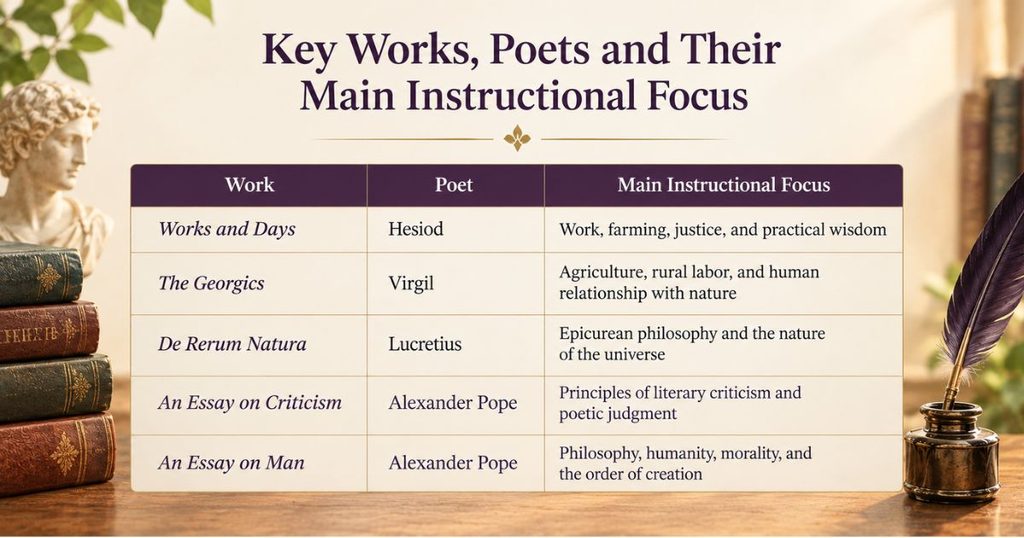
Hesiod’s Works and Days combines practical agricultural advice with reflections on justice and proper conduct. Virgil’s Georgics, meanwhile, presents farming within a much broader meditation on labour, nature, and Roman life.
Pope’s An Essay on Criticism is another useful example because it offers principles concerning literary judgment while using polished heroic couplets.
How Can You Identify a Didactic Poem?
To determine whether a poem is didactic, look beyond whether it contains a lesson. Ask what the poem is primarily doing.
Use these steps:
- Identify the central purpose. Is the poet deliberately trying to teach or instruct?
- Find the lesson. What knowledge, principle, or belief does the poem communicate?
- Examine the structure. Does the poem organize material around explanation, advice, argument, or instruction?
- Consider the speaker’s role. Does the speaker act as a teacher, guide, philosopher, adviser, or commentator?
- Check the importance of instruction. Would removing the teaching element fundamentally change the poem?
This last question is especially useful. A poem may contain wisdom without being classified as didactic.
Didactic Poetry and Related Literary Forms
Didactic poetry overlaps with several other literary forms, but they are not identical.
| Form | Primary Function | Typical Feature |
| Didactic poem | Teach or instruct | Lesson is central |
| Lyric poem | Express emotion or thought | Personal voice and feeling |
| Narrative poem | Tell a story | Characters and events |
| Fable | Teach through a short story | Often uses animals and an explicit moral |
| Allegory | Communicate deeper meanings | Characters or events represent ideas |
A narrative poem can contain instruction, and a lyric poem can express a moral belief. That does not automatically make either one didactic.
A fable is usually more directly moral and often uses a brief narrative to deliver its lesson. A didactic poem, however, can teach through argument, description, philosophical reflection, or practical explanation without using a fable-like story.
Common Misconceptions About Didactic Poems
One common misconception is that any poem with a moral is didactic. That is too broad.
A poem may mention kindness, death, justice, or love without having instruction as its main function. Readers can learn from almost any serious literary work, but that does not mean every poem is didactic.
Another misconception is that didactic poetry must be dry or purely educational. Many didactic poems use metaphor, rhythm, imagery, narrative, irony, and sophisticated poetic structures.
The key distinction is purpose and emphasis. If instruction is a substantial function of the poem, the didactic classification becomes more appropriate.
FAQs
Q: What is a didactic poem in simple words?
A: A didactic poem is a poem that mainly aims to teach or instruct readers. Its lesson may involve morality, philosophy, religion, practical knowledge, society, or human behavior. The poem can still use imagery, rhythm, metaphor, and other literary techniques. The important point is that teaching forms a significant part of its purpose.
Q: What is an example of a didactic poem?
A: Works and Days by Hesiod is a well-known example. It combines advice about farming and work with ideas about justice and proper conduct. Virgil’s Georgics is another major example because it presents agricultural instruction through poetic language while also exploring nature, labor, and human life.
Q: Is every poem with a moral lesson didactic?
A: No. A moral idea alone does not make a poem didactic. The teaching function must be important to the poem’s overall purpose. A lyric poem may express a moral observation without being primarily instructional, while a didactic poem deliberately gives instruction a substantial role.
Q: What is the difference between didactic poetry and a fable?
A: A fable usually teaches a moral through a short narrative, often involving animals that behave like humans. Didactic poetry has a broader range of methods. It can teach through direct advice, philosophical argument, practical information, description, or reflection without using a fable-like story.
Q: Why is didactic poetry important?
A: Didactic poetry shows how literature can combine artistic expression with education. Historically, poetry was used to preserve knowledge about farming, philosophy, morality, religion, and social behavior. Studying didactic poetry therefore helps readers understand both literary technique and the ideas a culture considered important.
Final Thoughts
So, what is a didactic poem? It is poetry in which teaching, instruction, or the communication of knowledge plays a substantial role. Its subject can range from morality and philosophy to agriculture, religion, criticism, or practical wisdom.
The most important test is not whether a poem contains a lesson. Instead, ask whether instruction is central to what the poem is trying to accomplish. Once that distinction is clear, it becomes much easier to recognize didactic poetry and understand how it differs from lyric, narrative, fable, and allegorical forms.
Recent Article : Theme of the Poem ‘My Hobby: Reading’ Explained

Jennifer Aston is a passionate poetry curator and writer with a deep love for the written word. She believes poetry has the power to heal, inspire, and connect people across all walks of life. Through PoemSteric, she brings together timeless and modern verses for every emotion and every moment.