
Introduction
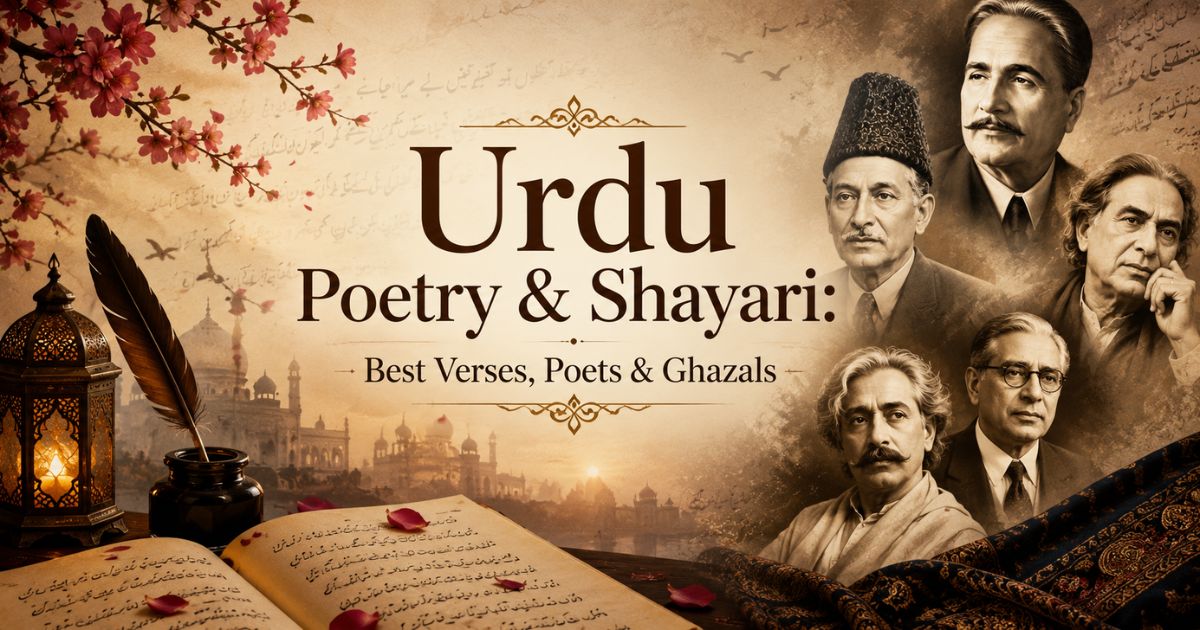
Urdu Poetry is a centuries-old literary tradition that expresses love, loss, philosophy, and social struggle through tightly structured verse forms like the ghazal and nazm. It grew out of the Indo-Persian courts of the Mughal era and today lives on through poets such as Mirza Ghalib, Allama Iqbal, Faiz Ahmed Faiz, and Ahmad Faraz, whose work is still recited, sung, and shared across South Asia and the diaspora. Whether you’re a beginner trying to understand the difference between a ghazal and a nazm, or a longtime reader looking for the right couplet to share, this guide covers everything you need to know.
Key Takeaways
Urdu Poetry covers several distinct forms ghazal, nazm, rubai, and marsiya each with its own rules and purpose.

The tradition traces back to the 17th–18th century Deccan and Mughal courts, later flourishing in Delhi and Lucknow.

Mirza Ghalib and Allama Iqbal are considered the two towering classical figures, while Faiz Ahmed Faiz and Ahmad Faraz represent the modern, socially conscious wave.

A ghazal is built from independent couplets (sher) that share a rhyme (qafiya) and refrain (radif) . You don't need to read it front-to-back like a story.

Reading shayari well means paying attention to meter, symbolism (the candle, the moth, the wine, the beloved), and the poet's historical context.

Reliable places to find authentic verses include published diwans (poetry collections), university archive projects, and reputable literary platforms not random social media screenshots, which are frequently misattributed.
What Is Urdu Poetry? Origins and Meaning
“Shayari” simply means poetry in Urdu and Hindi, but in everyday usage it has come to refer specifically to short, emotionally charged verses often about love, longing, or life’s contradictions that are recited aloud or shared as standalone couplets. Urdu poetry as a broader literary tradition includes shayari but also encompasses longer narrative and philosophical forms.
The Roots of Urdu Poetry in the Mughal Era
Urdu itself developed as a bridge language in the multilingual camps and courts of medieval North India, blending Persian, Arabic, Turkic, and local Indic vocabulary. Persian was the language of Mughal administration and high literature, and early Urdu poets consciously borrowed Persian poetic forms, the ghazal chief among them while writing in the emerging Urdu tongue. By the 18th century, Delhi had become a major center of Urdu literary production, and after the decline of the Mughal court, Lucknow rose as a second hub with its own distinct poetic style, known for ornate language and courtly themes.
Shayari vs Ghazal vs Nazm: Key Differences
These three terms are often used loosely, but they mean different things:
- Shayari is the general, informal term for poetry or verse, especially short romantic or reflective couplets.
- Ghazal is a specific classical form made up of a series of independent two-line couplets (ashaar, singular sher), unified by a common rhyme and refrain, traditionally exploring themes of love and separation.
- Nazm is a poem with a single, continuous theme developed from beginning to end, more like a Western poem, and often used for social or political commentary.
Understanding this distinction matters because a “shayari” shared on social media is often actually a single sher pulled out of a longer ghazal.
Famous Urdu Poets Who Shaped Shayari
No discussion of Urdu Poetry Urdu Shayari is complete without its foundational poets. Their influence still shapes how contemporary shayari is written and performed at mushairas (poetry recitation gatherings).
Mirza Ghalib: The Master of Ghazal
Mirza Asadullah Khan Ghalib (1797–1869) is widely regarded as the greatest classical Urdu poet. Writing in Delhi during the twilight of Mughal rule, Ghalib is known for philosophical depth, wit, and a willingness to question conventions both religious and poetic. His ghazals frequently explore themes of existential doubt, unrequited love, and the absurdity of human striving, delivered with a distinctive blend of irony and tenderness. Ghalib wrote in both Urdu and Persian, and his Urdu diwan remains one of the most studied and quoted collections in the language.
Allama Iqbal: The Poet of the East
Sir Muhammad Iqbal (1877–1938), often called Allama Iqbal or the “Poet of the East,” took Urdu poetry in a different direction toward philosophy, self-realization, and political awakening. Iqbal is best known for developing the concept of khudi (selfhood), urging individuals and nations toward spiritual and intellectual self-strengthening. He wrote extensively in both Urdu and Persian, and his poetry played a significant role in shaping political thought in pre-Partition South Asia. Unlike Ghalib’s introspective melancholy, Iqbal’s tone is often energizing and aspirational.
Faiz Ahmed Faiz and Ahmad Faraz: Modern Voices of Urdu Poetry
The 20th century brought a new generation of poets who merged the classical ghazal form with modern political and social concerns.
Faiz Ahmed Faiz (1911–1984) is closely associated with the Progressive Writers’ Movement, using traditional ghazal imagery, the beloved, separation, the prison of the heart as metaphors for colonial oppression, resistance, and social justice. Faiz spent time imprisoned for his political activities, and his poetry from that period remains some of the most widely quoted in the Urdu canon, later set to music by numerous singers across generations.
Ahmad Faraz (1931–2008) is often described as one of the most popular Urdu poets of the modern era, known for a more direct, conversational style that made his ghazals especially accessible and widely quoted in everyday shayari culture. His work frequently addresses both romantic longing and political dissent, and he too faced periods of censorship and exile due to his outspoken views. Faraz’s popularity in contemporary shayari sharing on posters, in songs, and now online is arguably unmatched among 20th-century poets.
Together, Faiz and Faraz represent the bridge between classical ghazal tradition and the more casual, widely shared shayari culture of today.
How to Read and Understand Urdu Shayari
If you’re new to Urdu Poetry Urdu Shayari, here’s a practical approach to reading and appreciating it:
- Start with a single sher, not a full ghazal. Each couplet in a ghazal is meant to stand independently, so you don’t need to read the whole poem to appreciate one line.
- Identify the qafiya and radif. Notice the rhyming word (qafiya) and the repeated refrain word or phrase (radif) at the end of each couplet; this is what gives a ghazal its musical quality.
- Look for symbolic vocabulary. Classical shayari relies on a shared symbolic language: the candle and moth (self-destructive love), the wine and cupbearer (spiritual intoxication), the garden and nightingale (longing and beauty).
- Consider the historical context. A Faiz couplet about prison walls reads very differently once you know he was writing from an actual jail cell under a military government.
- Read it aloud, or listen to a recitation. Urdu poetry is written to be spoken and heard; the meter (bahr) and rhythm often reveal meaning that’s lost on a silent read.
- Check the attribution before you share it. Misattributed couplets circulate widely online verify the poet and source before quoting a sher as someone’s work.
Popular Themes in Urdu Poetry Urdu Shayari
Certain themes recur across generations of Urdu poets, which is part of why the tradition feels so cohesive despite spanning centuries:
- Ishq (love) and judai (separation): the emotional core of the classical ghazal, often addressed to an idealized or unattainable beloved.
- Tasawwuf (mysticism): Sufi-influenced verses that use romantic imagery to describe a longing for the divine.
- Watan (homeland) and inquilab (revolution): especially prominent in Faiz’s and Iqbal’s work, addressing colonialism, nationhood, and social change.
- Zindagi aur maut (life and mortality): reflective, often melancholic meditations on time, aging, and impermanence, central to much of Ghalib’s work.
- Khudi (selfhood): Iqbal’s signature theme, encouraging individual and collective self-realization.
Where to Find Authentic Urdu Poetry Online?
This is one of the most common questions people ask when they first get interested in shayari, so it deserves its own section.
Where can I find authentic, correctly attributed Urdu poetry online? Look for digitized diwans (poetry collections) hosted by university or library archive projects, dedicated Urdu literature databases that credit each poet and cite the original collection, and published anthologies rather than screenshots circulating on social media. Many popular “shayari” posts online are either misattributed or altered from the original text, so cross-checking a couplet against a published diwan or a reputable literary archive is the safest way to confirm both wording and authorship before quoting or sharing it.
FAQs
What is the difference between shayari and a ghazal?
Shayari is a general term for poetry or verse, while a ghazal is a specific classical form made of independent rhyming couplets unified by a shared refrain.
Who is considered the greatest Urdu poet?
Mirza Ghalib is most commonly cited as the greatest classical Urdu poet, though Allama Iqbal, Faiz Ahmed Faiz, and Ahmad Faraz are also regarded among the most important voices in the tradition.
What is a sher in Urdu poetry?
A sher is a single two-line couplet, the basic building block of a ghazal, capable of standing on its own as a complete thought.
Why do so many Urdu couplets mention candles, wine, and gardens?
These are traditional symbols in classical Urdu and Persian poetry: the candle and moth represent self-destructive love, wine represents spiritual intoxication, and the garden represents beauty and longing.
Is Urdu poetry the same as Hindi poetry?
No. While Urdu and Hindi share a common spoken base and are mutually intelligible in everyday speech, Urdu poetry draws heavily on Persian and Arabic vocabulary and script, giving it a distinct literary register from Hindi poetry.
How can I tell if a shayari quote online is correctly attributed?
Cross-check it against a published diwan or a reputable literary archive; many viral shayari posts misattribute lines or alter the original wording.
Final Thoughts
Urdu Shayari endures because it manages to be both deeply literary and instantly personal; a single couplet from Ghalib or Faraz can capture a feeling that takes paragraphs to explain in prose. Whether you’re drawn to Ghalib’s philosophical wit, Iqbal’s call to self-realization, or the politically charged tenderness of Faiz and Faraz, the tradition rewards slow, attentive reading. Start with one poet, read a handful of their ghazals in a reliable published edition, and let the symbolism and rhythm become familiar before moving on; that’s how generations of readers have built a lasting relationship with this poetry.
Recent Article : Poems on Mother Death: Words for a Grieving Heart

Jennifer Aston is a passionate poetry curator and writer with a deep love for the written word. She believes poetry has the power to heal, inspire, and connect people across all walks of life. Through PoemSteric, she brings together timeless and modern verses for every emotion and every moment.