
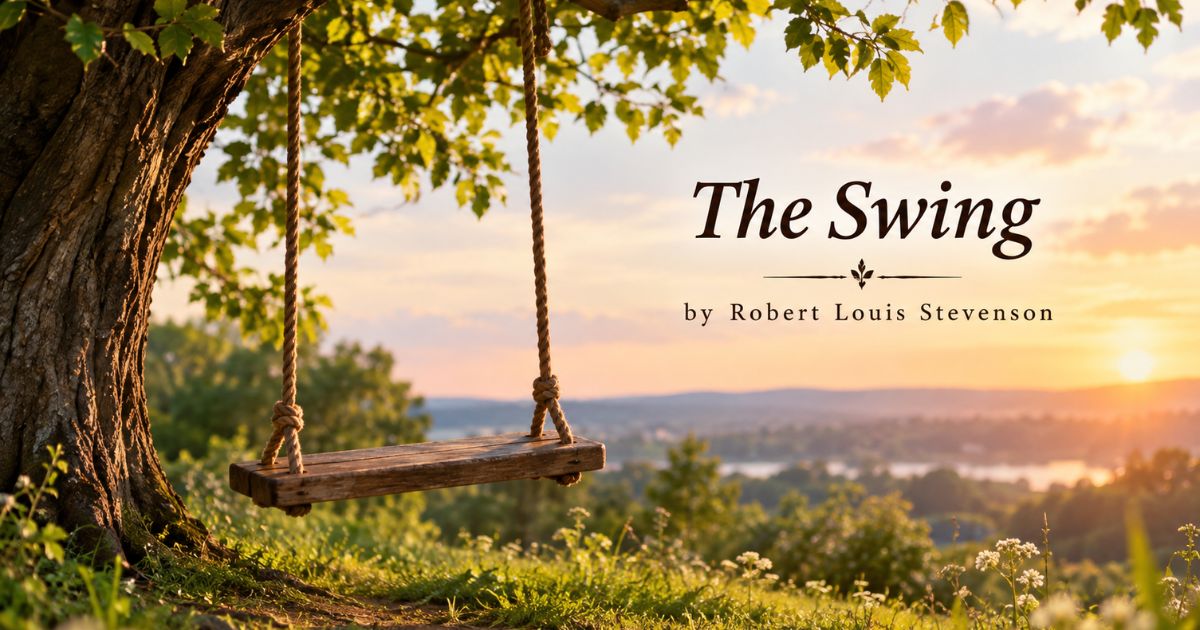
Few poems capture the pure joy of childhood as simply as “The Swing” twelve short lines that turn a backyard swing ride into a tiny flight of imagination. It’s one of the most searched children’s poems online, largely because it’s taught in primary school English classes across the world. So who wrote it, what does it mean, and why has it stayed popular for over 140 years? Let’s break it down.
Introduction
Almost everyone remembers the feeling of swinging as a child, that brief rush of weightlessness as you rise into the air and the world suddenly looks a little bigger. Robert Louis Stevenson bottled that exact feeling into a short, sing-song poem over a century ago, and it’s still one of the first poems many children encounter in school today. In this article, we’ll look at who wrote and read the full text, walk through its meaning stanza by stanza, explore its poetic devices, and answer the most commonly asked questions about it everything you need in one place, whether you’re a student, a parent, or just curious.
Key Takeaways
- Poet: “The Swing” was written by Robert Louis Stevenson, published in 1885 in A Child’s Garden of Verses.
- Structure: Three quatrains with an ABAB rhyme scheme and alternating long-short lines that mirror the swing’s up-and-down motion.
- Perspective: The poem is told from a child’s point of view, opening with a question and answering it with pure enthusiasm.
- Imagery: Contrasts the enclosed, familiar garden (green grass, brown roof) with the wide, open countryside (rivers, trees, cattle) seen from the swing’s highest point.
- Theme: Captures the joy, freedom, and imaginative wonder of childhood play.
- Devices used: Rhetorical question, vivid imagery, repetition, and rhythm that imitates motion.
- Legacy: Still widely taught in primary schools and remains one of the best-known poems from Stevenson’s children’s poetry collection.
Who Is the Poet of “The Swing”?
Robert Louis Stevenson was 5the Poet, the Scottish novelist, poet, and travel writer best known for Treasure Island and The Strange Case of Dr. Jekyll and Mr. Hyde. The poem appeared in his 1885 poetry collection for children, A Child’s Garden of Verses, a book of 64 poems written from a child’s point of view.
Full Text of “The Swing”
How do you like to go up in a swing, Up in the air so blue? Oh, I do think it is the most pleasant thing a child can do!
Up in the air and over the wall, Till I can see so wide, River and trees and cattle and all Over the countryside.
Till I look down on the garden green, down on the roof so brown – Up in the air I go flying again, Up in the air and down!
(This poem is in the public domain.)
About the Poet: Robert Louis Stevenson
Robert Louis Balfour Stevenson was born on November 13, 1850, in Edinburgh, Scotland, and died in 1894. Though he’s remembered today mostly for adventure fiction and Gothic horror, Stevenson also had a gift for writing in a child’s voice, simple, rhythmic, and full of wonder rather than moralizing. He wrote much of A Child’s Garden of Verses while living abroad and unwell, drawing on vivid memories of his own Edinburgh childhood which is part of why poems like “The Swing” feel so specific and lived-in rather than invented.
About the Collection: A Child’s Garden of Verses
Published in 1885, A Child’s Garden of Verses is considered one of the works that reshaped English-language children’s poetry. “The Swing” is poem number 64 in some editions and remains one of the collection’s best-known entries, alongside poems like “My Shadow” and “Bed in Summer.”
Stanza-Wise Summary of “The Swing”
Stanza 1: The poem opens as a question a child (the speaker) asks how you like going up in a swing, high into the blue sky. The speaker immediately answers their own question: it’s the most pleasant thing a child could ever do.
Stanza 2: As the swing rises, the child’s view expands beyond the garden wall. They can suddenly see the wider world rivers, trees, grazing cattle, and the countryside spread out below.
Stanza 3: As the swing comes back down, the child looks down at the familiar green garden and brown rooftop. Then the swing lifts again, flying “up in the air and down” capturing the endless back-and-forth rhythm of swinging.
Central Theme and Meaning
At its core, “The Swing” is about the joy and freedom of childhood imagination. It becomes a small vehicle for a big feeling: for a moment, an ordinary garden becomes an entire world, and a child gets to feel like they’re flying. The poem also plays with a gentle contrast between the enclosed, safe world of the garden (walls, green grass, a brown roof) and the wide, open world beyond it (rivers, cattle, countryside) suggesting how curiosity and play let children glimpse something bigger than their everyday surroundings.
Poetic Devices Used in “The Swing”
- Rhetorical question: The poem opens with a question (“How do you like to go up in a swing…”) that draws the reader directly into the child’s excitement.
- Imagery: Visual details like “air so blue,” “garden green,” and “roof so brown” create a vivid, colorful picture.
- Repetition: Phrases like “up in the air” recur throughout, mimicking the physical motion of swinging up and down.
- Alternating meter: The poem alternates longer and shorter lines (roughly four-beat and three-beat), creating a rising-and-falling rhythm that mirrors the swing’s motion on the page.
- First-person perspective: Told entirely from a child’s point of view, giving it an authentic, unfiltered sense of wonder.
Rhyme Scheme and Structure
The poem has three quatrains (four-line stanzas) with an ABAB rhyme scheme in each stanza (e.g., swing/blue with thing/do). This simple, musical structure is part of why it’s so easy for young children to memorize and recite.
Why “The Swing” is Still Loved Today
Over a century after it was written, “The Swing” remains a staple in primary-school English curricula worldwide appearing in textbooks from Class 3 to Class 6 in various countries. Its appeal lies in how well it captures a universal childhood experience in language simple enough for a young reader, yet crafted well enough to reward closer reading by adults, too.
Common Question & Answer Section
Q1. Who wrote the poem “The Swing”?
Robert Louis Stevenson wrote “The Swing.” It was published in 1885 in his collection A Child’s Garden of Verses.
Q2. What does the child see when the swing goes up and over the wall?
The child sees rivers, trees, cattle, and the wider countryside spread out beyond the garden wall.
Q3. What does the poet see when the swing comes back down?
On the way down, the poet/speaker sees the green garden and the brown roof of the house.
Q4. Why does the poet say the air is “blue”?
Because the child is looking straight up at the daytime sky while swinging, and the sky appears blue.
Q5. What is the “pleasantest thing” mentioned in the poem?
According to the poem, going up high in a swing is “the pleasantest thing / Ever a child can do.”
FAQs
Q. Is “The Swing” a famous poem?
A. Yes, it’s one of the best-known poems from A Child’s Garden of Verses and is widely taught in schools around the world.
Q. What age group is “The Swing” written for?
A. It’s a children’s poem, commonly taught to students in early primary grades (roughly ages 6–11), though its imagery and craftsmanship appeal to readers of any age.
Q. Is “The Swing” based on a real memory?
A. While not documented as one specific memory, Stevenson wrote most of the collection while reflecting on his own childhood in Edinburgh, giving the poems a strong sense of remembered, lived detail.
Final Thought
What makes it’s special isn’t complexity, it’s precision. In just twelve lines, Stevenson manages to recreate a physical sensation, a child’s voice, and a fleeting sense of wonder, all without a single wasted word. That’s likely why, more than 140 years after it was written, children are still asked to read it, recite it, and every now and then go outside and actually feel it for themselves.
Recent Article : When Lilacs Last in the Dooryard Bloom’d: A Complete Guide

Jennifer Aston is a passionate poetry curator and writer with a deep love for the written word. She believes poetry has the power to heal, inspire, and connect people across all walks of life. Through PoemSteric, she brings together timeless and modern verses for every emotion and every moment.