
Introduction
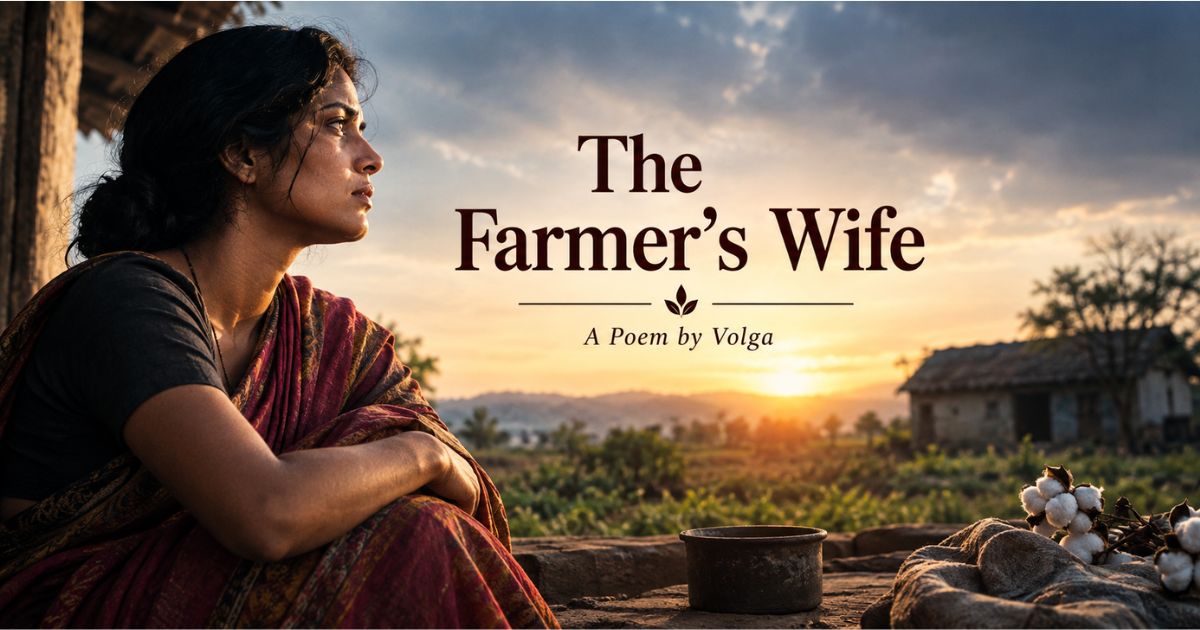
The poem “The Farmer’s Wife” depicts the painful life of a farmer’s widow who is left to face debt, poverty, social pressure, and the responsibility of raising her children after her husband’s suicide. Written by Telugu writer P. Lalita Kumari, known by her pen name Volga, the poem presents the woman’s suffering while also showing her courage to continue living.
The poem is not simply about the death of a farmer. Instead, it shifts attention toward the family that remains behind. The wife questions her husband’s decision because his death does not end the family’s problems. It leaves her facing creditors, children, poverty, and the emotional consequences of his decision.
The poem was translated into English by Vasanth Kannabiran from the Telugu poem Chavuni Kaadu Batukuni, meaning “Not Death but Life.” This original title is important because it reflects the poem’s central movement from death toward survival.
The speaker is therefore both a grieving wife and a determined mother. She remembers the difficulties of her married life, questions the social conditions around her, and finally decides that she must live and teach her children to face life’s struggles.
Key Takeaways
The life depicted in “The Farmer’s Wife” is one of hardship, responsibility, gender inequality, and resilience. The poem presents the widow’s experience after her husband dies because he cannot cope with agricultural failure and debt.
Several important ideas shape the poem:
- Farmer’s hardship: The farmer faces crop failure, debt, and pressure from creditors.
- A widow’s suffering: His death does not release the family from its problems. Instead, his wife inherits the financial and social burden.
- Gender inequality: The woman explains that she has already experienced humiliation and suffering throughout her life.
- Domestic violence: She recalls being abused and beaten by her husband when he was drunk.
- Motherhood: Her children become a major reason for choosing life.
- Social criticism: The poem questions a society that may respect a dead man while leaving his family to suffer.
- Resilience: The speaker finally chooses to live and struggle rather than follow her husband into death.
The contrast between the farmer and his wife is especially important. He seeks escape from his immediate suffering, while she must remain and face its consequences. Educational interpretations of the poem similarly emphasize the contrast between the farmer choosing death and the wife choosing life.
Thus, the poem presents the life of a rural woman struggling against poverty, patriarchy, widowhood, and family responsibility. Yet it does not portray her only as a victim. Her final decision gives the poem a strong message about courage and survival.
Central Idea and the Life Depicted in the Poem
The central idea is that the poem depicts the hard and uncertain life of a farmer’s wife who must survive after her husband’s suicide. Her life is shaped by poverty, debt, social humiliation, domestic suffering, motherhood, and the need to remain strong when the person who supported the family is gone.
The farmer’s suicide is connected with crop failure and debt. His inability to repay creditors becomes unbearable. However, the wife sees the situation differently. For her, death is not a solution because the family still exists. The debts remain, the children remain, and she remains responsible for their future.
The poem therefore changes the reader’s focus. At first, the farmer appears to be the central figure because his death creates the situation. Gradually, however, the wife becomes the emotional center of the poem.
She asks what will happen to the family after his death. This question reveals the difference between individual escape and family responsibility. The husband may have escaped the immediate pressure of creditors, but the wife has to face those pressures directly.
Agricultural Poverty and Debt
The agricultural crisis is an important part of the woman’s life. The farmer’s crop has failed, and debt has become a serious burden. The educational text identifies the failed crop as cotton and connects the farmer’s suicide with his inability to repay his debts.
However, the poem does not treat the economic problem as an isolated financial issue. Poverty affects dignity, relationships, family security, and emotional well-being.
The farmer is unable to face his creditors, while his wife is forced to face them after his death. This creates one of the poem’s strongest contrasts. What he avoids becomes her responsibility.
Gender Inequality and Women’s Suffering
The poem also depicts the life of a woman living within a patriarchal social structure. The wife explains that she has already lived with humiliation and suffering.
Her husband’s death is therefore not the beginning of her hardship. She recalls that she endured abuse, insults, and physical violence during the marriage. Educational notes on the poem specifically identify her memories of her husband’s drunken abuse and her acceptance of it because she considered him a man.
This makes her final decision more powerful. Despite everything she has experienced, she refuses to surrender her life.
The poem therefore connects farmer distress with women’s oppression. The woman suffers because of economic hardship, but she also suffers because of social expectations about marriage, gender, and obedience.
Survival, Motherhood, and the Farmers Wife Courage
One of the strongest aspects of the poem is its movement from grief toward survival. The farmer’s wife does not deny her pain. Instead, she speaks about it directly and questions the decision that has left her alone.
Her children give her a reason to continue. The poem refers to them through the image of the “harvest of my womb.” This metaphor connects motherhood with agriculture. Just as the farmer cared about his crop, the woman sees her children as the living result of her own life and struggle. Educational interpretations identify this image with the farmer’s children.
The contrast is meaningful:
| Farmer | Farmer’s Wife |
| Faces crop failure | Faces the consequences of his death |
| Cannot repay debt | Must continue facing creditors |
| Chooses death | Chooses life |
| Leaves the family | Remains with the children |
| Escapes immediate suffering | Accepts the struggle of survival |
The wife therefore becomes the stronger surviving voice of the poem. Her strength does not mean that she is free from grief. Instead, courage appears through her decision to continue despite grief.
The final part of the poem develops this idea further. She wants to teach her children not simply to survive for food, but to struggle against the difficulties of life. The educational text describes the ending as a will to survive against all odds.
This is why the poem’s original Telugu title, Chavuni Kaadu Batukuni, meaning “Not Death but Life,” provides useful context. The poem ultimately turns toward life rather than glorifying death.
Literary Devices, Tone, and Important Images
Volga uses a direct and emotionally charged voice to present the woman’s experience. The poem is written in free verse, without a regular rhyme scheme or fixed metrical pattern. This allows the speaker’s thoughts and questions to move naturally.
The tone changes throughout the poem. At first, it was sorrowful and bitter. Then it becomes questioning and accusatory. Finally, it becomes determined.
One important technique is irony. The wife calls her dead husband “virtuous,” but the expression does not simply praise him. In context, it exposes the contradiction between society’s possible respect for his death and the suffering his decision has caused his family. Educational notes specifically identify “virtuous” as ironic in the speaker’s voice.
The poem also uses agricultural imagery to describe human suffering. The failed crop represents the farmer’s economic crisis, while the “harvest of my womb” represents the children.
Another important image is the outstretched hand. It represents dependence, humiliation, and the need to ask others for help. The farmer refuses to bend his head or stretch out his hand before creditors, yet his death leaves his wife in exactly that position.
The repeated questions in the poem are equally significant. The wife does not simply accept what happened. She asks why her husband did not think about the family before taking his life.
These questions make the poem more than a personal lament. They turn her private suffering into a wider social question about farmers, widows, poverty, gender roles, and responsibility.
Why the Farmer’s Wife’s Life Matters Today
The life depicted in the poem remains important because it connects personal suffering with larger social problems. The poem shows that a farmer’s financial crisis can affect an entire household, not just the person who earns the income.
The wife is left with responsibilities that do not disappear after her husband’s death. She must think about food, children, debt, dignity, and survival. Therefore, the poem asks readers to look beyond the immediate tragedy.
The work also gives attention to a woman’s voice. Instead of allowing the farmer’s death to become the only story, Volga lets the widow explain what his decision means for those left behind.
This is particularly important because the wife is not presented as a silent victim. She criticizes her husband’s decision and remembers the suffering she endured during the marriage. More importantly, she makes her own decision about the future.
In my reading of the poem, this change from mourning to determination is its most significant movement. The speaker’s grief is real, but it does not become the final message.
For students, the poem can therefore be understood through four connected ideas:
- Economic hardship creates pressure on the farming family.
- Patriarchal expectations shape the woman’s married life.
- The husband’s death transfers greater burdens to the widow.
- Motherhood and courage lead her toward survival.
The poem consequently presents rural life from the perspective of someone who must continue living after a devastating loss.
What the Poem Teaches About Life and Responsibility
The poem’s deepest lesson concerns the difference between escaping suffering and confronting it. The farmer believes death can end his immediate problems. His wife, however, sees that death transfers those problems to the people who remain.
Her response is therefore not merely an emotional reaction. It becomes a statement about responsibility.
She has children who cannot solve the family’s financial problems. She must therefore become emotionally and practically strong. The poem presents this responsibility as painful, but it also gives her a sense of purpose.
The work also questions social ideas about courage. The wife suggests that simply facing death is not necessarily the greatest form of courage. Sometimes courage means remaining alive when life is extremely difficult.
This idea explains the importance of the poem’s ending. She decides to teach her children to fight the struggles of life. The final emphasis is not on helplessness but on determination.
The poem also shows how economic hardship can deepen existing inequalities. The woman has already experienced gender-based suffering. After her husband’s death, financial insecurity adds another burden.
Therefore, the life depicted in the poem is both personal and social. It is the life of one widow, but it also represents questions faced by farming families, women, and children affected by the economic crisis.
For an exam answer, the strongest approach is to mention both sides: the woman’s suffering and her final assertion of life. Describing only her grief misses the transformation that gives the poem its lasting meaning.
FAQs
Q: What life is depicted in “The Farmer’s Wife”?
A: The poem depicts the difficult life of a farmer’s wife who is left alone after her husband commits suicide because of agricultural failure and debt. She must face creditors, poverty, social pressure, and responsibility for her children. At the same time, she remembers the abuse she experienced during marriage. Despite these hardships, she chooses to continue living and raising her children. Therefore, the poem presents both suffering and remarkable resilience.
Q: Which life depicted in the poem The Farmer’s Wife is most important to understand?
A: The most important life depicted is that of the farmer’s widow after her husband’s death. Her experience reveals how one person’s financial crisis can affect an entire family. She inherits the responsibility of dealing with creditors and caring for her children. However, the poem does not present her only as helpless. Her decision to embrace life gives the poem a message of courage, responsibility, and resistance against overwhelming circumstances.
Q: Why did the farmer’s wife criticize her husband?
A: The wife criticizes her husband because his suicide leaves her and their children with greater suffering. He escapes the immediate pressure of debt and creditors, but she must continue facing those problems. She also questions why he did not consider his family before taking such a decision. Her criticism is therefore connected to responsibility rather than simply anger. She believes that life must be faced, even when the circumstances are extremely difficult.
Q: What is the main message of The Farmer’s Wife?
A: The main message is that difficult circumstances should be confronted with courage rather than escaped through death. The poem also highlights the suffering of farmers’ families and the unequal burdens carried by women. The farmer’s wife experiences poverty, widowhood, domestic suffering, and responsibility for her children. Yet she chooses life. Her decision transforms the poem from a simple lament into a statement about resilience, motherhood, dignity, and the struggle to survive.
Q: Who wrote The Farmer’s Wife poem?
A: “The Farmer’s Wife” was written by Telugu writer P. Lalita Kumari, who is better known by her pen name Volga. The English version was translated by Vasanth Kannabiran from the Telugu poem Chavuni Kaadu Batukuni, meaning “Not Death but Life.” The poem appears in the 1st PUC English curriculum and focuses on the suffering and resilience of a farmer’s widow.
Q: What does the ending of The Farmer’s Wife mean?
A: The ending expresses the woman’s decision to choose life despite suffering. She wants to live for her children and teach them to face difficulties with courage. This ending is important because the poem does not finish with complete despair. Instead, it moves toward determination and survival. The phrase “not death but life,” associated with the poem’s Telugu title, captures this movement from tragedy toward the will to continue living.
Final Thoughts
The life depicted in “The Farmer’s Wife” is the difficult but courageous life of a woman left to face poverty, debt, widowhood, social pressure, and motherhood after her husband’s suicide. Volga does not allow the farmer’s death to become the whole story. Instead, she gives the surviving wife a powerful voice.
The poem shows that her suffering existed even before her husband’s death. However, his decision creates new responsibilities that she cannot escape. Her final choice to live, care for her children, and face life’s struggles gives the poem its strongest message.
In short, the poem depicts a life marked by hardship, gender inequality, economic crisis, motherhood, resilience, and the determination to survive. Its central movement is from death toward life and from helplessness toward courage.
Recent Article : What is the Theme of the Poem Custard the Dragon? Explained

Jennifer Aston is a passionate poetry curator and writer with a deep love for the written word. She believes poetry has the power to heal, inspire, and connect people across all walks of life. Through PoemSteric, she brings together timeless and modern verses for every emotion and every moment.