
Introduction
The Bazaars of Hyderabad is a poem written by Sarojini Naidu, first published in 1912 in her collection “The Bird of Time.” It paints a vivid, question-and-answer picture of merchants, vendors, and craftspeople in a traditional Hyderabad marketplace, moving from bright colors and precious goods toward a final, quieter reflection on life and death. The poem remains one of Naidu’s most widely studied works, appearing in school curricula across India and abroad.
Readers are often drawn in by the poem’s musical rhythm before they realize how much cultural detail it packs into just thirty lines. Below, we will look at who Sarojini Naidu was, what the poem’s full text says, and how its structure builds toward a surprisingly reflective ending.
The question-and-answer format is part of why the poem still stands out. Instead of describing the bazaar from an outside perspective, Naidu lets the sellers speak for themselves, each answering a simple question about their trade. As a result, readers experience the marketplace almost as a series of short, overheard conversations rather than a single narrated description.
Key Takeaways
Here is a quick summary before we go into more detail:
- This poem was written by Sarojini Naidu and published in 1912 in “The Bird of Time.”
- Naidu was an Indian poet, political activist, and independence leader known as the “Nightingale of India.”
- The poem has five stanzas of six lines each, called sestets, totaling thirty lines.
- Each stanza follows a question-and-answer structure, asking a group of sellers what they sell, weigh, grind, or make.
- The poem moves through merchants, vendors, goldsmiths, fruit sellers, musicians, and flower-girls before ending on themes of life and death.
- Its rhyme scheme (ABCBCB) and trochaic rhythm give the poem a chant-like, musical quality.
Who Wrote The Bazaars of Hyderabad? Meet Sarojini Naidu
This poem was written by Sarojini Naidu, born on February 13, 1879, in Hyderabad, India. Naidu is remembered both as a celebrated poet and as a significant leader in India’s struggle for independence from British rule. She published the poem in 1912 as part of “The Bird of Time,” within a section titled “Songs of My City,” drawing directly on the sights and sounds of the city where she grew up.
In my own reading of Naidu’s work, “The Bazaars of Hyderabad” stands out because it reads almost like a memory brought to life on the page. Rather than describing the bazaar from a distance, Naidu builds the entire poem around direct questions and answers, as though the reader is walking through the market themselves, stopping at each stall to ask what is for sale.
About Sarojini Naidu, the Nightingale of India
Sarojini Naidu earned the nickname “Nightingale of India” because of her lyrical, musical style of writing, which she carried across poems about nature, love, and patriotism. However, poetry was only one part of her public life. In 1904, she joined the Indian National Congress and later became the first woman to serve as its president in 1925.Naidu was arrested multiple times during India’s independence movement and spent more than 21 months in jail for her activism.
After independence, she made history again in 1947 by becoming the first woman governor of the United Provinces. Readers often tell us that knowing this background adds weight to her poetry, since Naidu was not simply an observer of Indian life; she was actively shaping the nation’s future while writing about its culture.
Her literary reputation extended well beyond India during her own lifetime. In fact, an excerpt from this very poem appeared in The New York Times in April 1913, where a reviewer praised it as an “Oriental gem.” That early international recognition shows how quickly Naidu’s blend of vivid imagery and musical language reached readers far from Hyderabad, even before India gained independence more than three decades later.
Full Text and Structure of the Poem
This poem is built from five stanzas of six lines each, a structure known as sestets, adding up to thirty lines in total. Every stanza follows the same pattern: a question addressed to a specific group of sellers, followed by a short list of the goods, sounds, or crafts connected to their trade. Here is the poem’s full original text:
What do you sell, O ye merchants? Richly your wares are displayed. Turbans of crimson and silver, Tunics of purple brocade, Mirrors with panels of amber, Daggers with handles of jade.
What do you weigh, O ye vendors? Saffron and lentil and rice. What do you grind, O ye maidens? Sandalwood, henna, and spice. What do you call, O ye pedlars? Chessmen and ivory dice.
What do you make, O ye goldsmiths? Wristlet and anklet and ring, Bells for the feet of blue pigeons, Frail as a dragon-fly’s wing, Girdles of gold for the dancers, Scabbards of gold for the king.
What do you cry, O ye fruitmen? Citron, pomegranate, and plum. What do you play, O musicians? Cithar, sarangi, and drum. What do you chant, O magicians? Spells for aeons to come.
What do you weave, O ye flower-girls With tassels of azure and red? Crowns for the brow of a bridegroom, Chaplets to garland his bed, Sheets of white blossoms new-garnered To perfume the sleep of the dead.
As a result, the poem’s structure works almost like a walking tour, guiding the reader from stall to stall while the rhythm and rhyme scheme, ABCBCB in each stanza, keep the pace lively and musical throughout.
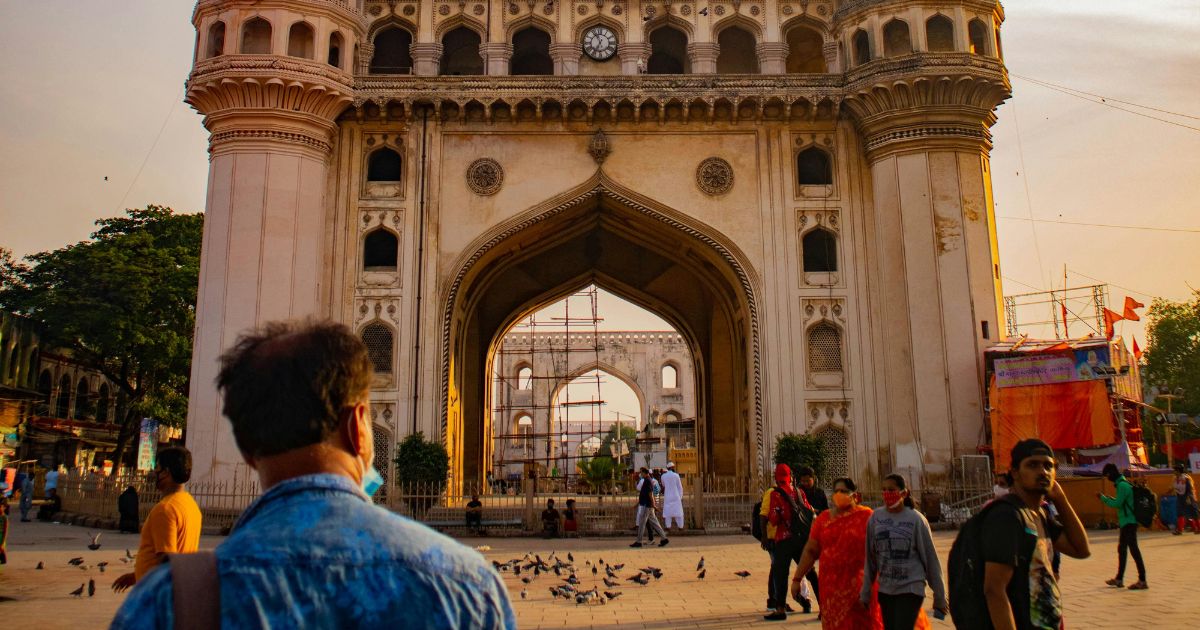
Naidu’s imagery closely mirrors real historical markets that still exist in Hyderabad today, such as Laad Bazaar near the Charminar monument, long known for bangles, pearls, and fine textiles. For centuries, Hyderabad served as a major trading hub for pearls and Golconda diamonds, and the city’s markets attracted merchants from across the region. This real-world backdrop grounds the poem’s imagery in genuine local history rather than purely imaginative description, which is part of why the poem still feels authentic to readers familiar with Hyderabad’s bazaars today.
Meaning and Themes of The Bazaars of Hyderabad
At its heart, the poem celebrates the richness and variety of everyday Indian life, using the marketplace as a symbol of the city’s culture, craftsmanship, and trade. For example, the poem lists turbans, brocade tunics, and jade-handled daggers in its opening stanza, immediately establishing a scene full of color, luxury, and skilled artistry. However, the poem is not only about material goods.
As it progresses, the poem shifts focus from goods to people, showing vendors weighing spices, maidens grinding sandalwood, and goldsmiths crafting jewelry for both dancers and kings. This range suggests that the bazaar serves every level of society, from ordinary households buying rice and lentils to royal courts commissioning golden scabbards. In doing so, Naidu presents the market not just as a place of commerce, but as a gathering point where all parts of the community meet.
Step-by-Step Breakdown of Each Stanza
Reading the poem stanza by stanza reveals how carefully its structure builds toward its final message:
- Stanza one introduces the merchants, showcasing luxury textiles and decorative objects like mirrors and daggers.
- Stanza two shifts to everyday trade, covering vendors, maidens, and peddlers selling food, spices, and small games.
- Stanza three highlights craftsmanship, focusing on goldsmiths creating jewelry for both dancers and royalty.
- Stanza four adds sound and mystery, introducing fruit sellers, musicians, and magicians chanting spells.
- Stanza five delivers the emotional turn, moving from flower-girls preparing wedding garlands to blossoms meant to honor the dead.
This progression matters because the final stanza deliberately places a wedding image beside a funeral image within the same six lines. Because both moments rely on flowers from the very same bazaar, Naidu suggests that everyday commerce quietly touches every stage of human life, from celebration to loss.
The poem also relies heavily on sensory imagery to bring the bazaar to life. Colors like crimson, silver, purple, and azure appear throughout, while sounds come from the cithar, sarangi, and drum played by the musicians. Smells enter through sandalwood and henna, and even taste is suggested through citron, pomegranate, and plum. This layering of sight, sound, and smell is one reason the poem still feels vivid and immersive more than a century after it was first published.
Consider how differently this poem might read if it simply listed goods without any human voices attached. A plain inventory of turbans, spices, and jewelry would feel flat and impersonal. However, by framing every stanza as a question asked directly to merchants, vendors, and flower-girls, Naidu turns a simple list into a living scene filled with distinct voices and trades. This choice is a key reason the poem continues to feel warm and personal rather than purely descriptive.
FAQs
Q: Who wrote The Bazaars of Hyderabad?
A: The Bazaars of Hyderabad was written by Sarojini Naidu, an Indian poet and independence activist born in 1879. She published it in 1912 as part of her poetry collection “The Bird of Time,” in a section called “Songs of My City.” Naidu drew on her own memories of Hyderabad, the city where she was born, to create the poem’s vivid marketplace scenes.
Q: What is the meaning of the poem?
A: The poem celebrates the richness of everyday life in a traditional Indian bazaar, using questions and answers to reveal what different sellers offer, from luxury textiles to spices, jewelry, and flowers. It highlights craftsmanship, trade, and community, while its final stanza reflects on both weddings and funerals. This ending suggests that the marketplace touches every important moment in human life.
Q: How many stanzas and lines does the poem have?
A: The Bazaars of Hyderabad contains five stanzas, each made up of six lines, known as sets, for a total of thirty lines. Every stanza follows the same question-and-answer pattern, addressed to a different group of sellers such as merchants, vendors, goldsmiths, or flower-girls. This repeated structure gives the poem a steady, musical rhythm throughout.
Q: Why is this poem still studied in schools today?
A: This poem remains popular in classrooms because it combines vivid, colorful imagery with a simple, repeatable structure that is easy to analyze. It also offers a genuine window into early twentieth-century Indian culture, trade, and daily life. Because of its rich vocabulary and clear rhyme scheme, teachers often use it to introduce students to imagery, structure, and cultural context together.
Q: What other notable works did Sarojini Naidu write?
A: Sarojini Naidu, the poet behind The Bazaars of Hyderabad, wrote many other well-known poems, including works on nature, love, and Indian patriotism, collected across several published volumes. Beyond poetry, she is remembered for her political achievements, including becoming the first woman president of the Indian National Congress in 1925 and later the first woman governor of the United Provinces in 1947.
Final Thoughts
The Bazaars of Hyderabad endures because it does more than describe a marketplace; it captures an entire culture through sound, color, and craftsmanship. Sarojini Naidu’s careful structure, moving from luxury goods to spices, jewelry, music, and finally flowers for both weddings and funerals, gives the poem an emotional depth that goes well beyond a simple list of items for sale.
Recent Article : When We Two Parted Poem: Powerful Meaning & Analysis

Jennifer Aston is a passionate poetry curator and writer with a deep love for the written word. She believes poetry has the power to heal, inspire, and connect people across all walks of life. Through PoemSteric, she brings together timeless and modern verses for every emotion and every moment.